
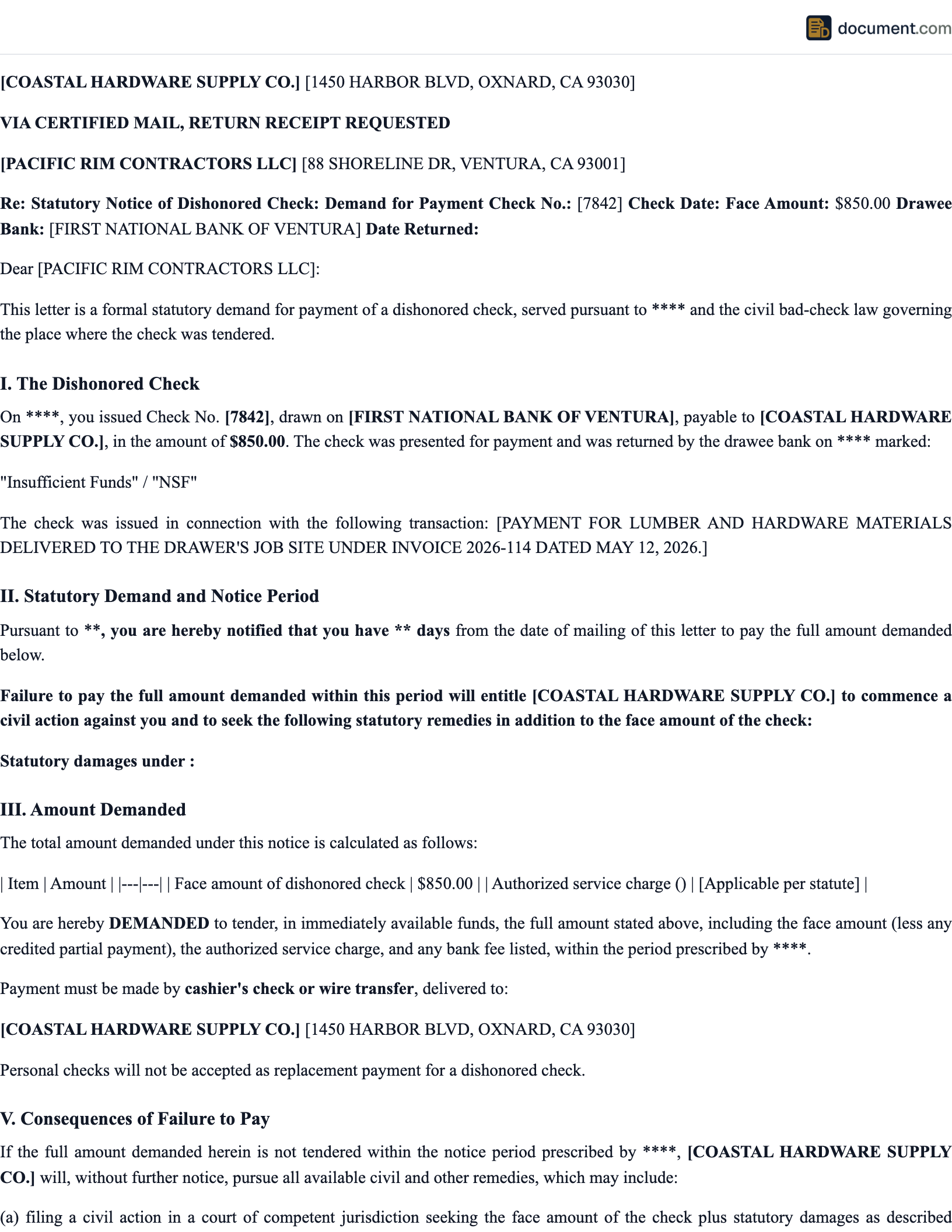



New Mexico Notice of Dishonored Check Overview
New Mexico gives the holder of a worthless check a direct civil remedy that can return far more than the face amount of the instrument. Under N.M. Stat. Ann. § 56-5-2, a payee who follows the prescribed notice procedure and waits out a ten-day cure window may sue for triple the check amount -- or $100, whichever is greater -- subject to a cap that limits enhanced damages to $500 above the check face. For a small retailer or contractor holding a $400 NSF check, that cap structure means the total civil recovery reaches $900 if the drawer ignores the demand. The statute is straightforward, but its conditions are strict.
The civil remedy is separate from -- and in most cases faster than -- New Mexico's criminal worthless-check statute, N.M. Stat. Ann. § 30-36-5, which governs prosecution by the state. A payee pursuing the civil track does not need to wait for a criminal filing, does not need to work through a district attorney's office, and walks away with a money judgment enforceable against the drawer's wages, bank accounts, and property. Most bad-check disputes in New Mexico belong on the civil track, particularly when the amount falls within the $10,000 jurisdictional ceiling of the state's magistrate courts, where the process is designed to handle these claims efficiently.
The threshold condition the statute imposes is a written demand mailed before suit. That demand must satisfy specific requirements -- certified mail, the right address, and mandatory language warning of triple damages -- before the enhanced civil remedy is available. A payee who skips the notice or sends it by ordinary mail takes the risk of being limited to the face amount of the check alone, which is recoverable as a simple contract claim but carries none of the multiplier. The sections below walk through what the statute requires, how the damages arithmetic works, and what the notice must contain.
$100 or 3x check amount, whichever is greater
Civil damages
10 days after certified mail demand (notice must warn of triple damages)
Notice period
Up to $25
Service charge
N.M. Stat. Ann. § 56-5-2
Controlling statute
The Controlling Statute: N.M. Stat. Ann. § 56-5-2
N.M. Stat. Ann. § 56-5-2 creates a civil cause of action for the holder of a worthless check against the drawer. The statute defines a worthless check as a check, draft, or order for payment drawn on a bank or other depository, issued in exchange for anything of value, when the drawer knows at the time of issuance that there are insufficient funds in or credit with the depository to cover payment in full upon presentation. The intent element -- knowledge of insufficient funds at the time of issuance -- is what distinguishes a civil bad-check claim from a mere contract dispute over an unpaid debt. A check returned because of a bank error or a deposit that posted late after the check was written may not satisfy the knowledge element, and the payee pursuing the statutory remedy should be prepared to address that if the drawer raises it.
The statute conditions the triple-damage recovery on two things: first, the plaintiff must have made a written demand for payment at least ten days before filing suit; second, the defendant must have failed to tender the amount demanded before the action commenced. Both conditions must be satisfied. Demand that is sent but arrives after a lawsuit is already filed does not satisfy the pre-suit requirement. Payment tendered after the suit is filed but before judgment does not defeat the claim -- the opportunity to cure expired when the action was commenced -- though it may affect the practical calculus of whether to settle.
The demand itself must include a specific warning. The statute requires the written notice to state that if the money is not paid within ten days, triple damages may be incurred. This is a substantive requirement, not a courtesy. Courts in similar jurisdictions have found that a demand letter omitting the statutory warning about the multiplier fails to trigger the enhanced remedy, even when the payee otherwise waited the required time and mailed the notice correctly. The language does not need to be verbatim, but the substance -- that triple damages may follow nonpayment -- must be present and clear.
The statute also permits recovery of court costs and service costs incurred in connection with the action, on top of the check amount and the statutory damages. These are separate from the treble-damage calculation and do not count against the $500 cap on enhanced damages. The cap governs only the penalty component; court costs and the authorized service charge of up to $25 are recoverable in addition.
Statute Reference
N.M. Stat. Ann. § 56-5-2
Damages: $100 or 3x check amount, whichever is greater; not to exceed check + $500
What You Can Recover in New Mexico
The damages formula under § 56-5-2 has two layers. The first is the check amount itself -- the face value of the dishonored instrument, which the drawer owes regardless of the civil penalty. The second is the statutory penalty: $100 or three times the check amount, whichever is greater, subject to the cap that enhanced damages may not exceed the check amount by more than $500. Working through concrete numbers clarifies how the cap operates at different check sizes. On a $30 check, triple the face amount is $90, which is less than $100, so the floor kicks in and the total recovery is $30 (face) plus $100 (penalty) = $130. On a $200 check, triple is $600, but the cap limits the penalty enhancement to $500, so the total recovery is $200 plus $500 = $700. On a $1,000 check, the same $500 cap applies, yielding $1,500 total. The cap makes the statute most powerful on smaller checks, where the floor and multiplier together produce recoveries several times the face amount, and less powerful proportionally on larger instruments.
The $100 floor on the penalty is significant for holders of small checks. A $20 NSF check ordinarily creates only a $20 contract claim, but under § 56-5-2 the statutory penalty alone is $100, bringing the total potential recovery to $120 before service charges and costs. This makes the civil bad-check procedure worth pursuing even for relatively minor checks, provided the payee can prove the requisite intent element and has followed the notice requirements correctly.
On top of the damages formula, the statute authorizes recovery of incurred court and service costs. The authorized service charge is capped at $25. A payee should include the service charge demand in the initial notice letter and itemize it separately from the check face amount. Courts have reduced or denied the service charge where the demand letter did not specifically claim it and state the amount. The service charge can be collected at the time the drawer responds to the notice, before any lawsuit is filed.
- Civil damages: $100 or 3x check amount, whichever is greater; not to exceed check + $500
- Service charge: Up to $25
- Notice period before suit: 10 days after certified mail demand (notice must warn of triple damages)
Notice Procedure and Timeline in New Mexico
The demand must be in writing and must be sent by certified mail to the drawer's last known address, with return receipt requested and marked 'deliver to addressee only.' That last qualifier -- deliver to addressee only -- is not a formality. A certified mailing without that restriction can be accepted by anyone at the delivery address, which means the drawer can later claim not to have received it. The restricted delivery instruction ensures the post office will only deliver the piece to the addressee personally and return it undelivered if the addressee is unavailable, creating a more definitive record of whether the drawer had the opportunity to receive the demand. Keep the certified mail tracking printout and, if the piece is returned, the envelope with the postal endorsement.
The ten-day notice period runs from the mailing of the demand, not from the date the drawer receives or signs for it. State the mailing date on the notice letter and calculate the specific calendar date on which the ten days expire. Writing 'you have ten days from the date of mailing of this notice, until [specific date], to pay the amount demanded' removes any ambiguity about the deadline. Do not file suit before that calendar date arrives. Filing even one day early puts the triple-damage claim at risk, because the statute makes the pre-suit demand and the waiting period explicit conditions on the enhanced remedy.
The notice must contain the warning that triple damages may be incurred if payment is not made within ten days. Include that language directly and prominently. A notice that demands payment and cites the statute but omits the triple-damage warning may be found deficient. Beyond the mandatory language, the notice should specify the amount demanded -- check face, service charge, and any bank fee the statute allows you to pass through -- so the drawer knows exactly what sum will cure the default. If the drawer sends full payment of the demanded amount within the ten days, the civil penalty does not attach, and the payee's remedy is satisfied.
New Mexico-Specific Notes
New Mexico's criminal worthless-check statute, N.M. Stat. Ann. § 30-36-5, sets an unusually low felony threshold compared to most states. A worthless check of $25 or more is a fourth-degree felony, carrying potential imprisonment in the state penitentiary for one to three years and a fine up to $1,000. Checks between $1 and $25 are a misdemeanor. This low threshold means that checks of any meaningful commercial amount carry potential felony exposure, which is worth noting in the civil demand letter: the demand letter documents the element of written notice that a district attorney's office will look for if the payee decides to escalate to a criminal referral after the civil notice period passes without payment.
New Mexico does not operate a statewide centralized bad-check diversion program through the district attorney system the way some states do. Individual judicial districts run pre-prosecution diversion programs under N.M. Stat. Ann. § 31-16A for low-level, non-violent matters, and worthless-check cases may be accepted into those programs at the discretion of the local district attorney. A payee interested in criminal referral should contact the district attorney's office in the judicial district where the check was written. The Sixth Judicial District, the Second Judicial District (Bernalillo County), and others each run their own diversion offices with distinct intake requirements.
Civil bad-check claims in New Mexico that fall within the $10,000 ceiling of the magistrate court -- or the Bernalillo County Metropolitan Court for claims arising there -- can be filed without an attorney in the small claims division. Because the $500 damages cap keeps most bad-check judgments well below that ceiling, the magistrate court is the practical venue for the vast majority of these cases. Filing fees are modest and the process is designed for self-represented parties. Bring the original check or a clear copy, the bank's dishonor notice, the demand letter, and the certified mail proof. Those four items establish every element of the statutory claim.
New Mexico Specific Note
New Mexico's 'worthless check' definition in § 56-5-2 requires that the drawer knew, at the time of issuance, that there were insufficient funds in the account. A drawer who wrote a check in good faith relying on a deposit that subsequently failed, or who issued a post-dated check, may argue that the knowledge element is not satisfied. Stop-payment checks present a related but distinct issue: whether the stop was entered to defraud the payee or to assert a legitimate dispute over the underlying transaction can determine whether the civil bad-check statute applies at all. When the underlying transaction is in dispute, the payee may still have a contract claim for the face amount of the check but should be cautious about asserting the treble-damage remedy without evidence of the requisite intent.
New Mexico Bad Check FAQ
Other State Bad Check Laws
Each state sets its own notice period, damage formula, and service charge. Browse sibling state pages for the specific rules that apply to your situation, or return to the full 50-state guide.
Create your New Mexico Notice of Dishonored Check in minutes.
Answer a few questions and download a New Mexico-compliant bad check demand letter that cites N.M. Stat. Ann. § 56-5-2 and is ready to mail certified.