
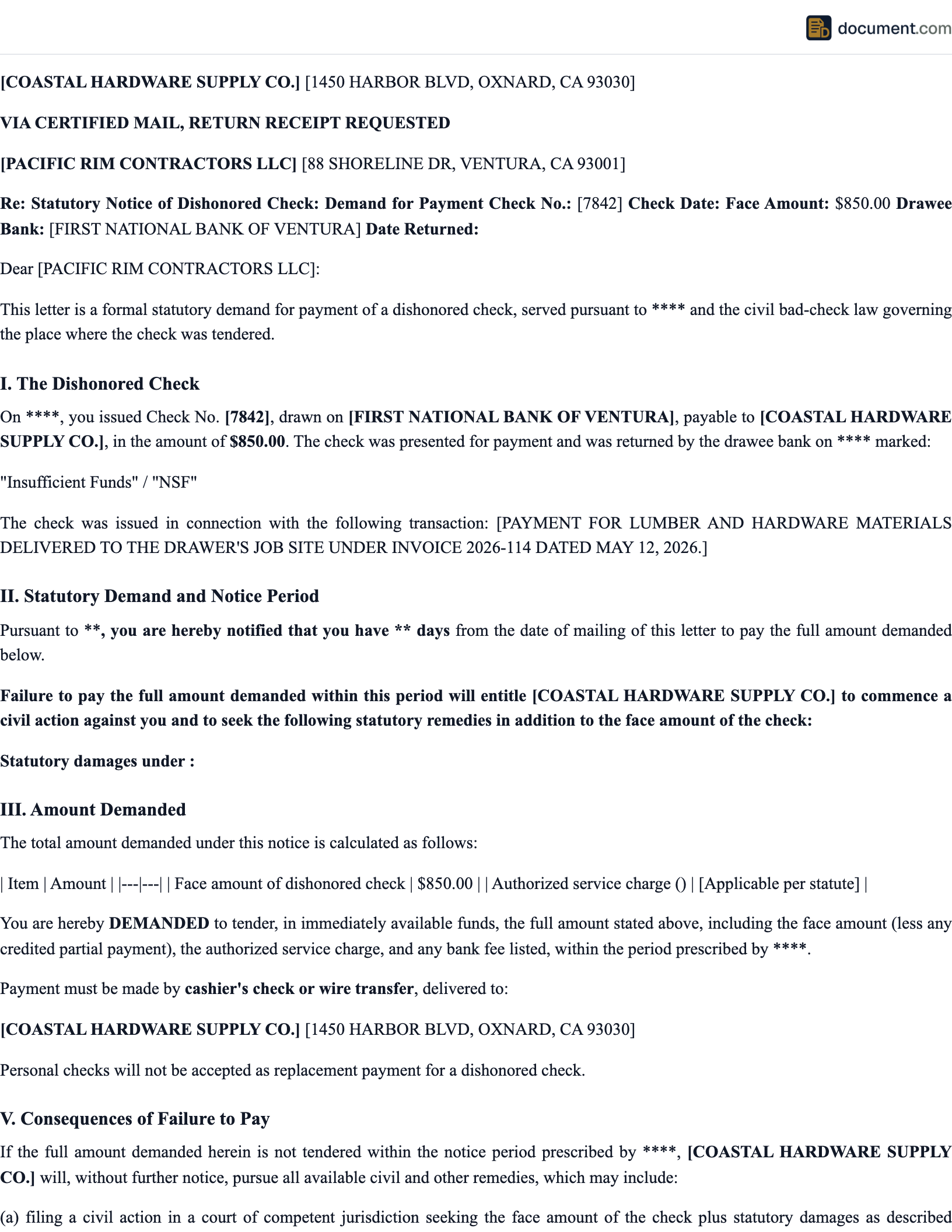



New Jersey Notice of Dishonored Check Overview
New Jersey's civil bad-check statute, N.J. Stat. Ann. § 2A:32A-1, gives the holder of a dishonored check a direct private remedy against the drawer without first going through the criminal courts. The statute covers both paper checks and electronic fund transfers, so a landlord whose tenant's ACH rent payment is returned has the same standing to send a statutory demand as one whose paper check was returned NSF. The 35-day notice period is the longest mandatory waiting period of any state, but in exchange the holder gets a clean damages formula, an attorney-fee provision, and a claim that can be filed immediately in the Special Civil Part once the window closes without payment.
New Jersey processes dishonored check claims through the Superior Court, Special Civil Part. That court's small-claims section handles claims up to $5,000, which covers the statutory ceiling under § 2A:32A-1 for most individual checks. For claims above $5,000 the regular Special Civil Part docket applies, with a $20,000 jurisdictional ceiling. Either track is available to an individual or business without an attorney, though the Special Civil Part regular docket is procedurally more demanding than small claims.
The civil bad-check remedy in New Jersey runs on a separate track from the criminal statute, N.J.S.A. 2C:21-5. The civil claim requires no finding of criminal intent and no conviction. It requires only that a check or electronic transfer was dishonored, that proper notice was sent, and that the drawer failed to pay the full amount demanded within 35 days. Holders who want criminal prosecution as well can pursue both tracks concurrently; the civil judgment does not bar a criminal referral, and a criminal prosecution does not preclude the civil award.
$100 or 3x check amount, whichever is greater
Civil damages
35 days after certified mail demand
Notice period
Reasonable attorney fees and mailing costs
Service charge
N.J. Stat. Ann. § 2A:32A-1
Controlling statute
The Controlling Statute: N.J. Stat. Ann. § 2A:32A-1
N.J. Stat. Ann. § 2A:32A-1 creates a civil cause of action in favor of any holder of a check or electronic funds transfer that is dishonored by the drawee bank. The statute applies regardless of the reason for dishonor: insufficient funds, a closed account, and a stop payment made to defeat a legitimate obligation all trigger the civil remedy. The holder must be the payee or a person who acquired the instrument with the right to enforce it; assignees and collection agencies that can document a proper chain of title may send the statutory notice in their own names.
The statute conditions enhanced damages on a pre-suit written demand. That demand must be sent to the drawer by certified mail, return receipt requested. The address used should be the address printed on the check or, if that address is outdated, the drawer's last known address that the holder can verify. New Jersey does not require a simultaneous first-class mailing in the same way that California and Illinois do, but sending a first-class copy the same day the certified piece goes out is sound practice because it documents that the drawer had a reasonable opportunity to receive the demand even if the certified piece goes unclaimed.
Once the 35-day period runs without payment in full, the holder may bring a civil action in the Superior Court, Special Civil Part, for the face amount of the check, the civil damages the statute authorizes, and reasonable attorney fees and mailing costs. The statute does not fix the service charge at a flat dollar amount the way some other states do; instead it allows recovery of reasonable mailing costs (the out-of-pocket certified-mail fee) and attorney fees if an attorney is engaged. The absence of a flat service-charge figure means the holder should not include a speculative fee line in the demand; mailing costs and actual attorney fees are recoverable after judgment, not as a demand element before litigation.
The § 2A:32A-1 framework is straightforward to plead. In small claims, the holder files a standard Special Civil Part complaint, attaches the original check or a legible copy, attaches the bank's return notice identifying the reason for dishonor, attaches the certified-mail receipt and tracking confirmation (or the returned unclaimed envelope), and states the date the 35-day period expired. Courts in the Special Civil Part are familiar with the claim structure and commonly grant default judgment on a complete paper record when the drawer does not appear.
Statute Reference
N.J. Stat. Ann. § 2A:32A-1
Damages: $100 or 3x check amount, whichever is greater; cap: check + $500
What You Can Recover in New Jersey
Under § 2A:32A-1, the damages award is the greater of $100 or three times the amount of the dishonored check, subject to a ceiling equal to the face amount of the check plus $500. That ceiling is the most important number to understand before you calculate what you will demand. On a $50 check, three times the amount is $150, which exceeds $100, and the ceiling is $50 plus $500 equals $550 -- so the full $150 is recoverable. On a $300 check, three times the amount is $900, but the ceiling is $300 plus $500 equals $800, so the recovery is capped at $800. On a $2,000 check, three times the amount would be $6,000, but the ceiling is $2,500, so the maximum civil damages on a $2,000 check are $2,500.
The practical effect is that the treble-damage formula drives the result on small checks, while the cap structure controls on anything above roughly $250. A check for exactly $250 produces three times $250 equals $750, which equals the ceiling of $250 plus $500. Above $250, the cap bites. The $100 floor means the statute remains worthwhile even on very small checks -- a $20 dishonored check still entitles the holder to $100 in civil damages if the notice is properly sent and the drawer does not pay within 35 days.
On top of the damages formula, the holder may recover reasonable attorney fees and the actual cost of certified-mail service. Attorney fees are not capped separately in the statute, so on larger checks where an attorney's involvement is warranted, the fee award can add meaningfully to the recovery. A holder who sends the notice without an attorney and then retains counsel only for the litigation phase can still recover fees incurred after the notice period expired, because the fee provision runs to the civil action, not just to the demand letter.
- Civil damages: $100 or 3x check amount, whichever is greater; cap: check + $500
- Service charge: Reasonable attorney fees and mailing costs
- Notice period before suit: 35 days after certified mail demand
Notice Procedure and Timeline in New Jersey
The demand letter must be sent by certified mail, return receipt requested, to the drawer's address as shown on the check or to the drawer's last known address. The 35-day period begins to run from the date the notice is mailed, not from the date the return receipt is signed. That starting point matters when the drawer delays picking up certified mail or is temporarily away: the 35-day clock runs from the postmark regardless of when the drawer actually opens the envelope, so a drawer who waits until day 30 to retrieve a piece of certified mail does not gain extra time by doing so.
Calculate the deadline as a specific calendar date and state it plainly in the demand letter. If the notice goes out on a Monday in late May, the 35-day window closes on a Thursday in late June; write that date in the letter. Ambiguity about when the window closes has led courts in other states to find notices technically deficient, and the same risk exists in New Jersey. A clean deadline date also removes any argument the drawer might raise that they were confused about the last day to cure.
Send a simultaneous first-class copy the same day the certified piece goes out, even though the statute does not expressly require it. If the drawer later claims never to have received the certified mail, the first-class copy -- which the postal service delivers to the address without a signature requirement -- establishes that the demand reached the correct address. Keep the certified mail tracking printout, the USPS PS Form 3800 receipt, and if the piece comes back unclaimed, the returned envelope with the postal notation intact. These three documents are the evidentiary core of the notice element at trial or on a default judgment motion.
New Jersey-Specific Notes
New Jersey's criminal bad-check statute, N.J.S.A. 2C:21-5, grades the offense by amount. A dishonored check or electronic transfer under $200 is a disorderly persons offense. Amounts from $200 to just under $1,000 are a fourth-degree crime. Amounts from $1,000 to just under $75,000 are a third-degree crime. Amounts of $75,000 or more are a second-degree crime. These criminal thresholds are relevant to civil holders in two ways: first, the grade of the offense affects how seriously a county prosecutor's office will treat a referral; second, in transactions above $1,000 the threat of a third-degree criminal charge often produces faster voluntary payment after a civil demand is sent, without the holder ever needing to file a civil complaint.
New Jersey's Special Civil Part small-claims section handles money claims up to $5,000. Because the civil damages ceiling under § 2A:32A-1 is the face amount of the check plus $500, most bad-check civil claims fall within the $5,000 small-claims ceiling and can be filed there. The small-claims section does not require an attorney, the filing fee is modest, and service on the defendant is handled by the court. Holders whose check plus the $500 damages cap exceeds $5,000 -- meaning checks above $4,500 -- must file in the regular Special Civil Part docket, where the $20,000 jurisdictional ceiling comfortably covers the maximum recovery.
New Jersey Specific Note
New Jersey's 35-day notice period is the longest mandatory waiting period of any state. Filing a civil action before the 35th day runs forfeits the right to the statutory damages. Courts count calendar days, not business days, and day one is the day after the notice is mailed. If day 35 falls on a weekend or court holiday, the notice period still closes on that day; the holder cannot file until the following business day when the court is open, but the damages right vests on day 35 itself. Mark the filing-eligible date on the calendar before the demand goes out and do not file early.
The § 2A:32A-1 civil remedy extends to dishonored electronic fund transfers on the same terms as paper checks. A holder whose ACH debit was returned can use the same notice procedure, the same damages formula, and the same court. Document the authorization for the electronic transfer carefully before sending the notice -- a drawer who contests whether the transfer was authorized will raise that issue as a defense, and the holder's ability to produce the original authorization agreement significantly affects the outcome of a contested small-claims hearing.
New Jersey Bad Check FAQ
Other State Bad Check Laws
Each state sets its own notice period, damage formula, and service charge. Browse sibling state pages for the specific rules that apply to your situation, or return to the full 50-state guide.
Create your New Jersey Notice of Dishonored Check in minutes.
Answer a few questions and download a New Jersey-compliant bad check demand letter that cites N.J. Stat. Ann. § 2A:32A-1 and is ready to mail certified.