
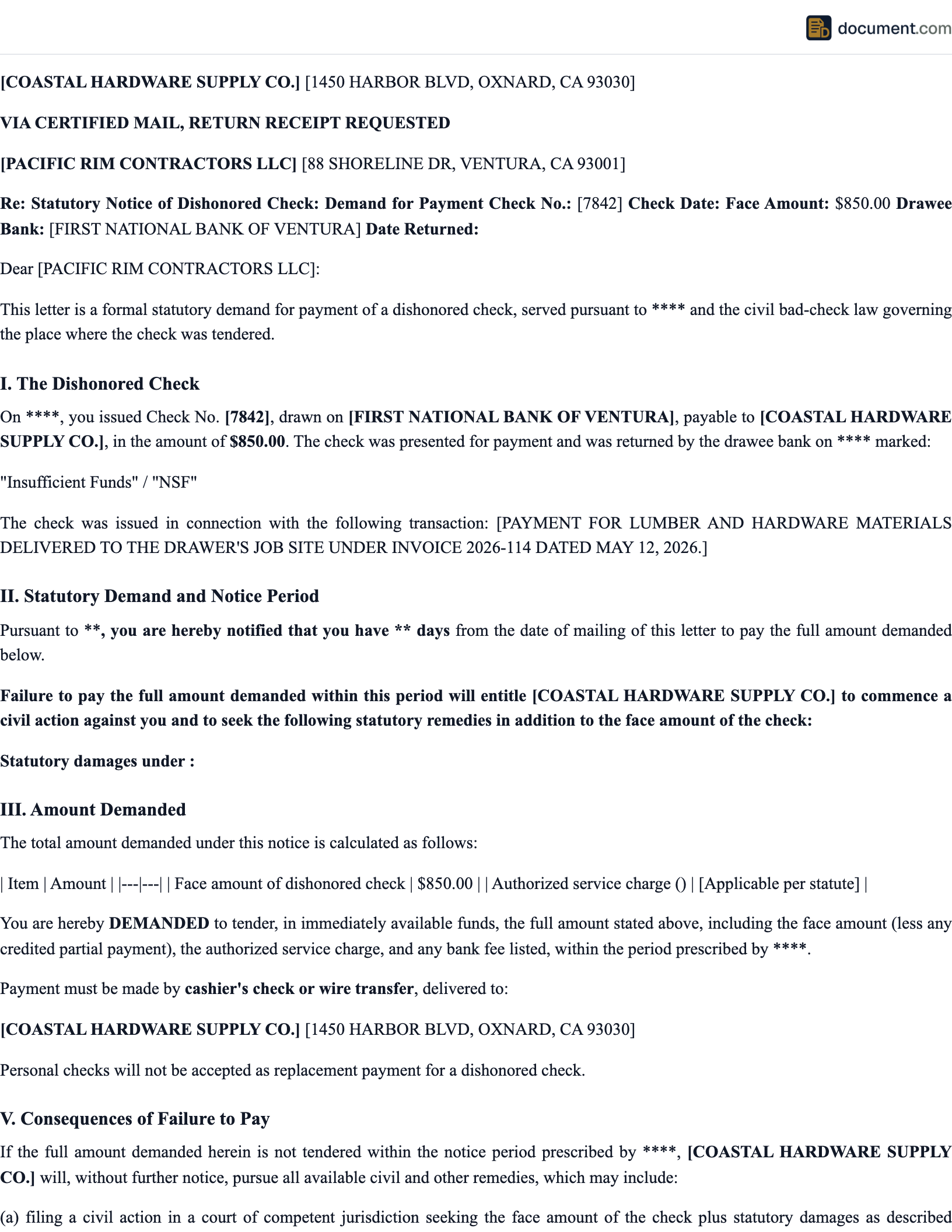



Montana Notice of Dishonored Check Overview
Montana's civil bad-check statute is one of the shorter-notice frameworks in the country. Under Mont. Code Ann. § 27-1-717, a payee who receives a dishonored check can recover far more than the face amount of the instrument, but only after sending a properly addressed written demand and waiting at least 10 days for the check writer to respond. That 10-day window is short compared to the 30-day floors most states impose, which means a Montana payee can reach the courthouse door relatively quickly when the drawer fails to cure.
The civil remedy operates independently of the criminal track. Montana's criminal bad-check statute, Mont. Code Ann. § 45-6-316, requires the check writer to make good within 5 days of written notice of nonpayment before criminal intent can be inferred. The civil statute runs on a separate clock and a separate set of conditions. A payee who wants enhanced damages pursues the § 27-1-717 civil route; a payee who wants criminal prosecution contacts the local sheriff or county attorney's office with the original check and supporting documentation. Many payees choose the civil route because it produces an enforceable money judgment without waiting for the criminal process.
Regardless of which path a payee takes, the written demand is the essential first step. Under the civil statute, no demand means no access to the treble-damage multiplier and no service charge beyond the check face amount. Under the criminal statute, the 5-day written notice creates the prima facie evidence of intent that prosecution requires. A single properly drafted letter, sent by certified mail to the address on the check, serves both functions simultaneously, and in Montana, that letter can be followed by a civil suit in as little as 11 days.
$100 or 3x check amount, whichever is greater
Civil damages
10 days written demand before commencing action
Notice period
Up to $30
Service charge
Mont. Code Ann. § 27-1-717
Controlling statute
The Controlling Statute: Mont. Code Ann. § 27-1-717
Mont. Code Ann. § 27-1-717 establishes civil liability for two categories of dishonored checks. The first and more common category covers checks returned because the drawer had insufficient funds or no account at all with the named bank. The second, narrower category covers stop-payment orders entered with the intent to fraudulently defeat a possessory lien or otherwise defraud the payee. A drawer who stopped payment in good faith, because the goods were defective, for example, does not fall within this second category, and the civil statute's enhanced damages would not apply to that scenario.
The statute creates a two-track recovery structure. The payee may collect a service charge of up to $30, separate from the check face amount, to compensate for the administrative cost of the returned item. If the payee seeks civil damages beyond the service charge, those damages are calculated using a multiplier formula subject to a cap. The payee cannot stack both the flat service charge and the full multiplier simultaneously; the damages provision already incorporates the service charge into the recovery formula.
The elements the payee must establish are straightforward. The payee must hold a check that was dishonored, returned by the bank for insufficient funds, a nonexistent account, or a qualifying fraudulent stop payment. The payee must send a written demand to the drawer's address as it appears on the check, or to the drawer's last-known address if that address differs. The payee must then wait at least 10 days from the mailing of that demand before filing suit. If the drawer pays within those 10 days, the civil action cannot proceed, though the payee retains the service charge as compensation for the demand process.
The limitations period under § 27-1-717 is six years, running from the date of the demand, not the date the check was dishonored and not the date the suit is filed. That starting point matters: a payee who sends the demand years after dishonor starts the six-year clock from that demand date. Conversely, a payee who sends a demand but waits too long to file the lawsuit may find the claim time-barred even though the demand was timely. Sending the demand promptly after dishonor, then filing suit promptly after the 10-day window closes without payment, is the correct sequence.
Statute Reference
Mont. Code Ann. § 27-1-717
Damages: $100 or 3x check amount, whichever is greater; cap: check amount + $500; plus service charge
What You Can Recover in Montana
Montana's damages formula awards the greater of $100 or three times the face value of the dishonored check, plus the service charge of up to $30, but the total recovery cannot exceed the face amount of the check plus $500. On a small check, the $100 floor does real work. If a tenant writes a $40 NSF check, three times the face amount is only $120, but the floor guarantees at least $100 in civil damages on top of the service charge, making the minimum recovery $130 on a $40 check. The multiplier structure rewards pursuing the civil remedy even on low-dollar items.
On mid-range checks, the cap disciplines the multiplier. Suppose a contractor receives a $400 NSF check. Three times $400 is $1,200, but the statute caps total recovery at the face amount ($400) plus $500, meaning the ceiling is $900. The payee can recover $900 plus the $30 service charge, for a total of $930, still more than double the face amount, and a meaningful premium over simply re-depositing the check and hoping for the best. On checks above $500, the cap effectively reduces the multiplier below three; on a $1,000 check, the maximum recovery is $1,500 (face plus $500) plus $30, not $3,030.
The $30 service charge is capped, not mandatory. The payee may elect to waive it, though there is seldom a reason to do so. The service charge covers the payee's bank fee and the cost of processing the return, and demanding it in the notice letter puts the drawer on clear notice of the total amount needed to cure the claim. A payee who sends the demand but forgets to specify the service charge may face an argument that the charge was not adequately demanded, so stating it explicitly in the notice, along with the calculation showing how the total was reached, is the better practice.
- Civil damages: $100 or 3x check amount, whichever is greater; cap: check amount + $500; plus service charge
- Service charge: Up to $30
- Notice period before suit: 10 days written demand before commencing action
Notice Procedure and Timeline in Montana
Montana's civil statute requires written demand sent to the address printed on the check, or to the drawer's last-known address. The statute does not prescribe a specific mailing method, unlike California or Illinois, which explicitly require certified mail. That said, the practical standard is certified mail with return receipt requested, possibly paired with a simultaneous first-class copy. A payee who cannot prove the demand was sent and received cannot establish that the 10-day period ran without payment, and the enhanced damages depend on that sequence. The certified-mail receipt and tracking confirmation are the exhibits that resolve that dispute.
The 10-day period is a floor, not a ceiling for how long the drawer has to cure. The payee must allow not less than 10 days before commencing the action. Counting begins the day after the mailing date, following Montana's standard rule for computing time. If the notice is mailed on a Monday, the payee cannot file suit before the following Friday at the earliest. Courts will examine the postmark or the tracking timestamp when the payee's compliance with the notice period is challenged. Filing even a day early risks dismissal of the enhanced-damage claim, so payees should add a day or two as buffer and state the specific calendar date by which payment is due in the notice letter itself.
Address the notice to the name and address as they appear on the check. If the address on the check is outdated and the payee has reliable knowledge of a current address, sending a copy to both addresses is the conservative approach. The statute refers to the 'last-known address,' which suggests the payee is not locked into the check address if a better address is available, but the safest posture is to send to both. Note the date of mailing on the retained copy and keep a paper file that includes: the original check or a bank-certified copy, the bank's dishonor notice, the demand letter, the certified-mail receipt, and, if the piece is returned unclaimed, the unopened envelope with its postal notation. These materials constitute the complete documentary record if the case proceeds to small claims court.
Montana-Specific Notes
Montana's small claims court can hear civil bad-check cases where the total amount demanded does not exceed $7,000. Because the statute caps the civil damages at face value plus $500 plus the $30 service charge, most bad-check claims fall well within that ceiling. A payee seeking $500 or less in total recovery can file in justice court small claims without an attorney, present the certified-mail receipt and a copy of the demand letter, and in straightforward cases obtain a default judgment on the papers. The combination of Montana's short notice period and its accessible small claims process makes the civil route attractive for landlords, retailers, and contractors dealing with single dishonored checks.
Montana's criminal bad-check statute, Mont. Code Ann. § 45-6-316, sets the felony threshold at $1,500. A bad check below that amount, or a series of checks not part of a common scheme, is a misdemeanor punishable by a fine of up to $1,500 or up to six months in county jail. Checks above $1,500, or a pattern of bad checks forming a common scheme, can be charged as a felony. Criminal prosecution requires that the payee provide the original check (or a bank-certified copy), the drawer's current address, and positive identification. Madison County's published bad-check policy, representative of practices in smaller Montana counties, notes that restitution through the criminal process is requested at sentencing but not guaranteed, one more reason to pursue the civil remedy in parallel.
Montana Specific Note
Montana's criminal statute requires only 5 days' written notice before the nonpayment of a check constitutes prima facie evidence of criminal intent. That 5-day criminal notice and the 10-day civil notice are different instruments serving different purposes. A payee who sends only the 5-day criminal demand and then files a civil suit the next day has not satisfied the civil statute's 10-day requirement. Use a single letter that satisfies both timelines, wait the full 10 days before filing the civil action, and allow the 5-day window to close before making any criminal referral, so both avenues remain available.
Montana's civil statute expressly covers stop-payment checks, but only where the stop was made with intent to fraudulently defeat a possessory lien or otherwise defraud the payee. A drawer who stopped payment on a legitimate dispute, a contractor who walked off the job, goods that arrived damaged, is not exposed to the civil multiplier under § 27-1-717. If the underlying transaction is contested and the stop payment was arguably justified, the payee's practical remedy is a contract or UCC Article 3 claim for the face amount rather than a civil bad-check action. The distinction matters before sending the statutory notice, because sending a demand letter that asserts statutory civil penalties against a drawer who had colorable grounds to stop payment can invite a counterclaim for abuse of process.
Montana Bad Check FAQ
Other State Bad Check Laws
Each state sets its own notice period, damage formula, and service charge. Browse sibling state pages for the specific rules that apply to your situation, or return to the full 50-state guide.
Create your Montana Notice of Dishonored Check in minutes.
Answer a few questions and download a Montana-compliant bad check demand letter that cites Mont. Code Ann. § 27-1-717 and is ready to mail certified.