
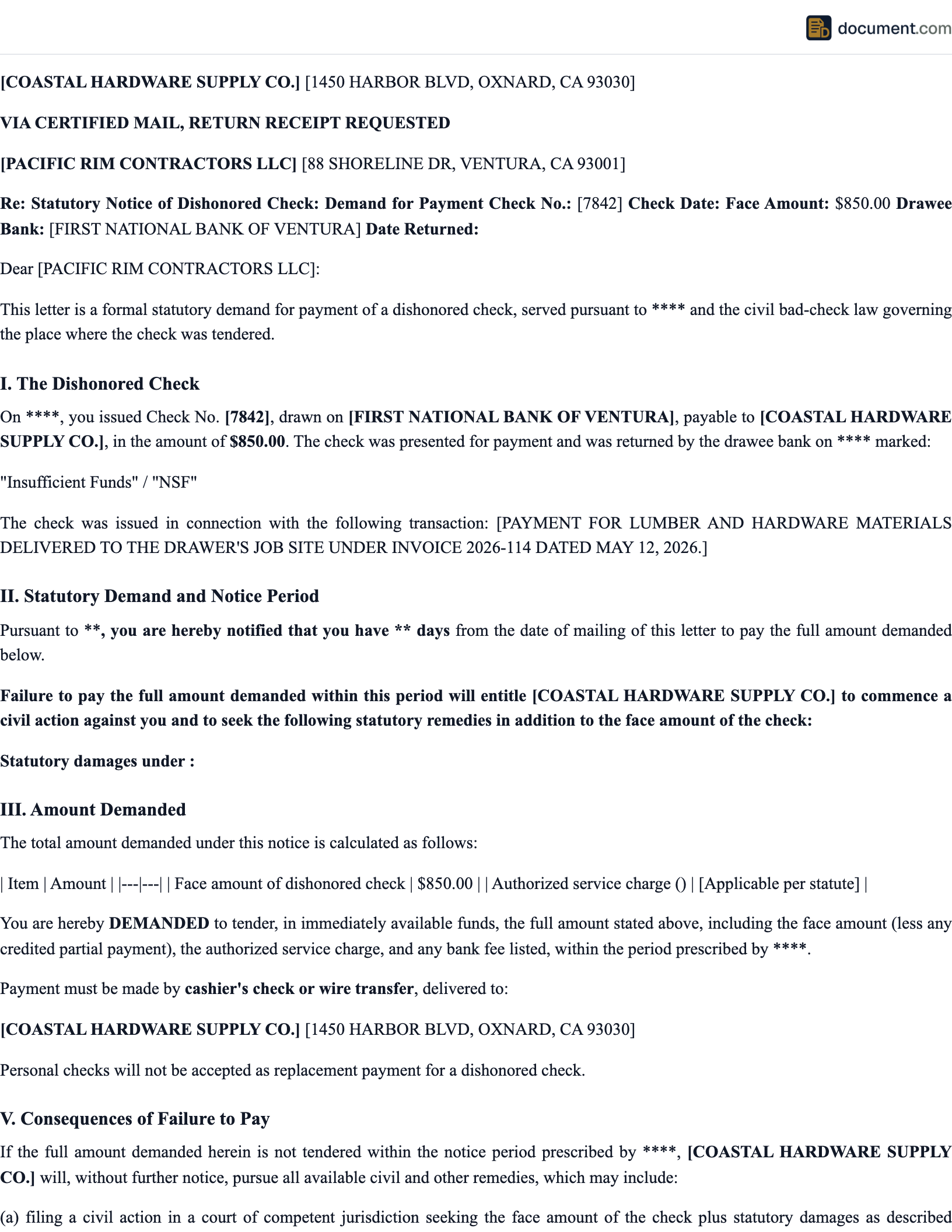



Nevada Notice of Dishonored Check Overview
Nevada gives the holder of a returned check a straightforward civil remedy under Nev. Rev. Stat. § 41.620. Send a certified-mail demand to the check writer, wait 30 days, and if payment does not arrive in full, you may sue for three times the check amount -- subject to a floor of $100 and a ceiling of $500 above the face value. The statute also authorizes a $25 service charge on top of the check amount, which can be demanded in the same letter.
The civil remedy runs on its own track, separate from the criminal bad-check statute at NRS 205.130. You do not need a district attorney, a police report, or a criminal conviction to use it. A single properly prepared certified-mail letter starts the clock, and once 30 days pass without full payment, you have a statutory civil claim you can take to Nevada's justice courts or small claims court.
Nevada's two largest counties -- Clark and Washoe -- each operate DA-supervised bad-check diversion programs that can run alongside or instead of a civil action. Understanding how those programs fit with § 41.620 is worth a few paragraphs of attention before you decide which route to take. For most straightforward bounced checks, the civil notice procedure under § 41.620 is faster and entirely in your control.
3x check amount
Civil damages
30 days after certified mail demand
Notice period
Up to $25
Service charge
Nev. Rev. Stat. § 41.620
Controlling statute
The Controlling Statute: Nev. Rev. Stat. § 41.620
Nev. Rev. Stat. § 41.620 creates a civil cause of action in favor of any person who takes a check or other negotiable instrument in exchange for money, goods, or services and whose check is subsequently dishonored by the drawee bank. The statute is not limited to businesses; any individual who accepted a returned check may use it. The cause of action is independent of the criminal bad-check law and does not require that the drawer be charged with or convicted of anything.
The statute conditions the enhanced civil remedy on a prior written demand. The holder must send notice by certified mail to the drawer at the address shown on the check or the drawer's last known address, stating that the check has been dishonored, demanding payment of the check amount plus the authorized $25 service charge, and informing the drawer that failure to pay within 30 days may result in civil liability for treble damages. That 30-day window is the drawer's last chance to resolve the matter short of litigation.
If 30 days pass without full payment, § 41.620 authorizes the holder to recover in a civil action: (1) the face amount of the check; (2) the $25 service charge; and (3) damages of three times the check amount. The treble-damage component is subject to a floor and a ceiling: it cannot be less than $100 nor more than $500 above the amount of the check. That cap structure means the penalty enhancement is bracketed, not open-ended, which keeps the statute from producing disproportionate results on very small checks while also limiting the upside on large ones.
Proof of the mailing is the first thing a court will examine. Keep the certified-mail receipt, the USPS tracking record confirming delivery or attempted delivery, and a copy of the notice letter itself. If the certified mail comes back unclaimed, the fact of proper mailing to the address on the check is generally sufficient; Nevada courts follow the principle that a party who refuses certified mail cannot exploit that refusal to defeat a statutory notice requirement.
Statute Reference
Nev. Rev. Stat. § 41.620
Damages: 3x check amount; not less than $100 nor more than $500 above check amount
What You Can Recover in Nevada
Under § 41.620, the total recovery in a successful civil bad-check action has three components. First, the face value of the dishonored check itself -- this is the straightforward contract recovery you would have in any event. Second, the $25 service charge, which compensates for the cost of the returned-check fee your bank assessed and the administrative effort of collecting. Third, civil damages equal to three times the check amount, subject to the statutory floor and ceiling.
The floor-and-ceiling structure requires careful arithmetic. The treble-damage component cannot be less than $100 above the check amount, so even on a $30 check, the damages award must be at least $130 (face amount plus $100 minimum). At the other end, the treble component cannot exceed $500 above the check amount, so a $5,000 check yields a maximum penalty of $5,500 in damages plus the $25 service charge -- not $15,000. For checks between roughly $167 and $250, the actual treble calculation (3x) exceeds the $500 cap, so the cap governs. For checks below approximately $50, the floor governs. In the broad middle range, the holder recovers the full 3x amount.
To illustrate: a $400 check that goes unpaid through the full 30-day period produces a maximum recovery of $400 (face) + $1,200 (3x) + $25 (service charge) = $1,625, capped at $400 + $500 + $25 = $925. A $75 check produces $75 (face) + $225 (3x) + $25 = $325, also within the $500 ceiling above face, so the full 3x award of $225 applies. Working through the arithmetic before filing removes uncertainty about how much to demand and what to request in your complaint.
- Civil damages: 3x check amount; not less than $100 nor more than $500 above check amount
- Service charge: Up to $25
- Notice period before suit: 30 days after certified mail demand
Notice Procedure and Timeline in Nevada
The § 41.620 notice must be sent by certified mail. Address it to the name on the check and to the address printed or handwritten on the check; if you have a more current address verified through your own records, you may use that as well, but keep proof of how you identified it. The notice must state the check amount, the date of dishonor, the name of the drawee bank, the $25 service charge you are claiming, and the fact that if payment is not received within 30 days, you intend to pursue civil damages under § 41.620. Citing the statute by section number in the letter is good practice and removes any argument that the drawer lacked adequate notice of the legal consequences.
The 30-day period runs from the date of mailing, not from the date of receipt or the date the USPS delivers the envelope. Mail the notice on a date you can prove -- the certified-mail receipt from the post office stamps the date -- and count forward 30 calendar days to establish your earliest filing date. If day 30 falls on a weekend or Nevada court holiday, filing on the next business day is conventional and courts routinely accept it, but do not file before the 30 days are fully up. A premature filing risks dismissal of the penalty claim even if every other element is satisfied.
There is no statutory requirement under § 41.620 for a simultaneous first-class mailing in addition to the certified mailing, unlike California's Civil Code § 1719 or New York's GOL § 11-104. Nevada's statute requires only certified mail. That said, sending a duplicate by first-class mail on the same day costs almost nothing and gives you an additional delivery mechanism if the certified mailing is refused or returned. Document both mailings with a dated log entry and retain the first-class envelope confirmation as well.
Nevada-Specific Notes
Nevada's criminal bad-check statute, NRS 205.130, runs on a separate track from the civil remedy. Under NRS 205.130, passing a check or checks totaling less than $1,200 within a 90-day period is a misdemeanor; at $1,200 or more within 90 days, the offense becomes a category D felony carrying one to four years in state prison. A prior history of three misdemeanor bad-check convictions also elevates the next offense to a felony. These criminal thresholds are relevant for payees deciding whether to pair a civil demand with a DA referral: a single small check is a misdemeanor matter; a pattern of bad checks from the same drawer, or a single check over $1,200, enters felony territory.
Clark County's District Attorney operates a Bad Check Diversion Unit specifically designed to pursue restitution for payees through a DA-supervised program in lieu of prosecution. The unit assists both citizens and businesses. Participants with no serious criminal background may be offered the option of making full restitution plus administrative fees to avoid prosecution; the program also includes a financial-education component. Washoe County runs its own Fraudulent Check Diversion Program, authorized by NRS 205.466, which has collected over $1.2 million in restitution for local businesses since 2015. Both programs generally require the payee to submit the original check, the bank's return notice, and evidence that a prior demand was made -- which is precisely what a properly sent § 41.620 notice provides. Sending the civil demand letter first therefore serves double duty: it triggers the statutory civil penalty clock and documents the demand element needed for a DA submission.
Nevada Specific Note
The Clark County and Washoe County diversion programs have their own administrative fees and timelines that are separate from and do not affect your civil remedy under § 41.620. Submitting a check to a DA diversion program does not toll or extend the civil notice period. If you are considering both routes simultaneously, send the § 41.620 certified-mail demand first, on your own timeline, and submit to the DA program as a parallel step. Do not wait for the DA program's outcome before pursuing the civil action; the programs move at prosecutorial pace and the civil statute of limitations runs independently.
Nevada's small claims court, governed by NRS Chapter 73, handles money claims up to $10,000 per NRS 73.010. Most civil bad-check claims under § 41.620 fall well within that ceiling, making small claims court the natural venue. No attorney is required in small claims, and the filing process in Nevada justice courts is straightforward. For the rare bad check that, together with the treble-damage cap and service charge, could yield a judgment close to or above $10,000, file in justice court or district court as appropriate. The justice courts handle civil claims above the small claims ceiling up to $15,000; district court handles the rest.
Nevada Bad Check FAQ
Other State Bad Check Laws
Each state sets its own notice period, damage formula, and service charge. Browse sibling state pages for the specific rules that apply to your situation, or return to the full 50-state guide.
Create your Nevada Notice of Dishonored Check in minutes.
Answer a few questions and download a Nevada-compliant bad check demand letter that cites Nev. Rev. Stat. § 41.620 and is ready to mail certified.