
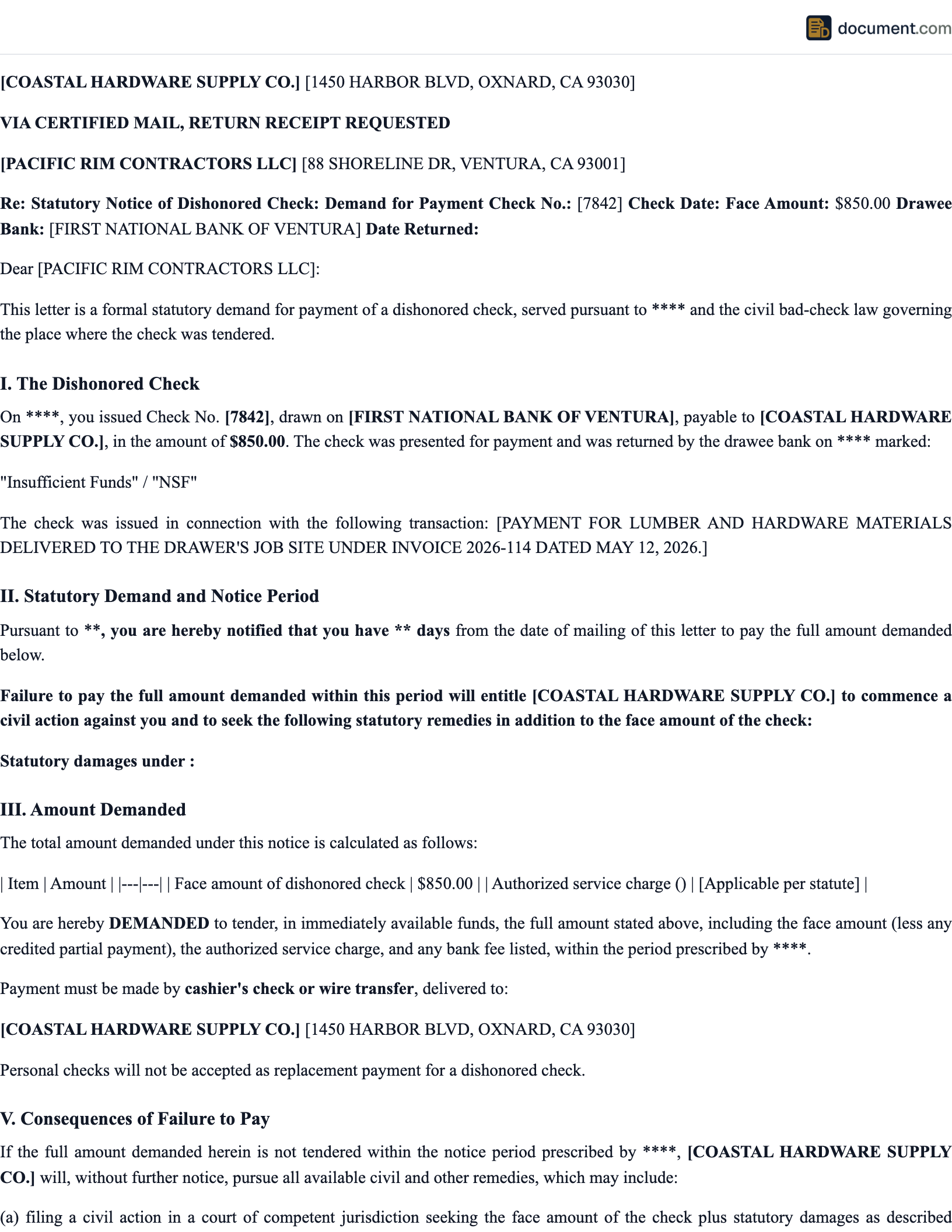



Nebraska Notice of Dishonored Check Overview
Nebraska handles bad checks differently from most states. Rather than creating a freestanding civil damages track with treble or double damages, Neb. Rev. Stat. § 28-611 funnels the collection process through the county attorney's office, coupling a criminal restitution mechanism with a civil claim for the check amount, a $10 service charge, and the holder's actual bank fees. The result is a system that enlists the prosecutor's authority to pressure payment while preserving the holder's ability to collect in court if payment is not forthcoming.
The county attorney's bad check unit -- most visibly the Douglas County unit in Omaha -- acts as a clearinghouse. The holder submits the dishonored check, a $10 filing fee per check, and supporting documentation. The office then sends the check writer a notice that a criminal complaint has been made and that payment of the check plus fees is required within 10 days. That notice period is the practical heart of the statute: if the check writer pays within the window, the matter closes without a criminal record. If not, the county attorney may pursue prosecution, and a criminal conviction carries a mandatory restitution order payable to the holder.
Understanding the difference between the county attorney track and a direct civil lawsuit matters for Nebraska holders. Small claims court in Nebraska has a $7,500 ceiling, and a holder with a check below that amount who wants faster resolution without waiting on prosecutorial bandwidth may file a civil action on contract grounds. The statutory right to the $10 service charge and bank fees applies on both tracks. What Nebraska does not provide is the treble- or double-damage multiplier that many other states give civil plaintiffs -- which makes the county attorney diversion process the primary lever for compelling payment when the check writer is unresponsive.
Restitution of check amount plus $10 and reasonable bank fees
Civil damages
10 days after receiving dishonor notice from county attorney
Notice period
$10 plus reasonable bank handling fees
Service charge
Neb. Rev. Stat. § 28-611
Controlling statute
The Controlling Statute: Neb. Rev. Stat. § 28-611
Neb. Rev. Stat. § 28-611 criminalizes issuing or passing a check, draft, order, or similar instrument knowing at the time of issuance that sufficient funds are not on deposit or that the account does not exist. The knowing-and-intentional element is critical: the state must prove that the intent to defraud existed at the moment the check was drawn, not that it developed afterward. A check returned for NSF due to a timing mishap, with the writer's account otherwise in good standing, presents a weaker criminal case than a check written on a closed account.
The statute grades the offense by dollar amount. A dishonored instrument below $500 is a Class II misdemeanor. An instrument of $500 or more but less than $1,500 is a Class I misdemeanor. An instrument of $1,500 or more but less than $5,000 is a Class IV felony. Nebraska also carries an aggregation rule: checks passed within the same county within a 60-day window may be combined for purposes of determining the offense class, though a series of checks may be aggregated into only one offense. A second or subsequent Class I or Class II misdemeanor conviction elevates automatically to a Class IV felony regardless of the check amount.
On the civil side, § 28-611 authorizes the holder to recover restitution of the check amount, an additional $10, and any reasonable handling fee imposed by a financial institution. The statute does not authorize a multiplier beyond those figures. The $10 charge is modest compared with the $20-to-$35 service charges common in other states, but the bank-fee pass-through can add meaningful amounts when the holder's institution charges a standard returned-check fee of $12 to $35 per item.
The statute also covers instruments other than paper checks. The phrase 'check, draft, order, or similar instrument' is broad enough to reach cashier's-check frauds, ACH-substitute instruments, and certain money order scenarios, though electronic ACH debits are a distinct category and holders seeking relief on a pure ACH return should confirm whether § 28-611 or a separate provision governs their transaction.
Statute Reference
Neb. Rev. Stat. § 28-611
Damages: Restitution of check amount plus $10 and reasonable bank fees; criminal restitution available
What You Can Recover in Nebraska
Nebraska's recovery formula under § 28-611 is additive rather than multiplicative. The holder is entitled to: (1) the face amount of the check, (2) the $10 statutory service charge, and (3) reasonable bank handling fees actually incurred. If your bank charged you $30 for the returned item, you may demand that $30 alongside the $10 statutory charge. On a $400 check with a $25 bank fee, the total demand is $435 -- meaningful but not the two-to-three times multiplier available in California, Florida, or Georgia.
Criminal restitution is the second recovery path. When the county attorney pursues a prosecution and the check writer is convicted, the court must order restitution covering the face amount of the check, the $10 statutory charge, and any bank fees. That restitution order is enforceable as a civil judgment against the defendant. For holders dealing with serial check writers -- particularly where the 60-day aggregation rule has pushed the offense to a Class IV felony -- the criminal restitution track can produce an enforceable judgment without the holder having to file a separate civil suit.
Nebraska does not cap recovery at a dollar ceiling tied to the check amount in the way some states cap treble damages, but there is no upside multiplier either. The practical ceiling is the check face plus $10 plus actual bank fees. Attorney fees are not separately authorized under § 28-611 for the civil holder, which is another reason the county attorney route tends to be the economically rational first step: it delivers compulsion at low cost to the holder, with the criminal restitution order serving as the enforcement instrument if prosecution proceeds.
- Civil damages: Restitution of check amount plus $10 and reasonable bank fees; criminal restitution available
- Service charge: $10 plus reasonable bank handling fees
- Notice period before suit: 10 days after receiving dishonor notice from county attorney
Notice Procedure and Timeline in Nebraska
The 10-day notice period under § 28-611 is triggered by the holder submitting the dishonored check to the county attorney, not by the holder mailing a demand letter directly to the check writer. The county attorney's office sends a notice to the check writer stating that a criminal complaint has been made and that the check plus fees must be paid within 10 days. This distinguishes Nebraska from states like California or Georgia, where the holder personally drafts and mails the statutory demand. In Nebraska, the demand goes out under the county attorney's authority, which substantially increases the practical pressure on the check writer to pay.
For Douglas County submissions, the holder brings or mails the original check (or a legible copy), documentation of the bank's dishonor, and a $10 submission fee per check to the Bad Check Unit. Other county attorneys operate similar programs, though procedures vary by county and holders outside major population centers should contact their county attorney directly to confirm submission requirements. Retain copies of everything submitted -- the original check, the bank dishonor notice, and any receipt from the county attorney's office -- because those documents become the exhibits if prosecution follows.
The 10-day clock runs from the check writer's receipt of the county attorney's notice. If the check writer pays within that window, the matter typically resolves without further proceedings. If not, the county attorney may file a criminal complaint. There is no provision that extends the window automatically, and partial payment during the 10 days does not restart or toll the period unless the county attorney's office specifically agrees to a payment arrangement. A holder who wants to pursue a civil judgment in small claims court independently of the county attorney process should be aware that Nebraska's small claims ceiling is $7,500 and that the statutory right to the $10 charge and bank fees applies in that forum as well.
Nebraska-Specific Notes
Nebraska's county attorney route is not available for every check. The county attorney's office exercises prosecutorial discretion, and checks from business transactions between commercial parties, post-dated checks (which the holder accepted knowing future funds were required), or checks where the underlying transaction is in genuine dispute may be declined or deprioritized. Holders who cannot use or choose not to use the county attorney process may still file a civil action and claim the statutory amounts under § 28-611, but they must prepare and serve their own demand.
The aggregation rule under § 28-611 is a tool holders often overlook. If a single check writer has passed multiple dishonored checks to you within a 60-day period in the same county, the combined face value determines the offense class. Multiple checks of $300 each that total $900 aggregate into a Class I misdemeanor rather than separate Class II misdemeanors. When presenting checks to the county attorney, submit all checks from the same writer within the 60-day window together so the office can assess the correct charge level.
Nebraska Specific Note
Nebraska's statute does not expressly cover post-dated checks as a criminal matter, because the writer and holder both know at the time of issuance that the funds are not yet available. Presenting a post-dated check before its date and having it returned NSF is not a § 28-611 violation. If you accepted a post-dated check as a deferred-payment arrangement, your remedy on a returned item is contract-based, not statutory. The $10 service charge and bank-fee recovery still apply civilly, but the county attorney's criminal-referral mechanism will generally not be available.
Nebraska's small claims court ceiling of $7,500 covers the large majority of consumer and small-business dishonored-check disputes. For checks exceeding that amount, the holder must file in county or district court, where attorney representation becomes more practical. Checks of $1,500 or more also carry Class IV felony exposure for the check writer, which increases the weight of the county attorney submission and the likelihood that the prosecution track yields a restitution order without requiring the holder to litigate separately.
Nebraska Bad Check FAQ
Other State Bad Check Laws
Each state sets its own notice period, damage formula, and service charge. Browse sibling state pages for the specific rules that apply to your situation, or return to the full 50-state guide.
Create your Nebraska Notice of Dishonored Check in minutes.
Answer a few questions and download a Nebraska-compliant bad check demand letter that cites Neb. Rev. Stat. § 28-611 and is ready to mail certified.