
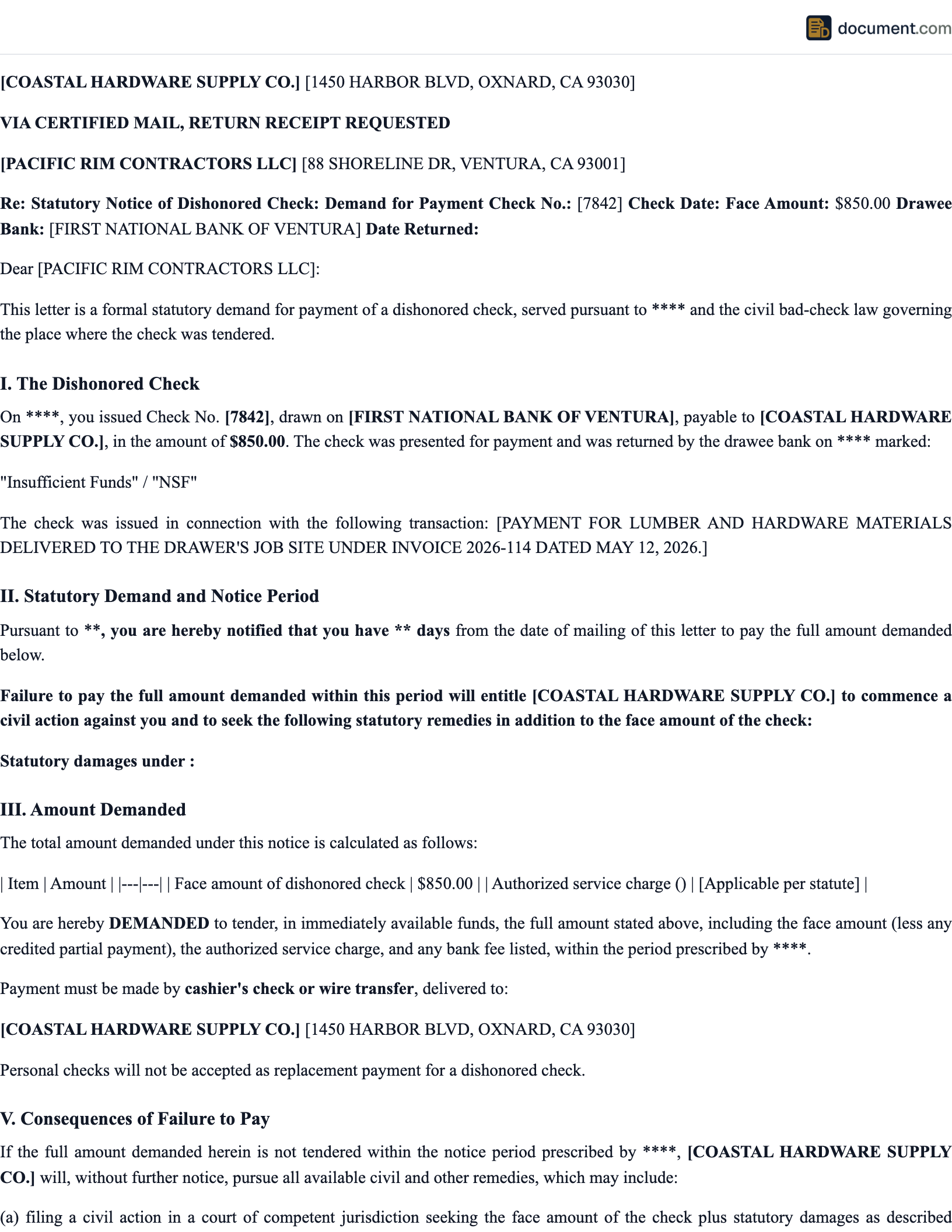



Mississippi Notice of Dishonored Check Overview
Mississippi gives payees two parallel tools when a check comes back from the bank: a civil remedy under Miss. Code Ann. § 11-7-12 and a criminal statute under § 97-19-55 through § 97-19-67. The civil track is a private action between the payee and the check writer. The criminal track runs through the district attorney. Most payees start with the civil route because it produces a money judgment the payee can enforce directly and does not depend on prosecutorial discretion.
The civil remedy is straightforward but procedurally strict. Before the payee can sue for anything beyond the face amount of the check, the payee must send written notice to the drawer and give that person 15 days to make good on the check. The notice period is not a formality. Courts in Mississippi have held that the prior-written-demand requirement is a substantive condition precedent to the civil penalty, not a mere procedural suggestion. A payee who sues before the 15 days have run, or who never sends the notice at all, can still recover the face amount of the check on ordinary contract or commercial paper grounds, but forfeits the civil penalty and the authorized service charge.
The statute covers more than traditional paper checks. Mississippi amended its bad check provisions to reach electronically converted checks and electronic commercial debits, so the same notice procedure applies when a payee accepts a check that is converted to an ACH transaction at the point of sale and that transaction is subsequently dishonored. If the underlying instrument was a paper check or an electronic debit authorized by the drawer, the Mississippi civil bad check framework governs the recovery procedure.
Civil penalty recoverable
Civil damages
15 days after written notice before prosecution or civil action
Notice period
Up to $30
Service charge
Miss. Code Ann. § 11-7-12 / § 97-19-67
Controlling statute
The Controlling Statute: Miss. Code Ann. § 11-7-12 / § 97-19-67
Miss. Code Ann. § 11-7-12 is the civil engine of Mississippi's bad check framework. It authorizes the holder of a dishonored check to recover the face amount of the check plus a service charge as part of the civil action, provided the holder has complied with the written-notice requirement. The statute works in tandem with the criminal code provisions at § 97-19-55 through § 97-19-67, which define the conduct, establish criminal penalties, and set out the notice and restitution mechanics that feed back into the civil process.
Section 97-19-55 defines the offense: knowingly issuing a check, draft, or order on a bank when the drawer knows at the time of issuance that there are insufficient funds or credit to cover the instrument, or that the account does not exist. The statute extends to electronically converted checks and electronic commercial debits, meaning a drawer who authorizes a merchant to electronically debit their account and then has the transaction returned for insufficient funds is in the same legal position as someone who handed over a paper check that bounced.
Section 97-19-57 provides the presumption of fraudulent intent that anchors the criminal case. It also establishes that sending written notice by certified or registered mail to the drawer's last known address, and receiving no payment within 15 days of that notice, raises a presumption that the drawer acted with the intent to defraud. That presumption matters in a criminal prosecution. On the civil side, it reinforces why the written notice and the 15-day waiting period are the structural foundation of both recovery tracks: the same demand letter that opens the civil remedy also begins building the evidentiary record for a potential criminal referral.
Section 97-19-67 sets out the criminal penalty scale. A first-offense bad check under $100 is a misdemeanor punishable by up to six months in the county jail and a fine of up to $500. Once the check amount reaches $100 or more, even a first offense becomes a felony, punishable by up to three years in the state penitentiary and a fine of up to $1,000. A third or subsequent violation is a felony regardless of the check amount, and the statute also addresses restitution to the victim as part of any criminal sentence. The felony threshold in Mississippi at $100 is notably low compared to most states, which means that a dishonored check for a routine commercial transaction can carry felony exposure for the drawer from the outset.
Statute Reference
Miss. Code Ann. § 11-7-12 / § 97-19-67
Damages: Civil penalty recoverable; restitution of face amount plus service charge
What You Can Recover in Mississippi
Mississippi's civil remedy allows the payee to recover the face amount of the check plus a service charge. The service charge is capped at $30 per check. That service charge is separate from the face amount and is authorized by statute as compensation for the cost of the returned item, not as a civil penalty. The $30 cap applies regardless of whether the payee's bank assessed a higher returned-item fee; the statutory service charge is the amount the payee can demand from the drawer, not a passthrough of whatever the payee's bank charged.
Mississippi does not use the treble-damage or double-damage formula that many other states apply to dishonored checks. The civil penalty structure is a restitution-plus-service-charge model rather than a multiplier model. That means a payee holding a $500 dishonored check can demand $530 under the civil statute: $500 face amount plus the $30 service charge. A payee in California holding the same check might be entitled to $1,500 under a treble-damage formula. Payees accustomed to the civil penalty structures in neighboring states should not assume Mississippi's framework produces the same arithmetic.
The modest civil recovery ceiling makes the district attorney's check unit a more significant part of the practical landscape in Mississippi than in states with robust treble-damage statutes. For checks below $100, the civil recovery is the face amount plus up to $30, which may not justify the cost of filing suit. For checks at $100 or more, where the criminal statute treats the offense as a felony, referral to the DA's office carries real deterrent weight and the restitution ordered as part of a criminal sentence can cover the full face amount of the check. The practical playbook in Mississippi often pairs the civil notice with a referral to the local check unit, particularly for checks that are clearly in felony territory.
- Civil damages: Civil penalty recoverable; restitution of face amount plus service charge
- Service charge: Up to $30
- Notice period before suit: 15 days after written notice before prosecution or civil action
Notice Procedure and Timeline in Mississippi
Before suing under the civil statute or filing a complaint with the district attorney's check unit for an NSF check, the payee must send written notice to the drawer. The notice must be sent by certified or registered mail to the drawer's last known address. The 15-day cure period begins running from the date the notice is mailed, not from the date the drawer actually receives it. For account-closed checks, Mississippi's district attorney check units generally do not require the 15-day notice before accepting a complaint, because the closed-account scenario is treated as clearer evidence of intentional conduct. Confirm the specific practice of the DA's office in the relevant judicial district before skipping the notice step even for a closed-account check.
The notice itself should identify the check by date, amount, check number, and the name of the drawee bank; state the reason for dishonor as reflected on the bank's return; demand payment of the face amount plus the $30 service charge; and specify that the drawer has 15 days from the date of mailing to tender payment before the payee proceeds with civil action or criminal referral. State the payment deadline as a specific calendar date rather than just counting forward 15 days and leaving the math to the reader. A notice mailed on June 10 should state that payment is due on or before June 25. Mississippi's § 97-19-57 provides that a return-receipt certified mailing to the drawer's last known address, if returned undelivered, can itself serve as evidence of intent to defraud in a criminal proceeding, so keep the returned envelope.
After the 15-day period runs without payment, the payee has satisfied the notice prerequisite for the civil action under § 11-7-12. At that point the payee can also file a complaint with the district attorney's check unit. Mississippi's DA offices operate check units across all judicial districts; they accept complaints only after the statutory notice requirement has been satisfied for NSF checks. The check unit will send its own collection letters and, if the drawer still does not pay, refer the matter to the grand jury for indictment. The DA check unit process is not an alternative to the civil remedy; many payees pursue both simultaneously, filing the civil suit while the DA's office runs its own process.
Mississippi-Specific Notes
Mississippi's felony threshold of $100 is among the lowest in the country. Most states set the felony-misdemeanor line for bad check offenses at $500, $1,000, or higher. In Mississippi, a check for $100 or more is a felony on the first offense. A landlord whose tenant gives a $150 security deposit check that bounces is holding a check that carries felony exposure for the drawer from the moment of dishonor. This low threshold increases the leverage a payee has when sending the civil demand notice, because the drawer understands that the gap between a civil collection letter and a grand jury referral is narrow.
Mississippi's district attorney check units are widely distributed across the state's judicial districts and operate under a self-funding model: program costs are covered by service fees recovered from check writers who pay restitution through the office. The fees charged at the DA level are separate from the $30 statutory service charge the payee is authorized to demand under the civil statute. The DA's office charges its own administrative fees to the check writer as part of the restitution process; those fees are collected from the writer, not the victim. Payees should understand that submitting a check to the DA unit does not prevent them from also pursuing the civil action independently.
Mississippi Specific Note
Mississippi's civil bad check statute does not authorize attorney fees as part of the civil recovery. A payee who retains an attorney to pursue a dishonored check action will absorb those fees out of the recovery, which is limited to the face amount plus the $30 service charge. On checks of modest size, the economics of hiring counsel rarely work. For checks at or above the small claims ceiling, the payee should weigh civil court costs against the alternative of allowing the DA unit to pursue restitution through the criminal track, where no out-of-pocket cost falls on the payee.
Mississippi's Justice Court handles small claims civil matters and the jurisdictional ceiling is $3,500 under Miss. Code Ann. § 9-11-9. Civil bad check actions for face amounts at or below that ceiling can be filed in Justice Court without an attorney and at minimal cost. For a dishonored check of, say, $2,500, the payee can file in Justice Court, attach the original bank return notice, the demand letter, and the certified-mail receipt, and present the case to the judge. Justice Court judges handle dishonored check cases with regularity, and a complete documentary record from the civil notice through the expiration of the 15-day period typically produces a straightforward judgment.
Mississippi Bad Check FAQ
Other State Bad Check Laws
Each state sets its own notice period, damage formula, and service charge. Browse sibling state pages for the specific rules that apply to your situation, or return to the full 50-state guide.
Create your Mississippi Notice of Dishonored Check in minutes.
Answer a few questions and download a Mississippi-compliant bad check demand letter that cites Miss. Code Ann. § 11-7-12 / § 97-19-67 and is ready to mail certified.