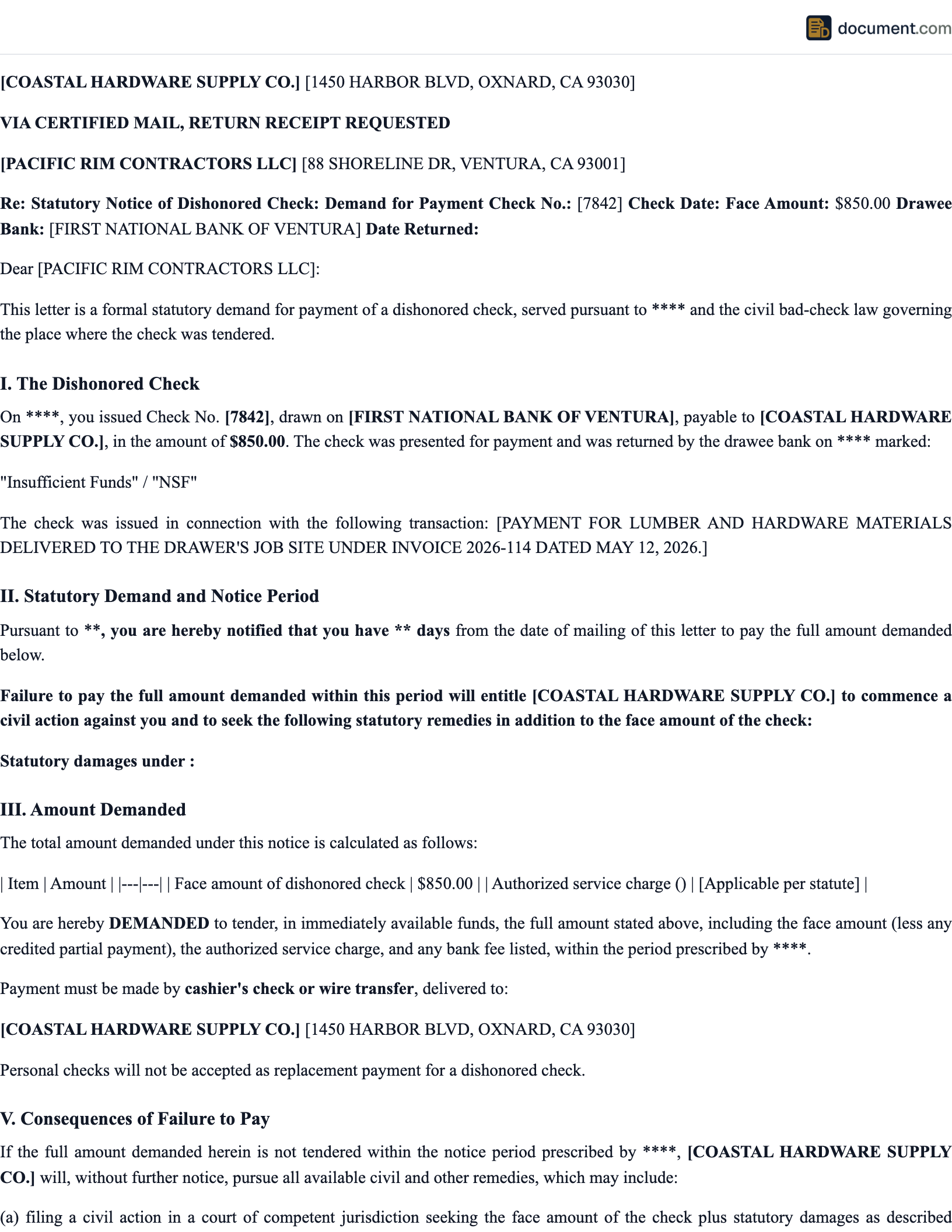



Minnesota Notice of Dishonored Check Overview
Minnesota handles civil bad-check liability under Minn. Stat. § 604.113, a standalone civil remedies statute that runs parallel to the criminal dishonored-check provision at § 609.535. The civil track gives payees a direct path to money damages without waiting for a criminal prosecution or relying on the district attorney to take action. A landlord whose tenant's rent check bounces, a contractor who accepted a bad check for completed work, or a retailer whose point-of-sale check is returned by the bank can each pursue the § 604.113 remedy independently.
The structure of the Minnesota civil remedy differs from the treble-damage model used in many other states. Minnesota does not multiply the check amount by two or three. Instead it layers fixed civil penalties on top of the face amount, adds a service charge if properly posted, and allows attorney fees when the pattern of dishonored checks crosses a dollar threshold within a six-month window. That structure rewards payees who keep records and hold multiple returned checks from the same drawer.
Understanding what § 604.113 requires before you send a notice matters because mistakes in the notice procedure forfeit the civil penalty. A notice sent by the wrong method, addressed to the wrong party, or lacking the required statutory citation loses the enhanced-damage element even if the underlying check is concededly worthless. The statute is specific about form, method, and timing, and Minnesota courts read those requirements closely.
Civil penalty up to $100 or face value of check, whichever is greater
Civil damages
30 days after certified mail notice of dishonor
Notice period
Up to $30 (if conspicuously posted at point of sale)
Service charge
Minn. Stat. § 604.113
Controlling statute
The Controlling Statute: Minn. Stat. § 604.113
Minn. Stat. § 604.113 creates civil liability for any person who issues a check that the drawee bank dishonors. The statute covers the usual fact patterns: insufficient funds in the account, a closed account, and stop-payment orders entered without legitimate cause. The payee who holds the returned check is the person entitled to pursue the civil remedy, and the statute extends the same rights to holders who acquired the check from the original payee by assignment.
The civil penalty does not arise automatically on dishonor. It arises only after the payee has sent the required statutory notice and the drawer has failed to pay the full amount demanded within 30 days. Until that 30-day window closes without payment, the drawer still has the opportunity to make the check good and avoid the penalty entirely. The statute expressly says that the failure of a drawer to receive a notice sent by regular mail to the address on the check is not a defense, provided the drawer had actual notice of the dishonor for 30 days. That provision shifts the burden firmly to the drawer to respond.
Section 604.113 also explicitly references § 609.535, the criminal dishonored-check statute, and requires that the civil notice letter cite both provisions. That cross-citation requirement is not optional. A notice that cites only one section or describes only the civil consequences without mentioning the criminal statute does not comply with the statutory form requirement. Include both citations in the notice letter and describe the categories of liability each creates.
The statute permits the drawer to raise a complete defense if the drawer successfully completes a pretrial diversion program under Minn. Stat. § 628.69. That provision matters because county attorneys in Minnesota do operate bad-check diversion programs: a drawer who contacts the county attorney's office, pays restitution through the program, and completes any required conditions can walk away from both criminal liability and the civil penalty under § 604.113. If the drawer enters and completes diversion after you have sent the civil notice but before you file suit, the civil penalty defense becomes available, which means filing promptly after the 30-day window closes is strategically important.
Statute Reference
Minn. Stat. § 604.113
Damages: Civil penalty up to $100 or face value of check, whichever is greater
What You Can Recover in Minnesota
Minnesota § 604.113 authorizes four categories of recovery. First, the face amount of the check. Second, the service charge, up to $30, if you had conspicuous notice of the charge posted at the point of sale when the check was issued. Third, a civil penalty equal to the greater of $100 or the face value of the check. Fourth, interest on the face amount at the judgment rate. The civil penalty formula is distinctive: on a $50 check the penalty is $100 because the statutory minimum exceeds the face value; on a $400 check the penalty is $400 because the face value exceeds $100. The penalty is not multiplicative; it is the check itself used as the measuring rod once the face value clears $100.
Running the numbers concretely: a $75 check yields a civil penalty of $100, for a total claim of $205 plus interest (check $75 + service charge $30 + civil penalty $100). A $250 check yields a civil penalty of $250, for a total claim of $530 plus interest. A $1,000 check yields a civil penalty of $1,000, for a total claim of $2,030 plus interest. Compare that to a treble-damage state like Oregon or California, where a $1,000 check could yield $3,000 in damages plus costs. Minnesota's structure is more conservative on large checks but remains meaningful on small ones because the $100 floor prevents the civil penalty from vanishing when the face amount is trivial.
Attorney fees become available under § 604.113 only when the drawer has issued dishonored checks to you totaling more than $1,250 in any six-month period. That threshold is aggregate across multiple checks, not per check. A single $400 check does not trigger the attorney-fee provision. Two checks in the same six-month window totaling $1,300 do, provided both were dishonored and both are the subject of a timely § 604.113 notice. Payees dealing with a repeat offender should document each returned check separately, send a separate notice for each one, and track the running aggregate to preserve the attorney-fee right.
- Civil damages: Civil penalty up to $100 or face value of check, whichever is greater
- Service charge: Up to $30 (if conspicuously posted at point of sale)
- Notice period before suit: 30 days after certified mail notice of dishonor
Notice Procedure and Timeline in Minnesota
Minn. Stat. § 604.113 gives the payee two acceptable mailing methods: certified mail with return receipt requested, or regular mail. That optionality is more permissive than most state bad-check statutes, which require certified mail as the minimum. Minnesota allows regular mail, but if you use regular mail and the drawer later claims non-receipt, the statute provides that non-receipt is not a defense only if the drawer had actual notice of the dishonor for 30 days. Certified mail creates a stronger evidentiary record and removes that dispute entirely. Use certified mail unless there is a specific reason not to, and retain the tracking record and return receipt card as litigation exhibits.
Address the notice to the drawer at the address printed or written on the check. The statute ties the non-receipt defense to the address on the check, so sending the notice to a different address, even a more current one you happen to know, creates an argument that the statutory method was not followed. If you have reason to believe the address on the check is stale, send one copy to the check address and a second copy to the updated address by the same method, and document both mailings.
The notice must cite Minn. Stat. § 604.113 and § 609.535 and describe the applicable penalties under each. Include the face amount of the check, the service charge you are claiming, the civil penalty amount, and the specific calendar deadline by which payment must arrive. For a notice mailed on the 5th of the month, state the deadline as the 5th of the following month, or the next business day if that date falls on a weekend or holiday. Do not file suit before the 30-day window closes. A complaint filed on day 28 forfeits the civil penalty and gives the drawer an easy procedural defense to defeat the enhanced-damage claim.
Minnesota-Specific Notes
Minnesota's conciliation court, which is the state's small claims forum, accepts cases up to $20,000 for general civil claims. That ceiling is high enough to handle virtually any bad-check civil claim under § 604.113, including cases involving multiple returned checks where the aggregate face value and civil penalties together approach five figures. For consumer credit transactions the conciliation court ceiling drops to $4,000, but a straightforward civil bad-check claim arising from a goods or services transaction is not a consumer credit matter, so the $20,000 ceiling controls. Conciliation court filing fees are modest, the process does not require an attorney, and judges in that court see § 604.113 claims regularly.
Minnesota's criminal bad-check statute, § 609.535, uses three tiers based on the face value of the check. A check over $500 is a felony carrying up to five years imprisonment and a fine up to $10,000. A check between $250 and $500 is a gross misdemeanor carrying up to 364 days and a $3,000 fine. A check of $250 or less is a misdemeanor. Values of multiple dishonored checks issued by the same drawer can be aggregated across a six-month period for purposes of charging, which means a series of smaller checks can be combined to reach the felony threshold. The civil notice letter serves a practical role in a potential criminal referral: county attorneys and sheriff's offices with bad-check programs typically require evidence that a written demand was sent and ignored before they will accept a check for prosecution. The § 604.113 notice letter, with its certified-mail receipt, satisfies that prerequisite.
Minnesota Specific Note
Minnesota § 604.113 conditions the service charge on conspicuous posting of the charge at the point of sale at the time the check was issued. A payee who did not have that notice posted when the check was accepted cannot include the service charge in the demand, even if the statutory maximum is $30. Businesses that regularly accept checks should verify that their returned-check service charge notice is legibly posted near every point where checks are accepted. An improperly claimed service charge can complicate an otherwise straightforward civil case by inviting the drawer to dispute the demand amount and challenge whether the total demanded was accurate.
Minnesota Specific Note
the pretrial diversion defense in § 604.113 has a procedural implication that payees sometimes overlook. If the drawer enters the county bad-check diversion program after you have sent the § 604.113 notice, the drawer may have a statutory defense to the civil penalty even if diversion is completed after your 30-day notice period has expired. Once diversion is completed, § 604.113 expressly allows the drawer to raise that completion as a defense in any civil action. File suit promptly after the 30-day window closes if you want to secure a judgment before the diversion defense becomes available.
Minnesota Bad Check FAQ
Other State Bad Check Laws
Each state sets its own notice period, damage formula, and service charge. Browse sibling state pages for the specific rules that apply to your situation, or return to the full 50-state guide.
Create your Minnesota Notice of Dishonored Check in minutes.
Answer a few questions and download a Minnesota-compliant bad check demand letter that cites Minn. Stat. § 604.113 and is ready to mail certified.