
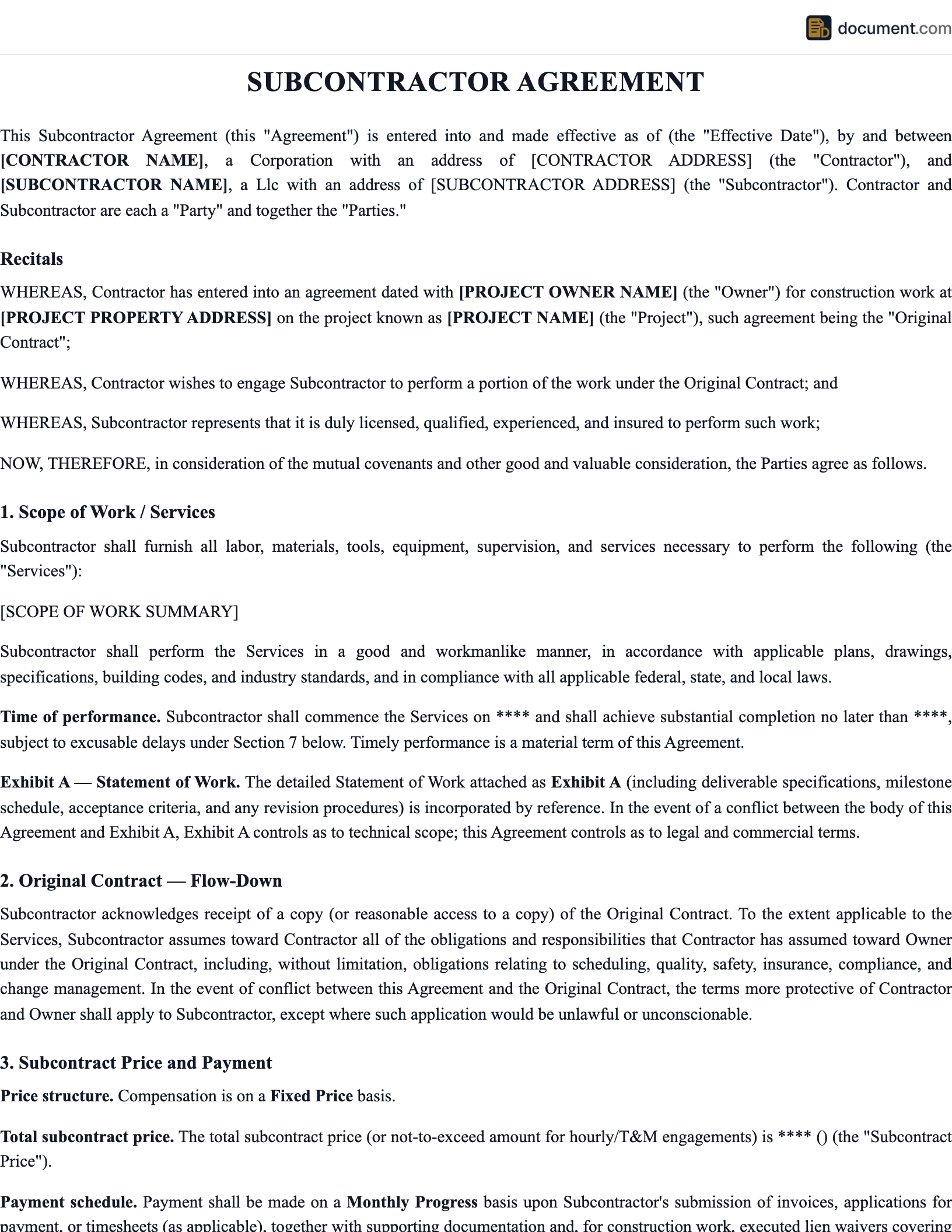



What Is a Subcontractor Agreement?
A subcontractor agreement is a written contract between a prime (general) contractor and a lower-tier contractor — a subcontractor — who performs a portion of the prime contractor's scope of work. The subcontractor is an independent business, not an employee of the prime contractor, and is typically hired because the prime does not self-perform that specialty trade or because the prime's crews are at capacity. Subcontracting is the dominant labor model in construction, and it also appears in IT services, telecommunications, trucking, janitorial, and healthcare vendor management.
A well-drafted subcontract identifies the parties, describes the scope of work (often by referencing the prime contract's plans and specifications), sets the price and payment schedule, allocates risk through indemnification and insurance, protects the prime from lien claims through lien waivers, and pushes the prime contract's material terms down to the sub through flow-down clauses. On federal work, FAR 52.244-6 mandates specific flow-down of Davis-Bacon, Service Contract Act, EEO, and other regulatory clauses. On AIA-form projects, AIA A401 is the standard subcontract template that flows AIA A201 general conditions.
Because this site generates twelve trade-specific subcontracts — construction, cleaning, concrete, HIPAA, IT, painting, plumbing, roofing, security, software development, solar panel, and truck driver — the template is tuned for the unique legal and technical issues each trade faces. A cleaning subcontract needs OSHA HazCom and janitorial bonding language; a HIPAA subcontract needs a Business Associate Agreement under 45 CFR § 164.314; a truck driver subcontract needs FMCSA 49 CFR § 376 owner-operator lease provisions. Select the variant that matches your trade from the dropdown above to generate a subcontract tuned to that trade's real-world risks.
When to Use a Subcontractor Agreement
Use a subcontractor agreement any time a prime contractor hires another independent business to perform a portion of the prime's scope. Typical scenarios include a general contractor hiring an electrical sub on a commercial project, a janitorial prime hiring a carpet-cleaning sub for a specialty scope, a software consulting firm hiring a freelance engineer to staff a client engagement, a healthcare-vendor prime hiring a downstream data-processor, or a trucking brokerage leasing on an owner-operator under FMCSA rules. In each case, the subcontract defines the relationship, allocates risk, and documents the independent-contractor classification.
Do not use a subcontractor agreement for employees. If the IRS or the Department of Labor determines that the worker is actually an employee — based on behavioral control, financial control, and relationship factors — the prime will be liable for back payroll taxes, unpaid overtime under the FLSA, workers' compensation premiums, and in some states, class-action penalties under AB 5-style statutes. Use an employment agreement for employees and a subcontract only for genuine independent businesses that supply their own crew, tools, and insurance.
Types of Subcontractor Agreements
Select the variant that matches your trade. Each template is tuned to the specific code, licensing, insurance, and regulatory issues that trade faces.
Construction Subcontractor
AIA A401 flow-down, progress billing, lien waivers, and OCIP/CCIP wrap-up coverage for prime contractors hiring trade subs.
Cleaning Subcontractor
Janitorial and specialty cleaning — OSHA HazCom compliance, SDS, bond/liability insurance, key access, and scope checklists.
Concrete Subcontractor
ACI 318 code compliance, rebar placement, curing schedules, cold-weather protection, and concrete pumping insurance.
HIPAA Subcontractor
Business Associate Agreement for downstream vendors handling PHI under 45 CFR §164.314, with breach notification chain.
IT Subcontractor
SOC 2 Type II obligations, work-for-hire IP, SLA uptime, source code escrow, and CCPA/GDPR data-processor terms.
Painting Subcontractor
VOC limits, RRP lead-paint certification, MSDS documentation, prep scope, and weather-day exclusions.
Plumbing Subcontractor
Journeyman licensing, UPC/IPC compliance, backflow testing, pressure testing, and gas-line CSST certification.
Roofing Subcontractor
OSHA §1926.501 fall protection, material manufacturer warranties, GAF/CertainTeed certification, and ice-and-water shield specs.
Security Subcontractor
State guard licensing (BSIS, D-license), firearms permits, use-of-force policy, and $1M E&O coverage.
Software Development Subcontractor
Acceptance criteria, 17 USC §101 work-for-hire IP assignment, source code escrow, and open-source compliance.
Solar Panel Subcontractor
Utility interconnection, NABCEP certification, UL 1703 listings, NEC Article 690, and SREC/rebate attribution.
Truck Driver Subcontractor
FMCSA 49 CFR §376 owner-operator lease, IFTA, HOS logs, CSA scoring, IRP plates, and cargo insurance.
Key Provisions
Every subcontractor agreement — regardless of trade — should address these core provisions.
Scope of work
Incorporated plans, specifications, and exhibits; exclusions; deliverables.
Price and payment
Lump sum vs. unit price; schedule of values; progress billing; retainage; pay-when-paid language.
Insurance
CGL $1M/$2M minimum; workers' compensation; additional insured endorsements (CG 20 10/CG 20 37).
Lien waivers
Conditional progress waivers; final unconditional waiver; statutory-form compliance.
Indemnification
Defend, indemnify, and hold harmless; comparative-fault limits under state anti-indemnity statutes.
Flow-down
Prime contract terms flow down; FAR 52.244-6 mandatory clauses on federal work; AIA A401 on private.
Safety and compliance
OSHA compliance; trade-specific codes (NEC, IPC, ACI); licensing and certifications.
Termination
Termination for default with notice and cure; termination for convenience with payment for work in place.
Legal Considerations
Subcontractor classification is the highest-exposure legal issue. The IRS uses a common-law control test, the Department of Labor's 2024 rule applies a six-factor economic reality test under the FLSA, and California's AB 5, New Jersey's ABC statute, and Massachusetts's independent-contractor law apply a stricter three-factor ABC test that presumes employment. A subcontract that carefully documents independent-business status — the sub's own insurance, license, tools, crew, right to work for other clients, and payment by deliverable — is the single most important defense against reclassification audits.
Lien rights are the second-largest exposure. Every state has a mechanic's lien statute that gives subcontractors a claim against the project property even though they have no direct contract with the owner. The prime contractor protects itself — and the owner — through a disciplined lien-waiver program: preliminary 20-day notices in states that require them, conditional progress waivers tied to each progress payment, and a final unconditional waiver at project close. Several states require statutory-form waivers (California Civil Code §§ 8132-8138, Texas Property Code Chapter 53, Florida Statutes § 713.20); using the wrong form can void the waiver entirely.
Anti-indemnity statutes in approximately 40 states limit the degree to which a sub can be required to indemnify the prime for the prime's own negligence. California Civil Code § 2782 voids "Type I" indemnities (sub indemnifies prime for prime's sole negligence) in most construction contracts. Drafters should use comparative-fault or "to the extent caused by" indemnities in these states, and pair indemnification with additional-insured endorsements rather than relying solely on contract transfer of risk.
How to Fill Out a Subcontractor Agreement
Follow these steps to produce a defensible subcontract. Fields map to the wizard questions in our document builder.
Identify the parties
Full legal entity names, state of formation, EIN, and licensed trade registration numbers for both prime and sub.
Reference the prime contract
Attach or reference the prime contract by owner name, project number, and effective date so flow-down is enforceable.
Define scope with exhibits
Incorporate plans, specifications, schedule of values, and a written scope-of-work exhibit; list exclusions expressly.
Set price and payment terms
Lump sum or unit price; progress billing tied to schedule of values; retainage 5-10%; pay-when-paid timing clause.
Require lien waivers
Conditional progress lien waiver for each progress payment; final unconditional waiver at retainage release; statutory form if required.
Specify insurance
CGL $1M/$2M minimum; workers' comp; auto liability; trade-specific professional or pollution coverage; additional-insured endorsements.
Add indemnification
Comparative-fault indemnity; waiver of subrogation; liability cap aligned with insurance limits.
Include flow-down
Incorporate prime contract terms; add FAR 52.244-6 flow-down on federal work; attach AIA A401 on AIA projects.
Set termination rights
Default termination with notice and cure (typically 72 hours); convenience termination with payment for work in place.
Choose governing law and dispute resolution
Governing law in the project state; mandatory mediation before arbitration; AAA Construction Industry Rules for construction disputes.
Frequently Asked Questions
Common questions about subcontractor agreements, classification, payment terms, and lien rights.
Create your subcontractor agreement in under 10 minutes.
Pick your trade, answer a few questions, and download a flow-down-ready, lien-waiver-compatible subcontract tuned to your state.