
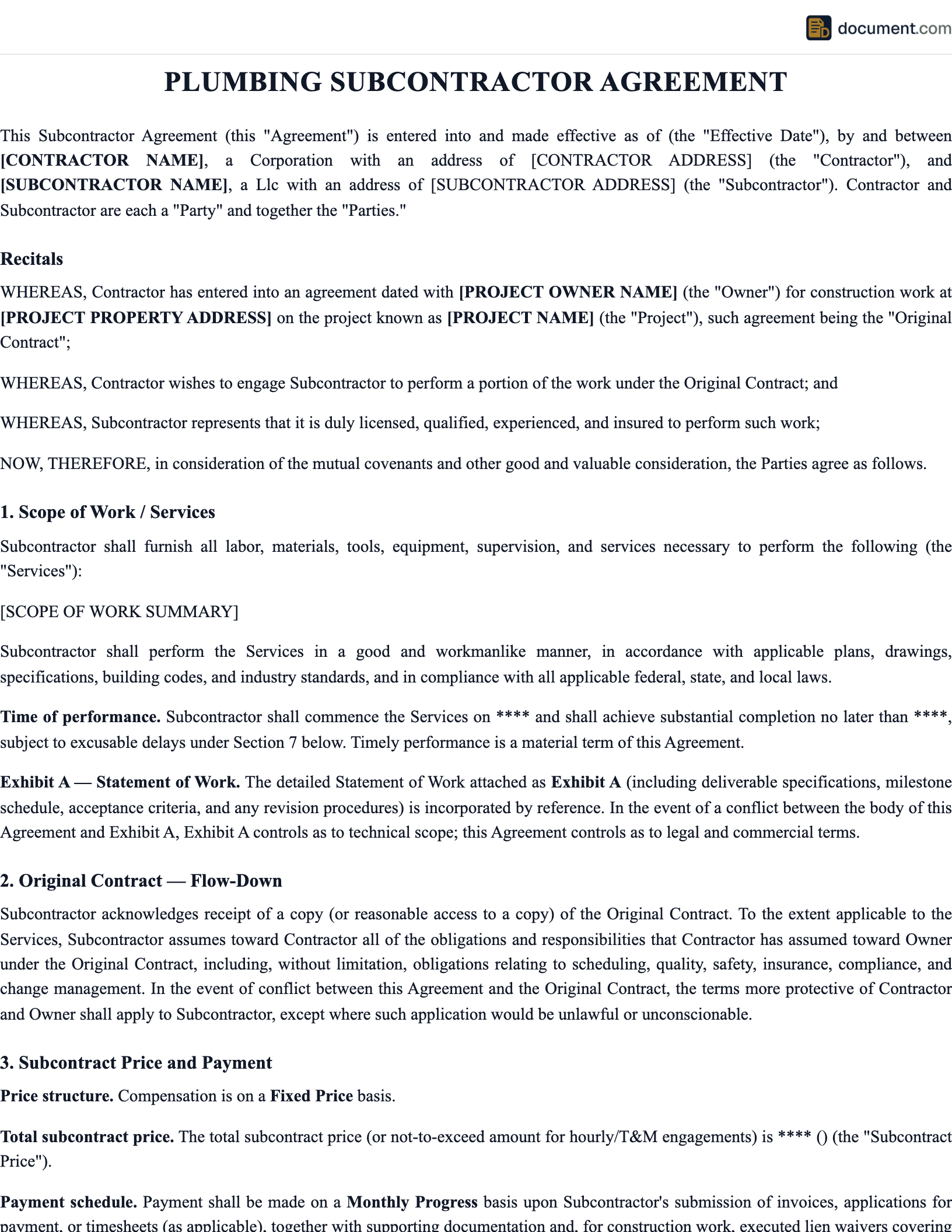



What Is a Plumbing Subcontractor Agreement?
A plumbing subcontractor agreement governs the relationship between a prime (general) contractor and a plumbing specialty contractor performing potable water distribution, sanitary drain/waste/vent (DWV), natural gas piping, fixture installation, water-heater replacement, or specialty piping work. Plumbing is one of the most tightly licensed trades in the U.S., with every state requiring Master Plumber licensure for contracting businesses and Journeyman licensure for field plumbers.
The plumbing subcontract must address the code governing the project (Uniform Plumbing Code in western states, International Plumbing Code in most others), licensing of the plumbing business and its field staff, pressure testing of rough-in before concealment, backflow prevention on cross-connections, gas-line certification (including CSST manufacturer certifications), water-heater permits and inspections, and warranty obligations. Water damage from plumbing failures is a leading cause of construction insurance claims, driving insurance minimums higher than for many other trades.
Use this template for new-construction plumbing, remodel and tenant-improvement plumbing, water-heater replacement, gas-line work, backflow device installation and testing, and specialty plumbing. The document covers scope, licensing attestations, UPC/IPC code compliance, pressure testing, backflow prevention, gas-line certifications, insurance with water-damage coverage, lien waivers, and warranty obligations.
When to Use a Plumbing Subcontractor Agreement
Use this agreement when a general contractor hires a plumbing specialty business to perform a portion of the construction scope — rough-in plumbing, finish plumbing, water-heater replacement, gas-line installation, backflow device work, specialty piping, or service work. The subcontract should always be paired with the mechanical, electrical, and plumbing (MEP) drawings and specifications, local code amendments, and a permit-responsibility schedule.
Do not use this template for DIY plumbing projects or for employee plumbers. State licensing laws require plumbing contractors to hold current Master Plumber licensure; hiring an unlicensed plumber can expose the prime to licensing violations, insurance denial, and warranty defeat. Always verify license status with the state licensing board before contract execution.
Key Provisions
Every plumbing subcontract should address these at minimum.
Scope & drawings
MEP drawings incorporated; fixture schedule; piping materials; exclusions.
Licensing attestation
Master Plumber of record; state license numbers; continuing-education compliance.
Code compliance
UPC or IPC edition; local amendments; gas per NFPA 54.
Permits & inspections
Sub pulls permits; passes all rough-in and final inspections at sub's cost.
Insurance
CGL $1M/$2M; umbrella $2M-$5M; water-damage coverage; gas-incident coverage.
Testing requirements
Water pressure test 100-150 psi; DWV test 10' head; gas per NFPA 54 § 8.1.
Backflow & gas
Licensed backflow tester; CSST manufacturer certification; bonding per NFPA 54.
Warranty
One-year workmanship; pass-through manufacturer; latent defects to state repose.
Legal Considerations
Licensing enforcement is strict. California Business & Professions Code § 7031 bars unlicensed plumbing contractors from collecting any payment and requires disgorgement of money already received. Florida, Nevada, Arizona, Texas, and most other states have similar strict statutes. The subcontract must require the sub to attest to current licensure, maintain it through project completion, and indemnify the prime for any damages from unlicensed work.
Water damage liability extends for years post-completion. Latent plumbing defects — fitting failures, inadequate pressure testing, incorrect pipe materials, improper solder — often appear 6-24 months after occupancy and cause cascade damage to flooring, drywall, electrical systems, and stored property. State statutes of repose run 4-15 years from substantial completion. The subcontract should require the sub to carry water-damage coverage on CGL, maintain completed-operations coverage for the full repose period, and agree to indemnify the prime for latent-defect claims caused by the sub's negligence.
Gas-line installations carry the highest consequences. An improperly installed gas line can cause explosion, fire, or CO poisoning with multi-million-dollar claims. NFPA 54 (National Fuel Gas Code) governs design and installation; CSST (corrugated stainless steel tubing) requires manufacturer certification and equipotential bonding per § 7.13.2. The subcontract should require specific gas-work certifications, bonding for lightning protection, pressure testing per NFPA 54 § 8.1, and excess liability of $5M+ for subs performing significant gas work.
Plumbing-Specific Issues
Pressure testing is the frontline defense against post-occupancy leaks. UPC § 609 and IPC § 312 require water distribution to be tested at working pressure plus 50 psi or 100 psi minimum, held 15 minutes without loss. DWV systems are tested at 10-foot head or 5 psi air. The subcontract should require the sub to perform tests before concealment with the inspector and prime's superintendent present, document the test with a photographed gauge and dated log entry, rework any failures, and preserve test records for 3 years.
Backflow prevention is a cross-connection issue. Federal Safe Drinking Water Act requires public water systems to maintain backflow programs; state and local codes implement enforcement. Required at any cross-connection: irrigation, commercial/industrial process water, multi-family boilers, medical/dental, car washes, laboratories. Annual testing by a licensed backflow tester (CCWG, ABPA, or state certification) is mandatory. The subcontract should specify who handles initial installation, annual testing, repair, and filing of test reports with the water authority.
Water-heater replacement requires permits, code-compliant venting, T&P valve discharge, earthquake strapping in SDC D+ (California two-strap requirement per CPC § 508.2), expansion tanks for closed-loop systems, and pan and drain above habitable space. The subcontract should require permit pull for every water-heater replacement, inspection pass at sub's cost, and one-year warranty from the sub plus pass-through of manufacturer warranty.
How to Fill Out the Agreement
Fields map to the wizard questions in our document builder.
Identify parties and project
Prime, sub, project name, address; applicable code (UPC/IPC); local amendments.
Licensing attestations
Master Plumber of record; state license numbers; backflow certification; gas/CSST endorsements.
Scope of work
MEP drawings incorporated; fixture schedule; piping materials; water-heater and gas-line details.
Pricing and payment
Lump sum or schedule of values; 5-10% retainage; net-30 pay-when-paid.
Testing and inspection
Pressure test 100-150 psi water; DWV 10' head; gas per NFPA 54; document all tests.
Permits and inspections
Sub pulls permits; schedules inspections; passes at sub's cost; re-inspection back-charge.
Insurance and warranty
CGL $1M/$2M; umbrella $2M-$5M; water-damage coverage; one-year workmanship warranty.
Sign and retain
Signatures; retain permits, test logs, inspection records for 10 years per state repose.
Frequently Asked Questions
Common questions about plumbing subcontracts, code compliance, and gas-line work.
Create your plumbing subcontract in under 10 minutes.
Select your state, answer a few questions, and download a UPC/IPC-ready, license-attested plumbing subcontract.