
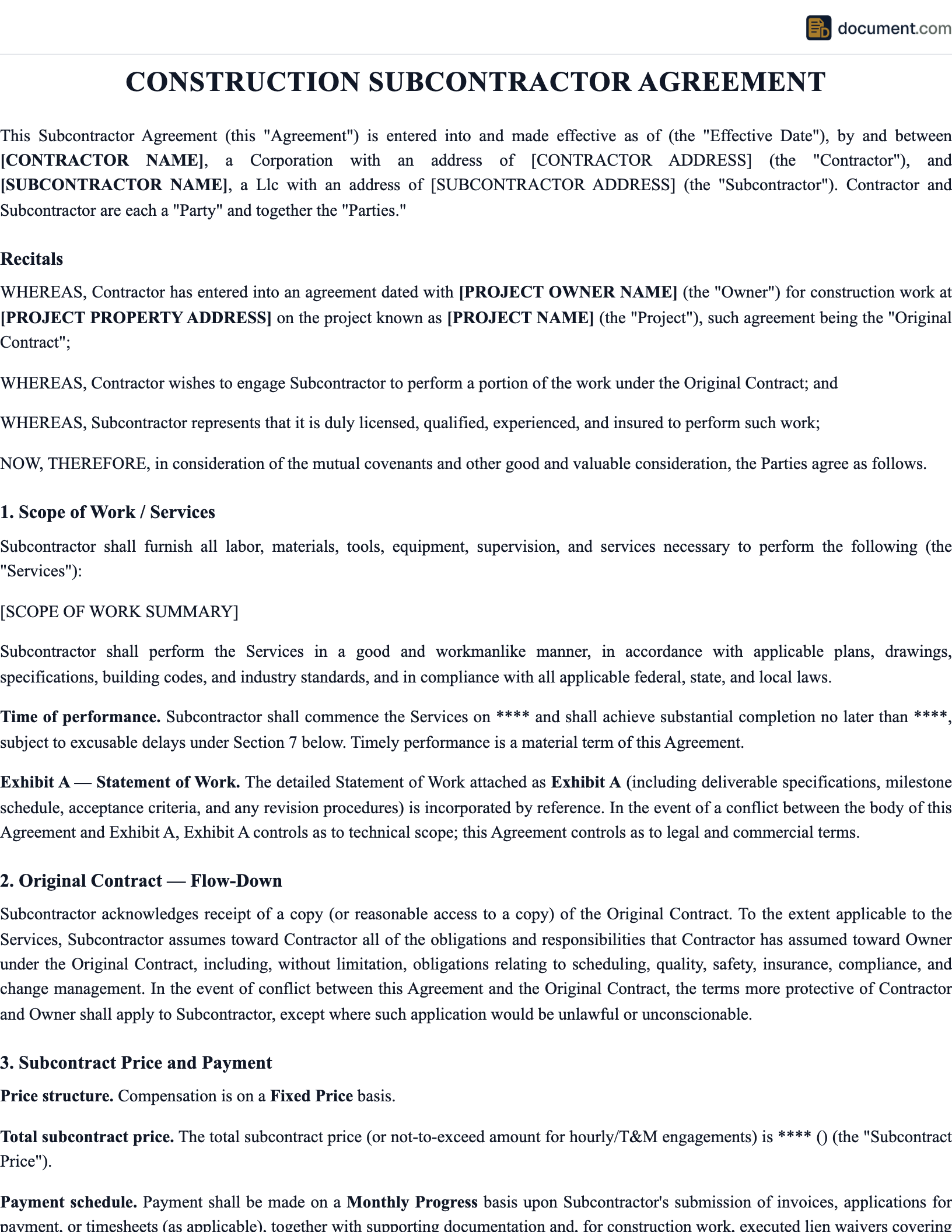



What Is a Construction Subcontractor Agreement?
A construction subcontractor agreement is the contract between a general (prime) contractor and a trade contractor performing a portion of the general contractor's scope — framing, electrical, mechanical, plumbing, drywall, finishes, sitework. It is the workhorse document of commercial construction, and its terms control $1+ trillion of U.S. construction spending every year. The most common form is AIA A401-2017, which flows down the AIA A201 General Conditions of the prime contract; other widely used forms are ConsensusDocs 750 and owner-drafted custom forms.
The subcontract allocates risk through six main provisions: scope of work, price and payment terms, insurance and indemnity, lien waivers, flow-down of prime contract obligations, and termination rights. Each has deep legal substance — indemnity clauses are limited by state anti-indemnity statutes, pay-if-paid clauses are refused by some states, statutory lien-waiver forms must be used verbatim in California/Texas/Florida, and federal flow-down clauses are mandatory on FAR-governed contracts.
Use this template for any trade or specialty contractor on a commercial, residential, or public construction project. The document covers scope, schedule, progress billing, AIA A401 flow-down, state-specific lien waivers, CGL and additional-insured endorsements, builder's risk cooperation, OCIP/CCIP wrap-up enrollment, change-order procedure, and termination for default and convenience.
When to Use a Construction Subcontractor Agreement
Use this agreement any time a general contractor hires a trade contractor to perform a portion of the prime scope — structural, architectural, mechanical, electrical, plumbing, civil, sitework, finishes, or specialty. The subcontract should always be paired with the prime contract (attached or referenced), plans and specs, and a written schedule. Do not use this template on federal work without adding the FAR 52.244-6 and other mandatory flow-down clauses for federal subcontracts.
For specialized trades this hub offers tuned variants (concrete, roofing, plumbing, painting, solar, HVAC, electrical, drywall). Use the specialized variant when available for trade-specific code compliance language.
Key Provisions
Every construction subcontract should address these at minimum.
Scope of work
Plans, specs, and exhibit; exclusions; deliverables; submittals.
Progress billing
AIA G702/G703 schedule of values; 5-10% retainage; pay-when-paid timing.
Insurance
CGL $1M/$2M; workers' comp; additional insured CG 20 10/20 37; umbrella.
Lien waivers
Conditional progress; final unconditional; statutory forms for CA/TX/FL.
Indemnification
Comparative fault (anti-indemnity statutes); waiver of subrogation.
Flow-down
AIA A201 general conditions flow down; FAR 52.244-6 on federal work.
Change orders
Written authorization; lump sum/unit price/T&M with markup; 30-day claim deadline.
Termination
Default with notice and 72-hour cure; convenience with payment for work in place.
Legal Considerations
Pay-if-paid enforceability varies sharply by state. California (Wm. R. Clarke Corp. v. Safeco Insurance, 15 Cal. 4th 882), New York (West-Fair Electric Contractors v. Aetna, 87 N.Y.2d 148), and North Carolina (N.C. Gen. Stat. § 22C-2) have refused to enforce pay-if-paid on public-policy grounds or construed ambiguous language as pay-when-paid timing provisions. Other states enforce it if the language is explicit. Drafters should use clear condition-precedent language ("owner payment is a condition precedent to prime's obligation to pay sub") and understand that enforceability still varies.
Anti-indemnity statutes restrict risk transfer. California Civil Code § 2782 voids Type I indemnities (sub indemnifies prime for prime's sole negligence) in most construction contracts. Texas Business & Commerce Code § 151 limits construction indemnities to the sub's own negligence. Nearly 40 states have similar statutes. Drafters should use comparative-fault or "to the extent caused by" indemnity language and pair indemnity with additional-insured endorsements on the sub's CGL policy.
Lien waivers in California (Civil Code §§ 8132-8138), Texas (Property Code Chapter 53), and Florida (Statutes § 713.20) must use statutory forms verbatim or they are void. Preliminary 20-day notices under California Civil Code § 8204 preserve lien rights and must be served within 20 days of first furnishing labor or materials. Missing a preliminary notice forfeits the sub's lien rights.
Construction-Specific Issues
OCIP/CCIP wrap-up enrollment changes the insurance landscape on large projects. When a project is wrap-enrolled, the sub's bid should reflect the insurance credit, the sub's own CGL and WC policies apply only to off-site operations and post-completion, and the sub must comply with the wrap-up manual (safety, audits, enrollment documents). Failure to enroll properly can void coverage.
Change-order discipline is the single highest-impact cost control. Verbal authorizations, directed changes without written pricing, and T&M work without documented labor and materials are the root cause of most construction disputes. The subcontract should require written authorization, specify pricing method (lump sum, unit price, T&M with 15-20% markup), require daily reports with labor and materials backup on T&M work, and impose a 30-day claim-filing deadline.
Substantial completion triggers multiple important events: start of warranty period, retainage release eligibility, end of builder's risk coverage, start of statute of repose period for construction defects. The subcontract should require the sub to submit a final application for payment, provide O&M manuals and warranties, complete the punch list within 30-60 days, and execute final unconditional lien waivers. Retainage release should be conditioned on punch-list completion and lien-waiver delivery.
How to Fill Out the Agreement
Fields map to the wizard questions in our document builder.
Identify parties and project
Prime and sub legal entities; project name, number, address; owner name; prime contract date.
Attach prime contract and plans
AIA A201 general conditions, specs, schedule, plans; list flow-down clauses.
Scope and schedule of values
Trade scope; AIA G703 line items; start date; duration; key milestones.
Progress billing terms
Monthly application for payment; pay-when-paid timing; 5-10% retainage.
Insurance and wrap-up
CGL $1M/$2M; workers' comp; additional insured CG 20 10/20 37; OCIP/CCIP enrollment if applicable.
Lien waiver schedule
Conditional progress waiver each pay; final unconditional at retainage; state statutory forms.
Change-order and claims procedure
Written CO required; pricing method; 30-day claim deadline; T&M with 15-20% markup.
Termination and warranty
72-hour cure; convenience termination with payment in place; one-year warranty; 10-year repose.
Frequently Asked Questions
Common questions about construction subcontracts, AIA forms, and payment.
Create your construction subcontract in under 10 minutes.
Select your state, answer a few questions, and download an AIA A401-ready, lien-waiver-compatible subcontract.