
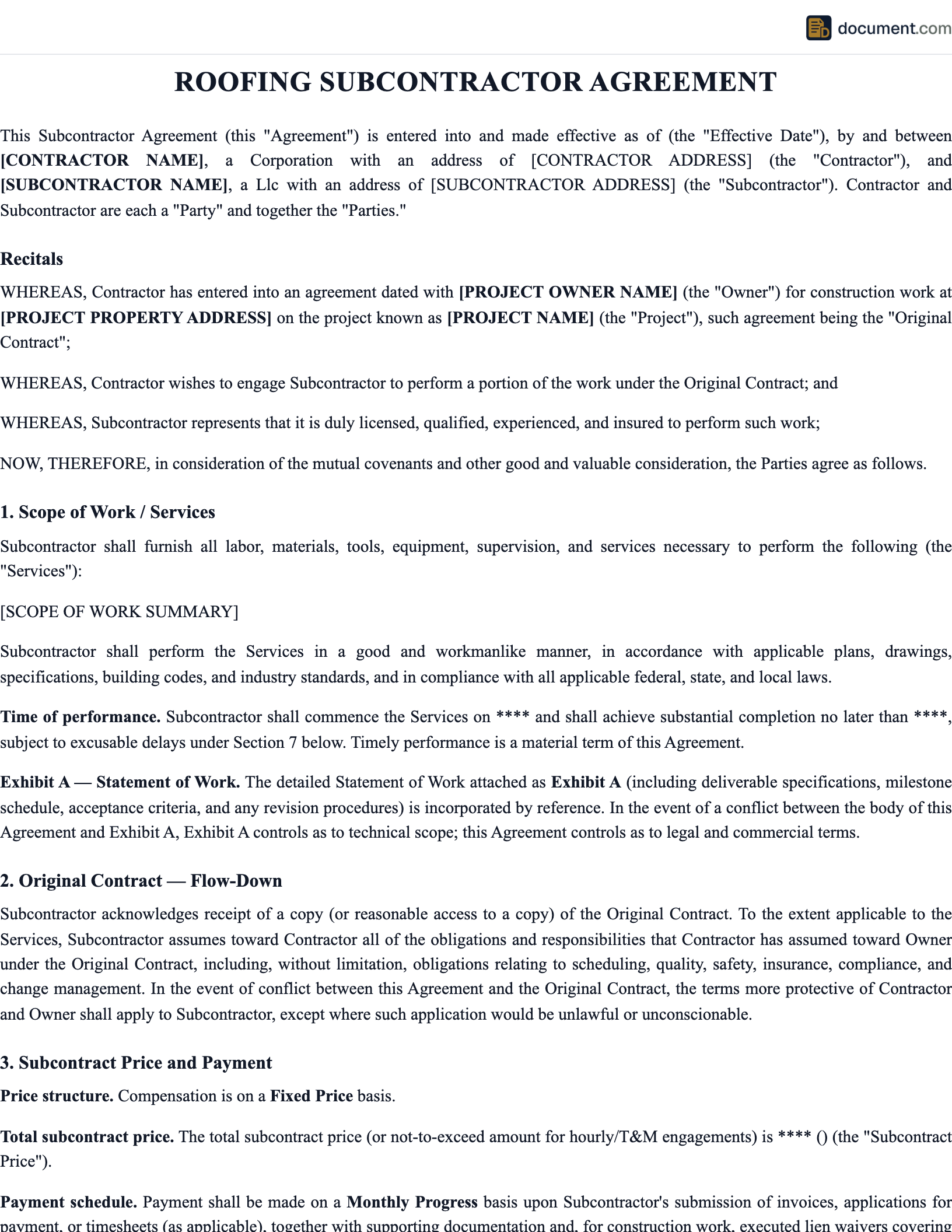



What Is a Roofing Subcontractor Agreement?
A roofing subcontractor agreement governs the relationship between a prime contractor or property manager and a roofing specialty contractor performing residential or commercial roofing installation, tear-off, repair, or replacement. Roofing is one of the highest-risk construction trades — fall fatalities, weather-dependent quality, long-tail leak claims, and specialty manufacturer warranties all drive legal complexity well beyond generic trade subcontracting.
OSHA fall-protection enforcement is aggressive on roofing. 29 CFR § 1926.501(b)(10) requires fall protection at any height above 6 feet, and roofing fatalities from falls drive the highest single-incident insurance claims in construction. Weather sensitivity means the sub must stop work in out-of-spec conditions and protect the deck from water intrusion; failure to do so can cause interior flooding and six-figure insurance claims. Manufacturer warranties (GAF Golden Pledge, CertainTeed SureStart, Carlisle Gold Shield) require specific certifications and installation procedures, and voiding the warranty through improper work exposes the prime to owner claims.
Use this template for residential reroofs, commercial new construction, flat-roof replacement (EPDM/TPO/PVC/modified bitumen), metal roofing, and specialty work (slate, tile, cedar shake). The document covers scope and tear-off, OSHA fall protection, manufacturer certification and warranty pass-through, weather constraints, ice-and-water shield requirements, insurance with water-damage coverage, and long-tail completed-operations protection.
When to Use a Roofing Subcontractor Agreement
Use this agreement when a general contractor or property manager hires a roofing specialty business for any portion of a project: residential reroof, commercial low-slope replacement, new-construction roofing, repair work, or specialty. The subcontract should be paired with the project specifications (roof assembly, underlayment, manufacturer warranty tier), plans showing all penetrations, and a weather-contingent schedule.
Do not use this template for DIY or unlicensed work. Most states require roofing contractors to hold a specialty license above a dollar threshold — California C-39 Roofing Contractor, Florida Certified Roofing Contractor, Texas Roofer registration, Arizona R-039 Roofing. Verify license status before execution.
Key Provisions
Every roofing subcontract should address these at minimum.
Scope & tear-off
Removal specs; deck inspection; disposal; landscape protection; daily cleanup.
Fall protection
OSHA §1926.501; written plan; training records; harnesses on steep-slope.
Manufacturer certification
GAF Master Elite, CertainTeed SELECT, Owens Corning Preferred as required.
Ice-and-water shield
State-specific coverage (eave + 24-48" inside wall; valleys; penetrations).
Insurance
CGL $2M/$4M; umbrella $5M-$10M; water-damage coverage; 10-year completed-ops tail.
Warranty pass-through
Manufacturer warranty in owner name; sub's own 2-year labor warranty.
Weather & protection
Temperature limits; wind limits; daily weather log; deck protection if interrupted.
Change orders
Deck repair unit pricing; written authorization; 15-20% T&M markup.
Legal Considerations
OSHA enforcement on roofing is the most aggressive of any construction trade. Fall protection citations under 29 CFR § 1926.501(b)(10) carry penalties of $15,000-$40,000 per serious violation and up to $156,259 for willful/repeated. Roofing fatalities drive OSHA's emphasis program. The subcontract should require a written fall-protection plan, OSHA 10 training for all field workers, harness and anchor use on steep-slope roofs, and allow the prime's safety manager to observe and stop unsafe work.
Manufacturer warranty compliance affects the owner's long-term roofing protection and the prime's ongoing exposure. Premium warranties (GAF Golden Pledge, CertainTeed SureStart Platinum, Carlisle Gold Shield) require certified installation and manufacturer inspection. Voiding the warranty through improper installation exposes the prime to owner claims. The subcontract should require the sub to be certified, follow installation requirements exactly, and indemnify the prime for any warranty issuance failure caused by the sub.
Long-tail leak claims extend for years post-completion. State statutes of repose for construction defects: California 10 years (CCP § 337.15); Texas 10 years (CPRC § 16.008); Florida 7-10 years (§ 95.11(3)(c)); Illinois 4-10 years sliding. The subcontract should require completed-operations coverage for the full repose period, two-year labor warranty with clear repair response times, and indemnification for defects caused by sub's negligence.
Roofing-Specific Issues
Weather stops roofing work. Asphalt shingles below 45°F do not seal; above 90°F they become soft and scuff. Cold-weather EPDM/TPO has similar temperature limits. Winds above 30 mph create safety and adhesion issues. Rain and snow require immediate work stoppage and deck protection. The subcontract should require the sub to maintain a daily weather log, stop work in out-of-spec conditions, tarp the deck if work is interrupted, and bear the cost of water-intrusion damage from inadequate temporary protection.
Ice-and-water shield is required in cold-climate regions by IRC § R905.1.2 and IBC § 1507.1.1 (where mean January temp is below 25°F). Coverage: eave to at least 24 inches inside the exterior wall line (some states require 36" or 48"); all valleys; penetrations; around skylights and chimneys. Inadequate ice-and-water coverage is a leading cause of warranty claims in winter climates. The subcontract should specify the coverage requirement by state and require the sub to warrant full-width coverage.
Deck repair discovered after tear-off is a frequent change-order source. The subcontract should require daily deck inspection, written condition reports, photographic documentation of all deficiencies, and unit pricing in Exhibit B for common repairs (per-sheet plywood replacement, per-linear-foot fascia repair). Surprise deck conditions on older roofs often require $5,000-$50,000 in repair; setting unit prices avoids field pricing disputes during emergency weather-driven work.
How to Fill Out the Agreement
Fields map to the wizard questions in our document builder.
Identify parties and project
Prime, sub, project address; building type (residential/commercial); pitch; SF of roof area.
Roofing system and warranty tier
Product (shingle model, membrane type); warranty tier; manufacturer certification required.
Scope and tear-off
Tear-off extent; deck inspection; ice-and-water coverage; flashing; penetrations; cleanup.
Fall-protection plan
Written plan; training records; harnesses on steep-slope; safety-monitor approach for low-slope.
Pricing and payment
Lump sum or unit prices per square (100 sq ft); 5-10% retainage; net-30 pay-when-paid.
Insurance minimums
CGL $2M/$4M; umbrella $5M-$10M; 10-year completed ops; waiver of subrogation.
Warranty and call-backs
2-year labor warranty; 48-72 hour response; manufacturer warranty in owner name; registration.
Sign and retain records
Signatures; retain fall-protection training, manufacturer certifications, warranty registration for 10 years.
Frequently Asked Questions
Common questions about roofing subcontracts, fall protection, and manufacturer warranties.
Create your roofing subcontract in under 10 minutes.
Select your state, answer a few questions, and download a fall-protection-ready, manufacturer-warranty-aware roofing subcontract.