
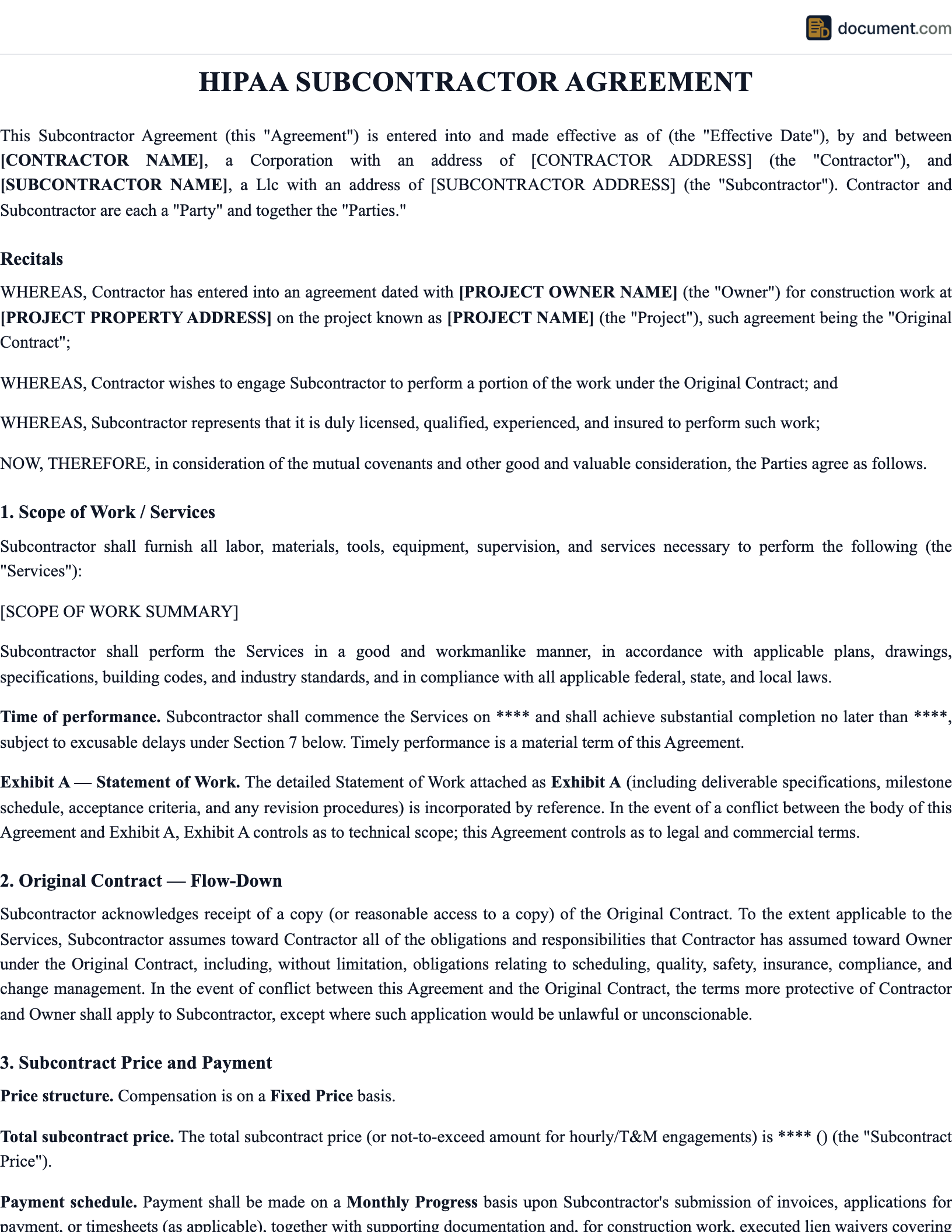



What Is a HIPAA Subcontractor Agreement?
A HIPAA subcontractor agreement — technically a downstream Business Associate Agreement (BAA) — is the contract required by 45 CFR § 164.314(a)(2)(i)(B) between a HIPAA Business Associate and any subcontractor that creates, receives, maintains, or transmits Protected Health Information (PHI) on behalf of the BA. It is the third level in the HIPAA contract chain: Covered Entity → Business Associate → Subcontractor (sub-BA) → (further subs if applicable).
The HITECH Act of 2009 and the HIPAA Omnibus Rule of 2013 made Business Associates and their subcontractors directly liable to the Department of Health and Human Services Office for Civil Rights (OCR) for HIPAA violations. Before HITECH, BAs had only contractual obligations to Covered Entities; now a sub-BA can be audited, investigated, and fined regardless of whether the upstream Covered Entity is involved. OCR has imposed multi-million-dollar settlements on small sub-BAs, including cloud storage vendors, transcription services, and IT MSPs.
Use this template when a Business Associate (BA) engages a subcontractor to perform a function involving PHI — a medical billing company hiring a coding contractor, a SaaS EHR vendor using AWS/Azure as infrastructure, an IT MSP hiring a break-fix technician with server access, a transcription service using overseas transcribers, or a shredding company contracting out destruction. The document incorporates all provisions required by 45 CFR §§ 164.504(e) and 164.314, the Security Rule safeguards under §§ 164.308-164.312, and breach notification obligations under §§ 164.400-164.414.
When to Use a HIPAA Subcontractor Agreement
Use this agreement whenever a Business Associate engages a subcontractor that will handle PHI — defined as creating, receiving, maintaining, or transmitting PHI on behalf of the BA. Common scenarios: cloud hosting of an EHR or billing system; offshore or domestic transcription services; coding and chart review contractors; shredding and destruction services; IT managed services with server or workstation access; analytics and reporting firms working with claims data; and secure messaging or telehealth platform vendors.
The narrow HHS conduit exception excludes pure transport providers (ISPs, USPS, courier services) that have only incidental access to PHI and do not store it. Cloud and SaaS vendors do not qualify for the conduit exception because they store PHI. When in doubt, execute the BAA — OCR is unforgiving of BAs that guess wrong and later find themselves with an unpapered sub-BA relationship.
Key Provisions
Every HIPAA sub-BAA must contain these provisions under 45 CFR §§ 164.504(e) and 164.314.
Permitted uses
Identify PHI categories and purposes for which sub-BA may use and disclose PHI.
Security Rule safeguards
Administrative, physical, and technical safeguards under §§ 164.308-164.312.
Breach notification
Report to upstream BA within 5-10 business days; 60-day outer limit under Rule.
Subcontractor flow-down
Sub-BA must obtain substantively equivalent BAAs with its own subs under § 164.308(b)(2).
Individual rights
Access, amendment, accounting of disclosures, and restriction requests.
Books and records
Make internal practices and records available to HHS Secretary upon request.
Return or destruction
Return or destroy PHI at termination; continue protection if return/destruction infeasible.
Termination for breach
Terminate BAA for material breach of HIPAA terms; report to upstream BA.
Legal Considerations
Direct OCR liability is the headline legal consideration. Since the Omnibus Rule of 2013, Business Associates and sub-BAs are directly liable for civil monetary penalties under HITECH — they can be audited, investigated, and penalized regardless of whether the upstream Covered Entity is involved. Penalties are tiered from $137 per violation to $2 million per identical provision per year (2024 amounts), and criminal penalties under 42 USC § 1320d-6 include up to 10 years of federal prison for the sale of PHI.
The Security Rule Risk Analysis at 45 CFR § 164.308(a)(1)(ii)(A) is the most frequently cited compliance failure in OCR enforcement actions. Sub-BAs must conduct and document an annual written risk analysis covering all systems that create, receive, maintain, or transmit PHI. Generic template risk analyses, unsigned and undated, or analyses more than 12 months old are red flags that OCR uses to establish willful neglect and drive penalties into Tier 4.
State privacy laws layer on top of HIPAA. California's Confidentiality of Medical Information Act (CMIA) imposes stricter notification and penalty rules than HIPAA. Texas HB 300 requires Texas-specific training for workforce members handling PHI. New York's SHIELD Act applies to any business that holds residents' data. Where state law is more protective than HIPAA (which HIPAA expressly permits), the sub-BA must comply with both. The BAA should require compliance with "HIPAA and applicable state privacy law."
HIPAA-Specific Issues
The subcontractor chain extends indefinitely. 45 CFR § 164.308(b)(2) requires the sub-BA to flow down equivalent BAA terms to its own subs. A cloud EHR vendor (BA) that uses AWS for hosting must have a BAA with AWS (sub-BA), and AWS must flow down safeguards to any of its own subcontractors. The chain continues until the PHI is returned, destroyed, or used solely by the downstream sub. Each tier must maintain BAAs with the next tier down; missing a BAA anywhere in the chain creates HIPAA exposure for every upstream party.
Breach notification timing is tight. The subcontractor must notify the upstream BA of any breach within 5-10 business days (industry best practice; the 60-day outer limit in the rule is too late because it leaves the upstream BA and Covered Entity unable to meet their own 60-day obligations). The BAA should require the sub-BA to provide all details needed for notification: affected individuals, PHI categories, date of breach, date of discovery, remediation, and a low-probability-of-compromise analysis if the sub-BA is rebutting the presumption of breach.
Cloud/SaaS configuration errors are the most common source of sub-BA breaches. OCR has penalized Business Associates and sub-BAs for misconfigured AWS S3 buckets left public, MongoDB instances without authentication, and Elasticsearch clusters exposed to the internet. The BAA should require the sub-BA to encrypt PHI in transit (TLS 1.2+) and at rest (AES-256), implement access control per the Security Rule, conduct quarterly vulnerability scanning, and provide SOC 2 Type II reports or HITRUST certifications on request.
How to Fill Out the Agreement
Fields map to the wizard questions in our document builder.
Identify the parties
Upstream BA (hiring party) and downstream sub-BA; legal entity names; primary HIPAA compliance contacts.
Describe the PHI and purpose
Categories of PHI (names, DOB, DX codes, claims, images); permitted uses; prohibited uses.
Specify Security Rule safeguards
Administrative, physical, technical safeguards; annual risk analysis; designated Security Officer.
Set breach notification timing
5-10 business days to upstream BA; include required information for 60-day cascade.
Require subcontractor flow-down
Sub-BA must have BAAs with its own subs; equivalent terms; records available for inspection.
Address individual rights
Access, amendment, accounting of disclosures, restriction requests; response timelines.
Set return/destruction
At termination, return or destroy all PHI including backups; certify destruction in writing.
Sign and retain for 6 years
Signatures; retain BAA and related documentation for 6 years per § 164.316.
Frequently Asked Questions
Common questions about HIPAA subcontractor agreements, HITECH, and breach notification.
Create your HIPAA sub-BAA in under 10 minutes.
Answer a few questions and download a HITECH-compliant, breach-notification-ready HIPAA subcontractor BAA.