
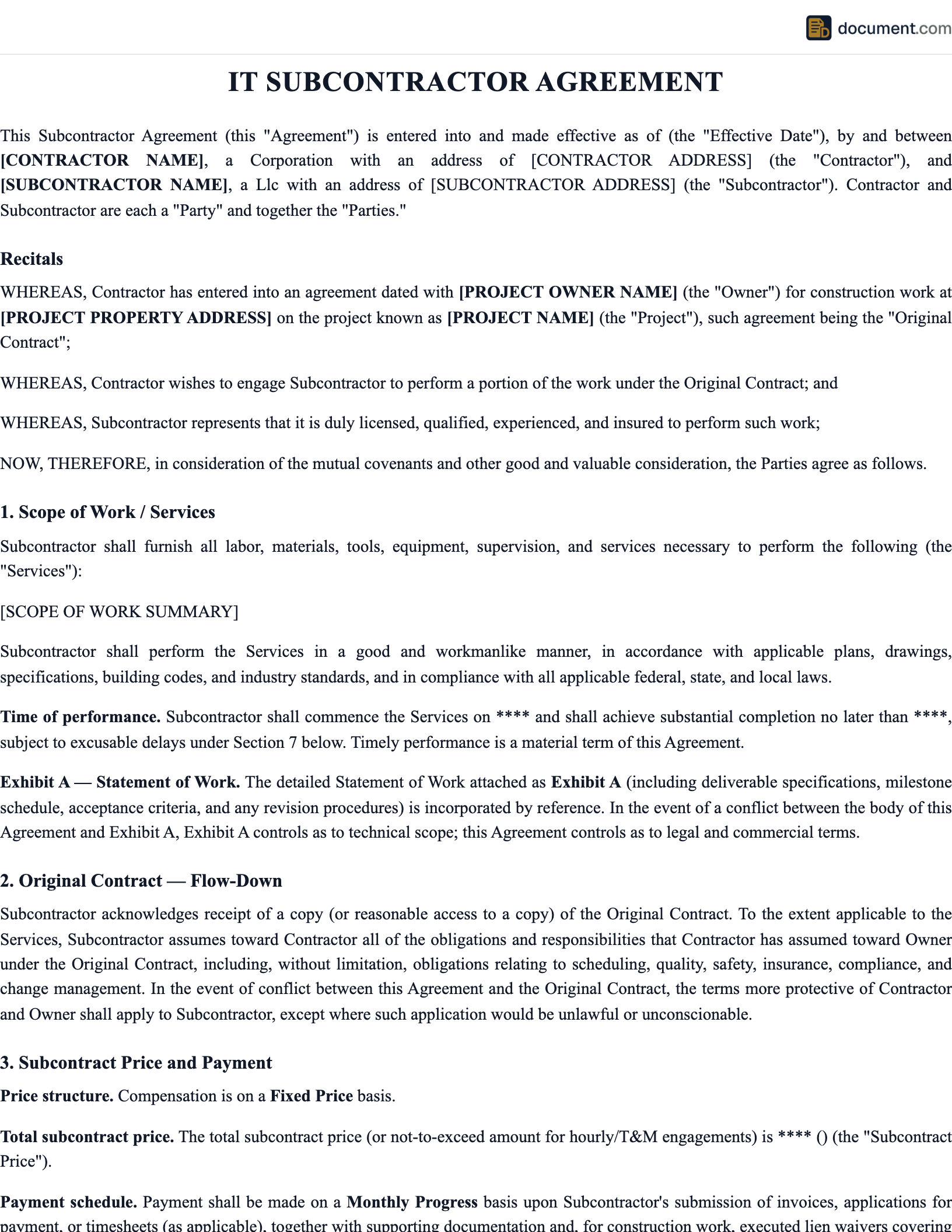



What Is an IT Subcontractor Agreement?
An IT subcontractor agreement is the contract between a prime IT services provider, consulting firm, or SaaS platform and a subcontractor who performs a portion of the prime's technical scope — infrastructure management, software development, data processing, help-desk operations, cybersecurity assessments, or cloud hosting. Unlike a generic subcontract, IT subcontracts must address data security, IP ownership, SLA metrics, cyber-liability insurance, and increasingly strict data-protection laws.
The core risk in IT subcontracting is data exposure. When the sub has access to prime or end-client data — customer records, source code, financial data, PHI, payment-card information — a breach by the sub creates direct liability for the prime under customer contracts, regulatory regimes (GDPR, CCPA, HIPAA, PCI-DSS), and common-law privacy torts. Modern IT subcontracts therefore require SOC 2 Type II, cyber-liability insurance, breach notification within 24-72 hours, and detailed data-processing addenda.
Use this template for managed IT services, staff augmentation, cloud infrastructure, data-processing, help-desk, cybersecurity consulting, and technology integration subcontracts. The document covers scope and SLAs, IP assignment and work-for-hire, SOC 2 / HITRUST / ISO 27001 attestations, CCPA/GDPR Article 28 data-processor terms, cyber-liability insurance minimums, source code escrow, and open-source license compliance.
When to Use an IT Subcontractor Agreement
Use this agreement when a prime IT services firm hires another IT business to perform part of the prime's scope: a managed service provider hires a 24/7 NOC sub; a cybersecurity firm hires a penetration tester; a SaaS platform hires AWS/Azure as infrastructure (often paired with a HIPAA BAA); a consulting firm hires freelance engineers through a staffing vendor; a cloud integrator hires a specialty migration partner. The subcontract defines scope, SLAs, data security, IP ownership, and cyber-liability allocation.
For individual IT freelancers under direct engagement (not via a staffing vendor), use the independent-contractor agreement. For an IT employee, use the employment contract. Classification risk is highest in staff-augmentation relationships where the sub's individual workers are embedded with prime's team — those require careful worker-classification documentation and ideally payment by deliverable rather than hours.
Key Provisions
Every IT subcontract should address these at minimum.
Scope & SLA
Services catalog; 99.9% uptime; response/resolution times; service credits.
Data security & SOC 2
SOC 2 Type II report annually; encryption TLS 1.2+ / AES-256; access controls.
IP assignment
Work-for-hire + present assignment under 17 USC §101; pre-existing IP license back.
Cyber-liability insurance
First- and third-party cyber $1M-$5M; tech E&O $1M-$5M; 3-year tail.
Breach notification
24-72 hours to prime; required details for GDPR/CCPA/HIPAA cascade.
Source code escrow
Iron Mountain or NCC; quarterly deposits; release triggers (bankruptcy, breach, EOL).
Open-source compliance
SBOM required; no GPL/AGPL without approval; infringement indemnity.
Limitation of liability
1-2x fees cap; carve-outs for confidentiality, IP, data breach, gross negligence.
Legal Considerations
IP ownership is the highest-dollar IT-subcontract issue. Under 17 USC § 101, work by an independent contractor is NOT a work made for hire unless it fits one of nine specific categories AND is agreed in writing. Most software development and consulting work does not fit the categories, so work-for-hire language alone is insufficient. The subcontract must include a present assignment of all IP rights — copyrights, patents, trade secrets, trademarks, moral rights — to the prime, plus a further-assurances clause requiring the sub to execute documents needed to perfect the assignment.
Data-protection laws impose direct processor obligations. GDPR Article 28 requires specific data-processor contract provisions; California's CCPA/CPRA (effective 2023) imposes similar service-provider obligations; HIPAA requires a BAA for PHI handling. The subcontract should incorporate a Data Processing Addendum (DPA) for EU data transfers with Standard Contractual Clauses, and a separate BAA for PHI. Without a compliant DPA, transferring EU personal data to a US IT sub violates Chapter V of GDPR and exposes both parties to fines up to 4% of global revenue.
Worker classification is acute in IT staff augmentation. The IRS common-law control test, the DOL 2024 economic reality test, and California's AB 5 (with its narrow B2B exception in Labor Code § 2775) all apply. A staff-aug sub whose individual workers are embedded with prime's team, use prime's tools, take prime's direction, and have no other clients is at high risk of reclassification. Mitigation requires strict contract language, B2B billing, sub-carried insurance, and outcome-based payment rather than hourly billing where possible.
IT-Specific Issues
SLA definition drives customer satisfaction and risk allocation. 99.9% uptime (three nines) allows 43.2 minutes of downtime per month — adequate for most business SaaS but insufficient for mission-critical systems. 99.95% is the premium tier, 99.99% is enterprise/financial, 99.999% is telco/payment. Service credits (typically 5% of monthly fee per 0.1% below target, capped at 30-50%) are a cap on liability, not a sole remedy — the subcontract should preserve termination rights for chronic SLA failure.
Source code escrow protects the prime against the sub's insolvency or failure to support. Quarterly deposits with Iron Mountain, NCC Group, or EscrowTech, with a verification release tested by the escrow agent, cost $2,000-$10,000/year and are essential when the sub provides mission-critical software. Release triggers typically include the sub's bankruptcy, material breach of the service agreement, discontinuation of the product, or failure to support.
Open-source license compliance is an emerging liability area. Using AGPL or GPL code in a proprietary deliverable can force relicensing of the entire work under GPL — a catastrophic outcome for commercial software. The subcontract should require an SBOM (Software Bill of Materials) in SPDX or CycloneDX format, prohibit copyleft OSS without prior approval, and require the sub to indemnify the prime for any third-party OSS claim.
How to Fill Out the Agreement
Fields map to the wizard questions in our document builder.
Identify the parties
Prime and sub legal entities; primary technical and contracting contacts.
Scope of services
Services catalog; deliverables; exclusions; engagement model (staff aug vs. managed).
SLA and service credits
Uptime target; response/resolution times; service-credit formula; termination for chronic failure.
IP assignment
Work-for-hire + present assignment; pre-existing IP schedule; OSS schedule; further assurances.
Data-protection DPA/BAA
Attach GDPR DPA with SCCs; HIPAA BAA if PHI; CCPA service-provider terms.
Security attestations
SOC 2 Type II annual; HITRUST if healthcare; ISO 27001; pen-test reports on request.
Insurance minimums
Cyber-liability $1M-$5M; tech E&O $1M-$5M; CGL $1M/$2M; 3-year tail after termination.
Sign and retain
Signatures; retain for at least the statute of limitations plus applicable tail period for claims.
Frequently Asked Questions
Common questions about IT subcontracts, IP ownership, and data security.
Create your IT subcontract in under 10 minutes.
Answer a few questions and download a SOC 2-ready, IP-assigned, CCPA/GDPR-compliant IT subcontract.