
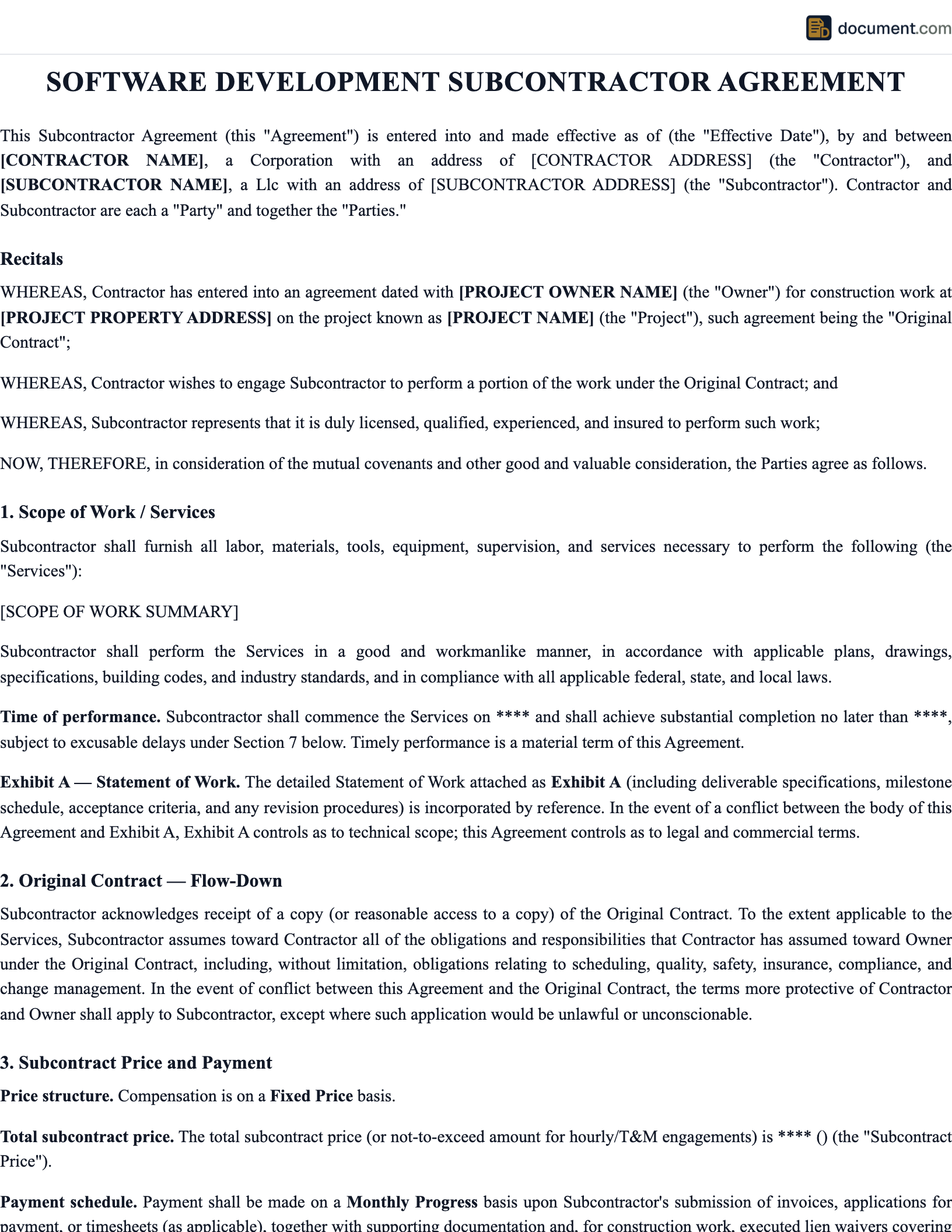



What Is a Software Development Subcontractor Agreement?
A software development subcontractor agreement governs the relationship between a prime software consulting firm, product company, or systems integrator and a subcontracted software development business that performs custom coding, architecture, design, testing, DevOps, or specialty technical work. Unlike a generic IT subcontract, the software development variant focuses on IP ownership, acceptance criteria, source code deliverables, open-source license compliance, and warranty obligations specific to custom software.
IP ownership is the highest-dollar issue. Under 17 USC § 101, work by an independent contractor is not work for hire unless it fits one of nine categories AND is agreed in writing. Software does not fit the categories, so work-for-hire language alone is insufficient — the subcontract must include a present assignment of all IP rights. Open-source license compliance is an emerging liability area: using GPL code in proprietary software can force open-sourcing of the entire work. Source code escrow protects the prime against the sub's insolvency.
Use this template for custom software development, mobile app development, SaaS platform engineering, enterprise application integration, staff-augmentation engineering, and specialty technical work (ML/AI, blockchain, firmware). The document covers WBS, written acceptance criteria, work-for-hire plus present IP assignment, source code escrow, open-source compliance with SBOM, SLA and warranty, Tech E&O insurance, and confidentiality.
When to Use a Software Development Subcontractor Agreement
Use this agreement when a software prime hires another software business to develop code, architect systems, integrate platforms, or augment the prime's engineering team: a SaaS company hires an offshore dev shop; a consulting firm hires a freelance React developer through a staffing vendor; an enterprise integrator hires a specialty ML/AI firm; a product company hires a mobile-app specialist. The subcontract should be paired with a detailed statement of work (or product backlog), acceptance criteria, and milestone schedule.
For individual engineers engaged directly (not through a subcontracting business), use the independent-contractor agreement. For a full-time employed engineer, use the employment contract. For SaaS platform licensing rather than custom development, use a license agreement.
Key Provisions
Every software subcontract should address these at minimum.
Scope & WBS
Statement of work; WBS with milestones; acceptance criteria per milestone.
IP assignment
Work-for-hire + present assignment under 17 USC §101; pre-existing IP license.
OSS compliance
SBOM in SPDX/CycloneDX; no GPL/AGPL without approval; infringement indemnity.
Source code escrow
Iron Mountain/NCC; quarterly deposits; verification release; triggering events.
Insurance
Tech E&O $1M-$5M; cyber $1M-$5M; IP infringement; 3-year tail.
SLA & warranty
99.9% uptime; 90-day acceptance; 12-month warranty; sev-based response times.
Confidentiality
NDA; DTSA immunity; 2-5 year term; perpetual for trade secrets.
Termination & handoff
Convenience 30-60 days; source code transfer; knowledge handoff; repo ownership.
Legal Considerations
IP ownership vesting is the paramount legal issue. 17 USC § 101's work-for-hire doctrine does not apply to custom software because software is not one of the nine enumerated categories. Without an explicit assignment, the sub retains the copyright and the prime has only an implied license. The subcontract must include a present assignment of all IP rights including copyrights, patents, trade secrets, and moral rights, worldwide — plus a further-assurances clause.
Open-source license compliance is a growing enforcement area. The Software Freedom Conservancy and individual OSS copyright holders have filed and won claims against commercial users who failed to comply with GPL. Using GPL or AGPL code in proprietary software requires open-sourcing the combined work. The subcontract should require a Software Bill of Materials (SBOM) and prohibit copyleft licenses without approval.
Worker classification is acute in staff-augmentation software subcontracts. California AB 5 (Labor Code § 2775) presumes employment; the B2B exception requires twelve strict conditions. A software consulting firm subcontracting out software development may fail factor B. The subcontract should document the sub's independent business status, require business-entity formation, and require the sub to carry its own insurance.
Software-Specific Issues
Scope control is the leading cause of software subcontract disputes. The subcontract should require a WBS as an early deliverable, written acceptance criteria for each milestone, a clear change-order process for out-of-scope features, and milestone-based payment tied to acceptance. Vague scope language and verbal scope changes are the root cause of most software overruns.
Source code escrow protects against sub insolvency or failure to support. Quarterly deposits with Iron Mountain, NCC Group, or EscrowTech cost $2,000-$10,000/year and are essential when the sub provides mission-critical software. Release triggers: sub's bankruptcy, material breach, discontinuation of product, failure to support.
Termination handoff must preserve prime's continuity. The subcontract should require immediate transfer of source code repositories (GitHub/GitLab ownership transfer), credentials, and infrastructure keys; knowledge-transfer documentation; transition assistance at sub's rate; and final invoice within 30 days. Poorly-handled terminations leave the prime unable to support the deliverable.
How to Fill Out the Agreement
Fields map to the wizard questions in our document builder.
Identify the parties
Prime and sub; engagement model (fixed price, T&M, staff aug); primary technical contacts.
Scope and WBS
Statement of work; WBS with milestones; user stories; acceptance criteria per milestone.
IP assignment structure
Work-for-hire + present assignment; pre-existing IP schedule; OSS schedule; further assurances.
Pricing and milestone payments
Fixed price per milestone, T&M rates, or hybrid; milestone-triggered payment on acceptance.
SLA and warranty
Uptime SLA if running software; 90-day acceptance; 12-month warranty; severity-based response.
Source code escrow and handoff
Iron Mountain/NCC escrow with release triggers; repo ownership; transition assistance.
Insurance minimums
Tech E&O $1M-$5M; cyber $1M-$5M; CGL $1M/$2M; 3-year tail after termination.
Sign and retain records
Signatures; retain WBS, acceptance records, OSS SBOM, and escrow records for full warranty + tail period.
Frequently Asked Questions
Common questions about software subcontracts, IP ownership, and open-source compliance.
Create your software subcontract in under 10 minutes.
Answer a few questions and download an IP-assigned, OSS-compliant, escrow-ready software subcontract.