
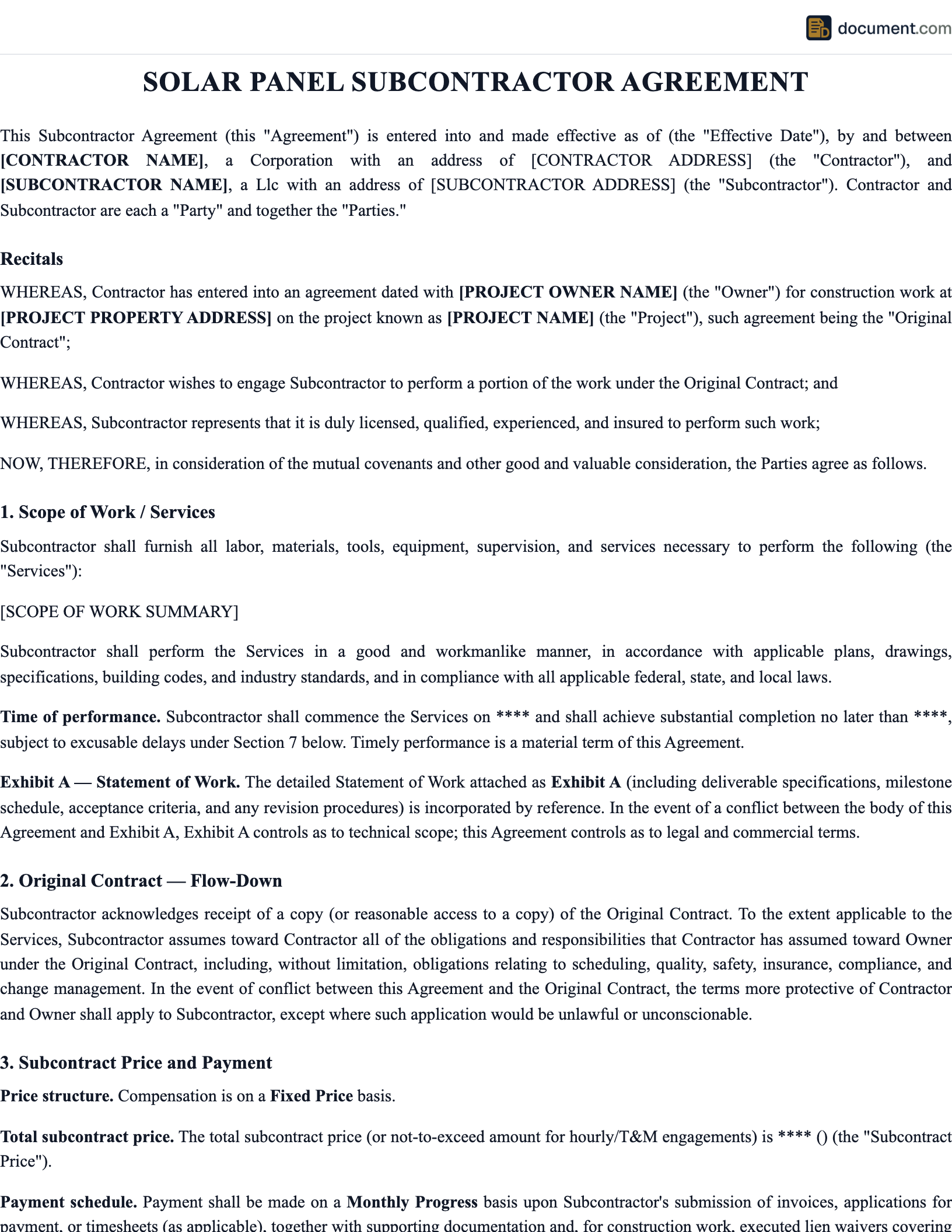



What Is a Solar Panel Subcontractor Agreement?
A solar panel subcontractor agreement governs the relationship between a prime solar contractor and a specialty solar installer, electrical sub, roofing sub, or structural sub performing a portion of a photovoltaic (PV) installation. Solar is a rapidly growing, heavily regulated industry that sits at the intersection of construction, electrical, roofing, and utility law.
The subcontract must address five regulatory domains at once: utility interconnection (FERC Order 2003-A and state utility tariffs); electrical code (NEC Article 690); product safety (UL 1703 panel listing, UL 1741 inverter listing); rooftop work safety (OSHA § 1926.501 fall protection); and state incentive programs (SRECs, state tax credits, rebate programs). Federal tax credits (IRC § 25D residential, § 48 commercial) and SRECs belong to the system owner, not the contractor, and the subcontract should reflect that.
Use this template for residential rooftop PV, commercial rooftop PV, ground-mount PV, battery storage additions, EV charger installations paired with solar, and repowering or re-certification of existing systems. The document covers scope, utility interconnection, NABCEP certification, NEC 690 compliance, UL-listed equipment, rooftop fall protection, commissioning and testing, manufacturer warranty pass-through, SREC and tax-credit attribution, and lien waivers.
When to Use a Solar Panel Subcontractor Agreement
Use this agreement when a solar prime hires a specialty subcontractor: a residential solar company hires a subcontracted installation crew; a commercial solar EPC hires a structural sub for roof attachment; a community solar developer hires a utility-interconnection specialist; a roofing company hires a solar sub for integrated roof-plus-solar work. The subcontract should be paired with the project engineering package (site plan, electrical single-line, structural calcs), the NEC edition in effect in the project jurisdiction, and the utility interconnection application.
Do not use this template for solar product sales without installation (use a purchase order or supply agreement), or for solar leases and PPAs (use a lease/PPA template with different commercial terms). For utility-scale solar over 1 MW, this template can serve as a starting point but should be augmented with FERC LGIA provisions and project-finance terms.
Key Provisions
Every solar subcontract should address these at minimum.
Scope & engineering
System size; panel/inverter/battery specs; engineering package; as-built drawings.
NEC 690 compliance
Article 690 provisions; rapid shutdown; disconnects; grounding; commissioning testing.
UL & NABCEP
UL 1703/61730 listing; UL 1741 inverter; NABCEP PVIP certification for installers.
Utility interconnection
Application submitted by sub; compliance with IEEE 1547; permission-to-operate before energize.
Rooftop fall protection
OSHA §1926.501; written plan; harness + anchor; anchor points rated 5,000 lb.
SREC & tax attribution
SRECs, ITC, net metering to system owner; sub delivers info; sub warrants ownership docs.
Insurance
CGL $2M/$4M; umbrella $5M-$10M; completed-ops 10-year tail for latent defects.
Workmanship warranty
5-10 year labor warranty; pass-through 25-year panel and 10-25 year inverter warranties.
Legal Considerations
Electrical licensing is mandatory. Most states require solar installers to hold a state electrical or solar contractor license. California requires a C-46 Solar Contractor or C-10 Electrical license. Florida requires a Certified Solar Contractor. Most other states require an Electrical Contractor license. Nevada requires a C-2 Electrical license with solar endorsement. The subcontract must require current licensure, identify the qualifying agent, and indemnify the prime for any licensing violations. Unlicensed solar work in California cannot be collected on (B&P Code § 7031).
Long-tail performance and defect claims are a unique solar risk. Solar systems are designed for 25-year operation and output. Latent defects (micro-cracks, snail trails, PID effects, inverter failures) often appear 3-10 years post-installation. State statutes of repose for construction defects (California 10 years CCP § 337.15; Texas 10 years CPRC § 16.008) apply. The subcontract should require completed-operations coverage for at least 10 years and pass-through of manufacturer warranties.
Fall protection enforcement is aggressive on rooftop solar. OSHA 29 CFR § 1926.501(b)(10) applies. Fatalities drive OSHA's Regional Emphasis Programs. The subcontract should require written fall-protection plans, OSHA 10/30 training, and allow the prime's safety manager to observe and stop unsafe work.
Solar-Specific Issues
Utility interconnection is often the critical-path item. Utility review timelines of 4-8 weeks (residential) to 12-52 weeks (commercial) drive project schedules. The sub should be responsible for: submitting the application; responding to utility engineering comments; scheduling and passing witness tests; and coordinating permission-to-operate (PTO) before energization. Unauthorized energization can trigger utility disconnection and fines.
NEC 690 rapid shutdown requirements (§ 690.12 in NEC 2017 and later) have significantly changed rooftop PV installation. Each panel requires a power-electronics device (microinverter, DC optimizer, or MLPE) for compliance. The subcontract should specify the NEC edition and require functional testing of rapid shutdown at commissioning.
SREC and tax-credit attribution is a common dispute source. SRECs, the IRC § 25D Residential Clean Energy Credit, and net metering belong to the system owner. The subcontract should explicitly confirm this, require the sub to deliver system information needed to claim credits, and prohibit the sub from claiming ownership of any environmental attribute or tax benefit.
How to Fill Out the Agreement
Fields map to the wizard questions in our document builder.
Identify parties and system
Prime, sub; system size (kW), panels, inverters; residential vs commercial; NEC edition.
Licensing attestations
Electrical/solar contractor license; qualifying agent; NABCEP certifications; journeyman list.
Utility interconnection
Utility name; interconnection tariff; application responsibility; PTO condition of final payment.
Code compliance
NEC 690 provisions; rapid shutdown; UL 1703/61730 panels; UL 1741 inverter.
Rooftop safety plan
OSHA fall-protection plan; anchor points 5,000 lb; training records; daily inspection.
Pricing and payment
Per-watt or lump sum; 5-10% retainage to PTO; pay-when-paid timing.
Insurance and warranty
CGL $2M/$4M; umbrella $5M-$10M; 10-year completed ops; 5-10 year labor warranty.
Sign and retain records
Signatures; retain permits, inspection reports, commissioning records, warranty docs for 10+ years.
Frequently Asked Questions
Common questions about solar subcontracts, NEC 690, and interconnection.
Create your solar subcontract in under 10 minutes.
Select your state, answer a few questions, and download a NEC 690-ready, NABCEP-aware solar subcontract.