
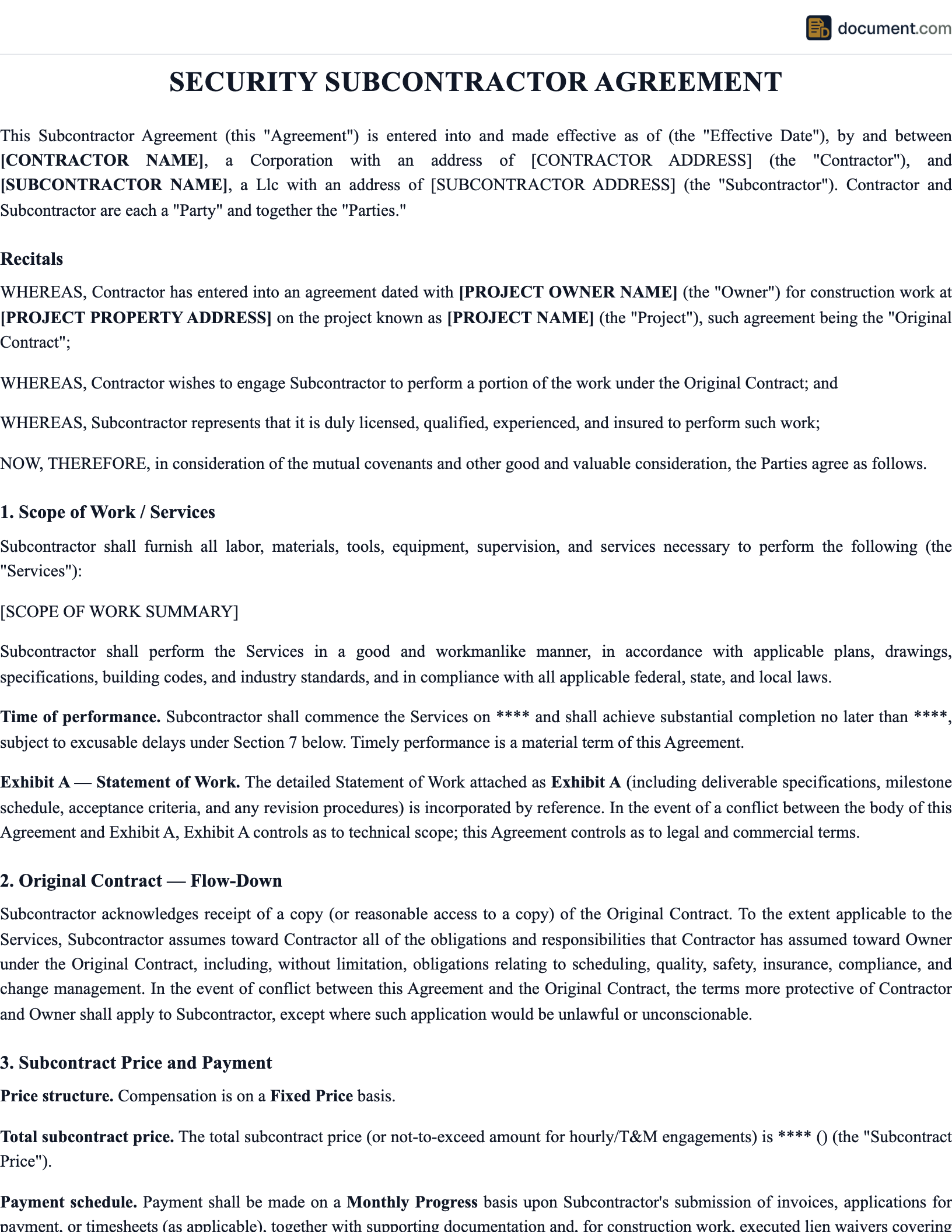



What Is a Security Subcontractor Agreement?
A security subcontractor agreement governs the relationship between a prime security company or property manager and a subcontracted security business that provides armed or unarmed guard services, patrol, access control, event security, or specialty security (executive protection, cash-in-transit, cannabis security). Security is one of the most heavily regulated service industries in the U.S., with licensing at the state (and sometimes city) level, firearms permits for armed work, and detailed compliance requirements.
The legal exposure in security subcontracting is unusually broad. Property owners can be sued on premises-liability theories for inadequate security; the security contractor is typically the first defendant and the prime follows. Armed incidents create respondeat superior and negligent-hiring claims. Wage-and-hour class actions target security companies for missed rest breaks and overtime. The subcontract must address all these exposures through strong licensing, use-of-force, insurance, post-order, and background-check provisions.
Use this template for contract guard services, event security, armed guard, patrol, cannabis-facility security, and specialty security subcontracts. The document covers licensing attestations, firearms permits, written use-of-force policy, E&O insurance, post orders and scope of duties, background-check requirements, wage-and-hour compliance, incident-reporting protocols, and transition procedures.
When to Use a Security Subcontractor Agreement
Use this agreement when a prime security company, property manager, or event organizer hires a security business to provide officers on a contract basis: recurring guard services at a commercial building; event-based security; armed patrol; cannabis-facility compliance security; specialty work (executive protection, cash-in-transit). The subcontract should be paired with site-specific post orders (Exhibit A), written use-of-force policy (Exhibit B), and a schedule of rates.
Do not use this template for individual off-duty law enforcement officers hired directly — those typically require a separate arrangement with the department's off-duty coordinator and have different licensing and qualified-immunity considerations.
Key Provisions
Every security subcontract should address these at minimum.
Scope & post orders
Post orders as Exhibit A; patrol routes; response procedures; prohibited actions.
Licensing attestation
Company PPO/agency license; individual guard cards; firearms permits for armed work.
Use-of-force policy
Written UOF continuum; reasonable-force standard; citizen's-arrest authority; annual training.
Background screening
FBI fingerprint; state criminal history; E-Verify; felon disqualification; re-check every 2 years.
Insurance
E&O $1M; CGL $1M/$2M (armed $2M/$4M); A&B endorsement; firearms liability.
Incident reporting
24-hour written report; immediate notice for serious incidents; 7-year preservation.
Wage and hour
FLSA compliance; state rest/meal breaks; employee classification; EPLI coverage.
Transition
30-90 day notice; return of keys/equipment; no poaching; overlap for high-security sites.
Legal Considerations
State licensing is strictly enforced. California's BSIS suspends and revokes PPO licenses for violations. Operating without a current PPO is a misdemeanor under Business & Professions Code § 7583.45. New York, Florida, Texas, and most states have similar strict statutes. The subcontract must require the sub to attest to current licensure, identify the qualifying agent, and indemnify the prime for any enforcement actions.
Premises liability is the leading source of security litigation. Property owners owe business invitees a duty of reasonable care; when a crime occurs, the victim typically sues the owner and the security contractor. The subcontract should require comprehensive insurance (CGL with assault-and-battery endorsement, E&O, umbrella for high-risk sites), mandatory incident reporting, compliance with site-specific post orders, and indemnification (subject to state anti-indemnity limitations).
Wage-and-hour class actions target security companies frequently. California PAGA claims over missed rest and meal breaks, off-the-clock work, and minimum-wage violations have produced multi-million-dollar settlements. The subcontract should require the sub to comply with all wage-and-hour law, carry EPLI with wage-and-hour sublimits, and indemnify the prime for any wage-claim exposure. Misclassifying guards as independent contractors to avoid overtime is a frequent class-action trigger.
Security-Specific Issues
Armed security requires additional licensing, insurance, and policy. Firearms permits at the state level (California Exposed Firearm Permit, New York armed registration, Florida Class G, Texas Level III), plus written use-of-force policy, assault-and-battery insurance endorsement, firearms-liability coverage, and annual qualification at a range. Misuse of force generates high-dollar claims; the subcontract should require $5M+ umbrella for armed sites.
Post orders are operational documents that win litigation. Detailed post orders (Exhibit A) supporting the sub's actions at the time of incident defeat plaintiff theories of negligent supervision. Vague scope language ("provide security services") loses. The subcontract should require the sub to develop post orders in coordination with the end client, train all officers on site-specific post orders before deployment, update them annually, and produce them on request.
Background checks must meet or exceed state requirements. California requires BSIS Live Scan; Florida requires Level 2 (FBI + FDLE); most states require FBI fingerprint plus state criminal history. The subcontract should require the sub to conduct background checks meeting or exceeding state requirements, verify E-Verify employment authorization, disqualify felons, re-check every 2 years or upon any arrest, and maintain records confidentially.
How to Fill Out the Agreement
Fields map to the wizard questions in our document builder.
Identify parties and services
Prime, sub; armed vs unarmed; number of officers; hours per week; site locations.
Licensing attestations
Company PPO/agency license; qualifying agent; guard cards; firearms permits for armed.
Post orders and scope
Site-specific post orders as Exhibit A; patrol routes; access control; response procedures.
Use-of-force policy
UOF continuum; reasonable-force standard; citizen's arrest; training and annual qualification.
Background check standards
FBI fingerprint; state criminal history; E-Verify; 2-year re-check; felony disqualification.
Pricing and payment
Hourly rates (regular/OT/holiday); invoicing; net-30 payment; CPI escalation for multi-year.
Insurance minimums
E&O $1M; CGL $1M/$2M ($2M/$4M armed); A&B endorsement; firearms liability; EPLI.
Sign and retain records
Signatures; retain background checks, training, incident reports, and payroll for 7 years.
Frequently Asked Questions
Common questions about security subcontracts, use-of-force, and firearms permits.
Create your security subcontract in under 10 minutes.
Select your state, answer a few questions, and download a license-attested, UOF-policy-ready security subcontract.