
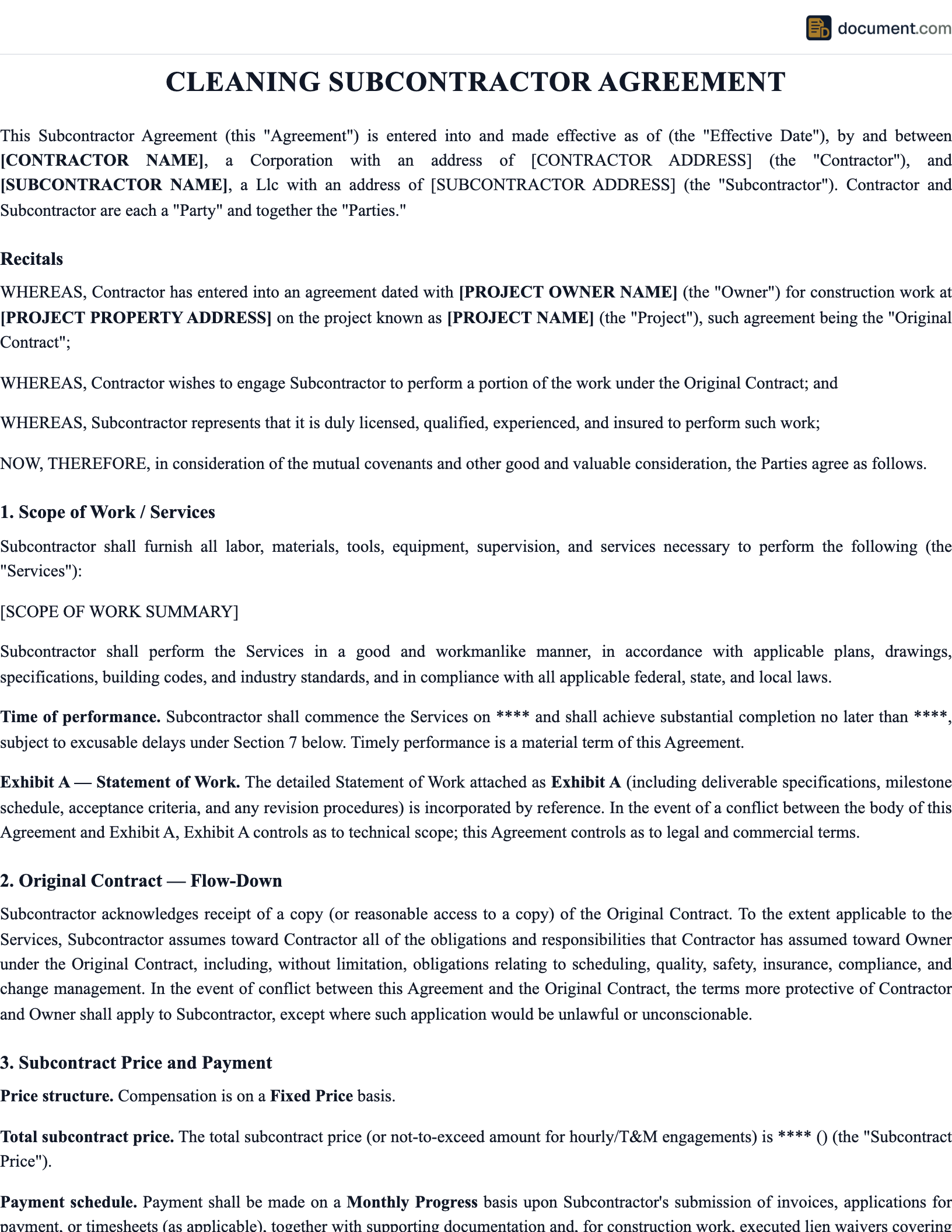



What Is a Cleaning Subcontractor Agreement?
A cleaning subcontractor agreement is a written contract between a primary cleaning company or property management firm (the prime) and an independent cleaning subcontractor (the sub) who performs janitorial, custodial, or specialty cleaning services. The sub operates as an independent business — supplies its own equipment and chemicals, hires and manages its own crew, carries its own insurance and janitorial bond, and controls the methods of cleaning within the quality standards defined in the contract.
Cleaning subcontracting dominates the $90 billion U.S. commercial cleaning industry. Large janitorial primes subcontract specialty services (carpet extraction, window washing, biohazard cleanup). Property managers subcontract all cleaning to avoid payroll overhead. Mid-sized cleaning companies subcontract overflow during peak seasons. In each case the subcontract defines scope, payment, insurance, chemical handling, key control, and worker-classification language. Deep legal exposure exists in four areas: OSHA HazCom compliance, state contractor-licensing (especially post-construction and specialty work), worker classification under AB 5/ABC tests, and commercial security/key liability.
Use this template for commercial janitorial, post-construction cleanup, specialty cleaning (carpet, window, pressure washing), and residential cleaning subcontracts. The document covers scope-of-work exhibits, approved-chemical lists, OSHA 29 CFR § 1910.1200 HazCom language, SDS requirements, janitorial bonds, CGL and additional-insured endorsements, state-specific licensing attestations, IRS 1099 classification, and termination rights.
When to Use a Cleaning Subcontractor Agreement
Use this agreement any time a cleaning prime or property manager hires an independent cleaning business to perform a portion of the prime's scope. Typical scenarios: a janitorial company hires a specialty carpet-cleaning sub; a property manager hires a nightly office-cleaning sub; a post-construction cleanup prime hires a specialty window-washing sub; a healthcare cleaning prime hires a biohazard-remediation sub.
Do not use this agreement for employees. If the sub performs the same work as the prime, is directed in the methods of cleaning, has no other clients, and is paid by hours worked rather than by deliverable, state ABC tests will likely reclassify the relationship as employment and expose the prime to back payroll taxes, workers' compensation premiums, and unpaid overtime claims.
Key Provisions
Every cleaning subcontract should include these provisions at minimum.
Scope of services
Room-by-room cleaning checklist with daily, weekly, monthly, and quarterly task breakdowns as Exhibit A.
Chemical handling (HazCom)
OSHA 29 CFR §1910.1200 HazCom, SDS maintenance, approved chemical list, and green-cleaning compliance.
Payment terms
Flat monthly fee or per-square-foot pricing; net-30 invoicing; CPI escalation for multi-year contracts.
Insurance & bonding
CGL $1M/$2M, workers' comp, janitorial bond $25K-$100K, additional-insured endorsements.
Key & alarm control
Master-key inventory, prohibition on duplication, liquidated damages for loss, alarm-code protocols.
Quality inspection
1-5 scoring system, weekly walk-throughs, cure periods for deficiencies, termination for persistent failure.
Worker classification
Independent-contractor representations, right to use own crew, ABC-test compliance for CA/NJ/MA.
Termination rights
Termination for default with 48-72 hour cure period; termination for convenience with 30-day notice.
Legal Considerations
OSHA compliance is the first legal checkpoint. The Hazard Communication Standard at 29 CFR § 1910.1200 requires the cleaning sub to maintain SDS for every chemical, train staff on GHS hazard classifications, and label all secondary containers. Violations trigger OSHA citations averaging $15,000 per serious violation, and on multi-employer worksites the prime can be cited as the controlling employer under OSHA's multi-employer citation policy even if the prime's own employees were not exposed.
Worker classification is the second legal checkpoint. California's AB 5 (Labor Code § 2775), New Jersey (NJSA 43:21-19(i)(6)(A)), and Massachusetts (M.G.L. c. 149 § 148B) apply a three-factor ABC test that presumes employment. A cleaning prime subcontracting out janitorial work may fail factor B (the work is within the prime's usual course of business). The subcontract should document the sub's independent business status through insurance certificates, business license attestations, client lists showing multi-client operation, and an explicit scope-of-work structure that pays by deliverable.
Licensing is the third checkpoint. Business licenses are required in every state; sales-tax permits are required in states that tax cleaning services (approximately half the states); specialty contractor licenses are required in some jurisdictions for post-construction, residential, or hazmat cleaning. Require the sub to represent and warrant license status and indemnify the prime for damages from unlicensed work.
Cleaning-Specific Issues
Chemical selection is a high-dollar liability issue. Using the wrong cleaner on marble, natural stone, or wood can cause thousands in property damage per incident. The subcontract should require the sub to use only products approved in writing by the prime and the property owner, to test new products in inconspicuous areas before full application, and to carry pollution liability coverage if the sub handles concentrated chemicals, mold remediation, or biohazard cleanup. Green Seal GS-42, USGBC LEED O+M, and ISSA CIMS-GB standards mandate approved chemical lists and training records for green-certified buildings.
Security protocols are critical because cleaning crews work after hours with master keys and alarm codes. The subcontract should specify key inventory control, prohibit duplication, set liquidated damages ($2,500-$10,000) for lost keys, require monthly alarm-code rotation, mandate background checks on all personnel with building access, require sign-in/sign-out logs, and require the sub to carry an adequate janitorial bond to cover theft by personnel.
Scope creep is the leading cause of cleaning subcontract disputes. Vague scope language leads to constant "that's not in scope" arguments. The template attaches a detailed room-by-room exhibit with daily/weekly/monthly/quarterly task allocation, explicit exclusions (server rooms, executive offices, hazmat areas), and a written extra-work authorization process to resolve scope questions in the prime's favor.
How to Fill Out the Agreement
Steps map to the wizard questions in our document builder.
Identify the parties
Legal entity names, EIN, state of formation, business license numbers, and primary contacts.
Describe the building(s) and scope
Address, cleanable square footage, type (office, medical, industrial), frequency (nightly, 3x/week, weekly), and exhibit A checklist.
Set pricing and payment
Flat monthly fee or per-square-foot rate; invoice submission date; net-30 payment; CPI escalation for multi-year.
Specify chemical and equipment requirements
Who supplies chemicals (typically the sub); approved chemical list; SDS maintenance; green-cleaning certification if required.
Set insurance and bonding
CGL minimums; workers' comp; janitorial bond amount; additional-insured endorsements CG 20 10 / CG 20 37.
Define security protocols
Key control, alarm codes, background-check requirements, sign-in/sign-out logs, and damages for lost keys.
Set quality inspection and cure
1-5 scoring; walk-through frequency; cure period for deficiencies (24-48 hours); escalation to termination.
Sign and retain records
Both parties sign; retain for 7 years after termination for tax and licensing audit purposes.
Frequently Asked Questions
Common questions about cleaning subcontracts, OSHA compliance, and worker classification.
Create your cleaning subcontract in under 10 minutes.
Select your state, answer a few questions, and download a HazCom-ready, bond-compatible cleaning subcontract.