
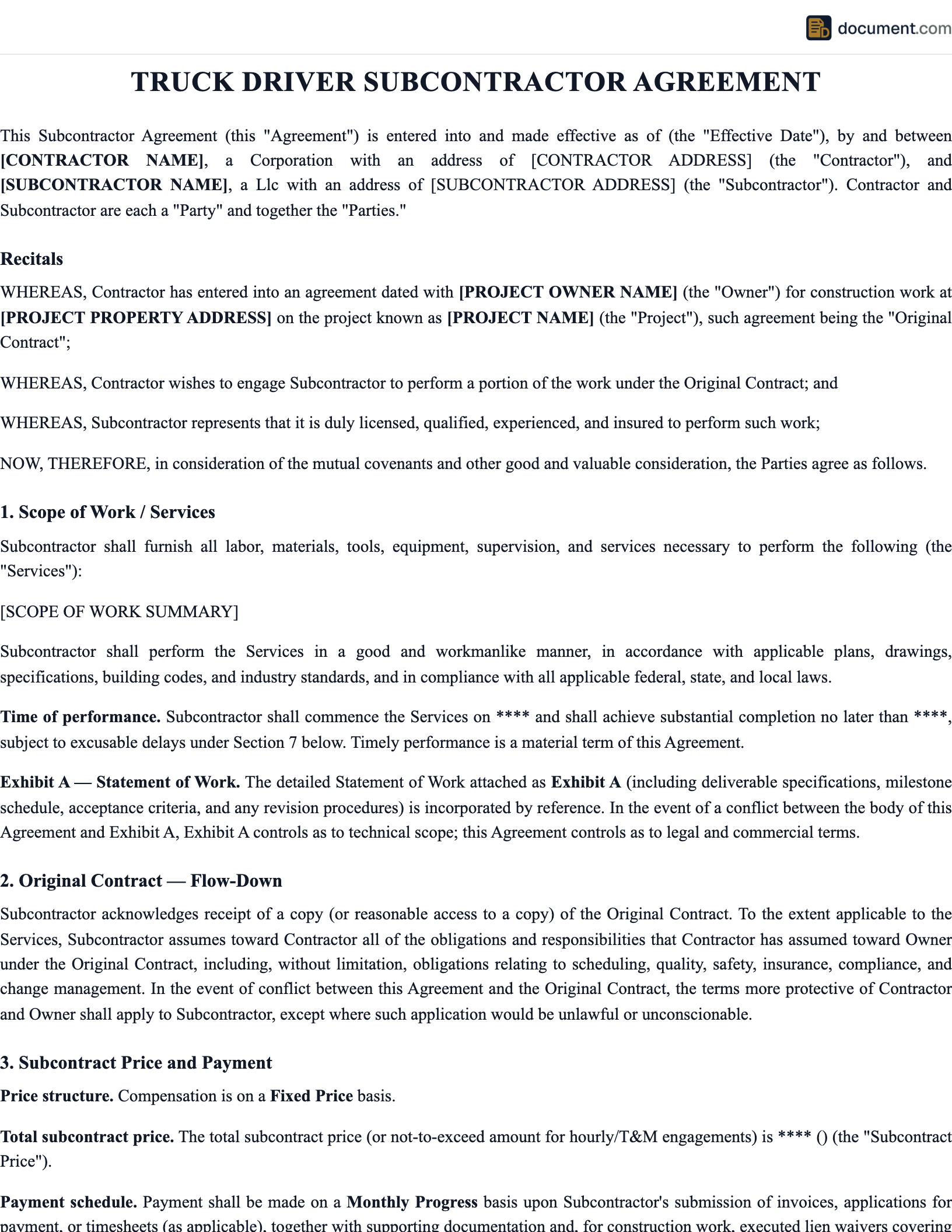



What Is a Truck Driver Subcontractor Agreement?
A truck driver subcontractor agreement — technically an owner-operator lease under FMCSA 49 CFR Part 376 — is the contract between an authorized motor carrier and an independent owner-operator driver who provides the tractor (and sometimes trailer) and drives under the carrier's operating authority. It is the foundation of the owner-operator trucking model that accounts for approximately 350,000 drivers and a significant share of interstate freight.
FMCSA regulation of these arrangements is extensive. 49 CFR § 376.11-376.12 require specific written lease provisions including the "exclusive possession" clause that makes the carrier legally responsible for the vehicle and cargo while leased. Hours of Service (§ 395), driver qualifications (§ 391), drug and alcohol testing (§ 382), and CSA safety scoring all apply. State trucking regulation adds intrastate commerce rules, and IRP/IFTA compliance handles the interstate tax and registration dimension.
Use this template for owner-operator leases, dispatch-only arrangements, and independent-contractor driver agreements. The document covers FMCSA § 376 lease compliance, IFTA fuel tax and IRP registration, Hours of Service and ELD mandates, CSA scoring, cargo and public liability insurance, DOT medical card maintenance, drug and alcohol testing, and chargebacks and settlement.
When to Use a Truck Driver Subcontractor Agreement
Use this agreement when a motor carrier leases on an owner-operator: the driver provides the tractor (and sometimes trailer), the carrier provides operating authority and dispatch. Typical scenarios: a large trucking company leases on owner-operators to expand capacity; a trucking brokerage's captive carrier leases on owner-operators for dedicated lanes; a motor carrier uses this template for subhauler arrangements where one carrier uses another carrier's equipment.
Do not use this template for employee drivers — those require an employment contract with W-2 wages, benefits, and workers' compensation. Do not use it for broker/carrier arrangements where no vehicle leasing occurs — those use a Broker-Carrier Agreement. California, New Jersey, Massachusetts, Illinois, and Oregon have strict worker-classification rules that have effectively prohibited owner-operator arrangements in some states; verify state law before using this template in those jurisdictions.
Key Provisions
Every truck-driver subcontract should address these at minimum.
FMCSA §376 lease
Written lease; exclusive possession; vehicle description; 30+ day minimum; copy in cab.
IRP & IFTA
IRP apportioned plates; IFTA fuel-tax reporting; home state; chargeback mechanics.
HOS & ELD
49 CFR §395; 11-hour drive limit; ELD mandatory; 34-hour restart; no fatigued driving.
Driver qualifications
CDL; DOT medical card; Clearinghouse check; Part 391 qualification file.
Insurance
Public liability $1M+ CSL; cargo $100K+; non-trucking bobtail; occupational accident.
Settlement & chargebacks
Itemized settlement; allowed chargebacks in exhibit; weekly payment; 3-year records.
Drug & alcohol testing
Pre-employment, random (50% annual), post-accident, reasonable suspicion per Part 382.
Termination
30+ day written notice for convenience; immediate for material breach; equipment return.
Legal Considerations
Worker classification is the highest-risk legal issue. California's AB 5 after Vazquez v. Jan-Pro effectively eliminated owner-operator classification in California — the B2B exception requires conditions few owner-operators can satisfy. New Jersey, Massachusetts, Illinois, and Oregon have similarly strict ABC tests. Misclassification settlements in trucking routinely exceed $10,000-$50,000 per driver plus class-action attorneys' fees. Federal FMCSA § 376 compliance supports independent-contractor status but does not override state ABC tests.
FMCSA § 376 lease compliance is regulatorily mandatory. Non-compliant leases can be declared void and expose the carrier to direct FMCSA enforcement. The exclusive possession requirement (§ 376.12(c)(1)) makes the carrier legally responsible for the vehicle while under lease — attempts to disclaim this liability to third parties are void. Every lease must be signed before service begins, have a 30-day minimum term, and be carried in the vehicle.
CSA score exposure affects the carrier's business. The owner-operator's violations appear on the carrier's CSA score, not the driver's. High CSA scores trigger FMCSA interventions, insurance rate increases, and shipper avoidance. The subcontract should require the sub to maintain compliance, cooperate with inspections, and indemnify the carrier for CSA score impacts from the sub's violations.
Trucking-Specific Issues
Hours of Service enforcement is automated. ELDs automatically record driving time and are subject to roadside inspection. Violations trigger fines up to $16,000 per violation for drivers, $17,000 for carriers. The subcontract should require the owner-operator to use a compliant ELD, comply with HOS rules, and indemnify the carrier for HOS violations attributable to the sub's driving decisions.
Settlement disputes are common in owner-operator arrangements. Chargebacks for fuel, IFTA, IRP, tolls, permits, insurance, and advances can consume significant portions of gross revenue. FMCSA § 376.12(h) requires chargebacks to be specified in the lease with backup documentation. The subcontract should list all allowed chargebacks in Exhibit B, require itemized settlement statements, and prohibit chargebacks not in the lease.
Accident response drives respondeat-superior liability. Commercial motor vehicle accidents generate multi-million-dollar wrongful-death and serious-injury claims, and the carrier is typically the primary defendant. The subcontract should require immediate accident reporting (within 2 hours or less), post-accident drug/alcohol testing per § 382.303, preservation of ELD and dashcam data, cooperation with safety and insurance investigation, and indemnification for claims caused by the sub's negligence.
How to Fill Out the Agreement
Fields map to the wizard questions in our document builder.
Identify parties
Carrier (prime) with USDOT/MC number; owner-operator (sub) with business name, EIN.
Vehicle description
Year, make, model, VIN, plate; GVWR; equipment details; exclusive-possession acknowledgment.
Lease term and renewal
Minimum 30 days; auto-renewal or month-to-month; termination notice.
Compensation
Percentage of line haul, per-mile rate, or per-load; surcharges; accessorial pay; fuel surcharge.
Chargebacks (Exhibit B)
Itemize: fuel, IFTA, IRP, tolls, insurance, ELD, permits; backup documentation required.
Insurance
Public liability $1M+ CSL; cargo $100K+; non-trucking bobtail; accident occupational.
Safety compliance
HOS, ELD, DOT medical card, drug/alcohol testing, driver-qualification file per Part 391.
Sign and retain records
Carrier retains lease, logs, drug/alcohol records, accident reports for DOT-required periods (3-10 years).
Frequently Asked Questions
Common questions about owner-operator leases, FMCSA compliance, and classification.
Create your owner-operator lease in under 10 minutes.
Select your state, answer a few questions, and download an FMCSA §376-compliant owner-operator lease.