
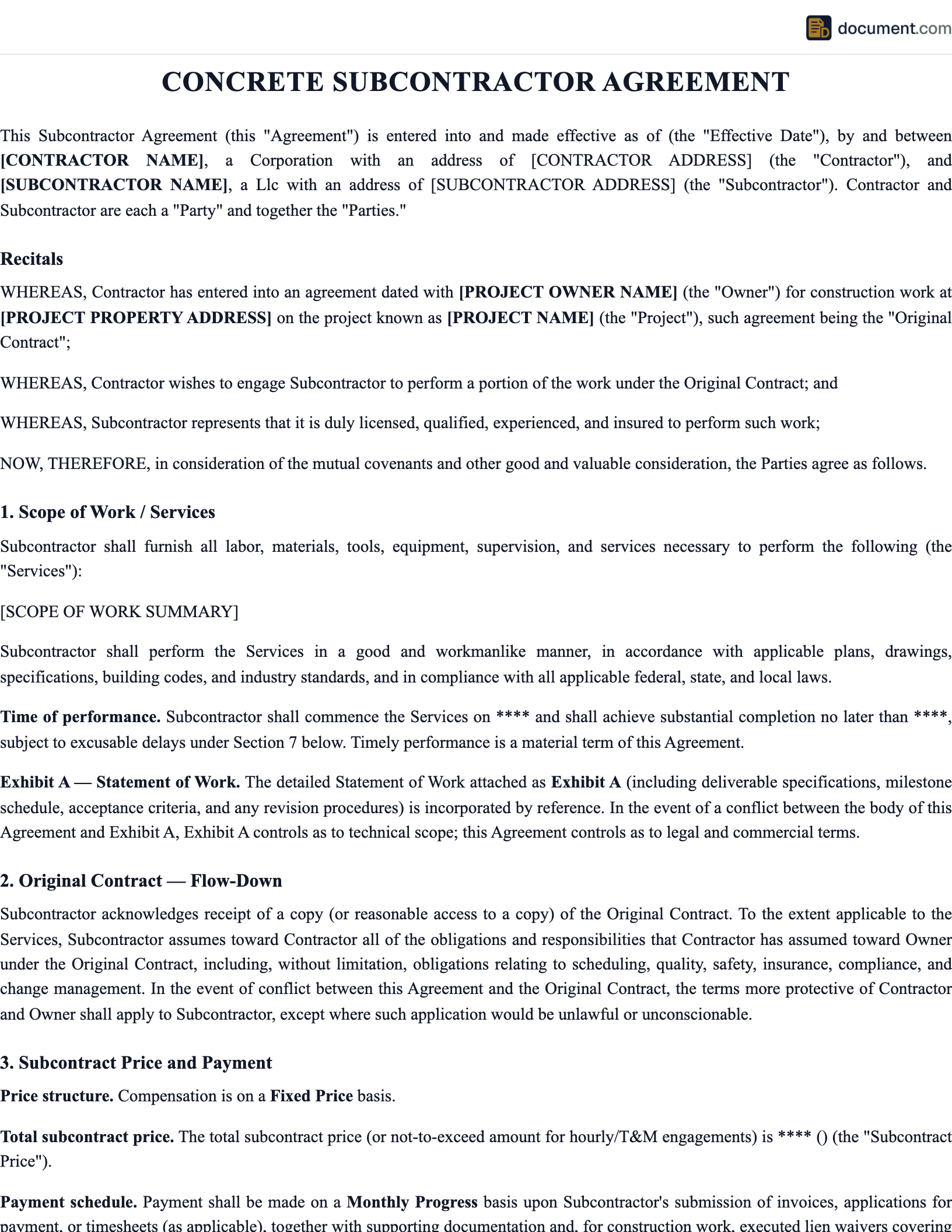



What Is a Concrete Subcontractor Agreement?
A concrete subcontractor agreement governs the relationship between a prime contractor and a concrete specialty contractor who performs structural concrete placement, flatwork, footings, foundations, slabs, tilt-up panels, or decorative concrete. Concrete work is tightly regulated by ACI 318 (incorporated into the International Building Code), subject to IBC Chapter 17 special inspection on most commercial projects, and governed by OSHA 29 CFR § 1926 Subpart Q safety standards.
The subcontract must address the specific technical and schedule risks of concrete: placement tolerances, cold-weather and hot-weather protection, curing, reinforcement placement, formwork design, and pump truck operation. Material warranties from admixture and ready-mix suppliers, special inspection cooperation, and timing coordination with other trades (embedded items, electrical conduit in slabs, plumbing rough-ins) are recurring sources of dispute and need clear contract language.
Use this template for structural concrete, slabs-on-grade, decorative flatwork, tilt-up walls, and architectural concrete subcontracts. The document covers scope, ACI 318/301/117 compliance, rebar placement protocols, cold-weather and hot-weather schedules, curing, concrete pumping insurance, lien waivers with statutory-form compliance, and AIA A401 flow-down for subcontracts under AIA-form prime contracts.
When to Use a Concrete Subcontractor Agreement
Use this agreement when a general contractor hires a concrete specialty contractor to perform any portion of the concrete scope on a project — footings and foundations, slab-on-grade, elevated slabs, walls, columns, stairs, tilt-up panels, decorative flatwork, or structural repair. Also use it when a concrete prime subcontracts out specialty work like polishing, staining, or post-tensioning.
The subcontract should always be paired with the prime contract plans and specs (by reference), a pre-construction meeting agenda, and a written schedule. Verbal promises about pour dates, mix designs, or finishes become the primary source of concrete disputes without contemporaneous documentation.
Key Provisions
Every concrete subcontract should address these at minimum.
Scope & mix designs
Plans and specs incorporated; mix designs for each strength class; submittals review.
ACI 318 compliance
Edition in effect on plan-set date; ACI 117 tolerances; ACI 301 specifications.
Rebar placement
Grade per plans; cover; lap lengths; pre-pour inspection; seismic A706/A615 for SDC D/E/F.
Progress billing
Schedule of values tied to pours; 5-10% retainage; pay-when-paid with statutory limits.
Insurance
CGL $1M/$2M, auto, workers' comp; pumping sub carries $5M-$10M umbrella.
Lien waivers
Conditional progress waiver each payment; final unconditional at retainage; statutory forms.
OSHA Subpart Q
Impalement protection, formwork per ACI 347, shoring inspection, PPE for fresh concrete.
Warranty & defects
One-year warranty; repair at sub cost; latent defects to state statute of repose.
Legal Considerations
State contractor licensing is mandatory for concrete work in nearly every state. California Business & Professions Code § 7031 bars unlicensed contractors from collecting any payment and requires disgorgement of money already paid — a concrete sub without a C-8 (concrete) license in California cannot collect even if the work is defect-free. Most states require a concrete or general-building license above a dollar threshold.
Mechanic's lien rights are stronger for concrete subs than for many other trades because concrete is a core improvement to real property. The subcontract should require strict lien-waiver discipline — conditional progress waivers with each payment, final unconditional waiver at retainage release, and statutory-form compliance in California, Texas, Florida, and other states with prescribed forms. Preliminary 20-day notices under California Civil Code § 8204 or similar statutes in Nevada and Arizona preserve the sub's lien rights and should be filed within 20 days of first supplying labor or materials.
Indemnity limitations in many states restrict how far the prime can push risk onto the sub. California Civil Code § 2782 voids Type I indemnities (sub indemnifies prime for prime's sole negligence) in most construction contracts. Texas Business & Commerce Code § 151 and similar statutes in other states limit indemnity to the sub's own negligence. Use a comparative-fault or "to the extent caused by" indemnity to stay compliant.
Concrete-Specific Issues
Cold-weather concreting under ACI 306 is the single largest seasonal risk. Placing concrete below 40°F without protection risks freezing before strength gain, which can lead to full slab removal and replacement. The subcontract should require the sub to bear the cost of cold-weather protection (heated enclosures, insulated blankets, heated water), notify the prime of planned cold-weather pours, and protect concrete for the first seven days at a minimum 50°F concrete temperature.
Concrete pumping is a catastrophic-loss exposure. Pump boom strikes on overhead power lines can cause multi-fatality incidents with claims exceeding $10 million. The subcontract should require the pumping sub to carry excess liability of $5M-$10M minimum, require ACPA operator certification, require a spotter during all pumping operations, require compliance with OSHA § 1926.703 and Subpart Q, and require the pump boom to maintain minimum 10-foot clearance from overhead lines (increasing with voltage per OSHA Appendix D to § 1926 Subpart V).
Placement tolerances under ACI 117 — slab flatness (F_F) and levelness (F_L), column plumb, anchor-bolt location — are frequent sources of rework cost. Out-of-tolerance slabs require grinding, self-leveling compound, or partial demolition. The subcontract should specify the applicable F-numbers, require measurement within 72 hours of placement, assign rework cost to the sub for out-of-tolerance work, and allow the prime to back-charge rework against pending progress payments.
How to Fill Out the Agreement
Fields map to the wizard questions in our document builder.
Identify the parties and project
Prime and sub legal entities; project address; plan set date; applicable ACI 318 edition.
Scope of concrete work
Footings, foundations, slabs, walls, tilt-up; mix designs by strength class; decorative finishes.
Progress billing and retainage
Schedule of values by pour or milestone; 5-10% retainage; 30-day pay-when-paid timing.
Insurance and pumping coverage
CGL $1M/$2M; workers' comp; auto; if pumping, excess $5M-$10M and ACPA certification.
Lien waivers
Conditional progress waiver each pay; final unconditional at retainage; statutory forms for CA/TX/FL.
Schedule and weather protection
Pour schedule; ACI 305 hot-weather plan; ACI 306 cold-weather plan; notice requirements.
Warranty and special inspection
One-year warranty; cooperation with IBC Ch. 17 special inspector; re-inspection back-charge.
Sign and retain records
Signatures; retain for 10 years per most states' statute of repose for construction defects.
Frequently Asked Questions
Common questions about concrete subcontracts, ACI compliance, and pumping insurance.
Create your concrete subcontract in under 10 minutes.
Select your state, answer a few questions, and download an ACI 318-ready, lien-waiver-compatible concrete subcontract.