
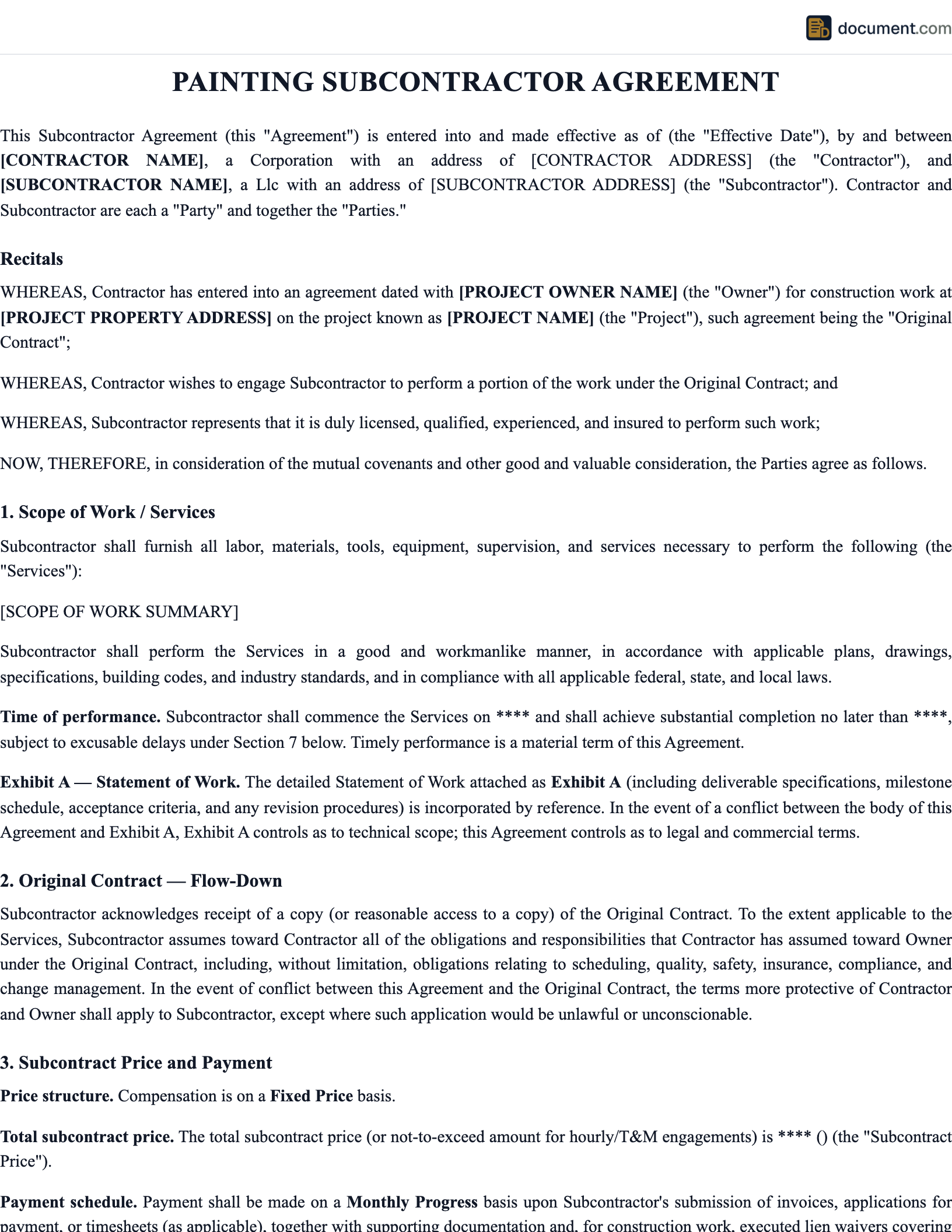



What Is a Painting Subcontractor Agreement?
A painting subcontractor agreement governs the relationship between a prime (general) contractor or property manager and a painting specialty contractor who performs interior or exterior painting, staining, coating, or protective-finish work. It is a common trade subcontract in both commercial construction and residential repaints, and must address specialized regulatory issues: VOC limits under EPA 40 CFR Part 59 and state/regional air-quality rules, RRP lead-paint certification under 40 CFR Part 745 for pre-1978 work, SDS and HazCom compliance, pressure-washing NPDES discharge rules, and manufacturer-warranty requirements that can run 25 years or lifetime.
Painting subcontracts are a frequent source of scope and color disputes. Prep work extent, number of coats, surface repair, and color approval are the leading sources of claims. The template includes a detailed scope-of-work exhibit, written color-approval process, weather constraints, warranty pass-through, and change-order procedure to reduce disputes and support defense if claims arise.
Use this template for interior repaints, exterior painting, commercial new construction, stain and varnish work, industrial coatings, and specialty finishes. The document covers scope, VOC and RRP compliance, prep protocols, color approval, weather constraints, manufacturer-warranty pass-through, insurance (including pollution liability for solvent-based and lead work), and lien-waiver discipline.
When to Use a Painting Subcontractor Agreement
Use this agreement when a general contractor or property manager hires a painting specialty contractor for a project — commercial office repaint, exterior of a multifamily building, new-construction painting, residential repaint, industrial coating. The subcontract should always be paired with the project specifications (paint selection, color schedule, finish schedule) and a written schedule accounting for weather days.
Do not use this template for general painting supplies or paint product sales — it governs installation services only. For paint-supplier agreements (Sherwin-Williams National Account, etc.), use a purchase order or supply agreement. For a sub-subcontract (a painting sub hiring another painter for a specialty scope like faux finish), use this template with modifications to address the two-tier relationship.
Key Provisions
Every painting subcontract should address these at minimum.
Scope & surfaces
Room-by-room finish schedule; surfaces; coats; prep level; exclusions.
VOC & MSDS
EPA 40 CFR §59 compliance; state/regional rules (CARB, SCAQMD); SDS accessible.
RRP lead-paint
EPA Lead-Safe certification for pre-1978 work; certified renovators; 3-year records.
Color & approval
Written submittal; on-site sample patch; photo documentation; not liable after approval.
Insurance
CGL $1M/$2M; workers' comp; pollution liability for solvents/lead; fire-legal for interior.
Manufacturer warranty
Product-spec warranty tier; register in owner name; labor warranty separate from product.
Weather & schedule
Temperature/humidity specs; stop work if out of spec; weather days built into schedule.
Change orders
Written authorization; unit-price schedule (extra coat, substrate repair); 15-20% T&M markup.
Legal Considerations
RRP compliance is the highest-penalty regulatory issue. The EPA Lead-Safe Certified Renovator program under 40 CFR Part 745 carries penalties up to $39,936 per violation per day. Uncertified work in pre-1978 housing or child-occupied facilities is actively enforced. The subcontract must require the sub to be a Certified Firm, employ a Certified Renovator on every job, test for lead before disturbance, follow lead-safe work practices, provide the EPA Renovate Right pamphlet, and maintain records for 3 years.
VOC compliance is regulated federally and by state. EPA 40 CFR Part 59 sets national limits; California Air Resources Board (CARB), South Coast Air Quality Management District (SCAQMD Rule 1113), and Bay Area AQMD impose stricter limits. LEED projects require low-VOC products. The subcontract should specify which standard applies, require the sub to maintain VOC content documentation, and indemnify the prime for regulatory violations.
Pressure washing creates NPDES and environmental exposure. Commercial exterior washing generates wastewater that must be collected (not discharged to storm drains) under the Clean Water Act. Runoff containing lead from pre-1978 buildings is RCRA-regulated waste. The subcontract should require the sub to obtain NPDES permits where required, collect and properly dispose of wastewater, carry pollution liability insurance, and protect adjacent property from over-spray and runoff.
Painting-Specific Issues
Prep disputes are the top source of painting-subcontract claims. The subcontract should specify the prep level required: pressure washing PSI and chemicals; scraping extent and method (wet for RRP); sanding grit and method; patching compound; masking and protection; deglossing of glossy surfaces. Extra prep discovered during work should go through a written change-order process with unit pricing rather than field verbal authorization. Vague scope language like "reasonable prep" loses in arbitration — detailed exhibits win.
Color approval must be documented in writing. The sub should provide a color submittal with paint chips, apply an on-site sample patch for final approval, and photograph the approved patch against the final finish. The subcontract should state that the sub is not liable for color mismatch after written approval — this provision wins most color disputes when properly documented.
Weather constraints affect both productivity and quality. Manufacturer specs typically require 50°F-90°F ambient, surface 5°F above dew point, below 85% relative humidity, no painting within 24 hours of rain. The subcontract should require the sub to follow manufacturer specs exactly, document daily conditions, and bear the cost of rework if the sub paints in out-of-spec conditions. Weather days should be built into the project schedule to avoid disputes over delay.
How to Fill Out the Agreement
Fields map to the wizard questions in our document builder.
Identify parties and project
Prime, sub, project name, address; pre-1978 building indicator for RRP triggers.
Scope and finish schedule
Surfaces, coats, prep level; interior vs. exterior; square footage; color schedule.
VOC and product requirements
VOC limit (federal/CARB/SCAQMD/LEED); manufacturer spec; product submittals for approval.
RRP compliance (if applicable)
Lead testing before disturbance; certified renovator; lead-safe practices; 3-year records.
Pricing and payment
Lump sum or per-square-foot; schedule of values; net-30 pay-when-paid; 5-10% retainage.
Insurance and warranty
CGL $1M/$2M; pollution liability; manufacturer warranty tier; one-year labor warranty.
Weather and schedule
Temperature/humidity/dew-point specs; weather-day contingency; daily weather log.
Sign and retain records
Signatures; retain including color submittals, sample photos, RRP records for 7 years.
Frequently Asked Questions
Common questions about painting subcontracts, VOC compliance, and lead-paint RRP.
Create your painting subcontract in under 10 minutes.
Select your state, answer a few questions, and download a VOC-compliant, RRP-ready painting subcontract.