



Wisconsin's UPOAA: Chapter 244 with a Twist
Wisconsin adopted the Uniform Power of Attorney Act under Wis. Stat. Chapter 244, joining the growing list of states using the model legislation developed by the Uniform Law Commission. But Wisconsin did not adopt it verbatim. The state added a two-witness requirement that makes its execution process stricter than nearly every other UPOAA jurisdiction. While most UPOAA states require only notarization, Wisconsin demands both notarization and two adult witnesses. This is not optional — a Wisconsin POA signed without witnesses is not merely questionable, it is legally invalid.
The default durability rule follows the UPOAA model: under Wis. Stat. §244.05, every power of attorney is presumed durable unless the document explicitly states that it terminates upon incapacity. This means your agent's authority continues even if you later become unable to manage your own affairs through illness, injury, or cognitive decline. You do not need special language to make it durable — you only need special language if you want to make it non-durable.
Wisconsin's marital property system adds another layer of complexity. As the only state in the country to use the term "marital property" (rather than community property), Wisconsin has a shared-ownership framework that directly impacts what a POA agent can and cannot do with assets acquired during a marriage. Understanding this system is essential before you draft your POA — the wrong assumptions about property ownership can leave your agent powerless over assets you thought were covered.
Chapter 244
UPOAA Adopted
Notarization
Required for validity
2 Witnesses
Required (unusual)
Marital
Property state
Marital Property Explained: Wisconsin's Unique System
Wisconsin adopted the Uniform Marital Property Act in 1986 under Wis. Stat. Chapter 766, making it the only state east of the Mississippi to adopt a community property-style system — and the only state anywhere to use the label "marital property" rather than "community property." The practical effect is the same as in California, Washington, or Texas: most assets acquired during marriage belong equally to both spouses, regardless of which spouse earned the money or whose name appears on the account.
For POA planning, this creates a critical question: does your agent have authority over marital property, individual property, or both? Wisconsin law classifies property into three categories — marital property (shared equally), individual property (owned by one spouse, typically from before the marriage or received as a gift or inheritance), and mixed property (individual property that has been commingled with marital assets). Your POA should explicitly state which categories your agent can manage.
If both spouses want to grant POA authority, each should execute their own document. A single POA cannot be signed by two principals in Wisconsin. Married couples often name each other as primary agents and designate a trusted third party (adult child, attorney, family friend) as the successor agent. This ensures that if one spouse becomes incapacitated and the other later does too, the successor can step in for both.
Wisconsin Marital Property Classification
Marital Property
Assets acquired during marriage — income, investments, real property purchased with joint funds
Individual Property
Assets from before marriage, gifts, and inheritances received by one spouse alone
Mixed Property
Individual property commingled with marital assets — often the most contested category
Wisconsin Power of Attorney Types
Wisconsin's Chapter 244 supports all nine POA types. Remember: each financial POA requires notarization plus two witnesses. Healthcare POAs fall under the separate Chapter 155 with their own rules. Select the type that fits your needs below.
General Power of Attorney
Broad authority over financial and legal affairs — must be signed before a notary and two witnesses under Wisconsin's distinctive execution requirements
Durable Power of Attorney
Survives incapacitation under Wis. Stat. §244.05, the default in Wisconsin unless the document affirmatively states that it terminates upon incapacity
Limited/Special Power of Attorney
Scoped to a single transaction or defined period — commonly used by Wisconsin dairy farmers authorizing a specific land sale or equipment purchase
Medical/Healthcare Power of Attorney
Governed separately under Wis. Stat. Chapter 155, with its own signing requirements — Wisconsin calls this the 'Power of Attorney for Health Care'
Financial Power of Attorney
Covers banking, investments, tax obligations, and financial management — important for Wisconsin's marital property system where spousal interests intersect
Springing Power of Attorney
Activates only upon a specified triggering event — permitted under Chapter 244 but requires precise language defining the activation conditions
Minor Child Power of Attorney
Temporary delegation of parental authority to a caregiver — used by Wisconsin families during extended travel, military service, or medical treatment
Real Estate Power of Attorney
Authorizes property transactions recorded with the Register of Deeds — Wisconsin's term for the county land records office in each of its 72 counties
Vehicle Power of Attorney
Enables Wisconsin DOT transactions including title transfers, plate registrations, and vehicle sales throughout the state
Wisconsin Execution Requirements — Stricter Than Most
Wisconsin's execution rules are among the strictest of any UPOAA state. The combination of notarization and two witnesses means you need to coordinate three people beyond yourself for the signing ceremony. While this may feel cumbersome, it provides an extra layer of protection against fraud and challenges to validity.
Two-Witness Requirement — Do Not Skip This
Under Wis. Stat. §244.05, your financial POA must be witnessed by two disinterested adults in addition to being notarized. The witnesses cannot be the named agent, a relative of the agent, or anyone with a financial stake in the principal's affairs. Both witnesses must physically sign the document. A Wisconsin POA without proper witnesses is invalid — period. This is the most common mistake people make when drafting Wisconsin POAs using forms from other states.
- Adult Principal with Capacity: You must be at least 18 and of sound mind — Wisconsin courts can invalidate a POA signed during diminished capacity
- Written Instrument: Wisconsin does not recognize oral grants of authority — the document must be in writing and signed by the principal
- Two Adult Witnesses: Both witnesses must be present when the principal signs, must be disinterested, and must sign the document themselves (Wis. Stat. §244.05)
- Notarized Acknowledgment: The principal's signature must be acknowledged before a Wisconsin notary public in addition to the witness requirement
- Agent Identification: Name the primary agent and any successor agents with full legal names and sufficient identifying information
- Marital Property Consideration: If married, specify whether the POA covers marital property, individual property, or both — this prevents ambiguity that could limit your agent's authority
Creating a Wisconsin Power of Attorney: Three Steps
The process requires more logistical coordination than most states because of the two-witness rule. Plan the signing session in advance — you will need a notary and two qualified witnesses all present at the same time.
Choose Your POA Type and Draft the Document
Determine whether you need a general financial POA, a limited POA for a specific transaction, a healthcare POA under Chapter 155, or some combination. If you are married, discuss with your spouse how marital property should be handled — both spouses may want to execute their own POAs. Wisconsin's UPOAA defines statutory authority categories under §244.41 through §244.57 — you can reference these or customize the authority grants. For dairy farms or manufacturing businesses, include operational authority explicitly.
Sign Before Two Witnesses and a Notary
Schedule a signing session with two qualified adult witnesses and a Wisconsin notary public. The witnesses must be disinterested — not the named agent, not related to the agent, and without financial interest in your affairs. All parties must be present when you sign. The notary verifies your identity and acknowledges your signature, while the witnesses observe the signing and add their own signatures. Keep the original securely and provide certified copies to your agent.
Record with the Register of Deeds and Distribute
If your POA includes real estate authority, record it with the Register of Deeds in the county where the property is located. Distribute copies to your agent, financial institutions, dairy cooperatives (if applicable), healthcare providers, and any other parties your agent may need to deal with. Many Wisconsin banks and credit unions have their own POA acceptance procedures — contact them in advance to register the document and avoid delays when the agent needs to act.
Sample Wisconsin Power of Attorney
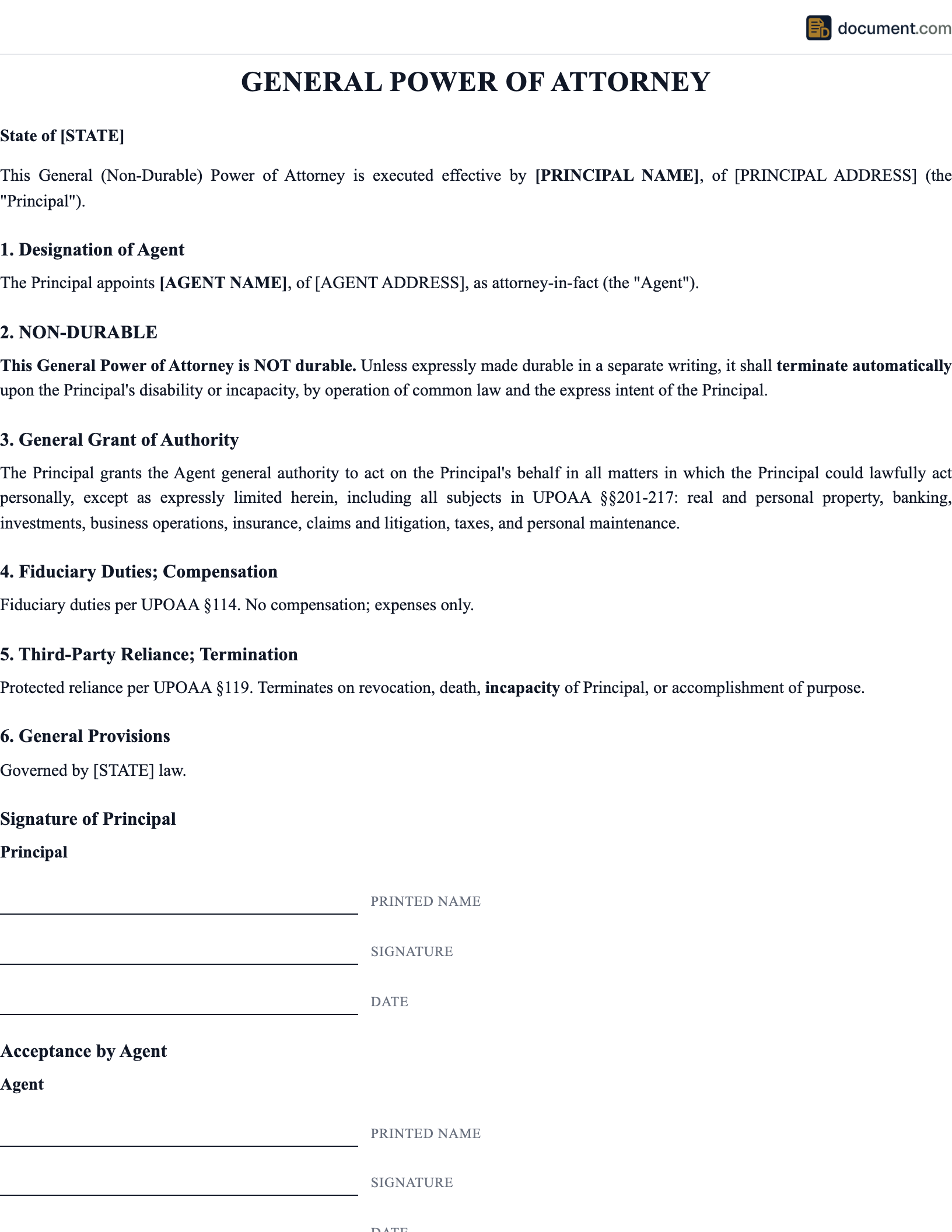
Below is a simplified preview of a Wisconsin POA. Note the witness signature lines, which are mandatory under Chapter 244. Your completed document will include full statutory references, marital property acknowledgments, and the two-witness attestation block.
STATE OF WISCONSIN
DURABLE POWER OF ATTORNEY
Pursuant to Wis. Stat. Chapter 244 (Uniform Power of Attorney Act)
PRINCIPAL:
Name: [Full Legal Name]
Address: [Wisconsin Address]
Marital Status: [Status]
AGENT (ATTORNEY-IN-FACT):
Name: [Agent Full Name]
Address: [Agent Address]
Relationship: [Relationship]
GRANT OF AUTHORITY
I, the undersigned Principal, a resident of the State of Wisconsin, hereby appoint the above-named Agent as my attorney-in-fact under Wis. Stat. Chapter 244 with the following authority:
Powers Granted: [As Specified]
Property Scope: This POA covers my individual property and my interest in marital property under Wis. Stat. Chapter 766.
Durability: This power of attorney shall not terminate upon my incapacity (Wis. Stat. §244.05).
Witnesses: This document is signed in the presence of two adult witnesses as required by Wisconsin law.
Wisconsin Power of Attorney — Your Questions Answered
From marital property to the two-witness requirement, dairy farm operations to cross-border issues with neighboring states — these are the questions Wisconsin residents ask most often.
Official Wisconsin Legal Resources
Authoritative sources for Wisconsin POA law, court procedures, and legal assistance throughout the Badger State.
Wis. Stat. Chapter 244
Full text of Wisconsin's Uniform Power of Attorney Act
State Bar of Wisconsin
Lawyer referral service and legal practice resources
Wisconsin Court System
Circuit court forms, self-help center, and filing guides
Legal Action of Wisconsin
Free civil legal services for qualifying Wisconsin residents
Power of Attorney in Other States
Need a POA for a neighboring state or another jurisdiction? Browse our complete library.
Create your Wisconsin Power of Attorney in under 5 minutes.
Answer a few questions and download a Wisconsin-compliant document, ready for the state agency.