



Michigan's EPIC: A Different Kind of POA Framework
When Michigan overhauled its probate laws in April 2000, it replaced the old Revised Probate Code with the Estates and Protected Individuals Code — known universally as EPIC and codified at Michigan Compiled Laws Chapter 700. EPIC did not just update the rules; it rebuilt the entire framework for how Michigan handles powers of attorney, conservatorships, guardianships, and protected individuals. The result is a POA system that functions differently from both UPOAA states and states that still rely on older uniform acts.
The most immediately noticeable difference is Michigan's treatment of healthcare authority. While most states let you combine financial and healthcare powers into a single document (or at least govern them under the same statute), Michigan insists on a separate instrument called a Patient Advocate Designation. This designation lives in MCL 700.5506-5512 and has its own execution requirements, its own activation triggers, and witness disqualification rules that are among the most detailed in any state.
Michigan's unique economy also shapes how POAs get used here. The state remains the center of American automotive manufacturing, home to the Big Three headquarters and thousands of suppliers. Retirees with GM, Ford, and Stellantis pensions need POAs that specifically address defined-benefit plan management. Meanwhile, Michigan's 3,200 miles of Great Lakes shoreline and 11,000 inland lakes make waterfront property management a constant POA consideration. A POA built for Michigan has to account for all of this.
Required
Notarization
2 Recommended
Witnesses (Req. for PAD)
EPIC (MCL 700)
Governing Statute
83 Counties
Register of Deeds
The Patient Advocate Designation: Michigan's Healthcare Decision Framework
Michigan does not use the term "healthcare power of attorney." Instead, the state created the Patient Advocate Designation (PAD) under MCL 700.5506, a legal instrument that functions similarly but comes with requirements you will not find in most other states. Understanding these differences is not optional — a document that fails to meet Michigan's PAD requirements is legally void.
First, the activation standard is specific: the PAD only takes effect when the patient's attending physician and one other physician or licensed psychologist each independently determine, in writing, that the patient is unable to participate in medical treatment decisions. This two-provider certification requirement is stricter than most states, which typically need only one physician's determination.
Second, the witness requirements are extensive. Two witnesses must be present at signing, and Michigan disqualifies a long list of individuals: the patient's spouse, parent, child, grandchild, sibling, any presumptive heir, any known devisee at the time of signing, the patient's physician, any employee of the patient's health insurance company, and any employee of the health facility where the patient is receiving care. Finding two qualified witnesses in a hospital setting can be genuinely challenging.
Third, the patient advocate's authority over end-of-life decisions is not automatic. The designation must contain specific language authorizing the advocate to make decisions about withholding or withdrawing treatment that would allow the patient to die. Without this explicit grant, the advocate cannot make those decisions regardless of what the patient verbally expressed. Michigan courts have upheld this requirement strictly.
Power of Attorney Types Under Michigan's EPIC
EPIC recognizes the full range of POA instruments, though the framework requires more explicit drafting than UPOAA states because Michigan does not provide statutory default powers. Each type below links to a Michigan-specific template.
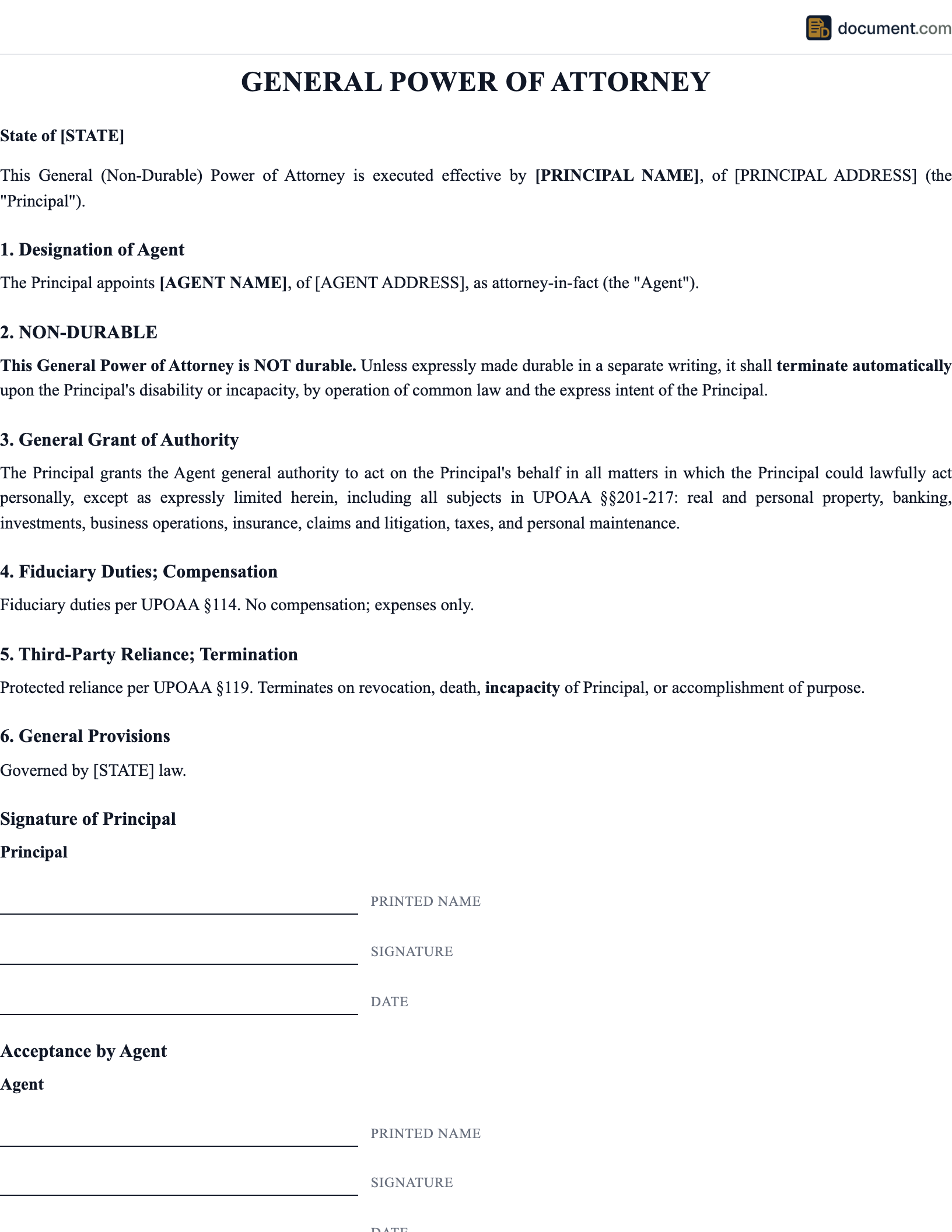
General Power of Attorney
Comprehensive authority for financial and legal matters — structured under EPIC's agency framework for Michigan-specific compliance
Durable Power of Attorney
Survives incapacity under MCL 700.5501 — the cornerstone of Michigan estate planning, especially for aging auto industry retirees
Limited/Special Power of Attorney
Scoped to a single transaction or time period — commonly used for lakefront cottage closings while the owner is out of state
Medical/Healthcare Power of Attorney
In Michigan, healthcare decisions require a Patient Advocate Designation under MCL 700.5506 — distinct from a financial POA
Financial Power of Attorney
Covers banking, investments, tax filings, and pension management — critical for Michigan's large union pension and auto retirement population
Springing Power of Attorney
Activates upon a triggering event such as physician certification of incapacity — recognized under EPIC's durable POA provisions
Minor Child Power of Attorney
Temporary caregiving delegation for Michigan parents — often used during extended work rotations at manufacturing plants or military deployment
Real Estate Power of Attorney
Must be recorded with the county Register of Deeds — essential for managing Michigan lakefront property, UP cabins, and Detroit real estate
Vehicle Power of Attorney
Handles Secretary of State branch office transactions — title transfers, registrations, and plate renewals across Michigan
Michigan Execution and Witness Requirements
Getting a Michigan POA accepted by banks, the Secretary of State, county Register of Deeds offices, and healthcare facilities requires strict compliance with EPIC's execution formalities.
- Principal must be at least 18 years old and mentally competent at the time of execution
- Financial POA must be signed and notarized by a Michigan notary public — two witnesses recommended
- Patient Advocate Designation requires two witnesses who meet MCL 700.5506's strict disqualification criteria
- Durability language per MCL 700.5501 — must state power is "not affected by the principal's disability"
- Real estate POA must be recorded with the county Register of Deeds where the property is located (83 counties)
- Recording standards: minimum 8.5" x 11" paper, legible text, principal's name printed below signature
- PAD must specifically authorize end-of-life decisions if desired — this authority is not granted by default
- Agent owes fiduciary duties under EPIC — must act in good faith, keep records, avoid conflicts of interest
Building a Michigan Power of Attorney: Practical Steps
A Michigan POA that actually works — one that the Secretary of State branch office, your bank, and Henry Ford Health will all accept — demands attention to EPIC's specific requirements.
Identify Your Needs: Financial POA, Patient Advocate Designation, or Both
Most Michigan residents should create both a financial POA (under MCL 700.5501) and a Patient Advocate Designation (under MCL 700.5506). They serve completely different purposes and have different execution requirements. If you own lakefront property, a vehicle titled in Michigan, or retirement accounts with Michigan-based employers, map those assets to the appropriate document type.
Draft with EPIC's Explicit-Powers Approach in Mind
Because Michigan lacks the UPOAA's default powers framework, every authority you want the agent to exercise must be spelled out. List banking powers, investment management, real property authority (including riparian rights for waterfront), vehicle transactions at Secretary of State offices, pension management, and tax filing authority individually. For the Patient Advocate Designation, include explicit end-of-life decision authority and address mental health treatment if desired.
Execute with Proper Witnesses and Notarization, Then Record
For the financial POA, sign before a Michigan notary with two witnesses present. For the Patient Advocate Designation, carefully select two witnesses who meet every disqualification criterion in MCL 700.5506 — have them confirm their eligibility before signing. Record the POA at the relevant county Register of Deeds for any real estate. Deliver copies to your agent, your bank, your Secretary of State branch, and your healthcare providers. Keep the originals in a fireproof location you can describe to your agent.
Sample Michigan Durable Power of Attorney
This preview shows the structural framework of a Michigan durable POA under EPIC. The completed document includes granular powers, fiduciary duty provisions, and Register of Deeds formatting requirements.
STATE OF MICHIGAN
DURABLE POWER OF ATTORNEY
Under the Estates and Protected Individuals Code (MCL 700.5501)
PRINCIPAL:
Name: [Full Legal Name]
Address: [Michigan Address]
County: [Michigan County]
AGENT (ATTORNEY-IN-FACT):
Name: [Agent's Full Legal Name]
Address: [Agent's Address]
Successor: [Successor Agent Name]
DURABILITY PROVISION
This power of attorney is not affected by the principal's subsequent disability or incapacity, per MCL 700.5501.
Effective Date: [Date]
Governing Law: State of Michigan — EPIC
Michigan Power of Attorney: Common Questions
Detailed answers to the questions Michigan residents ask most about EPIC compliance, Patient Advocate Designations, Register of Deeds recording, and cross-border issues with Canada.
Official Michigan Resources
Verify Michigan's EPIC requirements and access statutory text through these official state resources.
EPIC — MCL Chapter 700
Full text of Michigan's Estates and Protected Individuals Code
Michigan Secretary of State
Vehicle POA transactions and branch office locations
MI Dept. of Environment (EGLE)
Waterfront permits and riparian rights management
Michigan Probate Courts
Court directory for POA disputes and guardianship matters
Create your Michigan Power of Attorney in under 5 minutes.
Answer a few questions and download a Michigan-compliant document, ready for the state agency.