



What Is a Durable Power of Attorney?
A durable power of attorney is a legal document that authorizes a person you choose — your agent or attorney-in-fact — to handle your financial and legal affairs, and that remains in effect even if you become mentally incapacitated. The word "durable" refers to that single critical feature: durability. Without specific durability language, an ordinary power of attorney terminates the moment the principal loses mental capacity, leaving the agent powerless at exactly the moment authority is most needed. The durable POA solves that problem by including statutory language stating that the document survives subsequent disability or incapacity.
Modern durable POAs are almost always immediately effective, meaning the agent has authority the moment the document is signed and notarized. The principal does not have to be incapacitated for the agent to act — the agent could pay a bill or sign a deed the very next day. This sounds risky, but it is actually the practical default because it avoids the banking and title-company friction that springing POAs notoriously create. Trust in your agent is essential, and most people simply hold the executed document somewhere secure and do not deliver it until the agent is needed.
The durable POA has become the cornerstone of modern incapacity planning. It is the single most effective way to avoid a court-supervised conservatorship if you suffer a stroke, develop dementia, or are otherwise unable to manage money, sign documents, or interact with financial institutions. Rather than forcing your family into probate court — a public, expensive, slow, and adversarial process — a durable POA simply names your agent in advance and gives them the authority to step in seamlessly. For most adults over 50, an attorney will recommend a durable financial POA as the very first incapacity-planning document to put in place.
Durable POAs are governed primarily by state law, but more than 30 states have adopted some version of the Uniform Power of Attorney Act (UPOAA) of 2006. Under the UPOAA, every POA is presumed to be durable unless the document expressly states otherwise — a reversal of the older common-law presumption. The UPOAA also requires third parties to accept a properly executed POA within a reasonable time, defines the agent's fiduciary duties, and lists specific "hot powers" (such as the power to make gifts, change beneficiary designations, or create trusts) that must be expressly granted in the document. Our templates are written to comply with both UPOAA states and non-UPOAA states.
A durable POA is a financial document. It is not a substitute for a medical POA, a living will, or an advance healthcare directive — those are governed by separate state statutes and by HIPAA, and they should be drafted as standalone documents. A complete incapacity plan typically includes a durable financial POA, a separate medical POA, a HIPAA authorization, and a living will or advance directive.
Survives Incapacity
Continues in effect even if you can no longer manage your own affairs.
Avoids Conservatorship
Eliminates the need for a court-appointed conservator for financial matters.
Financial Focus
Built for banking, real estate, taxes, investments, and government benefits.
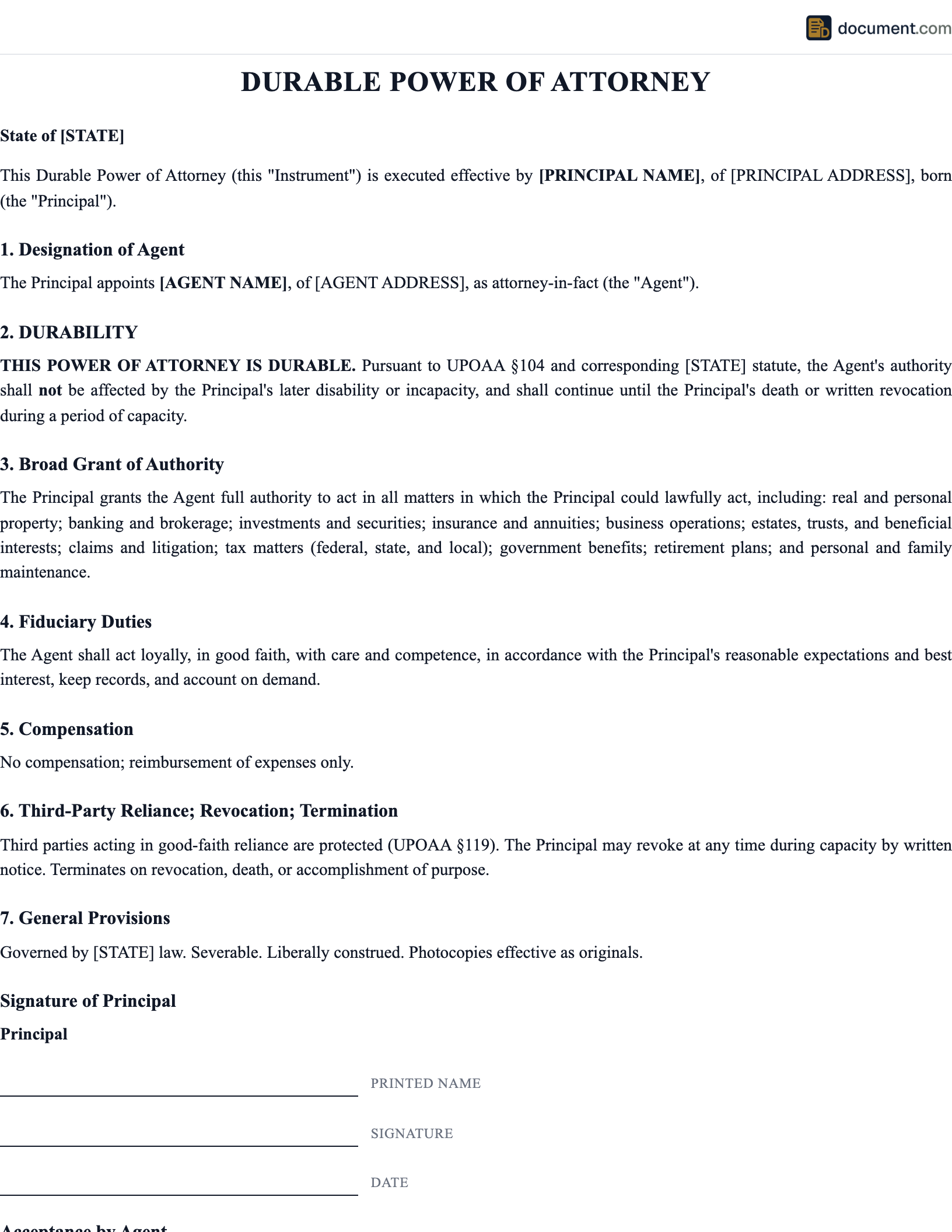
Durable POA Form Preview
Below is a structural preview of our durable power of attorney template. Notice the prominent durability clause and the immediately-effective designation — these are the two features that distinguish a durable POA from any other kind.
Durable Power of Attorney
For Financial & Legal Matters — Survives Incapacity
1. Principal
2. Agent & Successor Agent
3. Durability Clause
4. Effective Date
5. Powers Granted
- Banking, brokerage, and investment accounts
- Real estate transactions and property management
- Tax filings with the IRS and state agencies
- Government benefits (Social Security, Medicare, VA)
- Insurance and retirement account administration
- Hot powers: gifting, beneficiary changes, trust amendments (if expressly initialed)
6. Execution
Principal Signature
Notary Public & Seal
When You Need a Durable POA
A durable power of attorney is one of the few legal documents that almost every adult should have. The risk it protects against — losing the ability to manage your own finances — is universal. The cost of putting one in place is minimal. The cost of not having one when it is needed can be devastating.
Aging or Cognitive Decline
Dementia, Alzheimer's, and gradual cognitive decline are the single most common reasons families need a durable POA. Putting one in place early — while the principal is unquestionably competent — is essential.
Unexpected Illness or Injury
Stroke, traumatic brain injury, sudden coma, or major surgery can incapacitate a perfectly healthy person without warning. A durable POA ensures bills are paid and finances managed during recovery.
Comprehensive Estate Planning
Every estate plan should include a durable POA alongside a will, a medical POA, and either a trust or beneficiary designations. It is the "living" counterpart to the will.
Family Caregiver Coordination
When adult children are managing a parent's care, the durable POA is what lets them call the bank, file taxes, and pay long-term care bills without court intervention.
Durable POA vs Other Power of Attorney Types
A durable POA is one of several POA types, and the differences matter. Choosing the wrong type — for example, an ordinary general POA when a durable POA was needed — can leave you with no usable document at the worst possible moment.
Durable POA vs General POA
Durable POA
- - Survives mental incapacity
- - Designed for long-term planning
- - Usually presumed durable under UPOAA
- - Standard for incapacity protection
General (Non-Durable) POA
- - Terminates on incapacity
- - Useful only for short-term needs
- - Common for travel or single transactions
- - Not suitable for estate planning
Durable POA vs Springing POA
Immediately Effective Durable POA
- - Effective the moment it is signed
- - No physician certification needed
- - Easier acceptance by banks
- - Requires high trust in agent
Springing Durable POA
- - Activates only on incapacity
- - Requires physician certification
- - Banks often resist or delay acceptance
- - Better fit if agent trust is limited
Durable POA vs Medical POA
Durable Financial POA
- - Money, property, taxes, contracts
- - Governed by state property law & UPOAA
- - Banks & brokerages are the audience
Medical POA
- - Healthcare, treatment, end-of-life care
- - Governed by health-care consent statutes & HIPAA
- - Hospitals & physicians are the audience
How to Create a Durable Power of Attorney
Creating a durable POA involves more than filling in names. The document must include specific durability language, comply with your state's execution formalities, and expressly grant any "hot powers" you want your agent to have.
Confirm You Want a Durable POA (Not General)
Make a deliberate choice to create a durable POA — one that survives incapacity. In most states this is now the default presumption under the UPOAA, but the safest practice is to state durability explicitly in the document so there is no ambiguity.
Choose Your Agent and Successor
Pick someone you trust completely with your money — typically a spouse, adult child, or close family member. Always name at least one successor in case the primary agent is unavailable when needed. Confirm both are willing to serve before signing.
Decide: Immediately Effective or Springing
Most attorneys recommend immediately effective. It avoids the bank-acceptance friction that springing POAs cause and allows your agent to step in seamlessly. If you choose springing, the document must define exactly how incapacity is established (typically by one or two physicians).
Specify the Powers Granted
Use clear language listing banking, real estate, taxes, government benefits, investments, insurance, business, and litigation. Under the UPOAA, hot powers like gifting, changing beneficiaries, creating or amending a trust, or delegating authority must be expressly granted — they are not implied.
Add the Durability Clause
Include explicit language such as: 'This Power of Attorney shall not be affected by my subsequent disability or incapacity.' This single sentence is what makes the document durable. Without it, courts may treat the POA as terminated upon incapacity.
Set Limitations and Special Instructions
Cap gift amounts (often at the federal annual gift exclusion), prohibit self-dealing beyond ordinary support, restrict beneficiary changes, and require record-keeping or periodic accountings to a successor agent or trusted third party.
Sign Before a Notary (and Witnesses if Required)
Every state requires notarization for a financial durable POA, and many also require one or two adult witnesses who are not the agent. Sign in the presence of the notary — never beforehand.
Distribute Copies to Key Institutions
Give certified copies to your primary bank, brokerage, and CPA. Some institutions will pre-clear the document so it is on file when needed. Also give copies to your agent, successor agent, and estate-planning attorney.
Review Every 3-5 Years
Some banks resist accepting older POAs. Re-execute the document every few years, after major life events (marriage, divorce, death of an agent), or whenever you move to a new state.
Key Components of a Durable POA
A valid durable power of attorney has several essential building blocks. Missing any of them can render the document unenforceable or unacceptable to third parties.
Principal Identification
Full legal name, address, and date of birth of the person granting authority.
Agent & Successor
Name, address, and relationship of the primary agent and at least one successor.
Durability Language
Express statement that the POA survives the principal's incapacity.
Effective Date Clause
Whether the POA is effective immediately or springing on incapacity.
Scope of Authority
Specific list of powers granted, including any hot powers.
Limitations
Caps on gifting, restrictions on self-dealing, and special instructions.
Agent Acceptance
Many states require the agent to sign acknowledging fiduciary duties.
Notarization & Witnesses
Notary acknowledgment and any state-required witness signatures.
Legal Requirements: UPOAA & State Law
Durable powers of attorney are governed by state law, but the Uniform Power of Attorney Act (UPOAA) of 2006 has standardized many of the rules. More than 30 states have adopted the UPOAA in whole or substantial part, and even non-UPOAA states often follow its framework for durability, fiduciary duties, and third-party acceptance.
Under the UPOAA, every POA is presumed durable unless it expressly states otherwise — a reversal of the older common-law rule that POAs terminated on incapacity unless they said they were durable. The UPOAA also imposes a duty on banks, brokerages, and other third parties to accept properly executed POAs within a reasonable time, and authorizes attorney's fees and damages against institutions that unreasonably refuse.
Hot powers — including making gifts, creating or amending a trust, changing beneficiary designations, exercising rights of survivorship, delegating authority, and waiving rights to be a beneficiary — must be expressly granted in the document. A general grant of authority is not enough.
Notarization is universally required for durable POAs. Witness requirements vary: some states require two adult witnesses, some require one, and some require none. Florida and a handful of others have unique formalities such as "present and acting" language. Our templates apply the correct execution rules for your state.
Durable POA Requirements by State
Every state recognizes durable powers of attorney, but execution formalities and statutory frameworks vary. The list below shows the 50 states for which our templates apply state-specific rules.
Sample Durable Power of Attorney
Below is a condensed preview of our durable POA template, highlighting the durability clause and immediately-effective designation.
DURABLE POWER OF ATTORNEY
For Financial and Legal Matters
I, [Principal], of [Address], do hereby create this Durable Power of Attorney and appoint:
AGENT: [Agent Name]
SUCCESSOR AGENT: [Successor Name]
1. DURABILITY
This Power of Attorney shall not be affected by my subsequent disability or incapacity. The authority granted shall continue notwithstanding any later mental or physical incapacity that I may suffer, and shall remain effective until my death or written revocation.
2. EFFECTIVE DATE
This Power of Attorney is effective immediately upon execution and does not require a finding of incapacity to be exercised by my Agent.
3. POWERS GRANTED
My Agent has full power and authority to act for me in all financial and legal matters, including banking, real estate, brokerage, retirement accounts, taxes, government benefits, insurance, business operations, and legal proceedings.
4. HOT POWERS (initial each granted)
___ Make gifts up to the federal annual exclusion amount per recipient
___ Create, amend, or revoke a revocable trust
___ Change beneficiary designations on retirement and insurance accounts
___ Delegate authority to one or more agents
5. AGENT'S FIDUCIARY DUTIES
My Agent shall act in good faith, in my best interest, with the care of a prudent person, shall keep my property separate from the Agent's, and shall maintain complete records of all transactions on my behalf.
Frequently Asked Questions
Common questions about durable powers of attorney, durability language, springing triggers, agent duties, and the UPOAA.
Official Resources
Authoritative resources on durable powers of attorney, the UPOAA, fiduciary duties, and elder law.
ULC - Uniform Power of Attorney Act
The full text and state-by-state adoption status of the UPOAA.
ABA Commission on Law & Aging
American Bar Association resources on POA law and elder law.
CFPB - Managing Someone Else's Money
Federal guides for agents acting under a POA.
ACL - Administration for Community Living
Federal agency for older Americans and people with disabilities.
AARP - Power of Attorney Guide
Plain-language overview for caregivers and older adults.
NAELA - Elder Law Attorneys
Find a National Academy of Elder Law Attorneys member near you.
NIA - Advance Care Planning
National Institute on Aging guidance on incapacity planning.
SSA - Representative Payee Program
How Social Security handles authority over a beneficiary's benefits.
Create your Durable Power of Attorney in under 10 minutes.
Answer a few questions and download a compliant, attorney-drafted document ready for your state.