



Pennsylvania's UPOAA Adoption — With a Twist
When Pennsylvania adopted the Uniform Power of Attorney Act and codified it as 20 Pa.C.S. Chapter 56, the legislature did something almost no other state has done: it added a mandatory notice page. This single addition has defined Pennsylvania POA practice ever since. Every financial power of attorney executed in the commonwealth must include a notice — written in plain language — that explains the principal's rights, the agent's duties, and the consequences of granting authority. The principal must sign the notice to confirm they have read and understood it. Without this page, the POA is incomplete and will be rejected by banks, title companies, and courts throughout Pennsylvania.
On top of the notice page, Pennsylvania requires two witnesses and notarization for a financial POA. This three-layer execution standard — notice page, witnesses, and notary — puts Pennsylvania among the strictest states in the country for POA execution. The rationale is protection: the General Assembly wanted to ensure that principals fully understand what they are signing, that witnesses can attest to the voluntary nature of the act, and that a notary verifies identity. For estate planning attorneys in Philadelphia, Pittsburgh, and everywhere in between, getting these three elements right is non-negotiable.
Pennsylvania's economy adds its own wrinkles. The Marcellus Shale natural gas boom has made mineral rights a major asset for landowners in the northern and western parts of the state. Philadelphia and Pittsburgh are two of the largest real estate markets on the East Coast. And the commonwealth's 67 counties each maintain their own Recorder of Deeds office, meaning any POA involving real property must be recorded in the specific county where the land is situated. These factors make Pennsylvania POA planning more involved than a simple form.
Required
Notarization
2 Witnesses
Required
Adopted
UPOAA (Modified)
Notice Page
Mandatory
The Required Notice Page — Pennsylvania's Signature Addition
The notice page is the single most distinctive feature of Pennsylvania POA law. Required by 20 Pa.C.S. §5601(c), it is a separate page that must be physically attached to the front of every financial power of attorney. The notice is written in plain English — not legalese — and it tells the principal, in no uncertain terms, exactly what they are about to do.
The statutory notice must inform the principal that: (1) the document gives the agent broad powers to handle the principal's property and finances; (2) those powers will exist for the principal's entire lifetime unless the principal specifically limits them; (3) the principal can revoke the POA at any time as long as they are mentally competent; (4) the agent has a duty to act in the principal's best interest, keep records, and avoid conflicts; and (5) courts can hold the agent liable for misuse of the authority granted. The principal must sign the notice page separately from the POA itself, confirming they have read and understood these warnings.
Why does this matter in practice? Because Pennsylvania financial institutions have been trained to look for the notice page first. If you walk into a PNC Bank branch in Pittsburgh, a Citizens Bank office in Philadelphia, or a local credit union in Lancaster with a POA that lacks the notice page, you will be turned away. Title companies conducting real estate closings in any of Pennsylvania's 67 counties will reject the document. Even the Orphans' Court Division of the Court of Common Pleas — which handles POA disputes — will scrutinize whether the notice page was properly executed.
Our Pennsylvania templates include the complete statutory notice text as required by 20 Pa.C.S. §5601(c), with a dedicated signature block for the principal's acknowledgment. The notice is formatted to meet the presentation standards that PA banks and Recorders of Deeds expect to see, so your document will not be flagged for technical deficiencies.
Pennsylvania Power of Attorney Types
Pennsylvania recognizes nine types of POA, each requiring the mandatory notice page for financial instruments. Select the type that matches your needs for a PA-compliant template.
General POA
Comprehensive authority over financial and legal matters — PA's notice page must be attached, and the agent should understand fiduciary duties under 20 Pa.C.S. §5601
Durable POA
Survives the principal's incapacity — by far the most common POA type in Pennsylvania estate planning, required to include the statutory notice page
Limited / Special POA
Restricted to a specific transaction or timeframe — often used for Philadelphia or Pittsburgh real estate closings when the owner cannot attend
Medical / Healthcare POA
Appoints a healthcare agent under Pennsylvania's Advance Directive for Health Care Act (20 Pa.C.S. Chapter 54) — separate from financial POA requirements
Financial POA
Covers banking, investment management, and tax filings — essential for managing accounts at PA institutions like PNC, Citizens, and M&T Bank
Springing POA
Activates upon a triggering event such as incapacity — Pennsylvania allows springing POAs but they must still include the notice page
Minor Child POA
Delegates temporary parental authority — commonly used by PA military families and parents with seasonal or travel-intensive jobs
Real Estate POA
Authority for property transactions — must be recorded with the Recorder of Deeds in the county where Pennsylvania real property is located
Vehicle POA
Handles PennDOT title transfers and vehicle registrations — used for private sales, estate vehicles, and dealer transactions across the commonwealth
Pennsylvania's Three-Layer Execution Standard
A Pennsylvania financial POA must satisfy three requirements simultaneously: the notice page, two witnesses, and notarization. Here is what each entails.
Mandatory Notice Page Under §5601(c)
The statutory notice must be attached to the POA and signed by the principal. It explains the principal's rights, the agent's duties, and the legal consequences of the delegation. Without this page, the POA is invalid throughout Pennsylvania.
Two Adult Witnesses
Two witnesses who are not the named agent must observe the principal sign the POA and then sign the document themselves. The witnesses attest that the principal appeared competent and signed voluntarily. Family members may serve as witnesses in Pennsylvania unless they are also the agent.
Notarization
The principal's signature must be acknowledged before a Pennsylvania notary public or a notary authorized in the jurisdiction where signing occurs. The notary confirms identity and applies their official seal. This is in addition to — not a substitute for — the two witnesses.
Competent Adult Principal
The principal must be at least 18 years old and mentally capable of understanding the nature of the delegation. Pennsylvania courts apply the same capacity standard used for contract execution — the principal must understand what they are signing at the time of execution.
Recording with the Recorder of Deeds
For any POA involving real property or mineral interests, recording with the Recorder of Deeds in the relevant county is essential. Pennsylvania has 67 counties, and each maintains its own recording office. Philadelphia, Allegheny (Pittsburgh), Montgomery, and Bucks counties all have electronic recording; many rural counties still require physical submission.
Durability Language
To make the POA durable under 20 Pa.C.S. §5604, include a statement that the authority granted is not terminated by the principal's subsequent disability or incapacity. Pennsylvania presumes a POA is durable unless the document states otherwise, but explicitly including the language avoids any ambiguity.
How to Create a Pennsylvania Power of Attorney
Pennsylvania's execution process has more steps than most states. Here is the sequence to get it done correctly.
Select Your POA Type and Customize the Document
Choose from nine types based on your needs. Our Pennsylvania templates automatically include the mandatory notice page with the full statutory text from 20 Pa.C.S. §5601(c). Specify the powers you want to grant — including Marcellus Shale mineral rights authority if applicable — and name your agent and successor agents. The template generates witness and notary blocks formatted for Pennsylvania requirements.
Execute with Notice Page, Witnesses, and Notary
First, read and sign the notice page. Then sign the POA itself in the presence of two adult witnesses and a notary public. All signings should happen at the same session for efficiency. The witnesses sign after observing your signature, and the notary then acknowledges the document. Many PA law offices, banks, and UPS Store locations offer notary services.
Record and Distribute
Record with the Recorder of Deeds in every county where you own real property or mineral interests. Distribute certified copies to your agent, financial institutions, healthcare providers (for the healthcare directive), and any other parties who may need to verify authority. Keep the original with the notice page in a secure, accessible location — a fireproof safe or your attorney's office.
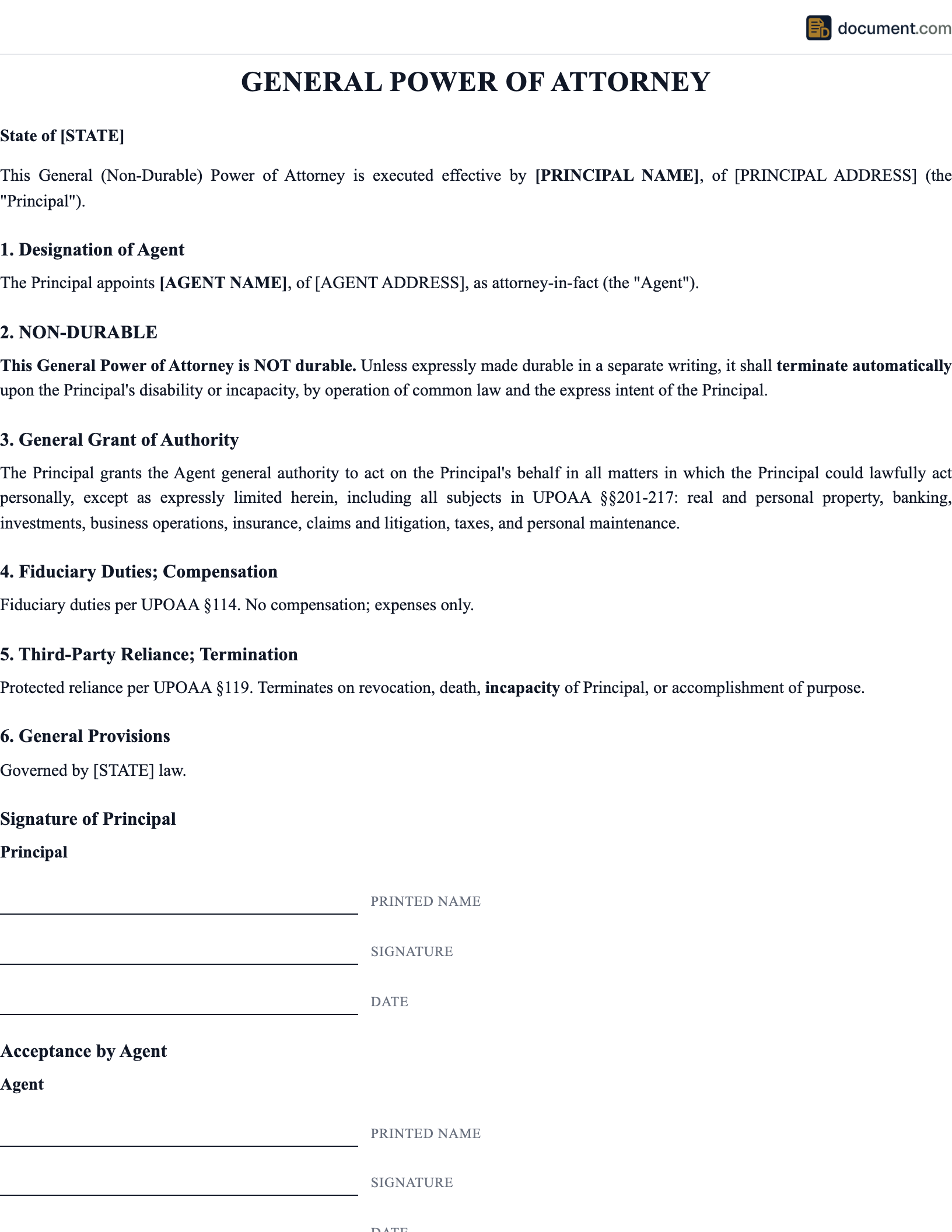
Sample Pennsylvania Power of Attorney
Below is a preview of our Pennsylvania-specific template. The completed document includes the mandatory notice page, two-witness signature blocks, notary acknowledgment, and provisions compliant with 20 Pa.C.S. Chapter 56.
POWER OF ATTORNEY
COMMONWEALTH OF PENNSYLVANIA
Pursuant to 20 Pa.C.S. Chapter 56 (UPOAA) — Notice Page Attached
PRINCIPAL:
Name: [Full Legal Name]
Address: [Pennsylvania Address]
County: [County of Residence]
AGENT (ATTORNEY-IN-FACT):
Name: [Agent's Full Legal Name]
Address: [Agent's Address]
Relationship: [Relationship to Principal]
POWERS GRANTED
Type: [General / Durable / Limited / Other]
Notice Page: Included (Page 1)
Effective Date: [Date or Triggering Event]
Expiration: [Date or Upon Revocation]
Governing Law: Commonwealth of Pennsylvania, 20 Pa.C.S. Chapter 56
Pennsylvania POA — Frequently Asked Questions
Answers to the questions Pennsylvania residents ask most often about the notice page requirement, witness rules, Recorder of Deeds filing, and Marcellus Shale mineral rights.
Official Pennsylvania Resources
Verify Pennsylvania's POA statutes, locate your county Recorder of Deeds, and access commonwealth legal resources.
20 Pa.C.S. Chapter 56 — UPOAA Text
Pennsylvania's Uniform Power of Attorney Act with notice page provisions
Unified Judicial System of Pennsylvania
Court of Common Pleas and Orphans' Court Division resources
Pennsylvania Attorney General
Elder abuse prevention, consumer protection, and legal guidance
PA Department of Aging
Elder care resources, Area Agencies on Aging, and protective services
Other Pennsylvania Legal Documents
A comprehensive Pennsylvania estate plan pairs the power of attorney with these related documents.
Pennsylvania Living Will
Advance directive under 20 Pa.C.S. Chapter 54
Pennsylvania Last Will and Testament
Estate distribution including real property and Marcellus Shale interests
Pennsylvania Promissory Note
Document loans with legally binding terms under PA law
Pennsylvania Bill of Sale
Transfer ownership of vehicles, equipment, or personal property
Create your Pennsylvania Power of Attorney in under 5 minutes.
Answer a few questions and download a Pennsylvania-compliant document, ready for the state agency.