



California Chose Its Own Path
When the Uniform Law Commission published the Uniform Power of Attorney Act, most states that updated their POA laws adopted it wholesale. California did not. Instead, the state maintains a comprehensive, home-grown framework under Probate Code Division 4.5 that reflects California's unique legal culture: detailed statutory forms, prescriptive fiduciary duties for agents, separate treatment of healthcare directives, and provisions that account for the state's enormous population, linguistic diversity, and complex real estate market.
The centerpiece of California's approach is the Statutory Form Power of Attorney codified at Probate Code §4401. This is a standardized, fill-in-the-blank document that covers 13 categories of financial authority. Because every bank, brokerage, and title company in California is familiar with the §4401 form, using it dramatically reduces the risk of rejection. The form's 13 categories — ranging from real estate and banking to litigation and personal property — let you grant broad or narrow authority by simply initialing the relevant lines.
California also separates financial powers from healthcare powers more firmly than most states. Healthcare authority is governed under a completely different statute — the Health Care Decisions Law (Probate Code §4600-4701) — and documented through an Advance Health Care Directive (AHCD), not a medical POA in the traditional sense. You cannot grant healthcare authority through a financial POA in California; you need a separate instrument. This two-document approach is standard practice for every California estate planning attorney.
Required
Notarization
2 (AHCD alt.)
Witnesses
No
UPOAA State
PC §4401
Statutory Form
The Probate Code §4401 Statutory Form Explained
California's statutory form organizes financial authority into 13 discrete categories. You grant a category by initialing next to it; you withhold it by leaving the line blank. This makes the document both granular and easy to understand. Here are the 13 categories:
Certain high-risk actions — such as creating a trust, making gifts, changing beneficiary designations, or delegating authority to another agent — are not covered by the 13 categories. To grant these powers, the principal must add a separate, express provision and initial it. This safeguard prevents agents from exercising sensitive powers unless the principal deliberately opted in.
Community Property Considerations
California's community property regime touches almost every financial POA executed in the state. If you are married and live in California, the majority of your assets are presumed to be community property unless you can trace them to a pre-marital source or a gift or inheritance received individually.
Real Estate Sales and Refinancing
A home purchased during the marriage with marital funds is community property even if only one spouse is on the title. To sell or refinance, both spouses must consent. If one spouse is incapacitated and the other holds a POA, the POA must explicitly authorize action on community real property. California title companies will not insure a transaction unless they are satisfied that community property authority is established.
Bank and Brokerage Accounts
Joint bank accounts funded with marital earnings are community property. An agent acting under one spouse's POA can typically manage that spouse's interest, but large withdrawals or account closures may require the other spouse's involvement. To avoid disputes, both spouses should execute separate POAs that coordinate authority over shared accounts.
Separate Property
Assets you owned before marriage, or that you received as a gift or inheritance during marriage, remain your separate property. Your POA covers these assets without your spouse's consent. However, if separate property has been commingled with community funds (a common occurrence), tracing becomes necessary. Keeping separate and community property distinct simplifies POA administration.
Advance Health Care Directives in California
California's Health Care Decisions Law (Probate Code §4600-4701) creates a standalone instrument — the Advance Health Care Directive (AHCD) — that serves a different purpose than a financial POA. The AHCD has two parts:
Part 1: Healthcare Agent Designation
Names the person who will make medical decisions for you when your attending physician determines that you lack capacity to make them yourself. The healthcare agent's authority is broad — they can consent to or refuse treatment, choose providers, admit or discharge from facilities, and access medical records. You can limit the agent's authority if you want, but the default is comprehensive.
Part 2: Individual Health Care Instructions
Records your own treatment preferences — sometimes called a living will. You can state whether you want life-sustaining treatment, artificial nutrition and hydration, or comfort care only. These instructions guide your healthcare agent and your physicians. If there is a conflict between your instructions and your agent's decision, California law gives your written instructions priority.
Execution differs from a financial POA: an AHCD can be either notarized or witnessed by two adults who are not your healthcare provider, the operator or employee of a residential care facility where you reside, or your appointed healthcare agent. This flexibility exists because the legislature recognized that people often execute AHCDs in hospital rooms or care facilities where a notary may not be readily available.
California Power of Attorney Types
Each type maps to different sections of the Probate Code. Select the one that fits your situation.
General Power of Attorney
Authorizes broad financial and legal action across all 13 statutory categories in the Probate Code. Does not survive incapacity unless drafted as durable.
Durable Power of Attorney
Includes the Probate Code §4124 durability clause so authority persists through the principal's incapacity. The most common type executed in California estate planning.
Limited / Special Power of Attorney
Confined to a specific transaction or timeframe. Frequently used in California real estate — for example, authorizing an agent to sign closing documents on a condo in San Diego while the owner is abroad.
Medical / Healthcare Power of Attorney
In California, healthcare authority is granted through an Advance Health Care Directive (AHCD) under Probate Code §4700, not a standard POA. The AHCD names a healthcare agent and can include treatment preferences.
Financial Power of Attorney
Covers the 13 Probate Code §4401 categories: real estate, banking, insurance, litigation, personal property, government benefits, retirement plans, taxes, and more. The backbone of California POA planning.
Springing Power of Attorney
Activated only by a triggering event. California permits springing POAs, but Probate Code §4129 requires a clear definition of the trigger and a method for determining when it has occurred.
Minor Child Power of Attorney
Delegates temporary parental authority for childcare, school enrollment, and medical consent. Used by California families during international travel, military deployment, or extended work assignments.
Real Estate Power of Attorney
Must be recorded with the county recorder (e.g., Los Angeles County, Orange County, San Francisco) before the agent can sign deeds or mortgages. California Civil Code §1095 requires recording for instruments affecting title.
Vehicle Power of Attorney
Authorizes title transfer and registration through the California DMV using REG 260 or similar forms. Necessary when the registered owner cannot visit a DMV office in person.
California Execution Requirements
California's Probate Code prescribes different execution rules for financial POAs and healthcare directives. Here is what each requires.
- Competent Principal: The principal must have the mental capacity to understand the document and act voluntarily
- Financial POA Notarization: Required under Probate Code §4121. This is the standard and preferred execution method
- AHCD Execution: Notarization OR two witnesses who meet the Probate Code §4701 qualifications
- Statutory Form: Optional but highly recommended — Probate Code §4401 is recognized by virtually every California institution
- County Recorder: Real estate POAs must be recorded before the agent acts on property — Civil Code §1095
- Fiduciary Duties: Probate Code §4230-4238 imposes statutory duties on the agent once they begin acting
How to Create Your California POA
California's two-document approach means you may need both a financial POA and an AHCD. Here is the process for each.
Determine What Authority You Need
Start with the question: what decisions could stall if you became incapacitated tomorrow? If the answer involves bank accounts, real estate, investments, or tax filings, you need a financial POA. If it involves medical treatment, hospital admissions, or end-of-life care, you need an AHCD. Most Californians need both. Identify a trustworthy agent for each — it does not have to be the same person, and in some families it should not be.
Fill Out the Statutory Form and Address Community Property
For the financial POA, use or model your document on the §4401 statutory form. Initial the 13 categories that apply, and add a separate provision for any sensitive powers you want to grant (gifts, trust creation, beneficiary changes). If you are married, add a community property clause that defines the agent's authority over shared assets. For the AHCD, name your healthcare agent, state your treatment preferences, and address organ donation and autopsy preferences if you wish.
Notarize, Record, and Distribute Both Documents
Take both documents to a California notary public. The financial POA must be notarized; the AHCD can be notarized or witnessed. After signing, record the financial POA with the county recorder if it covers real estate. Give copies to your agents, successor agents, every bank and brokerage, your healthcare providers, and anyone else who may need to rely on the documents. Store the originals in a fireproof location — not a safe deposit box that your agent cannot access.
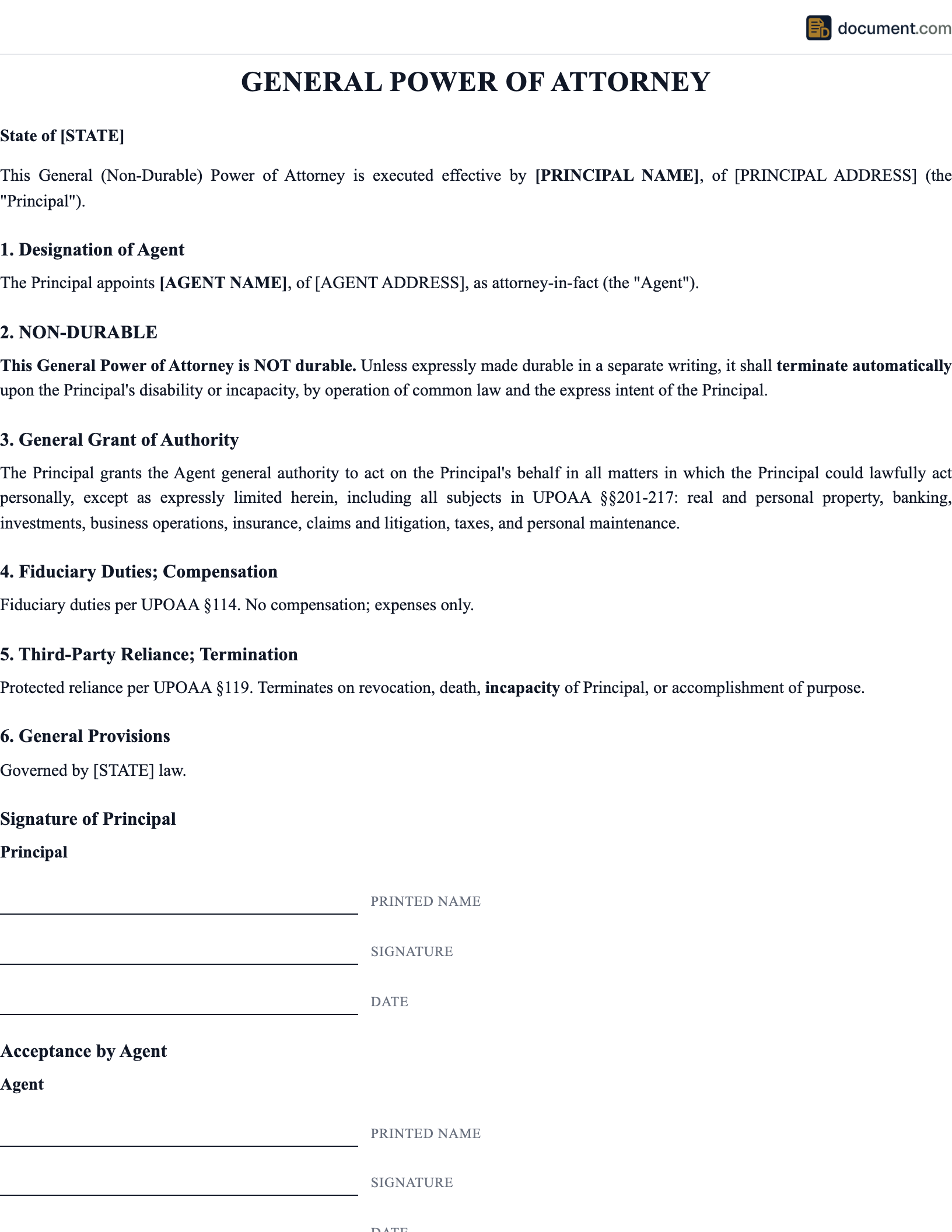
Sample California Power of Attorney
This preview follows the structure of California's Probate Code §4401 statutory form. Your completed document will include only the categories of authority you select.
STATE OF CALIFORNIA
UNIFORM STATUTORY FORM POWER OF ATTORNEY
Probate Code §4401
PRINCIPAL:
Name: [Principal Name]
Address: [California Address]
AGENT (Attorney-in-Fact):
Name: [Agent Name]
Address: [Agent Address]
CATEGORIES OF AUTHORITY (Initial all that apply)
[13 statutory categories]
SPECIAL INSTRUCTIONS
[Community property, digital assets, gifting authority]
California Power of Attorney FAQ
Answers to the questions California residents ask most, covering the statutory form, community property, healthcare directives, and digital assets.
Official California Resources
Review the Probate Code text, find your county recorder, and access the statutory form through these state resources.
Create your California Power of Attorney in under 5 minutes.
Answer a few questions and download a California-compliant document, ready for the state agency.