
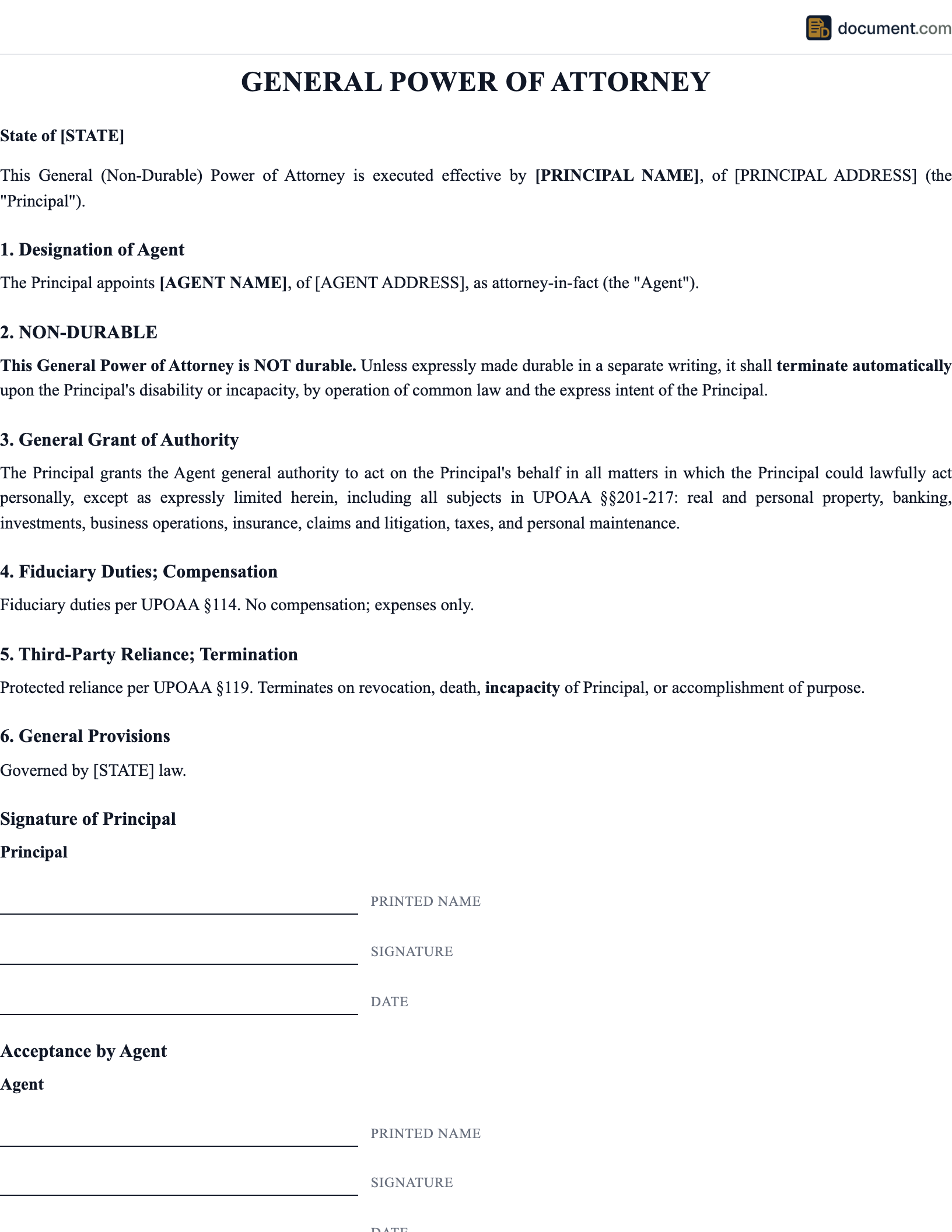



Texas: The Nation's Most Comprehensive POA Framework
Texas adopted a variant of the Uniform Power of Attorney Act through the Estates Code, Subtitle P, Chapters 751 through 753 — and then went further than most states by providing an actual statutory durable power of attorney form in Chapter 752. The form includes a structured checklist of powers that the principal can grant or withhold, covering real property, tangible personal property, stocks and bonds, commodities and options, banking, insurance, retirement plans, taxes, gifts, and more. Because it is codified in statute, the Ch. 752 form carries a presumption of validity that custom-drafted documents do not enjoy.
Perhaps the most important feature of Texas POA law is the durable-by-default rule. Under Estates Code §751.00201, every power of attorney executed in Texas is presumed durable — the agent's authority survives the principal's incapacity — unless the document expressly states otherwise. This is the opposite approach from states like Tennessee and Vermont, where durability must be affirmatively elected. Combined with the third-party acceptance enforcement under §751.201, Texas gives principals and their agents one of the strongest legal positions in the country.
Texas is also a community property state, which injects an additional layer of complexity into POA planning. A POA from one spouse does not automatically grant authority over the other spouse's community property interest. Real estate POAs must be recorded in the deed records of the county where the property is located — and with 254 counties, that can mean multiple filings. Healthcare authority is handled separately under Health & Safety Code Chapter 166, which provides for both a medical POA and a Directive to Physicians (living will).
Durable
By default
Statutory
Ch. 752 form
Community
Property state
254
Counties
Energy & Mineral Rights: POA for Texas's Oil Country
Texas sits atop the Permian Basin, Eagle Ford Shale, Barnett Shale, and Haynesville Shale — producing more oil and natural gas than any other state and more than most countries. For landowners with mineral rights, a power of attorney is not just an estate planning document — it is an operational necessity. If you become unavailable or incapacitated, someone needs to sign leases, execute division orders, and collect royalty checks.
Mineral Rights Warning
Texas landmen, operators, and title companies in the Permian Basin and Eagle Ford will reject a POA that does not explicitly grant mineral rights authority. A generic "all financial matters" clause is not sufficient. The POA must specifically authorize the agent to execute oil and gas leases, sign division orders, consent to pooling and unitization, and handle Texas Railroad Commission filings. Without these provisions, royalties may be held in suspense and lease negotiations may stall.
Essential Mineral Rights POA Provisions
- Oil & Gas Lease Execution: Authority to negotiate terms, sign primary and secondary leases, and agree to lease modifications
- Division Order Signing: Authority to execute division orders that direct how royalty payments are distributed among interest holders
- Pooling and Unitization: Authority to consent to pooling agreements that combine multiple tracts for drilling and production
- Railroad Commission Filings: Authority to file and respond to Texas Railroad Commission forms, including P-12 and W-2 certificates
- Pipeline Easements: Authority to negotiate and sign surface use agreements and pipeline right-of-way easements
- Royalty Management: Authority to collect royalty payments, manage royalty suspense accounts, and handle underpayment disputes
9 Types of Texas Power of Attorney
Texas offers both the statutory durable form under Estates Code Ch. 752 and customized POA documents. The statutory form is widely accepted and reduces third-party resistance, but principals with complex needs — mineral interests, ranch operations, community property — may benefit from supplemental provisions. Select the type that matches your situation.
General Power of Attorney
Broad authority under Estates Code Ch. 751 — Texas presumes durability unless the document states otherwise
Durable Power of Attorney
Uses the Ch. 752 statutory form with a checklist of grantable powers and durable-by-default protection
Limited/Special Power of Attorney
Confines authority to specific acts — frequently used for mineral lease signings and ranch closings across TX's 254 counties
Medical/Healthcare Power of Attorney
Governed separately by Health & Safety Code Ch. 166 — distinct from the Directive to Physicians
Financial Power of Attorney
Covers banking, oil royalty management, tax matters, and community property transactions
Springing Power of Attorney
Activates upon a defined event — Texas Estates Code permits springing provisions within the statutory form
Minor Child Power of Attorney
Delegates temporary parental authority under Family Code §34.0015 — common during military deployments from TX bases
Real Estate Power of Attorney
Must be recorded in county deed records and should specify authority over community and separate property
Vehicle Power of Attorney
Authorizes title transfers and registration through the TxDMV using Form VTR-271
Texas Estates Code Execution Requirements
Texas POA requirements come from the Estates Code (Chapters 751-753) for financial powers and the Health & Safety Code (Chapter 166) for medical powers. The Estates Code provides both mandatory execution rules and default provisions that apply unless the document states otherwise.
Durable by Default — Unlike Most States
Under Estates Code §751.00201, every Texas POA is durable unless the document expressly provides otherwise. You do not need special durability language — durability is the default. If you want a non-durable POA (one that terminates upon incapacity), you must affirmatively state that intention. Additionally, §751.201 imposes liability on third parties who unreasonably refuse to accept a valid POA, making Texas one of the strongest states for POA enforcement.
Execution Requirements
- Written Instrument: Must be in writing — oral grants of authority are not enforceable for POA purposes in Texas
- Signature: Signed by the principal (must be 18+, or married, or an active-duty military member)
- Notarization: Acknowledged before a Texas notary public — mandatory for financial POAs
- Recording for Real Estate: Must be filed in the county clerk's deed records for the county where the property is located
- Agent Certification: Under §751.203, the agent can provide a written certification affirming the POA's validity when presenting it to third parties
Agent Duties Under Estates Code §751.101
- Act in good faith, within the scope of authority granted, and in the principal's best interest
- Maintain records of all receipts, disbursements, and transactions conducted on the principal's behalf
- Keep the principal's property separate from the agent's own property unless commingling is expressly authorized
- Cooperate with the principal's healthcare agent if a medical POA exists
How to Create a Texas Power of Attorney
From Houston to El Paso, Dallas to the Rio Grande Valley, the process follows the same Estates Code framework — but the details depend on your specific assets and circumstances.
Select POA Type and Customize the Authority
Start with the Ch. 752 statutory form and check the applicable powers. Add supplemental provisions for mineral rights, community property, ranch operations, or any other Texas-specific needs. Name the principal, agent, and any successor agents. The form is durable by default, so no special durability clause is needed.
Execute Before a Texas Notary Public
The principal must sign before a notary. Texas allows Remote Online Notarization. Bring government-issued ID. For a medical POA under Health & Safety Code Ch. 166, you will also need two competent adult witnesses (who are not the agent, the principal's healthcare provider, or an employee of the provider).
Record, Distribute, and Enforce
Record the POA in the deed records of every county where you own real estate or mineral interests. Deliver copies to financial institutions, oil companies, ranch managers, and healthcare providers. If any third party refuses to accept the POA, invoke §751.201 — the agent can provide a written certification and, if necessary, seek a court order compelling acceptance.
Sample Texas Statutory Durable POA
This preview reflects the structure of the Estates Code Chapter 752 statutory form. The final document includes the powers checklist, community property provisions, mineral rights addendum, and notary acknowledgment.
STATE OF TEXAS
STATUTORY DURABLE POWER OF ATTORNEY
Estates Code, Chapter 752
PRINCIPAL:
Name: [Full Legal Name]
Address: [Texas Address]
County: [TX County]
AGENT (Attorney-in-Fact):
Name: [Full Legal Name]
Address: [Agent Address]
Successor Agent: [If Any]
GRANT OF AUTHORITY (Checklist)
Real Property: [Yes/No] | Banking: [Yes/No]
Mineral Rights: [Yes/No] | Insurance: [Yes/No]
Community Property: Addressed per Texas law
Governing Law: State of Texas, Estates Code Subtitle P
Texas Power of Attorney FAQ
Common questions from Texas residents about the statutory form, third-party enforcement, community property, mineral rights, and cross-county filing requirements.
Official Texas Resources
Verify statutory language, find a notary, or locate your county clerk through these official Texas state resources.
Other Texas Legal Documents
Round out your Texas estate plan with these complementary legal documents, each customized for TX law.
Create your Texas Power of Attorney in under 5 minutes.
Answer a few questions and download a Texas-compliant document, ready for the state agency.