
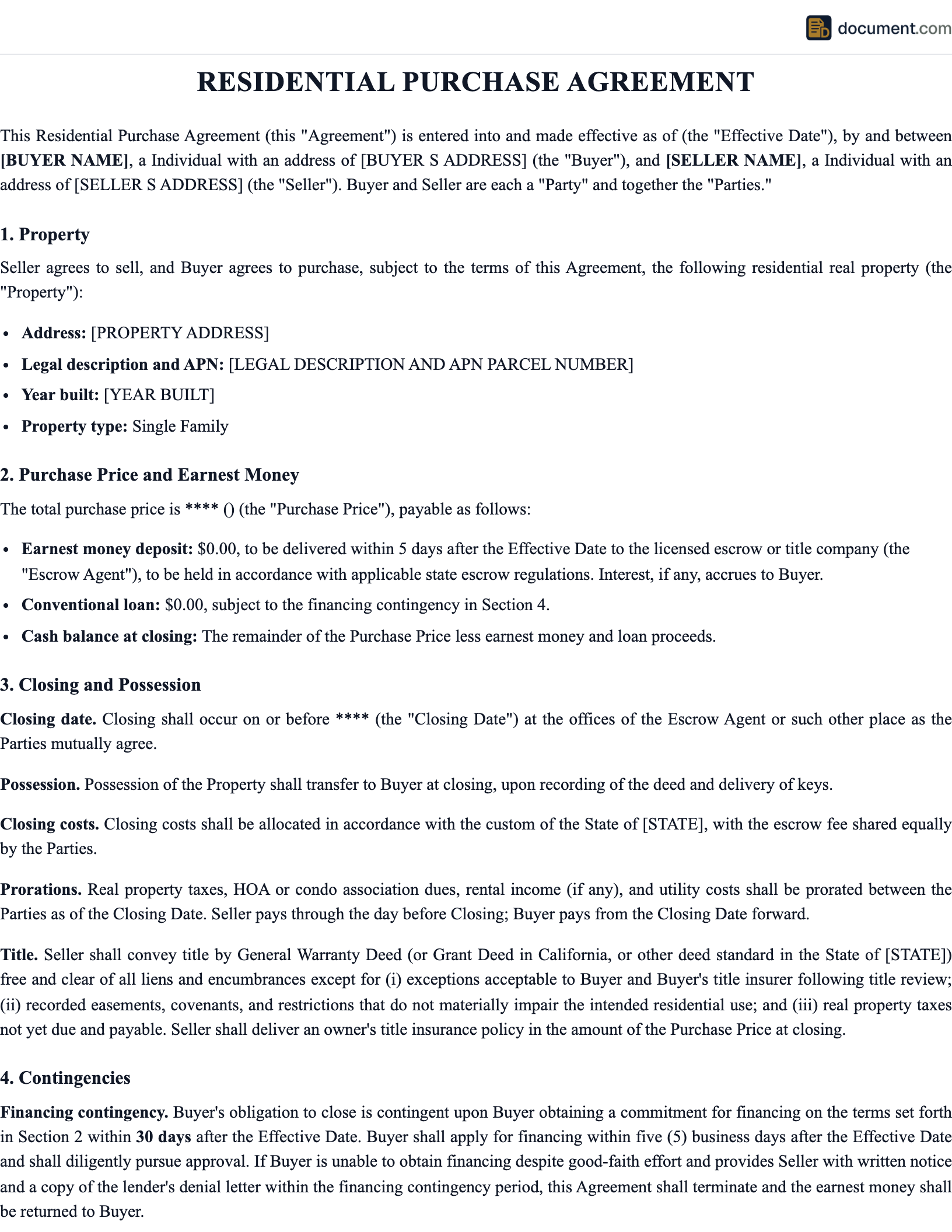



Texas Residential Purchase Agreement Overview
A residential purchase agreement in Texas is a legally binding contract between a buyer and seller that outlines all terms and conditions for the sale of residential real property within the state. Texas real estate transactions are governed by Texas Occupations Code Title 7, Chapter 1101, which establishes the legal framework for property transfers, agent licensing, and consumer protections.
Texas does not require attorney involvement in real estate closings, though many buyers and sellers choose to hire one for added protection. The Texas Real Estate Commission oversees real estate licensing and regulation in the state, ensuring that agents and brokers meet professional standards and comply with state law.
Whether you are buying your first home, upgrading to a larger property, or purchasing investment real estate in Texas, a well-drafted purchase agreement protects both parties by clearly defining the purchase price, earnest money, contingencies, closing date, and all rights and obligations throughout the transaction. Our Texas-specific template addresses all state requirements and local customs.
Texas Real Estate Quick Facts
None
Transfer tax rate
No
Attorney state
Mandatory TREC disclosure form
Disclosure requirements
$3,654
Avg. closing costs
Texas Real Estate Laws
Real estate transactions in Texas are governed by a combination of state statutes, regulations, and common law principles. The primary statutory framework is found in Texas Occupations Code Title 7, Chapter 1101. Key aspects of Texas real estate law that affect residential purchase agreements include:
- Contract Formation: Texas requires a written contract signed by both parties for real estate transactions to be enforceable under the statute of frauds. The contract must include the essential terms: parties, property description, price, and closing date.
- Agency Relationships: Texas law requires real estate agents to disclose their agency relationship (buyer's agent, seller's agent, or dual agent) at the earliest practical opportunity. The Texas Real Estate Commission enforces agent licensing and ethical standards.
- Earnest Money: Texas law governs how earnest money deposits are held in escrow, the conditions for release, and the procedures for resolving disputes over earnest money when a transaction falls through.
- Property Condition: Texas requires sellers to complete a property condition disclosure form detailing known defects, environmental hazards, and other material facts about the property.
- Closing Requirements: Texas allows closings to be conducted by title companies, escrow agents, or attorneys. The choice depends on local custom and the parties\' preferences.
Required Seller Disclosures in Texas
Texas requires sellers to complete a mandatory property condition disclosure form before or at the time of signing the purchase agreement. This disclosure covers the property's physical condition, systems, environmental hazards, and other material facts that could affect the buyer's decision.
Federal Lead Paint Disclosure (Pre-1978 Homes)
Regardless of Texas state law, federal regulations require sellers of homes built before 1978 to disclose known lead-based paint hazards, provide available lead inspection reports, and give buyers a 10-day opportunity to conduct a lead-based paint inspection. This is a non-negotiable federal requirement that applies in all 50 states.
Structural Condition
Foundation, roof, walls, floors, ceilings, windows, doors
Water & Sewer
Plumbing, water source, sewer/septic, water heater, drainage
HVAC & Electrical
Heating, cooling, electrical panel, wiring, insulation
Environmental Hazards
Lead paint, asbestos, radon, mold, underground tanks
Flood & Natural Hazards
Flood zone status, past flooding, drainage issues, soil stability
Legal & HOA
HOA fees, pending litigation, easements, boundary disputes, liens
Texas Closing Process
The real estate closing process in Texas typically takes 30-45 days from the date both parties sign the purchase agreement. Closings in Texas are typically handled by title companies or escrow agents, though buyers and sellers may choose to engage attorneys for additional protection.
Execute Purchase Agreement
Both parties sign the purchase agreement, and earnest money is deposited into escrow within 1-3 business days
Home Inspection & Due Diligence
Buyer conducts home inspection, reviews seller disclosures, and investigates property condition within the contingency period
Appraisal & Title Search
Lender orders appraisal to verify property value; title company conducts title search and issues title commitment
Loan Approval & Clear to Close
Lender completes underwriting and issues clear-to-close; buyer receives Closing Disclosure at least 3 business days before closing
Final Walkthrough
Buyer conducts final walkthrough 24-48 hours before closing to verify property condition and agreed-upon repairs
Closing Day
Sign closing documents, transfer funds, record deed at Texas county recorder's office, and receive keys
Texas Transfer Taxes & Closing Costs
Texas is one of the states that does not impose a state-level real estate transfer tax, which can save buyers and sellers significantly on closing costs. Average total closing costs in Texas are approximately $3,654 (excluding lender fees) for a median-priced home.
| Fee / Tax | Typical Amount |
|---|---|
| State Transfer Tax | None |
| Recording Fees | $50 - $250 |
| Title Insurance (Lender's) | $500 - $1,500 |
| Title Insurance (Owner's) | $500 - $2,000 |
| Escrow / Settlement Fee | $500 - $1,500 |
| Appraisal Fee | $300 - $600 |
| Home Inspection | $300 - $500 |
Texas Title Insurance Requirements
Title insurance is a critical component of any real estate transaction in Texas. While not legally mandated for all transactions, virtually all mortgage lenders require a lender's title insurance policy as a condition of the loan. An owner's title insurance policy is optional but provides important protection for the buyer's equity.
In Texas, the title company or attorney conducts a thorough search of public records to identify any liens, encumbrances, easements, or defects that could affect the title. Common issues discovered during title searches include unpaid property taxes, mechanic's liens, judgment liens, HOA liens, boundary disputes, and recording errors. Title insurance protects against losses from these and other title defects, including those not discoverable through the public record search.
Important: Owner's Title Insurance
The lender's title insurance policy only protects the lender's interest — not yours. An owner's title insurance policy protects your full equity in the property for as long as you own it (or have liability from ownership). The one-time premium typically costs $500-$2,000 and is one of the best investments you can make in a real estate transaction.
Texas Residential Purchase Agreement FAQ
Answers to common questions about residential purchase agreements, the closing process, and real estate laws in Texas.
Official Texas Resources
Use these official resources to verify Texas real estate requirements, find licensed professionals, and access state-specific forms and regulations.
Texas Real Estate Commission
Licensing, regulations, and consumer resources
CFPB — Owning a Home
Federal home buying resources and mortgage tools
HUD — Buying a Home
Federal housing resources, counseling, and assistance programs
EPA — Lead Paint Information
Federal lead paint disclosure requirements and safety
Create your Texas Residential Purchase Agreement in under 5 minutes.
Answer a few questions and download a Texas-compliant document, ready for the state agency.