



What Is a Commercial Purchase Agreement?
A commercial real estate purchase agreement (also called a commercial contract of sale, commercial purchase and sale agreement, or CRE purchase agreement) is a legally binding contract between a buyer and seller that governs the acquisition of commercial property — including office buildings, retail centers, industrial warehouses, multifamily apartment complexes (5+ units), hotels, and mixed-use developments.
Commercial purchase agreements are substantially more complex than residential contracts due to the larger transaction values, income-producing nature of commercial properties, environmental liability concerns, complex zoning requirements, and sophisticated financing structures involved. A well-drafted commercial purchase agreement addresses due diligence periods, environmental assessment requirements, tenant estoppel certificates, representations and warranties, prorations and adjustments, and detailed closing conditions.
Because commercial real estate transactions involve significant capital and potential liabilities (including environmental cleanup costs that can exceed the property value), it is critical that the purchase agreement is comprehensive, state-compliant, and reviewed by experienced commercial real estate counsel. Our state-specific templates provide a strong foundation that addresses the unique requirements of each jurisdiction.
All Property Types
Office, retail, industrial, multifamily, hotel, and mixed-use properties
Environmental Protection
Phase I/II ESA provisions and CERCLA liability protections
Financial Analysis
NOI verification, cap rate analysis, and rent roll review provisions
Commercial Purchase Agreement by State
Commercial real estate laws vary significantly by state — from transfer tax rates and environmental regulations to zoning authority and 1031 exchange facilitation. Select your state below for a commercial purchase agreement template that meets your jurisdiction's specific requirements.
Due Diligence Periods in Commercial Transactions
The due diligence period is arguably the most critical phase of a commercial real estate transaction. Unlike residential purchases where inspections may take 7-14 days, commercial due diligence typically requires 30-90 days to thoroughly investigate the property's physical condition, financial performance, legal compliance, and environmental status.
During the due diligence period, the buyer has the right to inspect the property, review financial records, analyze tenant leases, obtain environmental assessments, verify zoning compliance, and conduct any other investigations necessary to make an informed purchase decision. Most commercial purchase agreements give the buyer the unilateral right to terminate the contract during the due diligence period for any reason (or no reason) and receive a full refund of the earnest money deposit.
Physical Inspection (Days 1-30)
Engage qualified commercial inspectors to evaluate the building's structural integrity, HVAC systems, roofing, plumbing, electrical, elevators, fire safety systems, parking structures, and ADA compliance. For older buildings, assess potential asbestos, lead paint, and outdated building systems. Commercial property condition assessments (PCAs) are more comprehensive than residential inspections and typically cost $5,000-$25,000 depending on property size and complexity. The inspector should provide a capital expenditure projection estimating future repair and replacement costs.
Financial Analysis (Days 1-45)
Review 3-5 years of operating statements, tax returns, rent rolls, and utility bills. Verify current rental income against tenant leases. Analyze operating expenses, property management costs, capital expenditures, and vacancy rates. Calculate the actual Net Operating Income (NOI) and compare it to the seller's representations. Evaluate the debt service coverage ratio (DSCR) to ensure the property's income adequately covers mortgage payments. Identify any below-market or above-market leases that could affect future income.
Legal Review (Days 15-60)
Review all existing tenant leases, service contracts, management agreements, warranties, and permits. Examine the title commitment for liens, easements, encumbrances, and restrictions. Verify zoning compliance and any nonconforming use status. Review all pending or threatened litigation affecting the property. Evaluate CC&Rs, operating agreements, and any reciprocal easement agreements (REAs) for multi-tenant properties. Confirm compliance with all building codes, fire codes, and ADA requirements.
Environmental Assessment (Days 1-45)
Order a Phase I Environmental Site Assessment to identify potential contamination risks. If the Phase I reveals Recognized Environmental Conditions (RECs), proceed with Phase II testing (soil borings, groundwater sampling). Environmental contamination can result in cleanup costs that exceed the property value, and under CERCLA, the current property owner can be held liable regardless of who caused the contamination. A clean Phase I ESA provides the "innocent landowner" defense.
Environmental Assessments (Phase I & Phase II)
Environmental due diligence is non-negotiable in commercial real estate transactions. The Comprehensive Environmental Response, Compensation, and Liability Act (CERCLA) imposes strict, joint, and several liability on property owners for environmental contamination — meaning you can be held responsible for cleanup costs even if the contamination predates your ownership. A Phase I ESA is your primary defense.
Critical: CERCLA Liability
Under federal CERCLA law, the current property owner is strictly liable for environmental contamination regardless of fault. Cleanup costs can range from $100,000 to tens of millions of dollars. A properly conducted Phase I ESA (following ASTM E1527-21 standards) provides the "All Appropriate Inquiries" defense, which may shield you from CERCLA liability for pre-existing contamination. Never skip the Phase I ESA on a commercial acquisition.
| Assessment | What It Covers | Typical Cost | Timeline |
|---|---|---|---|
| Phase I ESA | Historical review, regulatory database search, site inspection — no sampling | $2,000 - $6,000 | 3-6 weeks |
| Phase II ESA | Soil borings, groundwater sampling, lab analysis of contaminants | $10,000 - $50,000+ | 4-8 weeks |
| Phase III (Remediation) | Cleanup plan development and execution if contamination is confirmed | $100,000 - $10M+ | Months to years |
Zoning Compliance
Zoning compliance is a fundamental consideration in any commercial property acquisition. Zoning laws govern how land can be used, what types of structures can be built, building heights, setbacks, parking requirements, signage, and density. Purchasing a property without verifying zoning compliance can result in an inability to operate your intended business, costly variance applications, or forced modifications.
Your commercial purchase agreement should include a zoning contingency that gives you time to verify the property's zoning classification and confirm that your intended use is permitted. Key areas to investigate include the current zoning designation, permitted and conditional uses, any nonconforming use status, floor area ratio (FAR) limits, parking requirements, sign regulations, and any planned zoning changes in the area.
Permitted Uses
Uses allowed "as of right" under the current zoning classification without requiring special approval. For example, a property zoned C-2 (General Commercial) may permit retail, office, and restaurant uses as of right.
Conditional / Special Use
Uses that may be allowed in a zoning district but require a special approval process (public hearing, planning commission review). Approval is not guaranteed, may take months, and often comes with conditions.
Nonconforming Use
A use that was legal when established but is no longer permitted under current zoning. "Grandfathered" uses may continue but typically cannot be expanded, and may be lost if the use is abandoned for a specified period (often 6-12 months).
Variance
An exception granted by the zoning board to deviate from specific zoning requirements (setbacks, height, parking). Requires demonstrating a hardship and that the variance will not adversely affect the neighborhood. Not guaranteed.
Tenant Estoppel Certificates
When purchasing an income-producing commercial property, tenant estoppel certificates are essential documents that verify the terms of each tenant's lease directly from the tenant. An estoppel certificate is a signed statement from the tenant confirming key lease information and the current status of the landlord-tenant relationship.
The purchase agreement should specify the seller's obligation to deliver tenant estoppel certificates within a defined timeframe (typically 15-30 days before closing). It should also establish what percentage of tenants must return estoppel certificates for the closing to proceed — commonly 75-80% of tenants by occupied square footage, including all major tenants (anchor tenants). If the required estoppels are not obtained, the buyer may have the right to terminate the contract or extend the closing date.
Key Information in a Tenant Estoppel Certificate
- Lease Dates: Commencement date, expiration date, and any renewal options
- Rent Amount: Current base rent, scheduled escalations, and any percentage rent
- Security Deposit: Amount held by landlord and any letters of credit
- Prepaid Rent: Any rent paid in advance beyond the current month
- CAM/NNN Obligations: Common area maintenance, tax, and insurance responsibilities
- Landlord Defaults: Any claimed defaults by the landlord or outstanding maintenance issues
- Lease Amendments: Confirmation of all amendments and side agreements
Commercial Financing, Cap Rates & NOI
Commercial real estate financing operates fundamentally differently from residential mortgages. Lenders underwrite commercial loans primarily based on the property's income potential rather than the borrower's personal income. Understanding cap rates, Net Operating Income (NOI), and debt service coverage ratios (DSCR) is essential for evaluating commercial properties and securing financing.
NOI
Net Operating Income = Gross Income - Operating Expenses (excludes debt service and depreciation)
Cap Rate
Capitalization Rate = NOI / Purchase Price (measures return independent of financing)
DSCR
Debt Service Coverage Ratio = NOI / Annual Debt Service (lenders require 1.20-1.50x)
| Loan Type | Typical LTV | Term | Best For |
|---|---|---|---|
| Conventional Bank | 65-75% | 5-10 year (25yr amort) | Stabilized properties, strong borrowers |
| SBA 504 | Up to 90% | 10-25 year fixed | Owner-occupied properties |
| CMBS (Conduit) | 65-75% | 5-10 year fixed | Larger stabilized properties ($2M+) |
| Bridge Loan | 65-80% | 1-3 year (interest-only) | Value-add, transitional properties |
| Hard Money | 50-70% | 6-24 months | Quick close, renovation projects |
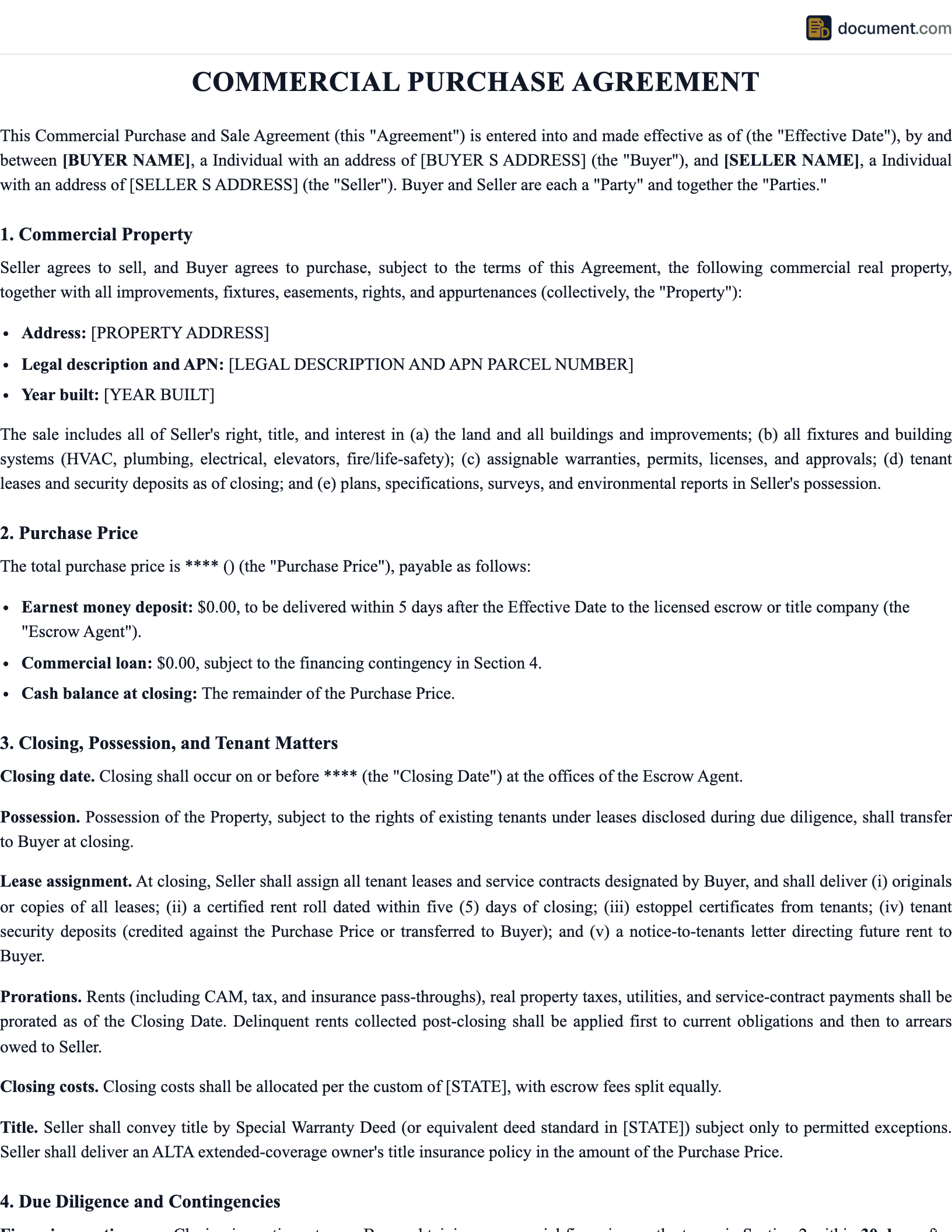
Form Preview: Commercial Purchase Agreement
Below is a preview of our commercial purchase agreement template. Your customized document will include all provisions required for your state, with comprehensive due diligence, environmental, and financing language.
COMMERCIAL REAL ESTATE PURCHASE AND SALE AGREEMENT
This Agreement is entered into as of the Effective Date set forth below
This Commercial Real Estate Purchase and Sale Agreement ("Agreement") is entered into on[Date]between:
BUYER:
Entity Name: ABC Investments, LLC
Contact: Michael Johnson, Managing Member
Address: 100 Commerce Blvd, Suite 200
SELLER:
Entity Name: XYZ Properties, Inc.
Contact: Sarah Williams, President
Address: 250 Market Street, Suite 400
1. PROPERTY
Address: 500 Industrial Parkway
Type: Multi-Tenant Office Building
Size: 45,000 SFParcel: 987-654-321
2. PURCHASE PRICE & DEPOSIT
Purchase Price: $4,250,000.00
Earnest Money: $100,000.00
Additional Deposit (after due diligence): $50,000.00
Escrow Agent: Commonwealth Title Co.
3. DUE DILIGENCE & CLOSING
Due Diligence Period: 45 days
Financing Contingency: 30 days after due diligence
Estoppel Delivery Deadline: 15 days before closing
Closing Date: 90 days after execution
Frequently Asked Questions
Find answers to common questions about commercial purchase agreements, due diligence, environmental assessments, and commercial real estate financing.
Create your Commercial Purchase Agreement in under 10 minutes.
Answer a few questions and download a compliant, attorney-drafted document ready for your state.