



One Statute, 88 Counties, Uniform Results
Ohio adopted the Uniform Power of Attorney Act under ORC Chapter 1337, replacing a patchwork of older statutes with a single, coherent framework. For a state with 88 counties — the most of any state east of the Mississippi — this uniformity matters enormously. Whether you are executing a POA in metropolitan Cuyahoga County (Cleveland, population 1.2 million) or rural Vinton County (population 13,000), the same execution requirements apply, the same agent duties are owed, and the same third-party acceptance rules protect the principal and agent.
Ohio's UPOAA presumes durability — meaning a POA remains effective even if the principal becomes incapacitated, unless the document expressly states otherwise. This is a critical distinction from non-UPOAA states like North Dakota, where durability must be explicitly opted into. For Ohio residents doing estate planning, this default gives immediate protection without the need for specific durability language (though including it for clarity is still good practice).
The state's diverse economic landscape — manufacturing in the Rust Belt corridor, agriculture in the western plains, healthcare institutions in Cleveland and Columbus, financial services in Cincinnati, and a growing technology sector throughout — means that POA documents in Ohio must be flexible enough to cover a wide range of transactions. ORC Chapter 1337 provides that flexibility through its comprehensive list of authority categories and the ability to customize grants of power through modifications.
UPOAA
ORC Ch. 1337
Notary
Required
None
Financial POA witnesses
88
County recorders
Healthcare POA for Ohio's World-Class Medical Institutions
Ohio is home to medical institutions that draw patients from around the world. The Cleveland Clinic — consistently ranked among the top hospitals globally and #1 in cardiology for over 25 years — treats hundreds of thousands of patients annually, many of whom travel from out of state or internationally. The Ohio State University Wexner Medical Center in Columbus is a leading academic medical center and the state's largest hospital. Cincinnati Children's Hospital Medical Center is a top-five children's hospital nationally. University Hospitals Cleveland Medical Center, ProMedica in Toledo, and Kettering Health in Dayton round out a healthcare landscape that is unusually dense with high-quality institutions.
For anyone who may receive care at these facilities — whether you are a local resident, an out-of-state patient, or an international visitor — an Ohio-compliant healthcare POA under ORC §1337.12 is essential. The healthcare POA authorizes your designated agent to: consent to or refuse medical treatment; choose or change your healthcare provider or facility; access your medical records under HIPAA; make decisions about life-sustaining treatment, organ donation, and autopsy; and authorize transfers between facilities. The Cleveland Clinic's patient registration process explicitly asks whether patients have a healthcare POA on file, and having one speeds the admission process considerably.
Important distinction: Ohio's healthcare POA (ORC §1337.12) is a separate statute from the financial POA (ORC Chapter 1337 UPOAA). The healthcare POA requires two witnesses, while the financial POA does not require witnesses at all. Many Ohio estate planning attorneys execute both documents at the same appointment, but they are independent instruments with different rules.
The 88-County Recorder System
Ohio's 88 counties each maintain an independent county recorder's office responsible for land records, deeds, mortgages, and — critically for POA purposes — any power of attorney that will be used for real property transactions. If your agent will buy, sell, lease, or mortgage real estate on your behalf, the POA must be recorded in the county where the property is located before the agent can act.
The three largest county recorder offices by volume are Cuyahoga County (Cleveland), Franklin County (Columbus), and Hamilton County (Cincinnati). These offices process thousands of recordings daily and have dedicated staff familiar with POA filings. In contrast, rural county recorders like Noble County, Monroe County, or Harrison County handle far fewer transactions but follow the same legal requirements. Recording fees are governed by ORC §317.32 and are consistent across the state.
A practical consideration for Ohio residents who own property in multiple counties: you must record the POA separately in each county where property is located. If you own a home in Summit County (Akron), a rental property in Lorain County, and a vacation cabin in Hocking County, three separate recordings are required. Each county recorder operates independently, and recording in one county does not create a record in another.
Ohio Power of Attorney Types Under ORC §1337
ORC Chapter 1337 provides a flexible framework for granting authority across a wide range of subjects. Each type below links to an Ohio-specific page with detailed guidance on how that particular POA operates under state law.
General Power of Attorney
Comprehensive authority under ORC §1337 — provides uniform coverage across Ohio's 88 counties from Ashtabula to Hamilton
Durable Power of Attorney
Presumed durable by default under Ohio's UPOAA — survives incapacity unless the document expressly states otherwise
Limited/Special Power of Attorney
Tailored for specific transactions — commonly used for Ohio real estate closings, business asset transfers, and single vehicle deals
Medical/Healthcare Power of Attorney
Governed by ORC §1337.12 — separate from the financial POA, with its own witness requirements and access to Cleveland Clinic, OSU Medical, and UC Health
Financial Power of Attorney
Covers banking, investments, and taxes — strong third-party acceptance provisions under ORC §1337 protect against institutional rejection
Springing Power of Attorney
Activates only upon a specified triggering event — permitted under Ohio's UPOAA with clear conditions for determining the trigger
Minor Child Power of Attorney
Delegates temporary parental authority — used by Ohio military families at Wright-Patterson AFB and families with seasonal work demands
Real Estate Power of Attorney
Must be recorded with the county recorder before use — Ohio's 88-county system means verifying the correct recording office is essential
Vehicle Power of Attorney
Handles Ohio BMV title transfers, registration, and sales — the BMV may also accept its own power of attorney form (BMV 3771)
Ohio POA Execution Requirements
Ohio's execution requirements for financial POAs are relatively lean — notarization only, no witnesses. But the healthcare POA has separate, stricter requirements. Here is what you need for each.
Competent Adult Principal
The principal must be at least 18 years old and have the mental capacity to understand the nature and consequences of granting authority. Ohio probate courts (each of the 88 counties has one) have jurisdiction to determine capacity if a dispute arises.
Written Document
Ohio does not prescribe a mandatory statutory form for financial POAs — you have drafting flexibility. The document must clearly identify the principal, agent, and the scope of authority. ORC Chapter 1337 enumerates specific authority categories that can be granted individually or collectively.
Notarization Required for Financial POA
The principal's signature must be acknowledged before an Ohio notary public. Ohio authorized remote online notarization under ORC §147.62, so principals who cannot appear in person can execute the document via audio-video conference with an approved Ohio notary.
No Witnesses for Financial POA
Ohio does not require witnesses for a financial power of attorney. Notarization alone satisfies the execution requirements under the UPOAA. This makes Ohio's financial POA among the simpler documents to execute properly.
Two Witnesses Required for Healthcare POA
The healthcare POA under ORC §1337.12 requires two adult witnesses. Neither witness can be the agent, the attending physician, or (with limited exceptions) an employee of the facility where the principal is a patient. This is a separate and stricter requirement than the financial POA.
County Recorder Filing for Real Property
Any POA used for real estate transactions must be recorded with the county recorder where the property is located. With 88 counties, it is essential to identify the correct recorder's office. Multi-county property owners must record separately in each county.
Presumed Durable
Under Ohio's UPOAA, a POA is durable by default — it survives the principal's incapacity unless the document expressly provides otherwise. This is a significant protection that eliminates the need for specific durability language (though including it remains best practice).
How to Create Your Ohio Power of Attorney
Our builder generates an ORC Chapter 1337-compliant document with all necessary provisions — whether you need a financial POA for banking and real estate or a healthcare POA for treatment decisions at a major Ohio medical center.
Select POA Type and Define Authority
Choose the type that fits your situation. For financial matters, select from the UPOAA authority categories — real property, banking, business operations, insurance, retirement plans, tax matters, and more. For healthcare, specify the scope of medical decision-making authority. Name your agent and any successor agents.
Review and Verify
Examine the generated document carefully. Confirm that all authority categories match your intent, that the agent's name and address are correct, and that any real estate descriptions are specific enough for the county recorder. If you generated both financial and healthcare POAs, review each independently — they are separate documents with different rules.
Execute and Record
For a financial POA: sign before an Ohio notary public (no witnesses needed). For a healthcare POA: sign before two qualified witnesses (plus notarization for added acceptance). Distribute copies to your agent, banks, healthcare providers, and attorney. Record the financial POA with the county recorder if real property is involved.
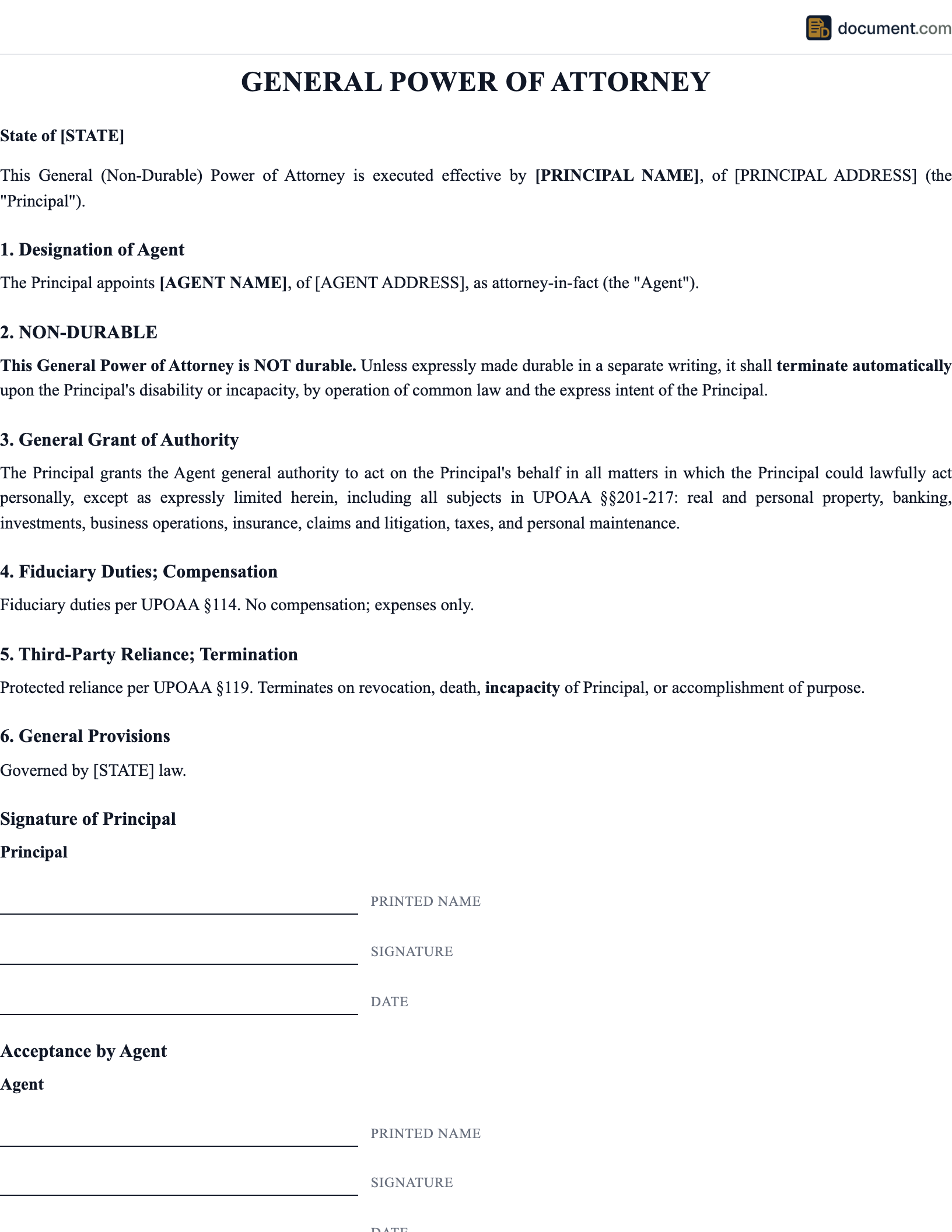
Sample Ohio UPOAA Power of Attorney
This condensed preview shows the structure of an Ohio financial POA under ORC Chapter 1337. Your completed document will include all authority categories, agent duty provisions, third-party acceptance language, and county-recorder-ready formatting.
OHIO POWER OF ATTORNEY
Executed Pursuant to ORC Chapter 1337 (Uniform Power of Attorney Act)
ARTICLE I: DESIGNATION OF AGENT
I, _________________________ ("Principal"), a resident of _____________ County, State of Ohio, hereby designate _________________________ ("Agent"), residing at _________________________, as my attorney-in-fact.
ARTICLE II: GRANT OF AUTHORITY
I authorize my Agent to act on my behalf with respect to the following subjects:
[ ] Real Property [ ] Tangible Personal Property [ ] Stocks and Bonds
[ ] Financial Institutions [ ] Business Operations [ ] Insurance
[ ] Estates, Trusts & Other Beneficial Interests [ ] Claims and Litigation
[ ] Personal and Family Maintenance [ ] Government Benefits
[ ] Retirement Plans [ ] Tax Matters [ ] All Subjects
ARTICLE III: DURABILITY
This power of attorney is durable and shall not terminate upon my incapacity, as provided by ORC §1337.24.
ARTICLE IV: AGENT DUTIES
My Agent shall act in good faith, within the authority granted, and in accordance with my reasonable expectations and best interests as required by ORC §1337.34.
Principal Signature: _________________________ Date: _____________
STATE OF OHIO, COUNTY OF _________________________
Acknowledged before me on _____________ by _________________________.
Notary Public: _________________________ Commission Expires: _____________
Ohio POA — Frequently Asked Questions
From county recorder procedures across 88 counties to healthcare POA planning for Cleveland Clinic visits — these are the questions Ohio residents and their families ask most.
Official Ohio Government Resources
Authoritative references for Ohio POA law, county recorder information, healthcare directive forms, and legal aid.
ORC Chapter 1337
Full text of Ohio's UPOAA and healthcare POA statutes
Supreme Court of Ohio
Probate court forms and self-help resources
OH Secretary of State — Notary
Notary search, online notarization, and commission info
Ohio Department of Aging
Elder care resources and POA abuse prevention
Ohio Legal Help
Free legal information and POA guidance for Ohioans
Ohio Dept. of Health
Healthcare directive information and advance care planning
Other Ohio Legal Documents
OH Durable Power of Attorney
Presumed durable under UPOAA — default in Ohio
OH Healthcare Power of Attorney
Two witnesses required — essential for Cleveland Clinic access
OH Financial Power of Attorney
Banking, real estate, and investment management across 88 counties
OH Notary Acknowledgment
Required for all Ohio financial POA documents
Create your Ohio Power of Attorney in under 5 minutes.
Answer a few questions and download a Ohio-compliant document, ready for the state agency.