



Washington's Power of Attorney Act: RCW 11.125
Washington adopted the Uniform Power of Attorney Act under RCW Chapter 11.125, replacing a patchwork of older statutory provisions with a modern, comprehensive framework. The act governs the creation, scope, interpretation, and termination of powers of attorney throughout the state. Washington's version closely tracks the uniform model while incorporating state-specific provisions that reflect Washington's community property system, progressive healthcare laws, and the economic realities of the Pacific Northwest.
Like most UPOAA states, Washington presumes that a power of attorney is durable. Under RCW 11.125.090, your POA continues in effect even if you later become incapacitated — unless the document itself says otherwise. This durability presumption is one of the most important features of the act, because it means your agent can step in precisely when you need them most. For Washington residents who hold significant equity compensation that requires timely action — like stock options approaching expiration or RSUs vesting on a schedule — this continuity is not just convenient, it can be financially critical.
Washington requires notarization for a POA to be valid. The state does not mandate witnesses for a standard financial power of attorney, keeping the execution process efficient. Washington was also an early adopter of remote online notarization (RON), which allows principals to execute documents via secure video conference — a feature that resonated strongly in the state's tech-forward culture, especially during and after the COVID-19 pandemic.
RCW 11.125
UPOAA Adopted
Notarization
Required for validity
No Witnesses
For financial POA
Community
Property state
Digital Assets & Tech Industry POA Considerations
Washington is home to some of the world's largest technology companies — Amazon and Microsoft in the Puget Sound region, Boeing's commercial division, and a thriving startup ecosystem from Seattle to Bellevue to Redmond. The compensation structures at these companies create POA planning challenges that most states never think about. When a significant portion of your net worth is tied up in restricted stock units that vest quarterly, stock options with expiration dates, and employee stock purchase plans with enrollment windows, a generic POA is not enough.
Your Washington POA should explicitly grant authority over equity-based compensation, naming the specific types of instruments you hold (RSUs, ISOs, NQSOs, ESPP shares) and the platforms where they are administered (Fidelity, E*Trade, Morgan Stanley, Schwab). The agent needs to understand the tax implications of exercising options versus letting them expire, selling vested RSUs at market versus holding, and managing supplemental tax withholding. Washington's capital gains excise tax — upheld by the state Supreme Court in March 2023 — adds another layer for large equity transactions exceeding $250,000 in annual gains.
Beyond publicly traded equity, Washington's startup ecosystem generates POA needs around private company shares, SAFEs (Simple Agreements for Future Equity), convertible notes, and LLC membership interests. If you are a founder or early employee holding illiquid equity, your POA agent may need authority to participate in tender offers, secondary sales, or corporate transactions on your behalf. Draft these provisions carefully — once you are incapacitated, it is too late to add authority your agent was never granted.
Tech Equity Types Your Washington POA Should Cover
Restricted Stock Units (RSUs) — vesting schedules
Incentive Stock Options (ISOs) — exercise decisions
Non-Qualified Stock Options (NQSOs) — tax withholding
Employee Stock Purchase Plan (ESPP) — enrollment windows
Private company shares — secondary sales, tender offers
SAFEs and convertible notes — conversion elections
Deferred compensation (NQDC) — distribution elections
Cryptocurrency and digital wallets — access and transfer
Washington State Power of Attorney Types
Washington's UPOAA framework supports nine POA types. Each one below leads to a Washington-specific page with detailed content, statutory references, and a form builder. Many Washington residents — particularly those with community property considerations — benefit from executing multiple types.
General Power of Attorney
Comprehensive authority over financial and legal affairs — used frequently by Washington tech professionals managing complex compensation packages
Durable Power of Attorney
Persists through incapacitation under RCW 11.125.090, the default rule in Washington unless your document states otherwise
Limited/Special Power of Attorney
Confined to a specific transaction or time window — common for Seattle real estate closings when the buyer is traveling internationally
Medical/Healthcare Power of Attorney
Appoints a healthcare agent under Washington's progressive Natural Death Act (RCW 70.122) and Health Care Decisions chapter
Financial Power of Attorney
Covers bank accounts, investment portfolios, RSU vesting schedules, and stock option exercises — built for Washington's equity-heavy compensation culture
Springing Power of Attorney
Becomes effective only upon a defined triggering event — permitted in Washington but requires careful drafting of the activation conditions
Minor Child Power of Attorney
Delegates temporary parental authority to a caregiver — used by Washington families during extended travel or military deployment from JBLM
Real Estate Power of Attorney
Authorizes property transactions recorded with the county auditor — Washington's distinctive recording office for real property instruments
Vehicle Power of Attorney
Permits Washington DOL transactions including title transfers, registration renewals, and vehicle sales across all 39 counties
Washington POA Execution Requirements
Washington's execution rules under RCW 11.125 are streamlined but non-negotiable. The state emphasizes notarization over witnesses, and adds the unique requirement that real property instruments be recorded with the county auditor rather than a county recorder.
County Auditor Recording — Washington's Unique System
Unlike most states where a county recorder or register of deeds handles land records, Washington assigns this function to the county auditor under RCW 65.04. If your POA grants real estate authority, record it with the auditor in the county where the property is located. King County (Seattle) offers online recording submission. Recording fees under RCW 36.18.010 start at approximately $80 for the first page.
- Competent Adult Principal: You must be at least 18 and mentally competent when you sign — Washington law does not allow a guardian to create a POA on behalf of an incapacitated person
- Written Document: All Washington POAs must be in writing — oral authority grants have no legal effect under state law
- Notarized Signature: The principal's signature must be acknowledged before a Washington notary or equivalent officer — RON is available under Washington's electronic notarization rules
- Agent Designation: Clearly identify the agent and any successors by full legal name and contact information
- Community Property Awareness: If you are married, consider how your POA interacts with community property — your agent's authority over jointly held assets may be limited without your spouse's consent
- Voluntary Execution: The principal must sign freely — a POA obtained through undue influence, fraud, or duress is voidable under Washington law
How to Create a Washington Power of Attorney
The process blends Washington's UPOAA requirements with practical considerations unique to the state's economy, property system, and healthcare laws. Follow these steps to create a document that will actually work when your agent needs to use it.
Identify Your Needs and Choose a POA Type
Think about what your agent will need to manage. A tech professional with significant RSU holdings needs explicit authority over equity compensation. A married couple selling community property should coordinate their POAs. A Bellingham resident with Canadian business ties may need both a Washington POA and a BC-compliant instrument. Washington's UPOAA (RCW 11.125.240 through 11.125.340) defines statutory authority categories — reference these or draft custom provisions.
Sign Before a Washington Notary
Have the completed POA notarized by a Washington state notary public. The notary verifies your identity and confirms voluntary execution. Washington's remote online notarization (RON) option is available for principals who cannot appear in person — particularly useful for tech workers traveling internationally or military families at Joint Base Lewis-McChord. Keep the original in a safe location and prepare certified copies for your agent.
Record, Distribute, and Pre-Register
If real property authority is included, record the POA with the county auditor where the property sits. Distribute certified copies to your agent, financial institutions, healthcare providers, and any employer benefits administrator. For equity compensation accounts at Fidelity, E*Trade, or Morgan Stanley, contact the brokerage in advance to register the POA on file. Proactive registration prevents delays when your agent needs to act under time pressure — like exercising options approaching their expiration date.
Sample Washington State Power of Attorney
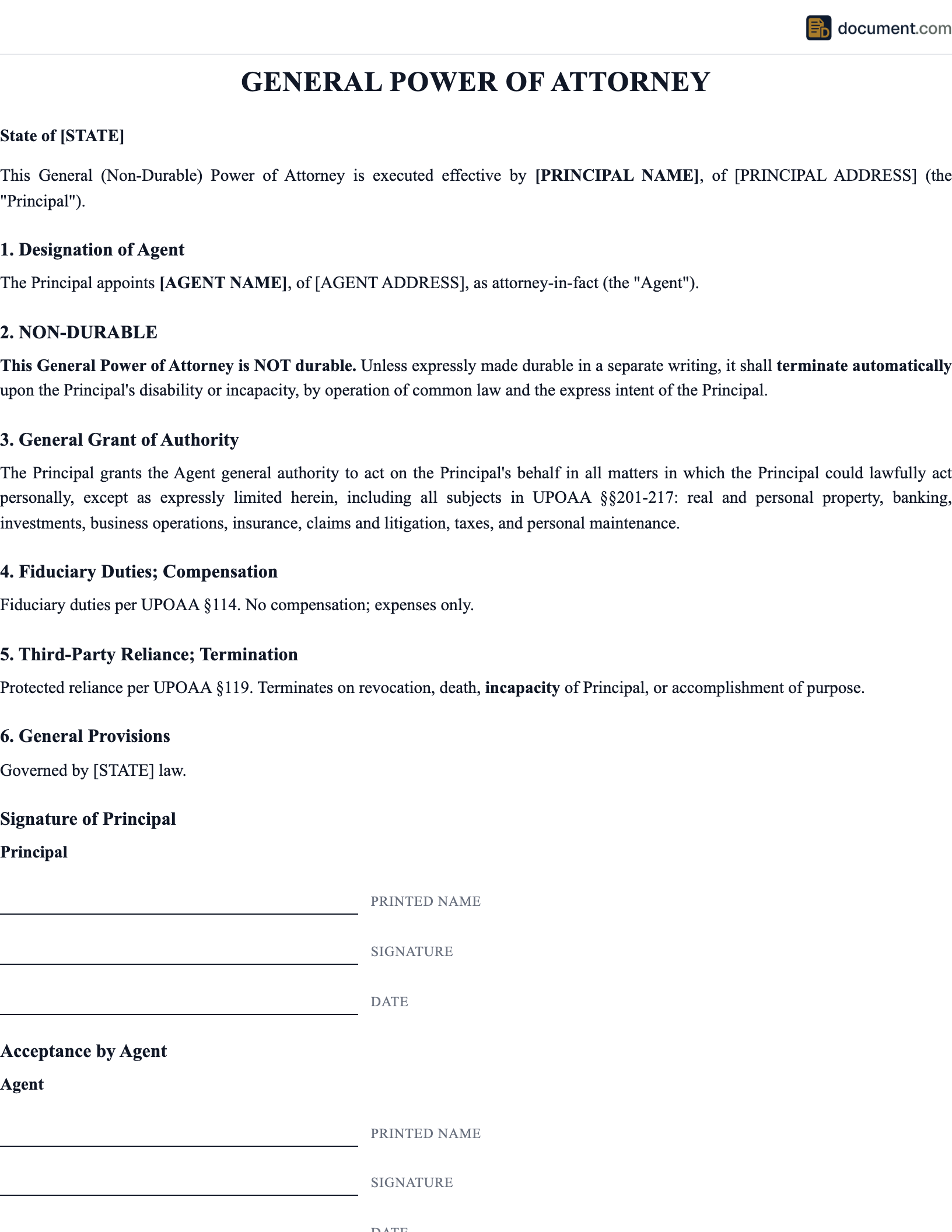
Here is a condensed preview of a Washington-compliant POA. Your final document will include full statutory references, community property acknowledgments where applicable, and comprehensive authority grants under RCW 11.125.
STATE OF WASHINGTON
DURABLE POWER OF ATTORNEY
Pursuant to RCW Chapter 11.125 (Uniform Power of Attorney Act)
PRINCIPAL:
Name: [Full Legal Name]
Address: [Washington Address]
Marital Status: [Status]
AGENT (ATTORNEY-IN-FACT):
Name: [Agent Full Name]
Address: [Agent Address]
Relationship: [Relationship]
GRANT OF AUTHORITY
I, the undersigned Principal, a resident of the State of Washington, hereby designate the above-named Agent as my attorney-in-fact with authority as defined in RCW 11.125.240 through 11.125.340:
Powers Granted: [As Specified]
Community Property Notice: This POA applies to my separate property and my interest in community property as permitted under RCW 26.16.
Durability: This power of attorney shall not terminate upon my incapacity (RCW 11.125.090).
Governing Law: State of Washington
Washington Power of Attorney — Frequently Asked Questions
Practical answers to questions Washington residents commonly ask about POA planning, from community property implications to tech equity management, county auditor recording, and cross-border issues with Canada.
Official Washington State Resources
Authoritative sources for Washington POA law, court procedures, and legal assistance programs available to state residents.
RCW Chapter 11.125
Full text of Washington's Uniform Power of Attorney Act
Washington State Bar Association
Lawyer referral service and legal practice resources
Washington Courts
Court forms, self-help resources, and filing information
Northwest Justice Project
Free civil legal aid for low-income Washington residents
Power of Attorney in Other States
Need a POA for another jurisdiction? Select from our complete state-specific library.
Create your Washington Power of Attorney in under 5 minutes.
Answer a few questions and download a Washington-compliant document, ready for the state agency.