



Oregon's Independent POA Framework Under ORS Chapter 127
Oregon is one of the states that has chosen not to adopt the Uniform Power of Attorney Act. Instead, the state maintains its own statutory framework under ORS Chapter 127, which governs the creation, execution, and scope of financial powers of attorney. Healthcare decision-making authority is handled separately under ORS 127.505 through 127.660, reflecting Oregon's deliberate approach to keeping financial and medical delegation in distinct legal lanes.
What makes Oregon's approach notable is the level of autonomy it gives the principal. Because the state has not adopted the UPOAA's default provisions, there are fewer automatic rules governing agent conduct and third-party acceptance. This means an Oregon POA needs to be more explicit about what the agent can and cannot do. It also means Oregon principals have more flexibility to craft documents that match their specific needs — whether that involves managing a timber tract in Douglas County, operating a Pinot Noir vineyard in the Dundee Hills, or handling a portfolio of rental properties in the Portland metro.
Oregon's progressive stance on healthcare law adds another dimension. The state was a national pioneer with the Death with Dignity Act, and its advance directive laws reflect a deep commitment to patient autonomy. When creating a healthcare POA in Oregon, understanding how the state's advance directive framework interacts with end-of-life decisions is not just good practice — it is essential to ensuring your wishes are carried out exactly as you intend.
Required
Notarization
Not Required
Witnesses (Financial)
Not Adopted
UPOAA
ORS 127
Governing Statute
Advance Directives in Oregon's Progressive Healthcare Framework
Oregon treats healthcare decision-making with a seriousness and nuance that few states match. The appointment of a healthcare representative under ORS 127.505 is not merely a form to fill out — it is a legal instrument that may determine the course of treatment at the most critical moments of your life. Oregon's healthcare representative has authority to consent to or refuse treatment, access medical records, and make decisions about facility placement and post-acute care.
The shadow of the Death with Dignity Act (ORS 127.800-127.897) hangs over every healthcare POA conversation in Oregon. While the Act itself requires the patient to personally make the request — no representative can do so on their behalf — the broader framework it established means that Oregon healthcare providers are trained to look carefully at advance directive documents and honor patient preferences rigorously. This creates both an opportunity and a responsibility: an Oregon healthcare POA that clearly spells out the principal's values, treatment preferences, and comfort care wishes will be taken seriously by every provider in the state.
For Oregon residents outside the Portland-Salem-Eugene corridor, healthcare POAs take on added urgency. In counties like Harney, Lake, Wheeler, and Grant, the nearest full-service hospital may be 75 or more miles away. Emergency medical decisions often need to be made by phone or telehealth, and having a legally authorized healthcare representative who can communicate with providers in real time can be the difference between appropriate treatment and a dangerous delay.
Oregon also recognizes a combined advance directive form that lets you name a healthcare representative and provide instructions about life-sustaining treatment, tube feeding, and comfort measures in a single document. Many Oregonians choose this integrated approach rather than executing separate healthcare POA and living will documents. The Oregon Health Authority provides resources and a standard form, though working with an attorney ensures the document addresses your specific medical situation and family dynamics.
Oregon Power of Attorney Types
Each type of Oregon POA serves a distinct purpose. Select the one that fits your situation to access an Oregon-specific template with detailed guidance and ORS Chapter 127 compliance built in.
General POA
Broad financial and legal authority — often used by Oregon timber owners and vineyard operators who need year-round management coverage
Durable POA
Persists through incapacity under ORS 127.005 — the backbone of most Oregon estate plans, particularly for aging residents in rural counties
Limited / Special POA
Scoped to a single transaction or time period — common for Portland real estate closings or selling a Willamette Valley vineyard parcel
Medical / Healthcare POA
Appoints a healthcare representative under ORS 127.505 — Oregon's progressive healthcare laws make this document especially consequential
Financial POA
Handles banking, investments, and tax filings — tailored for Oregon's income tax structure and timber tax obligations
Springing POA
Activates only upon a specified triggering event — gives Oregon principals full control until a defined contingency occurs
Minor Child POA
Delegates temporary parental authority — used by Oregon parents during seasonal employment, military assignments, or extended travel
Real Estate POA
Authority over property sales, purchases, and leases — must meet Oregon recording requirements at the county clerk's office
Vehicle POA
Handles Oregon DMV title transfers and registrations — used for private vehicle sales, estate vehicles, and fleet management
What Oregon Law Requires for a Valid POA
Oregon's execution requirements differ depending on whether you are creating a financial POA or a healthcare advance directive. Here is what each type demands.
Competent Adult Principal
The principal must be at least 18 years old and capable of understanding the nature and consequences of the delegation. Oregon courts evaluate capacity at the time of signing, not at any later point.
Notarization for Financial POAs
A financial power of attorney must be notarized to be legally effective in Oregon. The notary verifies identity, confirms voluntary signing, and applies their official seal. Oregon notaries are commissioned by the Secretary of State.
Witnesses for Healthcare Advance Directives
Oregon's healthcare advance directive requires either notarization or two witnesses. The witnesses must be adults who are not the appointed healthcare representative. If the principal is a resident of a long-term care facility, one witness must be a qualified individual as defined by ORS 127.515.
Explicit Durability Language Under ORS 127.005
For the POA to survive the principal's incapacity, it must contain language like "this power of attorney is not affected by subsequent disability or incapacity of the principal." Without this clause, authority terminates automatically upon incapacity.
County Clerk Recording for Real Property
If the POA authorizes real estate transactions, it should be recorded with the county clerk in the county where the property is located. Oregon has 36 counties with varying recording requirements and fees. Electronic recording is available in several urban counties.
Specificity of Powers Granted
Because Oregon has not adopted the UPOAA, there are no statutory default powers that automatically attach. Every authority you want the agent to exercise must be explicitly stated in the document. Oregon practitioners generally recommend being more detailed than you might be in a UPOAA state.
Creating an Oregon Power of Attorney Step by Step
Whether you are establishing financial management authority or appointing a healthcare representative, here is how to get it done under Oregon law.
Choose Your POA Type and Define the Scope
Because Oregon lacks UPOAA default rules, the scope of authority must be spelled out in the document itself. Think carefully about every type of transaction the agent may need to handle — from signing a timber harvest contract to paying property taxes to managing a vineyard lease. Our Oregon-specific templates prompt you for these details and generate language that Oregon institutions will recognize and accept.
Execute the Document Properly
For a financial POA, sign before a notary public. For a healthcare advance directive, choose between notarization or two qualified witnesses. If you are executing both documents, many Oregonians handle them in the same sitting for convenience. Notaries are available at banks, law offices, and through mobile services across all 36 Oregon counties.
Record, Distribute, and Inform Key Parties
Record with the county clerk if real property is involved. Deliver copies to your agent, banks, investment firms, and healthcare providers. In Oregon, it is especially important to file a copy of your healthcare advance directive with your primary care provider and any hospital you use regularly, as the Oregon Health Authority maintains a voluntary registry that healthcare providers can check.
Sample Oregon Power of Attorney
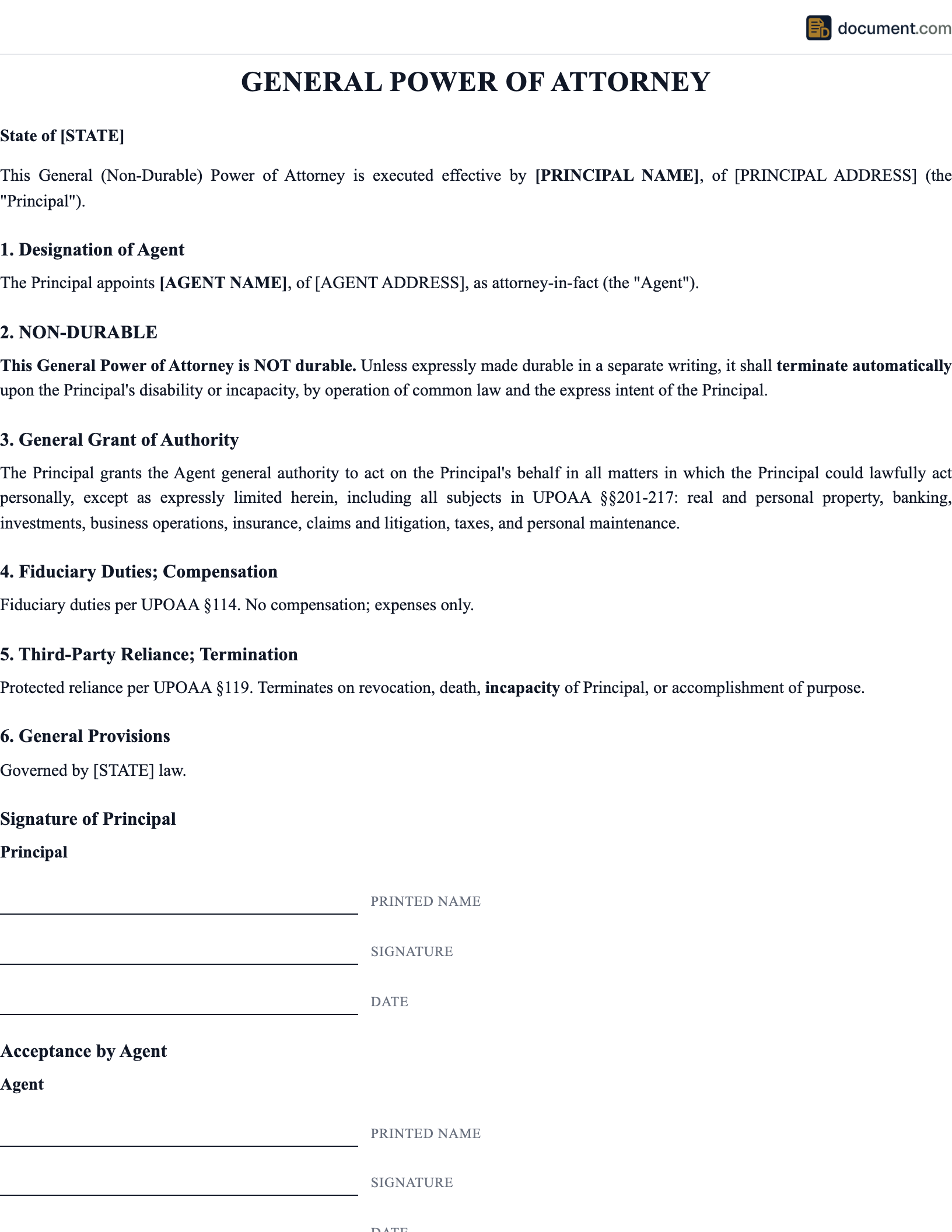
Here is a preview of our Oregon-specific template. The completed document will include all ORS Chapter 127 required provisions and can be customized for timber, vineyard, real estate, or general financial management.
POWER OF ATTORNEY
STATE OF OREGON
Pursuant to ORS Chapter 127
PRINCIPAL:
Name: [Full Legal Name]
Address: [Oregon Address]
County: [County of Residence]
AGENT (ATTORNEY-IN-FACT):
Name: [Agent's Full Legal Name]
Address: [Agent's Address]
Relationship: [Relationship to Principal]
POWERS GRANTED
Type: [General / Durable / Limited / Other]
Scope: [Specific Powers Granted]
Effective Date: [Date or Triggering Event]
Expiration: [Date or Upon Revocation]
Governing Law: State of Oregon, ORS Chapter 127
Oregon POA — Frequently Asked Questions
Practical answers to questions Oregon residents commonly ask about creating and using powers of attorney under ORS Chapter 127 and the state's advance directive framework.
Official Oregon Resources
Access Oregon's statutes, healthcare forms, and state agency guidance through these official sources.
ORS Chapter 127 — Full Text
Oregon's statutory framework for powers of attorney and advance directives
Oregon Health Authority — Advance Directives
State forms, registry information, and healthcare planning resources
Oregon Department of Justice
Elder abuse prevention, consumer protection, and legal resources
Oregon Department of Forestry
Forest Practices Act compliance, timber management, and permit information
Other Oregon Legal Documents
A well-rounded Oregon estate plan typically includes several documents alongside your power of attorney.
Oregon Living Will / Advance Directive
End-of-life treatment preferences under ORS 127.505
Oregon Last Will and Testament
Direct estate distribution including timber, vineyard, and real property
Oregon Promissory Note
Formalize loans with Oregon-compliant payment terms
Oregon Bill of Sale
Record the transfer of vehicles, equipment, or personal property
Create your Oregon Power of Attorney in under 5 minutes.
Answer a few questions and download a Oregon-compliant document, ready for the state agency.