



Why Power of Attorney Planning Is Especially Urgent in Hawaii
Geography defines daily life in Hawaii in ways that most mainland residents never experience. When a medical emergency strikes on Molokai, the nearest trauma center is a helicopter ride away on Oahu. When a Big Island rancher needs to close on a Honolulu investment property but cannot leave during calving season, a power of attorney is the only realistic option. And when a service member at Schofield Barracks receives deployment orders with 72 hours notice, there is no time to circle back and handle unfinished financial business.
Hawaii recognized these realities by adopting the Uniform Power of Attorney Act, codified as HRS Chapter 551E. The statute went into effect to modernize the state's POA framework and bring it in line with national best practices developed by the Uniform Law Commission. Under HRS 551E, a power of attorney in Hawaii requires only the principal's notarized signature — no witnesses are mandated. The act establishes default rules that presume durability (meaning the POA survives incapacity unless the document says otherwise), defines agent fiduciary duties, and creates a mandatory acceptance framework that prevents third parties from arbitrarily rejecting a properly executed document.
For the many Hawaii residents who split time between the islands and the mainland, the UPOAA's reciprocity provisions are equally important. A POA validly executed in another UPOAA state is generally recognized in Hawaii, and vice versa. That seamlessness matters enormously in a state where so many families maintain connections to both island and mainland communities.
Notary Only
No witnesses needed
UPOAA
HRS Chapter 551E
Presumed Durable
Unless stated otherwise
Bureau of Conveyances
Real estate filing office
Multicultural Family Dynamics
Hawaii's population reflects one of the most diverse communities in the United States. Extended family structures — common in Hawaiian, Filipino, Japanese, and Pacific Islander cultures — mean that POA decisions often involve broader family input than on the mainland. Choosing an agent may require balancing the expectations of multiple generations. It is wise to discuss your choice openly with family members and to explain why the designated agent was selected, especially when cultural traditions regarding elder care and family hierarchy play a role. Additionally, if your family speaks a language other than English at home, ensure that the principal fully understands the POA document before signing, as Hawaiian courts may scrutinize whether consent was truly informed.
Inter-Island Considerations for Hawaii POA
Hawaii is the only U.S. state composed entirely of islands, and that geographic reality shapes how powers of attorney are used in practice. A resident of Hana on Maui's remote east side faces a long winding drive just to reach Kahului, let alone travel to Honolulu for a specialized procedure. A Kauai landowner who needs to appear at a Bureau of Conveyances hearing in Honolulu would lose an entire day to flights and ground transport. The POA bridges these logistical gaps.
Medical emergencies highlight the inter-island challenge most starkly. Critical care capabilities are concentrated on Oahu at facilities like Queen's Medical Center, Tripler Army Medical Center, and Kapiolani Medical Center. Patients on neighbor islands frequently require air evacuation, and a healthcare POA ensures that an agent can authorize the transfer, consent to treatment at the receiving facility, and make decisions while the patient is in transit. Without one, physicians at the receiving hospital may face delays in obtaining consent — delays that can be medically dangerous.
Real estate transactions present a different but equally practical challenge. All conveyance documents in Hawaii are recorded centrally through the Bureau of Conveyances in Honolulu — there is no county-level recording system. Whether the property is a coffee farm in Kona, a beachfront lot in Haleiwa, or a condominium in Lahaina, the recording happens at the same Punchbowl Street office. A real estate POA allows an agent on Oahu to handle the recording in person while the principal remains on a neighbor island or the mainland.
Key Inter-Island POA Tips
Power of Attorney Types Available in Hawaii
HRS Chapter 551E supports a wide range of POA structures. Each one below links to a Hawaii-specific template that accounts for the state's unique filing requirements, multicultural family dynamics, and the practical realities of island living.
Hawaii General POA
Sweeping authority across financial and legal affairs — commonly used by snowbirds managing mainland and island assets simultaneously
Hawaii Durable POA
Persists through incapacity — critical on neighbor islands where limited medical facilities may require urgent off-island transfers
Hawaii Limited / Special POA
Tailored to a single transaction such as closing on a Kailua condo or signing a Maui timeshare deed
Hawaii Medical / Healthcare POA
Empowers your agent to authorize treatments, especially when specialists practice only on Oahu
Hawaii Financial POA
Covers banking at local institutions like First Hawaiian Bank, Bank of Hawaii, and military credit unions
Hawaii Springing POA
Lies dormant until a triggering event — popular among military families stationed at Pearl Harbor or Schofield Barracks
Hawaii Minor Child POA
Temporary parental authority for keiki — essential during deployments or extended inter-island work assignments
Hawaii Real Estate POA
Authorizes property transactions filed through the Bureau of Conveyances or Land Court — not county recorders
Hawaii Vehicle POA
Handles DMV title transfers and registration through Hawaii county offices
Executing a Valid POA Under HRS Chapter 551E
Hawaii's execution requirements are streamlined compared to many mainland states. The UPOAA framework deliberately minimized formalities to make POA creation accessible while maintaining strong safeguards against abuse. Here is what you need to know:
- Age and Capacity: The principal must be 18 or older and able to understand the nature and consequences of the document being signed
- Notarization: Mandatory under HRS 551E — the principal signs before a Hawaii-commissioned notary public who verifies identity and willingness
- Witnesses: Not required by statute — Hawaii is a notary-only state for POA execution
- Durability Default: Under the UPOAA, Hawaii POAs are presumed durable unless the document contains express language limiting that durability
- Real Estate Recording: File with the Bureau of Conveyances (regular system) or Land Court (Torrens system) at 1151 Punchbowl Street, Honolulu — include the TMK number
- Agent Acknowledgment: While not legally required, having the agent sign an acceptance of fiduciary duties strengthens the document and signals good faith to third parties
Creating Your Hawaii Power of Attorney: A Practical Walkthrough
Whether you are sitting in a Waikiki high-rise or at a kitchen table in Waimea, the process follows the same path. The goal is a document that Hawaii banks, hospitals, title companies, and the Bureau of Conveyances will accept without pushback.
Identify What You Need Covered
Think through your specific situation. Military deployment? You likely need both a durable financial POA and a healthcare POA. Managing a vacation rental from the mainland? A financial POA with real estate authority is essential. Parent of young children heading overseas? A minor child POA protects your keiki. Hawaii's UPOAA allows you to grant broad or narrow authority, so match the scope to your actual needs.
Pick Your Agent and Successor
In Hawaii's close-knit communities, ohana (family) is often the first choice. But if your family is spread across islands or on the mainland, consider proximity to the institutions that will rely on the POA. An agent on Oahu can walk into the Bureau of Conveyances, visit First Hawaiian Bank branches, or appear at Queen's Medical Center in person. Always name a successor agent — Hawaii's geographic isolation means that if your primary agent becomes unavailable, finding a replacement on short notice can be difficult.
Sign, Notarize, and Distribute
Find a notary — banks throughout Hawaii offer free notary services for account holders, and UPS Store locations on all major islands also provide the service. Sign in the notary's presence. Then distribute certified copies: one to your agent, one to each successor, one to your bank, one to your physician or hospital, and one for your own records. If real estate is involved, record the original with the Bureau of Conveyances and request at least two certified copies back.
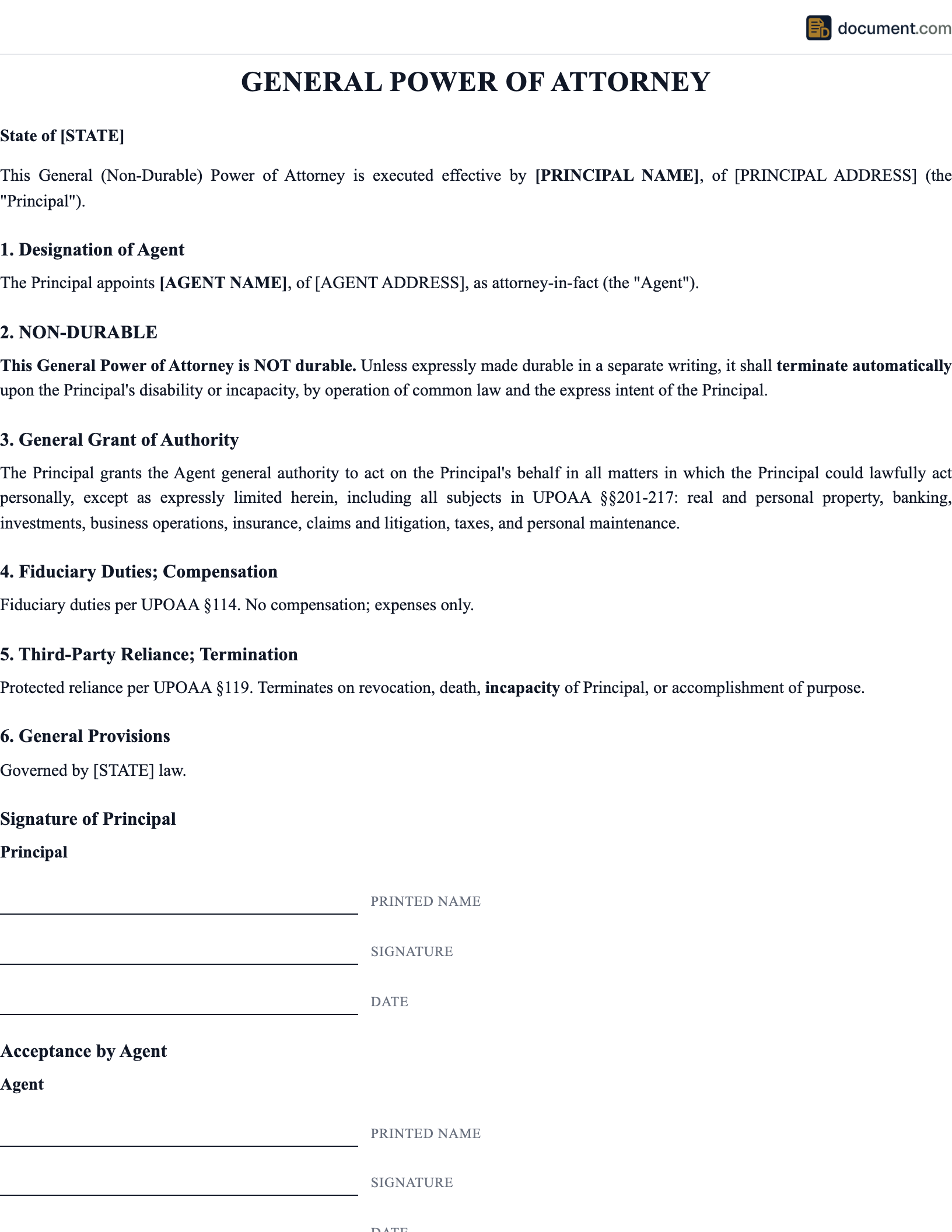
Sample Hawaii POA Document
This preview reflects the structure of a Hawaii-compliant power of attorney built on the HRS Chapter 551E framework. The actual document includes complete recitals, powers enumeration, agent duties acknowledgment, and a notary block formatted for Hawaii notarial practice.
STATE OF HAWAII
POWER OF ATTORNEY
Pursuant to Hawaii Revised Statutes Chapter 551E (UPOAA)
PRINCIPAL (Grantor):
Name: [Full Legal Name]
Address: [Hawaii Street Address, City, HI ZIP]
AGENT (Attorney-in-Fact):
Name: [Agent Full Legal Name]
Address: [Agent Address]
GRANT OF AUTHORITY
I hereby grant my agent the powers designated below, to be exercised in accordance with HRS Chapter 551E:[Selected powers]
Hawaii Power of Attorney: Frequently Asked Questions
Practical answers addressing the scenarios Hawaii residents encounter most often — from Bureau of Conveyances filings to inter-island medical transfers and military deployment planning.
Official Hawaii Government Resources
Verify statutory language, check Bureau of Conveyances filing procedures, and access the full text of Hawaii's UPOAA adoption through these official sources.
Create your Hawaii Power of Attorney in under 5 minutes.
Answer a few questions and download a Hawaii-compliant document, ready for the state agency.