



West Virginia's UPOAA: Chapter 39B and What It Covers
West Virginia adopted the Uniform Power of Attorney Act under W.Va. Code Chapter 39B, bringing the Mountain State into alignment with the national model that provides clear rules for creating, interpreting, and terminating powers of attorney. Before Chapter 39B, West Virginia's POA law was scattered across multiple code sections without a unified framework. The new act changed that, giving West Virginians and the institutions that serve them — from community banks in the coal counties to title companies in the eastern panhandle — a consistent set of rules to follow.
Under Chapter 39B, every power of attorney in West Virginia is presumed durable unless the document says otherwise. This matters enormously in a state where many property owners are elderly and where the closest family member with the ability to manage affairs may live hours away — or in another state entirely. A durable POA means your agent's authority survives your incapacitation, avoiding the need for an expensive and time-consuming guardianship proceeding in circuit court.
West Virginia requires the principal's signature to be notarized for the POA to be legally valid. Witnesses are not mandated for a financial POA under Chapter 39B, though the separate Medical Power of Attorney Act has its own witness requirements. If your POA involves real property or mineral rights — and in West Virginia, it very often does — you should record the document with the county clerk in each county where you hold interests.
Chapter 39B
UPOAA Adopted
Notarization
Required for validity
No Witnesses
For financial POA
55 Counties
County clerk recording
Energy & Natural Resources: The Heart of West Virginia POA Planning
No state in the eastern United States has a deeper relationship with its subsurface resources than West Virginia. Coal built the state's economy in the 19th and 20th centuries, and the Marcellus and Utica shale formations are driving a natural gas boom that has transformed counties from Wetzel to Wayne. For many West Virginia families, mineral rights are the most valuable asset they own — sometimes worth more than the surface land itself. A power of attorney that does not specifically address mineral interests is, for many West Virginians, fundamentally incomplete.
West Virginia's split estate tradition means the surface and mineral rights to the same parcel are often held by different owners. If you own mineral rights, your POA agent needs authority to negotiate and execute oil and gas leases, manage royalty payments from producing wells, authorize pipeline and access road easements, review and sign Division Orders, participate in pooling and unitization proceedings, and deal with the West Virginia Department of Environmental Protection on regulatory matters. Each of these actions requires explicit POA authority — a general grant of "real property" power may not cover subsurface mineral transactions under West Virginia case law.
Beyond oil, gas, and coal, West Virginia's natural resources include timber (particularly Appalachian hardwoods), water rights, and surface mining operations. If you own timberland, your agent may need to negotiate selective harvest contracts, manage forestry plans, and ensure compliance with the Logging Sediment Control Act. For surface mining, the agent may interact with the Office of Surface Mining Reclamation and Enforcement (OSMRE) and the state DEP.
West Virginia Natural Resource Authority Your POA Should Cover
Oil & gas lease negotiation and execution
Royalty payment collection and management
Pipeline and access road easements
Division Order review and signing
Coal lease and mining rights management
Timber sale contracts and harvest agreements
Water rights administration
DEP and OSMRE regulatory interactions
West Virginia Power of Attorney Types
Chapter 39B supports all nine standard POA types. Each one below links to a West Virginia-specific page with tailored guidance, statutory citations, and a form builder. Given the state's mineral wealth and aging demographics, many West Virginians benefit from executing multiple types.
General Power of Attorney
Broad financial and legal authority — essential for West Virginians managing mineral leases, timber rights, and family land across multiple counties
Durable Power of Attorney
Continues through incapacitation under W.Va. Code Chapter 39B — the default presumption unless your document explicitly opts out
Limited/Special Power of Attorney
Restricted to a defined transaction — commonly used for signing a mineral lease or closing a property sale when the owner lives out of state
Medical/Healthcare Power of Attorney
Designates a healthcare agent under the WV Medical Power of Attorney Act — separate from the financial UPOAA and governed by its own signing rules
Financial Power of Attorney
Covers banking, mineral royalty payments, tax filings, and investment management — critical for West Virginia's aging population planning ahead
Springing Power of Attorney
Activates only upon a triggering event like physician-certified incapacity — must include clear activation language under West Virginia UPOAA
Minor Child Power of Attorney
Temporary guardianship delegation — particularly important in WV where grandparents and extended family often serve as primary caregivers
Real Estate Power of Attorney
Authorizes property transactions recorded with the county clerk — covers both surface rights and the mineral estate when properly drafted
Vehicle Power of Attorney
Permits West Virginia DMV transactions including title transfers, registrations, and vehicle sales across all 55 counties
West Virginia Legal Requirements for a Valid POA
West Virginia's execution requirements under Chapter 39B are practical and straightforward. The key distinction to remember is that financial and healthcare POAs have different signing formalities — the medical POA requires witnesses, while the financial POA does not.
Separate Requirements for Medical vs. Financial POA
West Virginia maintains two separate frameworks. Your financial POA under Chapter 39B requires only notarization. Your medical POA under the Health Care Decisions Act (§16-30-1 et seq.) requires two adult witnesses who are not the agent, not related to you, and not your healthcare provider. These are separate documents with separate signing ceremonies — do not combine them into a single instrument.
- Age and Competency: The principal must be at least 18 years old and mentally competent at the time of execution
- Written Document: West Virginia does not recognize oral authority grants — every POA must be in writing
- Notarized Signature: The principal must sign before a West Virginia notary public who acknowledges the signature and verifies identity
- Agent Identification: Name the primary agent and any successor agents clearly — in rural WV counties, personal identification may carry less formality, but the document should be precise
- Mineral Rights Specificity: If mineral interests are involved, describe them with enough detail (county, district, tax map and parcel numbers) that a title examiner can identify the interest
- Voluntary Execution: The principal must sign without coercion — elder abuse through POA manipulation is a recognized concern in WV and courts scrutinize the circumstances of execution
Creating Your West Virginia Power of Attorney
The process is simple in structure but demands attention to West Virginia's unique asset landscape — especially mineral rights and the split estate tradition that defines property ownership across much of the state.
Inventory Your Assets and Choose Your POA Type
Before drafting, list everything your agent might need to manage: bank accounts, mineral leases, royalty payments, surface property, timber rights, vehicles, and healthcare decisions. If you own mineral interests, identify every county where rights are held and list the operators or lessees currently paying royalties. This inventory determines whether you need a general financial POA, a limited real estate POA, a medical POA, or all three. West Virginia's Chapter 39B provides statutory authority categories you can reference, or you can draft custom provisions.
Execute Before a West Virginia Notary
Sign the financial POA before a notary public. In rural West Virginia, notaries can sometimes be found at the county clerk's office, local banks, or through attorneys. If you are also executing a medical POA, remember that it requires two adult witnesses in addition to notarization. Keep the original in a secure, fireproof location — many West Virginia families keep originals in a bank safe deposit box — and prepare multiple certified copies for your agent and institutions.
Record with County Clerks and Notify Stakeholders
If your POA covers real property or mineral interests, record it with the county clerk in every county where you hold interests. Notify your bank, any operators or lessees paying you royalties, timber companies, and your healthcare providers. For mineral interests, send a copy of the POA along with a letter to each operator explaining that your agent is authorized to act on your behalf regarding Division Orders, lease modifications, and royalty payments.
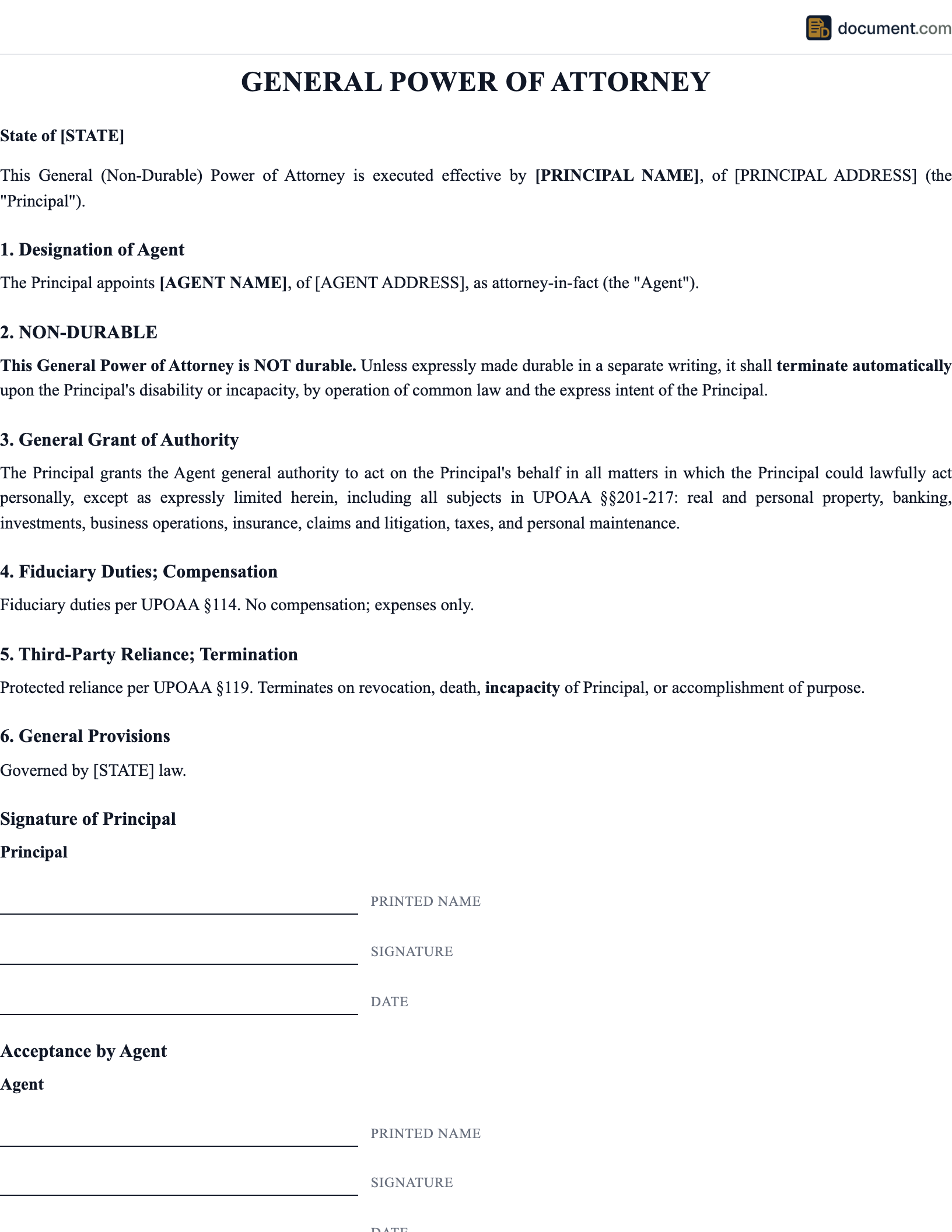
Sample West Virginia Power of Attorney
Below is a condensed preview of a West Virginia POA. Your completed version will include mineral rights provisions, full statutory references to Chapter 39B, and agent duty acknowledgments specific to West Virginia law.
STATE OF WEST VIRGINIA
DURABLE POWER OF ATTORNEY
Pursuant to W.Va. Code Chapter 39B (Uniform Power of Attorney Act)
PRINCIPAL:
Name: [Full Legal Name]
Address: [West Virginia Address]
County: [County]
AGENT (ATTORNEY-IN-FACT):
Name: [Agent Full Name]
Address: [Agent Address]
Relationship: [Relationship]
GRANT OF AUTHORITY
I, the undersigned Principal, a resident of the State of West Virginia, County of[County], hereby appoint the above-named Agent as my attorney-in-fact with authority under W.Va. Code Chapter 39B including but not limited to:
Powers Granted: [As Specified]
Mineral Rights Authority: [If Applicable]
Durability: This power of attorney is durable and shall not terminate upon my incapacity.
Governing Law: State of West Virginia
West Virginia POA — Questions and Answers
Practical answers to the questions West Virginians ask most about POA planning, from mineral rights authority to county clerk recording, elder care, and the distinction between financial and medical powers of attorney.
Official West Virginia Resources
Government and bar association resources for West Virginia POA law, mineral rights, and legal assistance programs.
W.Va. Code Chapter 39B
Full text of WV's Uniform Power of Attorney Act
West Virginia State Bar
Attorney referral and legal resources for WV residents
WV Judiciary — Circuit Courts
Court forms, guardianship information, and self-help resources
Legal Aid of West Virginia
Free legal help for qualifying West Virginia residents
Power of Attorney in Other States
Many West Virginia families have members in neighboring states. Select from our complete library.
Create your West Virginia Power of Attorney in under 5 minutes.
Answer a few questions and download a West Virginia-compliant document, ready for the state agency.