



A Modern POA Framework for the Banking Capital of the South
When North Carolina replaced its decades-old Chapter 32A with the Uniform Power of Attorney Act under N.C.G.S. Chapter 32C on January 1, 2018, the state did more than update a statute — it aligned its POA framework with the realities of a state that processes an extraordinary volume of financial transactions daily. Charlotte, home to Bank of America's corporate headquarters and Truist Financial, is the second-largest banking center in the United States by assets held. The new law's emphasis on mandatory acceptance by financial institutions was not an academic exercise — it was a direct response to the practical friction that banks, brokerages, and credit unions across the state had been creating by refusing to honor perfectly valid POAs.
Beyond banking, North Carolina's legal landscape is shaped by one of the largest military populations in the nation. Fort Liberty (the Army's most populated installation), Camp Lejeune (the Marine Corps' premier expeditionary base), and multiple Air Force and Coast Guard facilities generate a constant demand for deployment-ready POA documents. The state also stretches from the Appalachian Mountains to the Outer Banks, creating divergent needs — mountain timber land transactions in Avery County require different POA considerations than a beachfront rental management arrangement in Dare County.
North Carolina's UPOAA presumes durability, requires one witness plus notarization, and provides clear rules for agent accountability and third-party acceptance. It is a well-constructed statute that gives residents across the state's 100 counties a reliable legal tool for managing financial and property affairs.
UPOAA
Chapter 32C
Notary + 1
Witness required
100
Counties covered
Strong
Bank acceptance
Financial Institution Acceptance Rules
One of the most frustrating experiences for any POA holder is presenting a perfectly valid document at a bank and being told it will not be accepted. North Carolina's UPOAA directly addresses this problem. Under N.C.G.S. §32C-1-120, a person (including banks, credit unions, and brokerages) that is asked to accept a validly executed POA must do so within a reasonable time or provide a written statement of the reasons for refusal. The statute gives the agent the right to petition the superior court for an order compelling acceptance, and the refusing party may be held liable for attorneys' fees and costs.
This is particularly significant in Charlotte and the surrounding Mecklenburg County area, where Bank of America, Truist Financial (formed from the BB&T and SunTrust merger), Wells Fargo operations, and dozens of regional banks process millions of transactions annually. Compliance departments at these institutions have updated their internal policies to align with Chapter 32C, meaning a properly executed NC POA should encounter minimal friction at the teller window or with the wealth management team.
The statute does allow institutions to request an agent's certification (a sworn statement that the POA has not been revoked and that the agent's authority is still in effect) or an English translation if the POA is in another language. They may also refuse if they have actual knowledge that the POA has been revoked or that the agent is acting beyond their authority. But a blanket refusal based on the document's age, format, or the institution's internal preference for its own forms is not a valid basis for rejection under NC law.
POA Planning for North Carolina Military Families
North Carolina's military installations make it one of the most important states in the country for deployment-related POA planning. Fort Liberty (Cumberland County) alone has a population of approximately 57,000 active-duty soldiers and over 12,000 civilian employees. Camp Lejeune (Onslow County) is home to roughly 47,000 Marines and sailors. Seymour Johnson AFB (Wayne County) hosts the 4th Fighter Wing. Cherry Point MCAS (Craven County) is the Marine Corps' largest air station on the East Coast.
Before deployment, service members should execute three documents at minimum: a durable general POA for financial and property management, a healthcare power of attorney under N.C.G.S. §32A-25, and (if applicable) a minor child POA delegating temporary parental authority. The JAG (Judge Advocate General) offices at Fort Liberty and Camp Lejeune provide free POA preparation and notary services, though the wait times can be significant during pre-deployment surges. Many service members also use our builder to prepare documents in advance and then have them notarized at the JAG office or through a base-approved notary.
Military-specific considerations include ensuring the POA is broad enough to handle SCRA (Servicemembers Civil Relief Act) protections, BAH (Basic Allowance for Housing) adjustments, Tricare enrollment changes, and the management of any off-base rental property. If the service member owns real property in NC, the POA should be recorded with the Register of Deeds in the relevant county before deployment.
North Carolina POA Types Under Chapter 32C
Chapter 32C establishes the authority categories that a principal can delegate. Each type below links to a North Carolina-specific page with detailed guidance on that particular form of POA as it operates under NC law.
General Power of Attorney
Comprehensive authority under N.C.G.S. Chapter 32C — covers financial, legal, and property matters across all 100 NC counties
Durable Power of Attorney
Presumed durable by default under NC's UPOAA — survives incapacity unless the document expressly provides otherwise
Limited/Special Power of Attorney
Restricted scope for specific transactions — commonly used for Outer Banks property closings or single vehicle transfers at NC DMV
Medical/Healthcare Power of Attorney
Appoints a healthcare agent under N.C.G.S. §32A-25 — separate from the financial POA statute, with its own witness requirements
Financial Power of Attorney
Critical in Charlotte's banking hub — strong acceptance provisions under Chapter 32C mean financial institutions must honor valid POAs promptly
Springing Power of Attorney
Activates only upon a specified event like incapacity — permitted under NC's UPOAA with appropriate triggering conditions
Minor Child Power of Attorney
Temporary parental delegation — essential for military families at Fort Liberty, Camp Lejeune, and Seymour Johnson AFB during deployment
Real Estate Power of Attorney
Must be recorded with the Register of Deeds in the property's county — required for coastal property transfers along the Outer Banks and Crystal Coast
Vehicle Power of Attorney
Authorizes NC DMV transactions including title transfers, registration, and lien releases — uses the POA or NC DMV Form MVR-1
How to Execute a Valid NC Power of Attorney
North Carolina's execution requirements strike a balance — more protective than states requiring only notarization, but less burdensome than New York's two-witness-plus-notary mandate. Every element below must be satisfied.
Competent Adult Principal
The principal must be at least 18 and mentally capable. North Carolina follows the general contract capacity standard — the principal must understand the nature of the document and the authority being granted.
Written Document
The POA must be in writing, clearly identifying the principal, agent, and the scope of authority delegated. Chapter 32C does not prescribe a mandatory statutory form — NC allows flexible drafting as long as all requirements are met.
One Witness Required
NC requires one witness who is at least 18 years old and ideally not the named agent. The witness must observe the principal sign the document and then sign it themselves. This is a requirement that distinguishes NC from states requiring only notarization.
Notarization Required
The principal's signature must be acknowledged before a North Carolina notary public. Remote online notarization is authorized in NC under the Electronic Notarization Act (N.C.G.S. §10B-200 et seq.).
Register of Deeds Recording for Real Property
Any POA used for real estate transactions must be recorded with the Register of Deeds in the county where the property is located. North Carolina has 100 counties, each with its own Register of Deeds office.
Presumed Durable
Under N.C.G.S. §32C-1-104, a POA is durable unless the document expressly states it terminates upon the principal's incapacity. This default protects NC residents who intend their POA to survive incapacity but forget to include explicit durability language.
Creating Your North Carolina POA Step by Step
Our builder generates a Chapter 32C-compliant document tailored to your specific needs — whether you are a military spouse at Fort Liberty, a property owner on the Outer Banks, or a business operator in the Research Triangle.
Choose Your POA Type and Authority Scope
Select from the nine POA types and specify the powers you want to grant. If you need both financial and healthcare POAs, our builder can generate both — but remember that the healthcare POA has different execution requirements (two witnesses under §32A-25).
Review and Customize
Review the generated document for accuracy. Confirm that the agent's full legal name is correct, that the authority granted matches your intent, and that any real estate descriptions are specific enough for the Register of Deeds. Download in PDF or Word format.
Execute with One Witness and a Notary
Sign the POA in the presence of one qualified witness and a NC notary public. Distribute copies to your agent, your banks, and any relevant parties. If real property is involved, record the POA with the Register of Deeds in the property's county. Military families can use JAG office notary services at their installation.
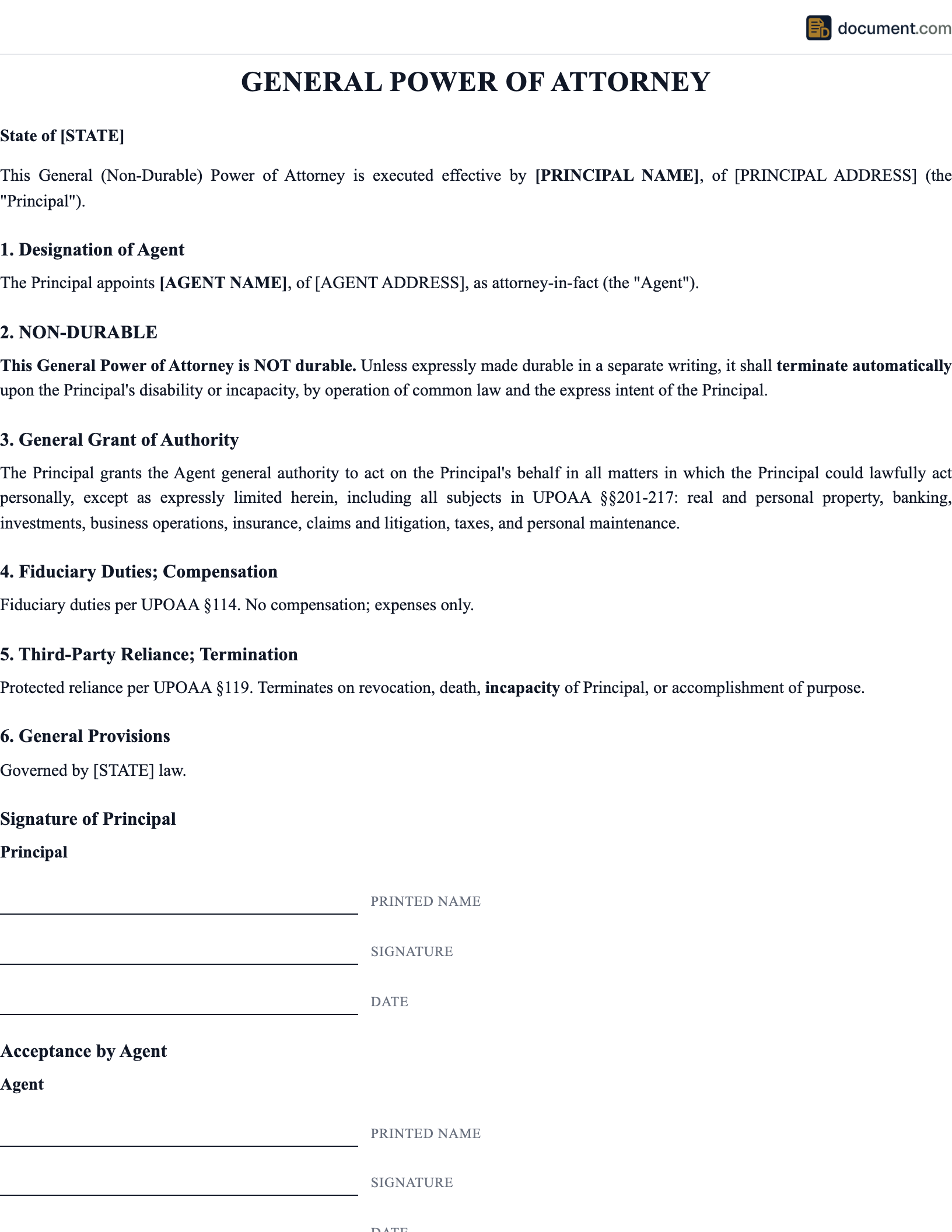
Sample North Carolina Chapter 32C Power of Attorney
This condensed preview illustrates the structure of a NC POA under the UPOAA. Your completed document will include full authority descriptions, agent duty provisions, witness and notarial sections, and Register of Deeds-ready formatting.
NORTH CAROLINA POWER OF ATTORNEY
Pursuant to N.C.G.S. Chapter 32C (Uniform Power of Attorney Act)
ARTICLE I: APPOINTMENT OF AGENT
I, _________________________ ("Principal"), a resident of _____________ County, North Carolina, appoint _________________________ ("Agent"), residing at _________________________, as my attorney-in-fact and agent.
ARTICLE II: GRANT OF AUTHORITY
I authorize my Agent to act on my behalf in the following matters:
[ ] Real Property [ ] Tangible Personal Property [ ] Financial Institutions
[ ] Business Operations [ ] Insurance [ ] Estates and Trusts
[ ] Claims and Litigation [ ] Personal and Family Maintenance
[ ] Government Benefits [ ] Tax Matters [ ] All Subjects Listed
ARTICLE III: DURABILITY PROVISION
This power of attorney is durable and shall not be affected by my subsequent disability or incapacity, as provided by N.C.G.S. §32C-1-104.
Principal Signature: _________________________ Date: _____________
Witness: _________________________ Date: _____________
STATE OF NORTH CAROLINA, COUNTY OF _________________________
Notary Public: _________________________ Commission Expires: _____________
North Carolina POA — Your Questions Answered
From banking acceptance in Charlotte to deployment planning at Fort Liberty, these are the questions NC residents ask most about powers of attorney.
Official North Carolina Resources
Authoritative references for North Carolina POA law, Register of Deeds information, and military legal assistance.
Other North Carolina Legal Documents
NC Durable Power of Attorney
Presumed durable under Chapter 32C — no extra language needed
NC Healthcare Power of Attorney
Under §32A-25 — requires two witnesses (different from financial POA)
NC Financial Power of Attorney
Strong bank acceptance provisions for Charlotte's financial hub
NC Notary Acknowledgment
Notarial certificates for NC legal documents
Create your North Carolina Power of Attorney in under 5 minutes.
Answer a few questions and download a North Carolina-compliant document, ready for the state agency.