
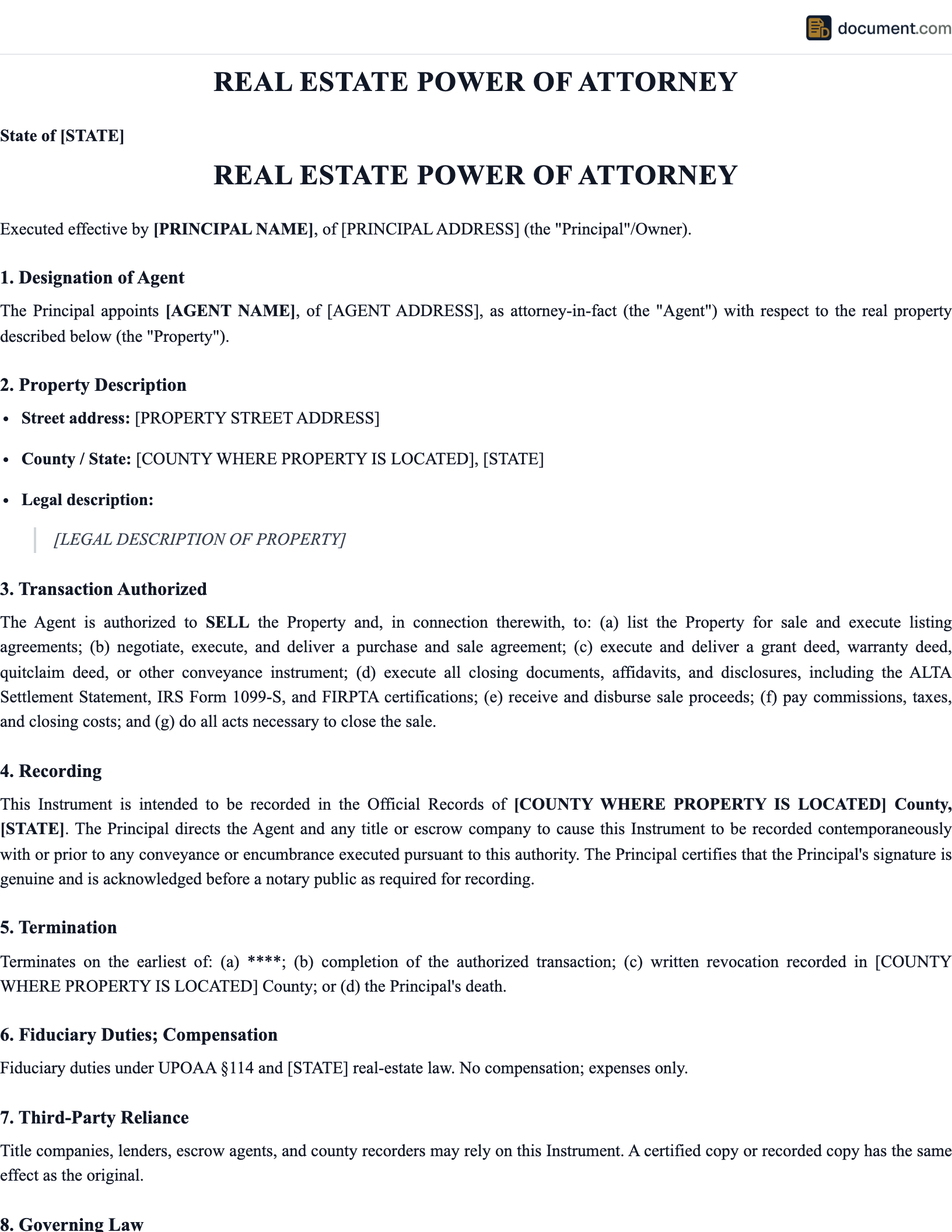



North Carolina Real Estate Power of Attorney Overview
A North Carolina real estate power of attorney authorizes an agent to handle property transactions on behalf of the property owner. This includes buying, selling, refinancing, leasing, and managing real property located in North Carolina. The POA must be recorded with the county recorder in the county where the property is located before the agent can execute any documents.
North Carolina requires all real estate POAs to be notarized and requires 2 required in addition to notarization. North Carolina provides a statutory form (Statutory short form (NCGS 32C)) that is recommended for use. Title companies in North Carolina will typically accept a properly recorded POA, though they may have additional requirements.
Lenders such as Fannie Mae, FHA, and VA have specific rules about POA use for mortgage transactions in North Carolina. The POA must specifically authorize mortgage or refinancing transactions, and the borrower typically must have signed the initial loan application personally.
Required
Recording
Required
Notarization
2 Required
Witnesses
Statutory short form...
Specific form
North Carolina Real Estate POA Requirements
Critical: Record Before Using
The POA must be recorded with the North Carolina county recorder BEFORE the agent signs any real estate documents. A deed or mortgage signed by an agent whose POA has not been recorded will be rejected.
- Notarization: Required for all North Carolina real estate POAs
- Witnesses: 2 Required in North Carolina
- Recording: Must be recorded in the county where the property is located
- Specific Form: Statutory short form (NCGS 32C)
- Title Company: Generally accepted
- Legal Description: Including the property's full legal description is strongly recommended
Recording in North Carolina
To use a real estate POA in North Carolina, the document must be recorded with the county recorder in the county where the property is located. This gives public notice of the agent's authority and is required before any real estate documents can be signed by the agent.
Prepare the Document
Ensure the POA is properly notarized and meets North Carolina recording format requirements
Visit the County Recorder
File the original notarized POA at the county recorder's office where the property is located
Pay Recording Fees
Fees vary by North Carolina county, typically $10-$50 depending on page count
Obtain Certified Copies
Get certified copies for the title company, lender, and your records
How to Create a North Carolina Real Estate POA
Identify Principal and Agent
Full legal names and addresses of the property owner and the person who will act on their behalf. Consider naming a successor agent in case the primary agent is unavailable.
Define the Real Estate Authority
Specify what the agent can do: buy, sell, refinance, lease, manage, or all of the above. Include the legal description of the North Carolina property if the POA is limited to specific property.
Execute, Notarize, and Witness
Sign before a North Carolina notary public. Obtain 2 required as required by North Carolina law. Ensure the document meets North Carolina county recording format standards.
Record with North Carolina County
File the original with the county recorder where the property is located. This must be done BEFORE the agent signs any documents. Get certified copies for the title company and lender.
Lender Acceptance in North Carolina
If the North Carolina real estate transaction involves a mortgage, the lender has additional requirements:
| Lender | Requirements |
|---|---|
| Fannie Mae | POA must authorize mortgages; agent cannot be loan officer; borrower signs initial app |
| FHA | POA must be recorded in North Carolina; must be property-specific; principal must be verified alive |
| VA | Accepted for active duty; must comply with North Carolina law; lender documents reason for POA use |
North Carolina Real Estate POA FAQ
Answers to common questions about North Carolina real estate powers of attorney, recording requirements, and title company acceptance.
Official North Carolina Resources
Use these official resources for your North Carolina real estate power of attorney.
Other North Carolina Power of Attorney Types
Need a different type of power of attorney for North Carolina?
North Carolina General POA
Broad authority for financial and legal matters
North Carolina Durable POA
Remains valid if you become incapacitated
North Carolina Medical POA
Healthcare decisions and HIPAA authorization
North Carolina Financial POA
Banking, investments, and financial management
North Carolina Limited POA
Specific transactions or time-limited authority
North Carolina Springing POA
Activates upon a specific event or condition
North Carolina Minor Child POA
Temporary guardianship for children
North Carolina Vehicle POA
DMV transactions and vehicle transfers
Create your North Carolina Real Estate Power of Attorney in under 5 minutes.
Answer a few questions and download a North Carolina-compliant document, ready for the state agency.