



What Is a Financial Power of Attorney?
A financial power of attorney is the agency-creating instrument by which a principal authorizes an agent (also called the attorney-in-fact) to act in financial matters on the principal's behalf. The document creates a fiduciary relationship governed by Restatement (Third) of Agency principles supplemented by state codes. Twenty-eight states have adopted some form of the Uniform Power of Attorney Act (UPOAA), which standardizes the categorical scope of agency-power grants under § 201, the durability presumption under § 104, banking-acceptance rules under § 120, and the agent's fiduciary duties under § 114.
The agent's authority is limited to the categories the document expressly grants. UPOAA § 201 enumerates 14 subject-matter categories: real property, tangible personal property, stocks and bonds, commodities and options, banks and other financial institutions, operation of an entity or business, insurance and annuities, estates and trusts, claims and litigation, personal and family maintenance, government benefits, retirement plans, taxes, and gifts. Each category requires express grant unless the document grants 'all authority' under § 301. UPOAA § 201(a) lists eight specific authorities that require express grant beyond the all-authority clause: making gifts, creating or changing rights of survivorship, changing beneficiary designations, delegating authority, waiving the principal's right to a survivor benefit, exercising fiduciary powers, and disclaiming property.
The principal-agent relationship continues until termination under UPOAA § 110: the principal's death, the principal's revocation, expiration by the document's own terms, the agent's death or incapacity (absent successor designation), or court order. Without a durable POA, the alternative on incapacity is court-supervised conservatorship under state Probate Code, typically costing $5,000 to $15,000 in legal and filing fees plus annual reporting obligations under state probate-court supervision.
UPOAA agency-power scope and account-by-account drafting
UPOAA § 201 permits two drafting approaches: catchall grant of all authority, or category-by-category specification. The catchall approach grants the agent every UPOAA § 202 through § 217 power except the eight specifically restricted under § 201(a). The category-by-category approach permits granular control: granting banking authority but not real-property authority, granting tax authority but not gift authority, restricting authority to specifically identified accounts by institution and number. UPOAA § 114(g) permits the principal to require periodic accountings to a designated monitor; the monitor mechanism is the practical check on agent misconduct without requiring the principal's ongoing oversight. High-net-worth principals routinely combine a primary agent with co-agents required for transactions above defined thresholds.
Banking acceptance under UPOAA § 120 and durability under § 104
UPOAA § 120 imposes a duty on third parties to accept an acknowledged POA within a specified time and limits the grounds for refusal. UPOAA § 119 protects the third party acting in good faith. State variations: California Probate Code § 4406 requires acceptance within 4 business days; New York GOL § 5-1504 requires acceptance within 10 days; Texas Estates Code § 751.201 requires acceptance within 7 business days; Florida Stat. § 709.2120 imposes equivalent obligations. Refusal without statutory grounds exposes the bank to court-ordered acceptance with attorney fees. UPOAA § 104 establishes the durability presumption: a POA is durable unless it expressly states otherwise, reversing the common-law default that POAs terminated at principal incapacity. Non-UPOAA states (California, Texas, Florida, New York) retain varying durability rules requiring explicit durability language.
Banking & Investments
Manage accounts, deposits, withdrawals, and portfolio decisions
Real Estate & Business
Buy, sell, or manage property and business operations
Taxes & Benefits
File tax returns and manage government benefits
Financial Power of Attorney by State
Financial power of attorney requirements vary by state. Many states have adopted the Uniform Power of Attorney Act (UPOAA), which standardizes requirements. Select your state below for a template that meets your state's specific requirements.
What a Financial Power of Attorney Covers
A financial POA can grant your agent authority over a wide range of financial matters:
| Area | What Your Agent Can Do |
|---|---|
| Banking | Open/close accounts, make deposits and withdrawals, write checks, manage online banking |
| Investments | Buy/sell securities, manage brokerage accounts, rebalance portfolios |
| Tax Filing | Prepare and file federal and state tax returns, handle IRS correspondence |
| Bill Paying | Pay mortgage, utilities, insurance premiums, and other recurring expenses |
| Insurance | File claims, manage policies, change beneficiaries |
| Retirement Accounts | Manage IRA, 401(k), pension distributions and rollovers |
| Government Benefits | Apply for and manage Social Security, Medicare, Medicaid, VA benefits |
| Real Estate | Buy, sell, lease, or manage real property |
| Business Operations | Manage business interests, sign contracts, handle business banking |
How to Create a Financial Power of Attorney
Follow these steps to create a valid financial POA.
Choose Your Financial Agent
Select someone you trust with your finances. This person should be responsible, financially literate, and organized. They will have access to your accounts and the ability to make binding financial decisions on your behalf.
Define the Financial Powers
Specify the financial powers granted: banking under UPOAA § 208, investments under § 204, taxes under § 215, real estate under § 202, business operations under § 207, or all authority under § 301. Grants may be categorical or limited to specific tasks and accounts identified by institution and account number.
Include Durable Language
Include durability language under UPOAA § 104 so the instrument survives the principal's incapacity. Without durable language, the POA terminates on incapacity under common-law default and surviving family members must seek court-supervised conservatorship under state Probate Code.
Sign, Notarize, and Present to Banks
Execute the document with proper notarization and witnesses as required by your state. Then present the POA to your financial institutions in advance to ensure they have it on file and will accept it when needed.
Financial POA vs. General POA
Understanding the differences helps you choose the right document for your needs.
| Feature | Financial POA | General POA |
|---|---|---|
| Scope | Financial matters only | Broad (financial + personal) |
| Bank Acceptance | Higher under UPOAA § 120 acceptance rules | May face resistance |
| Precision | Specific financial powers | Broad general authority |
| Best For | Financial management | Comprehensive delegation |
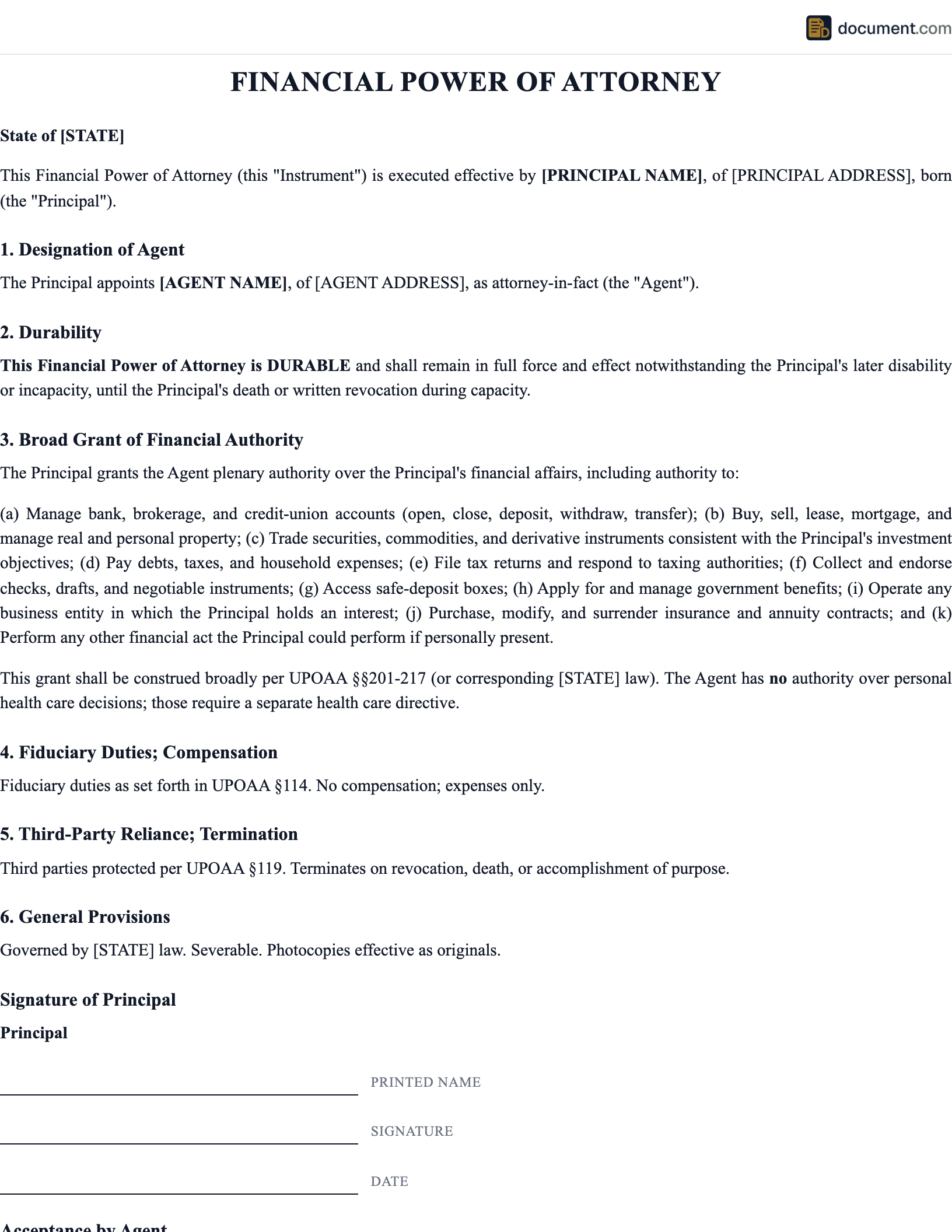
Sample Financial Power of Attorney
Below is a preview of our financial power of attorney template.
FINANCIAL POWER OF ATTORNEY
Durable Financial Agent Designation
I, [Your Name], hereby appoint the following person as my financial agent:
FINANCIAL AGENT:
Name: [Agent Name]
Address: [Agent Address]
FINANCIAL POWERS GRANTED:
☐ Banking ☐ Investments ☐ Tax Filing ☐ Real Estate
☐ Insurance ☐ Retirement Accounts ☐ Government Benefits ☐ Business
Frequently Asked Questions
Find answers to common questions about financial powers of attorney.
Create your Financial Power of Attorney in under 10 minutes.
Answer a few questions and download a compliant, attorney-drafted document ready for your state.