
Key Takeaways
- •An acknowledgement of receipt is not treatment consent, a privacy authorization or parental consent.
- •A disclaimer cannot authorize a prohibited AI therapy function or cure unsupported product claims by itself.
- •Describe actual crisis and human-support capabilities, including their limits; do not invent monitoring or response guarantees.
- •HIPAA, the FTC breach rule and COPPA require separate coverage assessments. Health information alone does not settle those questions.
- •Check the locations and audiences served independently, including mental-health chatbot and companion rules.
- •Unresolved reviews and prohibited service models stay in draft without signature fields.
The legal sources for these instructions are linked below.
What Is AI Mental-Health App Disclosure & Receipt?
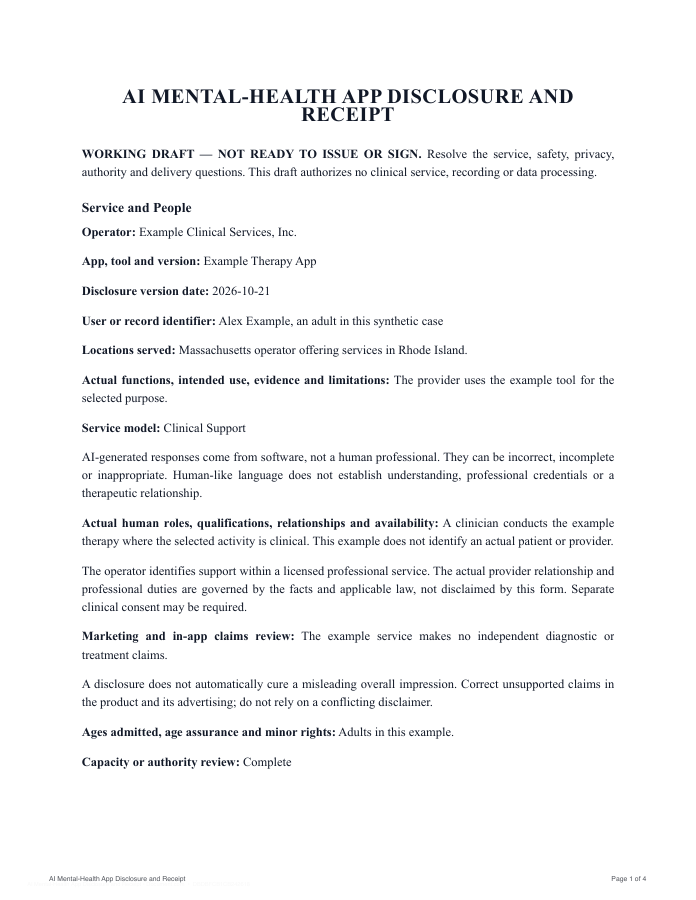
This disclosure explains an identified AI mental-health or wellness app: its functions, human roles, limitations, safeguards and information practices. An optional signature records receipt only.
The title does not establish that an app may offer therapy. Actual conduct, professional rules and state restrictions determine what services are permitted.
This revised form removes generic negligence waivers, damages caps, arbitration and blanket data-consent language. It supports a factual disclosure process without pretending to provide every required authorization.
Preview AI mental-health app disclosures
- Working draft before law and location review · PDF · Word
- Rhode Island provider using supplementary support · PDF · Word
- Remote direct therapeutic communication · PDF · Word
- Decision-specific authority of a parent · PDF · Word
- A legally authorized representative · PDF · Word
- Issued disclosure with no receipt requested · PDF · Word
- Patient independently initiated software use · PDF · Word
- Administrative scheduling assistance · PDF · Word
- Service offered entirely outside Rhode Island · PDF · Word
- Documented facility research exclusion · PDF · Word
- Unsigned draft for an AI-determined treatment plan · PDF · Word
- Public educational resource · PDF · Word
Why This Matters Now
Mental-health AI restrictions differ from general AI transparency rules. Illinois and Nevada restrict certain clinical functions even where a customer is willing to sign.
Utah has specific mental-health chatbot data, advertising and disclosure duties. New York companion rules require operational safety protocols and recurring notices.
California has current companion requirements and newly enacted changes with later operative dates. A one-time form cannot implement in-product protections.
The Legal Backbone
Clinical service and professional restrictions
Review the actual functions and professional roles. Illinois, Nevada and Rhode Island distinguish permitted support from restricted clinical uses. A wellness label or user permission does not override the law.
Rhode Island clinical care and separate consent
When therapy is offered to the Rhode Island public, a Rhode Island-credentialed professional must conduct it. The provider retains clinical judgment and reasonable oversight. AI cannot independently make therapeutic decisions or determine recommendations or treatment plans. Direct therapeutic communication requires an established treating relationship and patient consent, including for remote encounters.
Recorded companion sessions
For a covered companion used for therapeutic communication or supplementary support in a recorded or transcribed session, give written notice identifying the AI and its specific purpose. Obtain separate, current affirmative written consent from the patient or a legally authorized representative. Electronic consent can qualify. General terms or passive behavior do not.
Patient-initiated use and narrow exclusions
A clinician may discuss software the patient chose independently, with attention to confidentiality, safety, intervention, risks and limitations. The law separately defines faith-based counseling and peer support, public nonclinical self-help, federally cleared health tools and qualifying facility IRB research. Document the relevant facts for each activity.
Privacy roles and purpose-specific permissions
Assess HIPAA and the FTC Health Breach Notification Rule separately. The latter does not cover every non-HIPAA app and excludes HIPAA-covered activities as specified in the rule. Record actual recipients, purposes, agreements and incident-response duties.
Children and parental permissions
COPPA coverage depends on child-directed services and actual knowledge, subject to definitions and exceptions. The amended rule has separate consent requirements for nonintegral third-party disclosures. This receipt is not parental consent, and an age checkbox is not a full coverage assessment.
Consumer health data
Washington’s law is Chapter 19.373 RCW. Collection, sharing and sale have distinct requirements. Do not substitute blanket acceptance of a privacy policy for a required consent or sale authorization.
Companion safeguards and changing dates
New York requires recurring AI-identity notifications and a reasonable-efforts crisis protocol for covered companions. California SB1119 changes current law and phases in child protections. Review each applicable date and actual implementation.
Disclose real practices and preserve separate choices
Identify the operator, tool version, users, ages and locations served.
Describe actual functions and human involvement, with truthful limits on availability, performance and escalation.
Map information, vendors, purposes, retention and secondary uses. Record each required permission separately.
Review the applicable jurisdictions and implementation evidence. Do not select a scope exclusion solely because the operator is headquartered elsewhere.
Issue the reviewed disclosure only after resolving legality and implementation. Preserve delivery evidence and any optional receipt without converting it into blanket consent.
When You Need This
When preparing a factual disclosure for a permitted AI wellness or mental-health support service.
When replacing terms that confuse receipt with clinical or data permissions.
When updating a service after changes in features, audiences, recipients or applicable law.
How to Fill Out AI Mental-Health App Disclosure & Receipt
1. Identify the actual service
Record functions, version, locations, ages and human roles.
2. Check permitted scope
Resolve professional restrictions and any claimed exceptions before offering the service.
3. Verify safeguards
Document actual crisis, accessibility and support features with testing evidence.
4. Separate privacy permissions
Assess legal roles, purposes, recipients, child-data requirements and each required consent.
5. Review jurisdictions and delivery
Implement required notices and controls at the right time and in the right place.
6. Issue and retain the disclosure
Keep unresolved work in draft; use optional receipt only after review.
Key Terms Defined
- Receipt
- Evidence that a particular disclosure version was provided, without granting a separate permission.
- Clinical support
- Assistance within a professional service whose permitted scope depends on applicable law.
- Secondary processing
- A purpose beyond the described primary service, such as model training or marketing.
- Operational safeguard
- An implemented product or staff process, rather than a promise made only in a document.
Related Documents
Receipt versus consent
Receipt does not authorize treatment, recording or sensitive-data uses.
Wellness description versus actual conduct
The product’s functions and claims determine whether professional restrictions apply.
Privacy notice versus permission
A notice explains practices; a required consent or authorization must meet its own legal elements.
Disclosure versus implementation
A form cannot run recurring notifications, verify age or perform crisis escalation.
Legal Authorities & Sources
This page is grounded in primary law. The statutes and official resources below are the authorities behind the guidance above. Verify the current text of any statute before relying on it.
- HIPAA roles and privacy rules
- FTC Health Breach Notification Rule final text
- COPPA amended rule
- FTC COPPA guidance
- Illinois permitted AI support
- Illinois prohibited therapy uses
- Utah mental-health chatbot law
- Utah general AI disclosure law
- Nevada AB406 enacted text
- Rhode Island H7349A
- Rhode Island legislative confirmation
- New York companion definitions
- New York companion safety protocol
- New York recurring notifications
- California SB243
- California SB1119 chaptered bill
- California SB1119 enactment
- Washington collection and sharing
- Washington health-data guidance
Frequently Asked Questions
Create your AI Mental-Health App Disclosure & Receipt in minutes.
Describe the proposed tool, affected people and records of any completed steps.