



Key Takeaways
- •Informed consent for AI does not stand as a separate legal doctrine. It rides on the existing consent rules in your state's medical practice act and the common law, which require a physician to disclose material information a reasonable patient would want before agreeing to care.
- •Whether AI involvement is 'material' is the live fight. The safer practice is to disclose any AI tool that meaningfully shapes a diagnosis, screening result, or treatment recommendation, especially autonomous and generative tools.
- •HIPAA does not require AI-specific consent, but it does govern what happens to the patient data the AI ingests. A separate authorization is needed before that data goes to a vendor for a purpose outside treatment, payment, or operations.
- •Several states now regulate AI in care directly. California's AB 3030 (effective January 1, 2025) requires a disclaimer and human-contact instructions when generative AI communicates clinical information to a patient.
- •Utah's AI Policy Act requires regulated occupations, including licensed healthcare providers, to proactively disclose when a person is interacting with generative AI.
- •This form is a disclosure-and-acknowledgment record, not a liability waiver. A signed AI consent does not release a provider from negligence or from a defective-device claim against the tool's maker.
Reviewed for accuracy by the document.com legal team. Educational information, not legal advice.
What Is AI Healthcare Tool Informed Consent Form?
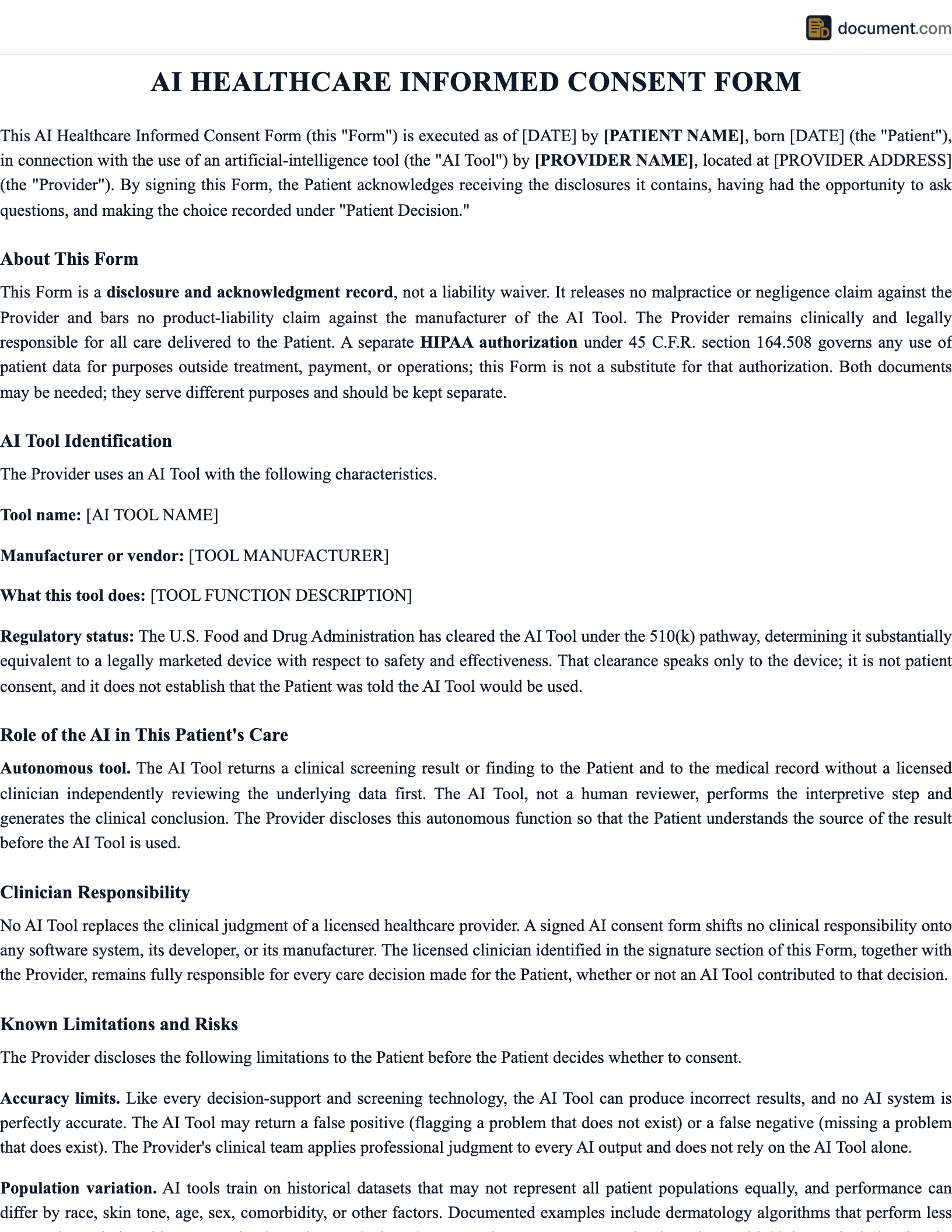
An AI healthcare informed consent form is a written disclosure and acknowledgment that documents a patient's agreement to the use of an artificial intelligence tool in their screening, diagnosis, treatment recommendation, or care communication. It names the tool, describes in plain language what the tool does and what role a human clinician keeps, explains the known limits and risks, and records the patient's signature and date.
The form rests on the older body of informed consent law. For more than fifty years, American courts have held that a physician must disclose the information a reasonable patient would consider material before that patient agrees to a procedure. The landmark case is Canterbury v. Spence, 464 F.2d 772 (D.C. Cir. 1972), which adopted the reasonable-patient standard. AI does not change that test. It adds a new category of fact, the involvement of an algorithm, that may be material and therefore disclosable.
The form satisfies the disclosure side of consent doctrine by telling the patient what is happening while simultaneously preserving evidence: a signed, dated acknowledgment that the conversation occurred, which becomes critical when a patient later claims they never knew an algorithm read their scan.
Know the form's limits before relying on it. It releases no liability. A HIPAA authorization is a separate document, though the two often travel together. And the licensed provider remains responsible for the care decision regardless of what the software suggested; signing the acknowledgment shifts none of that clinical judgment onto the machine.
Why This Matters Now
AI moved from the back office into the exam room fast. FDA has now authorized well over a thousand AI- and machine-learning-enabled medical devices, the agency's running count of which it updates periodically, covering radiology triage, diabetic retinopathy screening, sepsis prediction, and more. Patients are encountering these tools whether or not anyone tells them.
Autonomous diagnosis is already cleared. In 2018 the FDA authorized IDx-DR (now LumineticsCore), the first device permitted to make a screening decision for diabetic retinopathy without a clinician interpreting the result. When the machine, not the doctor, returns the finding, the case for disclosure is at its strongest.
Generative AI entered clinical communication in 2023 and 2024. Health systems began piloting large language models to draft patient-portal messages and visit summaries. California reacted with AB 3030, in force since January 1, 2025, which forces a disclaimer and human-contact instructions on AI-generated clinical communications.
Regulators are now writing AI disclosure into law directly. Utah's Artificial Intelligence Policy Act took effect May 1, 2024, and Colorado's SB 24-205, the first comprehensive state AI law, was signed in May 2024 with consumer-facing disclosure duties for 'high-risk' AI systems, a category that reaches healthcare.
Litigation has started. Putative class actions have targeted algorithmic care-denial tools, including suits against UnitedHealth over its 'nH Predict' algorithm and against Cigna over automated claim review, filed in 2023. The plaintiffs' bar is paying attention, and a documented consent conversation is cheap insurance.
The Legal Backbone
The common-law duty: Canterbury v. Spence and the reasonable-patient standard
Informed consent is, at bottom, a creature of tort law. In Canterbury v. Spence, 464 F.2d 772 (D.C. Cir. 1972), the court held that the scope of a physician's duty to disclose is measured by the patient's need for information, not by professional custom. A risk is material, and therefore must be disclosed, when 'a reasonable person, in what the physician knows or should know to be the patient's position, would be likely to attach significance to the risk' in deciding whether to proceed. Roughly half the states follow this reasonable-patient standard; the rest still use a professional standard keyed to what a reasonable physician would disclose. Either way, the threshold question for AI is the same: would a reasonable patient (or physician) consider it significant that an algorithm, not solely a human, is generating this finding or recommendation? For an autonomous or high-stakes tool, the honest answer is usually yes.
State medical practice acts and consent statutes
Most states codify informed consent for specified procedures by statute. Texas, for example, runs disclosure through the Texas Medical Disclosure Panel under Tex. Civ. Prac. & Rem. Code ch. 74, and New York addresses it in N.Y. Pub. Health Law section 2805-d. None of these older statutes mention AI. That silence cuts against an automatic statutory duty to disclose AI, but it does not end the analysis, because the common-law reasonable-patient duty operates alongside the statute. Confirm the exact rule in your jurisdiction, because the standard, the list of statutorily covered procedures, and the available defenses all vary by state.
California AB 3030: mandatory disclaimer for generative AI clinical communications
California enacted AB 3030 (codified at Health & Safety Code section 1339.75 et seq.), effective January 1, 2025. When a health facility, clinic, or physician's office uses generative AI to produce written or verbal communications to a patient about that patient's clinical information, the communication must include a prominent disclaimer that it was generated by AI, plus clear instructions on how the patient can contact a human healthcare provider. There is an exception when a licensed provider reviews the AI-generated communication before it goes out. This is the most concrete AI-specific patient-disclosure mandate in U.S. healthcare to date, and it is a template for what other states are likely to copy.
Utah AI Policy Act and Colorado SB 24-205: proactive disclosure duties
Utah's Artificial Intelligence Policy Act (S.B. 149, effective May 1, 2024) requires persons in regulated occupations, which includes licensed healthcare providers, to clearly and conspicuously disclose when a consumer is interacting with generative AI, and to do so proactively at the start of the interaction. Colorado's SB 24-205, the Colorado AI Act, is broader. It governs developers and deployers of 'high-risk' AI systems that make consequential decisions, expressly including decisions affecting healthcare services, and imposes notice and documentation duties. Both statutes are recent, and Colorado's effective date and details have been the subject of amendment, so verify the operative version before relying on it.
HIPAA and the patient data the AI consumes
The HIPAA Privacy Rule (45 C.F.R. Part 164) does not require a special consent before AI is used in treatment. Treatment, payment, and healthcare operations are permitted uses of protected health information without authorization under 45 C.F.R. section 164.506. The privacy exposure comes from the data flow underneath the tool. If an AI vendor accesses identifiable patient data to provide the service, that vendor is typically a business associate and needs a business associate agreement under 45 C.F.R. section 164.504(e). And if patient data is used to train a model, or shared for a purpose outside treatment, payment, or operations, a separate written HIPAA authorization under 45 C.F.R. section 164.508 is generally required. Keep that authorization distinct from this consent form.
FDA device regulation and the 'software as a medical device' line
Clinical AI that diagnoses, screens, or recommends treatment is frequently regulated by the FDA as a medical device, often as Software as a Medical Device (SaMD), under the Federal Food, Drug, and Cosmetic Act. The FDA has authorized more than a thousand AI/ML-enabled devices and maintains a public list. For consent purposes, FDA clearance speaks only to the device's safety and effectiveness; it says nothing about whether you told the patient the tool was being used, and it never amounts to consent. FDA's framework separately distinguishes tools that merely support a clinician (where the provider can independently review the basis for the recommendation) from autonomous tools (where the software returns the clinical conclusion). The more autonomous the tool, the stronger the disclosure argument.
AMA ethical guidance and the standard of care
The American Medical Association has issued principles for 'augmented intelligence' urging transparency with patients and continued physician oversight, and AMA Code of Medical Ethics Opinion 2.1.1 states the foundational duty of informed consent. Ethics opinions are not statutes, but they inform the standard of care that a jury applies in a malpractice case. A provider who deployed an opaque AI tool in a way the patient never knew about, contrary to professional guidance urging transparency, hands a plaintiff a ready-made breach-of-standard argument. Following published guidance is both good ethics and good defense.
What a defensible AI healthcare consent form actually contains
A consent form is only as good as the disclosure inside it, and most weak forms fail in the same place: they say an algorithm is involved without saying what it does. Start with identification. Name the specific tool, its manufacturer, and its regulatory status. 'We use an FDA-cleared software system called [X] from [vendor] to help screen your retinal images' tells the patient something real. 'This office may use artificial intelligence' tells them nothing and protects no one.
Next comes the function and the human role. Spell out exactly what the AI produces and who decides. A tool that flags an image for a radiologist to review differs meaningfully from a tool that returns a screening result on its own, and the patient should be able to tell which one they are getting. If a licensed clinician reviews and can override every AI output, say so plainly, because that human-in-the-loop design is both reassuring and legally protective. If the tool operates autonomously, the patient deserves to know that even more.
Then disclose limits and risks in language a non-expert can follow. AI tools make mistakes, and accuracy can drop for patients underrepresented in the training data, whether by skin tone or by age, a problem documented in dermatology and pulse-oximetry algorithms. Generative models bring a further failure mode: confident-sounding output that is simply wrong, the so-called hallucination. You do not need to turn the form into a statistics lecture, but a patient should walk away understanding that the tool assists human judgment and is fallible.
Address the data, because this is where HIPAA and consent overlap. State what patient information the tool uses, whether that information leaves the practice to reach a vendor, and whether it will be used to train or improve the model. If data is going to a vendor for training or any non-treatment purpose, that almost certainly needs a separate HIPAA authorization under 45 C.F.R. section 164.508, and you should reference it here rather than bury it. Be honest about retention and de-identification.
Give the patient a real choice and document it. A consent that offers no alternative is not much of a consent. Where a non-AI pathway exists, an image read by a radiologist instead of an algorithm, for instance, describe it and let the patient opt for it. Record the patient's decision: agree, decline, or agree with conditions. A refusal is just as important to document as a yes.
Close with the acknowledgment and signatures. Capture the patient's printed name, signature, and date; the name and signature of the clinician or staff member who explained the tool; and, where applicable, a personal representative or guardian for minors and patients lacking capacity. Add a line confirming the patient had the opportunity to ask questions and received answers. For California-regulated generative AI communications, build in the AB 3030 disclaimer and the human-contact instructions; the statute requires both. Keep the signed form in the medical record under your state's retention rule.
When You Need This
A diagnostic or screening AI generates a result that informs your care, such as AI-assisted retinal screening, AI mammography triage, or an algorithmic sepsis or deterioration alert.
An autonomous AI tool returns a clinical finding without a clinician independently interpreting the underlying data, which is the highest-disclosure scenario.
A generative AI system drafts or delivers clinical communications to the patient, including AI-written portal messages, after-visit summaries, or chatbot triage; in California this triggers AB 3030's disclaimer requirement.
Patient data will be sent to an AI vendor for a purpose beyond direct treatment, such as model training, product improvement, or analytics, which generally calls for a separate HIPAA authorization.
Your practice operates in a state with proactive AI-disclosure laws, such as Utah or Colorado, where regulated providers must tell consumers when they are interacting with generative AI.
An algorithm contributes to a coverage, triage, or care-rationing decision, the fact pattern behind recent class actions over automated claim and care-denial tools.
How to Fill Out AI Healthcare Tool Informed Consent Form
1. Identify the AI tool and its regulatory status
Enter the tool's commercial name, the manufacturer, and its FDA status if applicable (cleared, De Novo authorized, or not a regulated device). If it is a generative AI assistant rather than a cleared device, say so. Vagueness here is what makes a form worthless, so be specific even if the vendor's marketing name is unwieldy.
2. Describe what the tool does and who makes the final decision
Write one or two plain sentences explaining the tool's function and, critically, the human role. State whether a licensed clinician reviews and can override every output (human-in-the-loop), or whether the tool returns a result autonomously. The patient should be able to tell which from reading the form.
3. State the known limits and risks in plain language
List the material risks: the tool can be wrong, performance may differ across patient populations, and generative tools can produce inaccurate output. Avoid jargon. Aim for a patient who walks out understanding that the tool assists judgment and can err; if the form buries them in disclaimers, the disclosure has failed.
4. Disclose the data flow and link any HIPAA authorization
Specify what patient data the tool uses, whether it leaves the practice for a vendor, and whether it trains or improves the model. If data goes anywhere beyond treatment, payment, or operations, reference the separate HIPAA authorization under 45 C.F.R. section 164.508 and confirm a business associate agreement is in place with the vendor.
5. Offer and document the alternative
Where a non-AI pathway exists, describe it (for example, a human radiologist read instead of algorithmic triage) and make clear the patient may choose it. Provide checkboxes or fields for agree, decline, or agree with conditions, and capture the choice the patient actually makes.
6. Add the state-specific disclosures
If you operate in California and the tool is generative AI communicating clinical information, insert the AB 3030 disclaimer that the communication was AI-generated plus instructions to contact a human provider. In Utah or Colorado, add the proactive generative-AI interaction disclosure. Confirm the current requirement for your state before finalizing.
7. Capture signatures, witness, and representative fields
Collect the patient's printed name, signature, and date, and the name and signature of the clinician or staff member who explained the tool. Provide fields for a parent, guardian, or personal representative where the patient is a minor or lacks capacity, and add an interpreter line if one assisted.
8. File the signed form and set your retention clock
Store the executed consent in the patient's medical record, not in a loose AI-vendor system. Apply your state's record-retention period (commonly six to ten years for adults, and longer for minors). Keep the version of the form and the date so you can show which disclosure the patient actually received.
Key Terms Defined
- Informed consent
- The patient's voluntary agreement to care after a clinician discloses the nature of the intervention, its material risks and benefits, and the reasonable alternatives. For AI, the new question is whether the algorithm's involvement is itself a material fact that must be disclosed.
- Reasonable-patient standard
- The disclosure test adopted in Canterbury v. Spence and followed in roughly half the states, asking what information a reasonable patient in the same position would consider significant in deciding whether to proceed, rather than what physicians customarily disclose.
- Software as a Medical Device (SaMD)
- Software intended for a medical purpose, such as diagnosis or treatment recommendation, that performs that purpose without being part of a hardware device. Much clinical AI falls in this category and is regulated by the FDA under the Food, Drug, and Cosmetic Act.
- Autonomous AI
- An AI system that returns a clinical conclusion (a screening result or diagnosis) without a clinician independently interpreting the underlying data. Contrasted with assistive or human-in-the-loop AI, where a provider reviews and can override the output. Autonomy strengthens the case for patient disclosure.
- Business associate agreement (BAA)
- A HIPAA-required contract under 45 C.F.R. section 164.504(e) between a covered entity and a vendor that handles protected health information on its behalf. An AI vendor accessing patient data to provide a service is generally a business associate that needs a BAA.
- HIPAA authorization
- A patient's separate written permission under 45 C.F.R. section 164.508 to use or disclose protected health information for purposes outside treatment, payment, or operations, such as training an AI model. It is distinct from this consent form and is usually needed when data leaves the practice for a non-care purpose.
Related Documents
AI Healthcare Informed Consent vs. General Informed Consent
A general informed consent covers the nature, risks, benefits, and alternatives of a procedure or treatment. An AI healthcare informed consent layers in a specific disclosure that an algorithm is involved, what it does, the human's role, the tool's limits, and where the patient's data goes. Use the general consent for the underlying procedure and add the AI consent when an algorithm meaningfully shapes a diagnosis, screening, or recommendation. They stack; the AI form does not replace the procedure consent.
AI Healthcare Informed Consent vs. HIPAA Authorization
These solve different problems. The consent form addresses the clinical decision: do you agree to AI being used in your care. A HIPAA authorization under 45 C.F.R. section 164.508 addresses data: it permits the use or disclosure of protected health information for a purpose outside treatment, payment, or operations, such as training a model. When patient data leaves the practice for a non-care purpose, you typically need both documents, kept separate so each does its own job.
AI Healthcare Informed Consent vs. Liability Waiver
A consent form documents disclosure and agreement; a liability waiver tries to release a party from responsibility for harm. The AI consent is a disclosure record and provides no malpractice immunity. Courts in most states void prospective waivers of medical negligence as against public policy, so a provider cannot bootstrap a liability release into an AI consent. If you need a release for a non-clinical activity, that is a different instrument entirely.
Legal Authorities & Sources
This page is grounded in primary law. The statutes and official resources below are the authorities behind the guidance above. Verify the current text of any statute before relying on it.
- Canterbury v. Spence, 464 F.2d 772 (D.C. Cir. 1972) (reasonable-patient standard)
- California AB 3030 (2024), generative AI patient communications
- Utah Artificial Intelligence Policy Act, S.B. 149 (2024)
- Colorado SB 24-205, Consumer Protections for Artificial Intelligence
- HIPAA Privacy Rule, 45 C.F.R. Part 164 (uses, BAAs, authorizations)
- FDA, Artificial Intelligence and Machine Learning (AI/ML)-Enabled Medical Devices
- AMA Code of Medical Ethics, Opinion 2.1.1, Informed Consent
Frequently Asked Questions
Create your AI Healthcare Tool Informed Consent Form in minutes.
Answer a few questions and download a clear, attorney-drafted document that cites the controlling law and is ready to sign.