
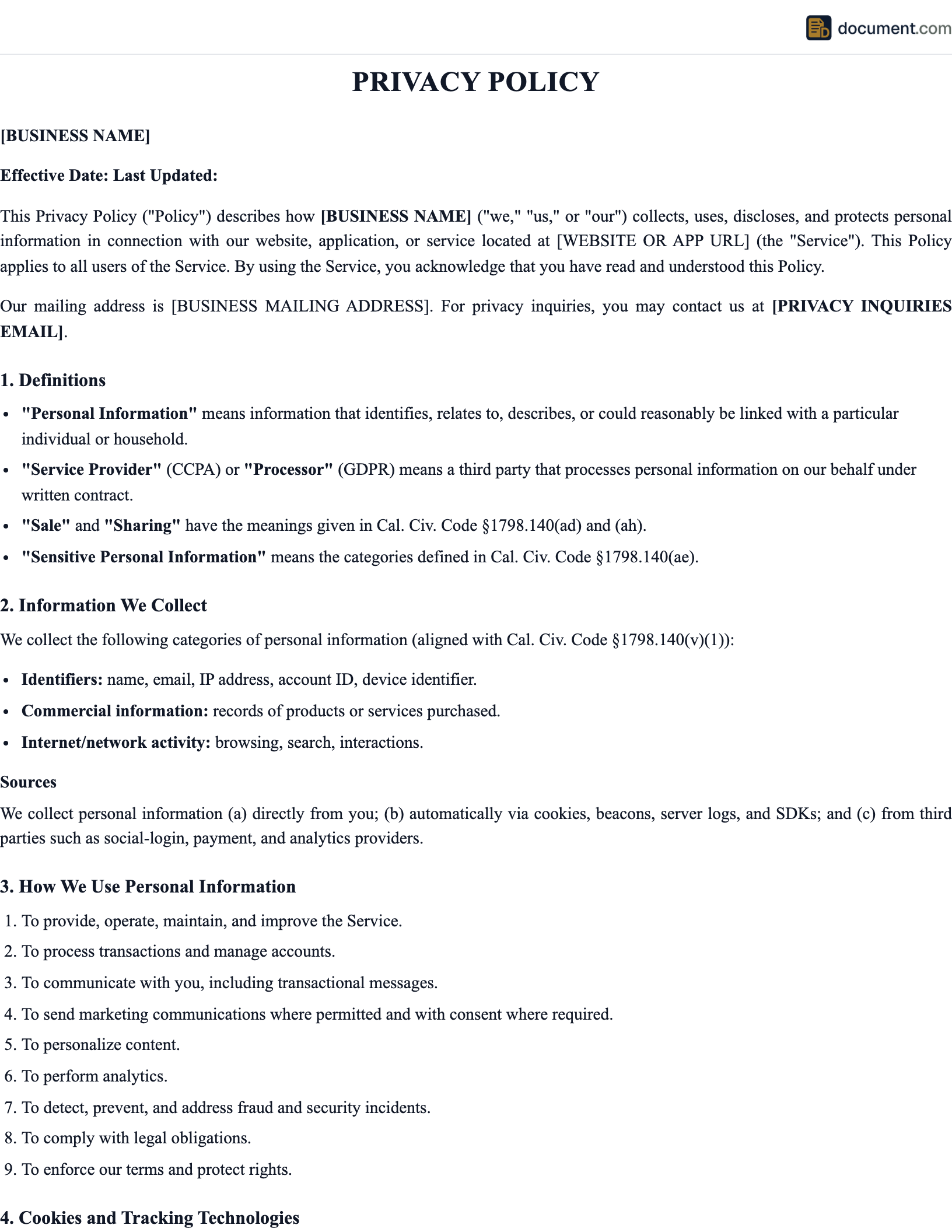



What Is a Website Privacy Policy?
A website privacy policy is a legal document that discloses how your website collects, processes, stores, shares, and protects the personal information of its visitors and users. It serves a dual purpose: satisfying regulatory transparency requirements and building trust with the people who interact with your site. Unlike a terms of service agreement, which is a negotiable contract between you and the user, a privacy policy is a mandatory disclosure driven by data protection laws.
The modern privacy policy traces its roots to the OECD's 1980 Guidelines on the Protection of Privacy and Transborder Flows of Personal Data, which established foundational principles like purpose limitation, data minimization, and individual participation. These principles were later codified into binding law through the EU Data Protection Directive (1995), CalOPPA (2003), COPPA (2000), the GDPR (2018), and the CCPA/CPRA (2020/2023). Today, virtually every jurisdiction with internet users has some form of privacy disclosure requirement, making a well-drafted privacy policy a practical necessity for any website that collects personal data.
Personal data, as defined by the GDPR, includes any information relating to an identified or identifiable natural person. This covers obvious identifiers like names and email addresses, but also extends to IP addresses, cookie identifiers, device fingerprints, browsing history, and location data. If your website uses analytics, contact forms, user accounts, payment processing, or advertising pixels, you are almost certainly collecting personal data and need a privacy policy that accurately describes those practices.
Our attorney-reviewed template produces a privacy policy tailored to your website's specific data practices, regulatory obligations, and third-party integrations. It covers everything from basic data collection disclosures through GDPR lawful basis determinations, CCPA consumer rights, COPPA parental consent, cross-border transfer mechanisms, and data breach notification procedures.
Multi-Regulation
Covers GDPR, CCPA/CPRA, CalOPPA, COPPA, and state-level privacy laws in one document
User Rights Built In
Pre-drafted sections for access, deletion, correction, portability, and opt-out requests
Data Mapping Ready
Structured tables for data categories, purposes, legal bases, and retention periods
Privacy Policy Form Preview
Below is a visual preview of the sections included in our standard website privacy policy template. The completed document is customized to your specific data practices, third-party integrations, and regulatory obligations.
Website Privacy Policy
Data Protection Disclosure
Section 1: Data Controller
Section 2: Information Collected
Section 3: User Rights
- Right to access your personal data
- Right to correct inaccurate data
- Right to delete your data
- Right to data portability
- Right to opt out of sale/sharing
Types of Data Your Website May Collect
Your privacy policy must accurately describe every category of personal information your website collects. Most site operators underestimate the breadth of data their site processes, particularly through third-party scripts and analytics tools. Here are the primary categories you need to address.
Personal Identifiers
Names, email addresses, phone numbers, mailing addresses, and usernames collected through registration forms, contact forms, newsletter signups, and checkout processes. Under the CCPA, this category also includes Social Security numbers, driver's license numbers, and passport numbers if your site collects them. Your privacy policy should list each type of identifier you collect and explain the specific purpose for each.
Technical and Device Data
IP addresses, browser type and version, operating system, screen resolution, device identifiers, referring URLs, and browsing patterns are typically collected automatically through server logs and analytics tools. The GDPR treats IP addresses as personal data because they can identify an individual when combined with other information held by the internet service provider. Your privacy policy must disclose this automatic collection even though the user did not actively provide the information.
Usage and Behavioral Data
Page views, click paths, time on page, scroll depth, search queries, and interaction events collected by analytics platforms like Google Analytics, Hotjar, or Mixpanel. This data is used to improve website performance and user experience, but it qualifies as personal data under the GDPR when tied to a cookie identifier or user account. The CCPA classifies browsing history and search history as personal information, and you must disclose this collection to California users.
Third-Party and Social Data
Information received from third-party sources including social media platforms (when users log in via Google, Facebook, or Apple), data enrichment services, advertising partners, and payment processors. Your privacy policy should identify the categories of data received from third parties, name or describe the sources, and explain how this data is combined with information you collect directly. Under the GDPR, receiving data from third parties triggers its own transparency obligations under Article 14.
User Rights by Regulation
Privacy regulations grant individuals specific rights over their personal data. Your privacy policy must clearly describe these rights and explain how users can exercise them. The specific rights available depend on which regulation applies.
GDPR User Rights (EU/EEA)
The GDPR grants eight specific rights to data subjects. Your privacy policy must address each one:
- Right of access (Art. 15): Users can request a copy of all personal data you hold about them
- Right to rectification (Art. 16): Users can correct inaccurate or incomplete data
- Right to erasure (Art. 17): Users can request deletion of their data in certain circumstances
- Right to restriction (Art. 18): Users can limit how you process their data
- Right to portability (Art. 20): Users can receive their data in a machine-readable format
- Right to object (Art. 21): Users can object to processing based on legitimate interest or direct marketing
- Rights related to automated decision-making (Art. 22): Users can opt out of purely automated decisions
- Right to withdraw consent (Art. 7): Users can withdraw previously given consent at any time
CCPA/CPRA Consumer Rights (California)
California consumers have the following rights under the CCPA as amended by the CPRA:
- Right to know: What personal information is collected, used, shared, and sold
- Right to delete: Request deletion of personal information
- Right to correct: Request correction of inaccurate personal information
- Right to opt out: Opt out of the sale or sharing of personal information
- Right to limit use of sensitive personal information: Restrict processing to what is necessary
- Right to non-discrimination: Cannot be penalized for exercising privacy rights
How to Create a Website Privacy Policy: 8 Steps
A privacy policy must accurately reflect your actual data practices. Generic templates that do not match your real operations can expose you to regulatory action. Follow these steps to build a policy that is both compliant and truthful.
Conduct a Data Inventory
Map every point where your website collects personal data: registration forms, contact forms, newsletter signups, checkout flows, analytics scripts, advertising pixels, live chat widgets, and server logs. For each collection point, document what data is collected, why it is needed, where it is stored, who has access, and how long it is retained. This inventory is the factual foundation of your privacy policy.
Identify Your Legal Obligations
Determine which privacy laws apply to your website based on where your users are located, not where your company is incorporated. If you have EU visitors, the GDPR applies. If you have California users and meet revenue or data volume thresholds, the CCPA/CPRA applies. If your site is directed at children under 13, COPPA applies. CalOPPA applies to virtually any commercial website that collects data from California residents.
Catalog Third-Party Services
List every third-party service that receives personal data from your website: analytics providers, advertising networks, payment processors, email marketing platforms, CRM systems, hosting providers, and CDN services. For each one, confirm that a data processing agreement is in place (required by GDPR Article 28), and link to their privacy policy in your disclosure.
Determine Lawful Bases for Processing
Under the GDPR, every processing activity must have a lawful basis. The six options are consent, contract performance, legal obligation, vital interest, public task, and legitimate interest. For most websites, consent covers marketing communications, contract performance covers order fulfillment, and legitimate interest covers fraud prevention and security. Document your lawful basis determination for each processing activity.
Draft Data Collection and Use Disclosures
Write clear, specific descriptions of what data you collect and why. Avoid vague language like 'we may collect information.' Instead, state exactly what you collect: 'We collect your name, email address, and mailing address when you place an order, to fulfill the order, send shipping confirmations, and process returns.' Specificity builds trust and satisfies regulatory requirements.
Write User Rights Sections
For each applicable regulation, describe the rights available to users and provide clear instructions for exercising them. Include a dedicated email address or web form for privacy requests, state the response timeframe (30 days for CCPA, one month for GDPR), and explain your verification process. Make the process accessible, not burdensome.
Address Data Security and Breach Notification
Describe the technical and organizational measures you use to protect personal data, such as encryption in transit (TLS), encryption at rest, access controls, and regular security audits. Include a data breach notification section explaining how you will notify affected users and relevant authorities in the event of a breach, consistent with GDPR Article 33 (72-hour notification to supervisory authorities) and state breach notification laws.
Publish and Maintain the Policy
Post the privacy policy on a dedicated, easily accessible page linked from your website's footer, signup forms, and checkout flow. CalOPPA requires a conspicuous link using the word 'privacy.' Add a 'last updated' date and maintain an archive of prior versions. Set a schedule to review and update the policy at least twice a year, and after any material change to your data practices.
Key Components of a Website Privacy Policy
A comprehensive privacy policy addresses each of the following areas. Omitting any one of them can result in regulatory findings or consumer complaints.
| Component | Description |
|---|---|
| Identity and Contact Details | Legal name of the data controller, registered address, and privacy contact email |
| Data Protection Officer | DPO name and contact information, if applicable under GDPR Article 37 |
| Categories of Data Collected | Complete list of personal data types collected, both directly and automatically |
| Purposes of Processing | Specific purposes for each category of data, not vague or overly broad descriptions |
| Lawful Basis for Processing | GDPR lawful basis for each processing activity: consent, contract, legitimate interest, etc. |
| Third-Party Recipients | Categories of third parties who receive data and links to their privacy policies |
| Cross-Border Transfers | Whether data is transferred outside the EEA/UK and the safeguards used (SCCs, adequacy) |
| Data Retention Periods | How long each category of data is retained and the criteria for determining retention |
| User Rights | Complete description of rights under GDPR, CCPA, and other applicable laws |
| Cookie and Tracking Disclosures | Reference to cookie policy or integrated cookie disclosure |
| Children's Privacy | COPPA compliance measures, age verification, and parental consent procedures |
| Data Security Measures | Technical and organizational safeguards protecting personal data |
| Breach Notification Procedures | How and when affected users and authorities will be notified of a data breach |
| Policy Updates | How material changes will be communicated and the version history |
Legal Requirements and Compliance
Privacy policy requirements vary by jurisdiction, but the trend is clearly toward greater transparency and stronger individual rights. Your policy needs to satisfy every law that applies to your website's user base.
GDPR (EU/EEA)
The GDPR applies to any organization processing personal data of EU/EEA residents, regardless of where the organization is based. Articles 13 and 14 specify exactly what information must be provided to data subjects at the time of collection. Non-compliance can result in fines up to 20 million euros or 4% of global annual turnover. The GDPR also requires that privacy information be provided in a concise, transparent, intelligible, and easily accessible form, using clear and plain language.
CalOPPA
The California Online Privacy Protection Act was the first U.S. law to require commercial websites to post a privacy policy. It applies to any website or online service that collects personally identifiable information from California residents. CalOPPA requires the policy to identify the categories of PII collected, the categories of third parties with whom PII is shared, the process for reviewing and requesting changes to PII, the effective date, and how the operator notifies users of material changes. The policy must be conspicuously linked from the homepage.
COPPA Compliance
If your website is directed at children under 13 or you have actual knowledge that you collect data from children under 13, COPPA requires verifiable parental consent before collection, a specific privacy policy describing children's data practices, and limitations on data retention. The FTC has imposed fines exceeding $500 million (Epic Games/Fortnite, 2022) for COPPA violations. Even general-audience websites should include a children's privacy section stating their policy on minors' data.
Emerging State Privacy Laws
- Virginia CDPA: Consumer Data Protection Act with rights to access, delete, correct, and opt out
- Colorado CPA: Colorado Privacy Act requiring privacy notice and universal opt-out mechanism
- Connecticut CTDPA: Data privacy act with consent requirements for sensitive data processing
- Utah UCPA: Consumer Privacy Act with narrower scope but similar disclosure obligations
Frequently Asked Questions
Common questions about website privacy policies, GDPR compliance, CCPA obligations, and data protection best practices.
Official Resources
Authoritative sources on privacy regulations, data protection guidance, and compliance frameworks.
GDPR Official Portal
Complete guide to the EU General Data Protection Regulation for website operators
California AG - CCPA/CPRA
Official guidance on California Consumer Privacy Act and CPRA obligations
FTC - COPPA Rule
Federal Trade Commission's Children's Online Privacy Protection Rule and compliance guidance
ICO UK GDPR Guidance
UK Information Commissioner's guidance on data protection compliance
European Data Protection Board
EDPB guidelines, opinions, and recommendations on GDPR implementation
IAPP
International Association of Privacy Professionals resources and training
Create your Website Privacy Policy in under 10 minutes.
Answer a few questions and download a compliant, attorney-drafted document ready for your state.