
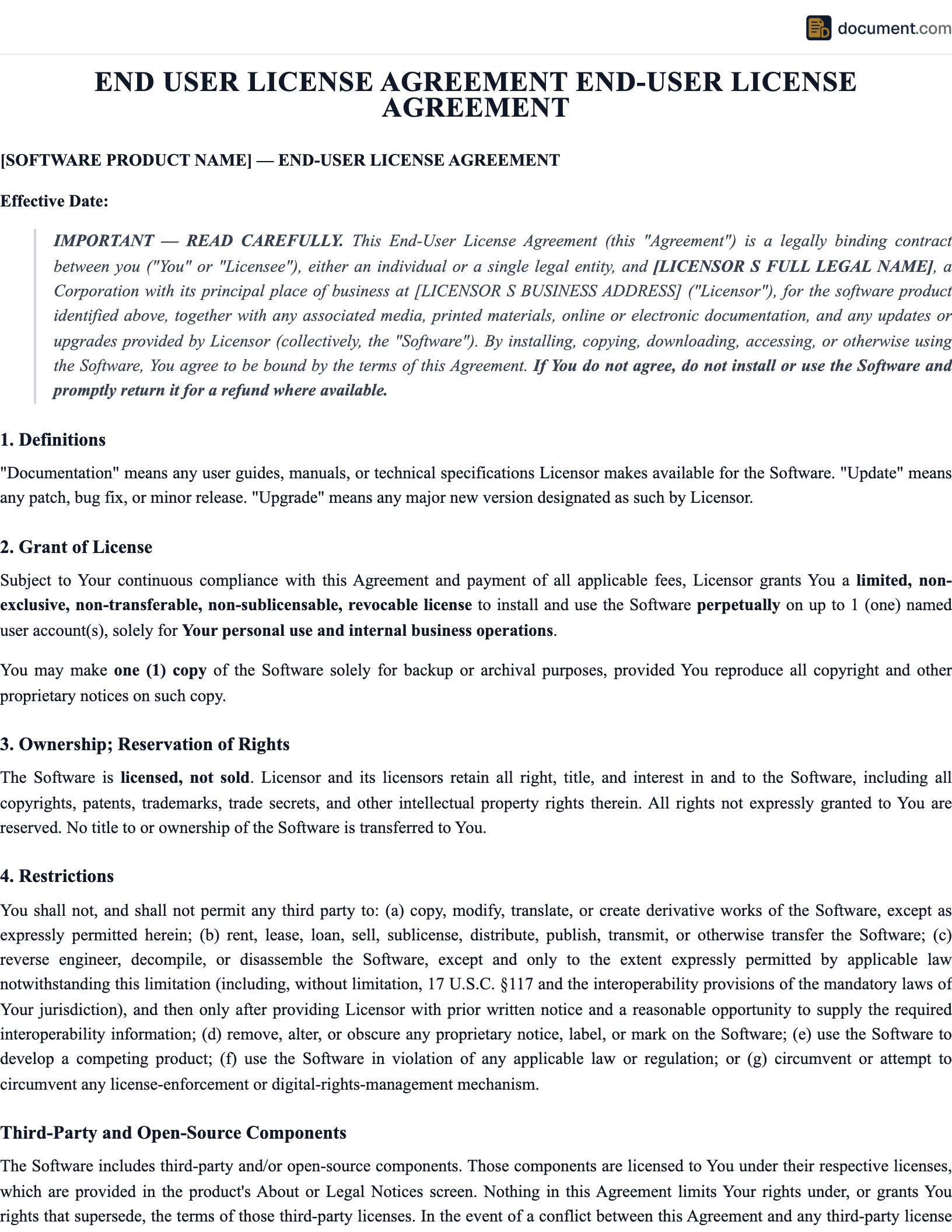



What Is an End User License Agreement?
An End User License Agreement, almost always abbreviated EULA, is a license contract between the copyright owner of a software product and the individual or business that installs or uses it. Unlike a sale of physical goods, software is rarely sold outright in the legal sense — what you receive is a bundle of permissions to copy, install, and run the program under defined conditions, while the publisher retains ownership of the underlying copyrights, trade secrets, and patents. The EULA is the document that defines exactly what those permissions are and where they end.
Because software can be reproduced infinitely at zero marginal cost, the entire commercial model of the industry depends on enforceable license restrictions. The EULA typically restricts the user from copying the software beyond a permitted number of installations, sublicensing or redistributing it, reverse engineering or modifying the binaries, transferring the license to another party, and using the software in high-risk applications such as medical devices, nuclear facilities, or aviation navigation systems where failure could cause death or serious injury.
An EULA is also where the publisher disclaims warranties and limits liability. Software is famously imperfect, and no rational publisher would ship a product if a single bug could expose the company to unlimited consequential damages. Conspicuous warranty disclaimers and a clearly drafted limitation of liability clause are therefore central features of any EULA, and U.S. courts have generally upheld them when they are presented prominently and the user has affirmatively assented to the terms through a clickwrap mechanism.
The legal status of EULAs has evolved through landmark cases including ProCD v. Zeidenberg (1996), which held that shrink-wrap licenses were enforceable when the user had an opportunity to review and return the software, and Vernor v. Autodesk (2010), which confirmed that software publishers can structure transactions as licenses rather than sales to prevent the first-sale doctrine from permitting resale. The result is a body of law in which a well-drafted EULA gives the publisher substantial control over how the software is used, even after it has been installed.
Whether you are launching a desktop utility, a mobile game, a SaaS platform, or firmware for a consumer IoT device, our attorney-reviewed EULA templates give you a foundation that addresses acceptance, license scope, intellectual property, restrictions, automatic updates, data collection, warranty disclaimers, limitation of liability, termination, export controls, and dispute resolution in language that has been calibrated to current U.S. and EU enforceability standards.
License Control
Define exactly how, where, and by whom your software may be installed and used
Liability Protection
Conspicuous disclaimers and damages caps limit exposure to consequential losses
Enforcement Tools
Termination rights, injunctive relief, and choice of forum for efficient resolution
EULA Form Preview
Below is a visual preview of the sections included in our standard EULA template. The completed document is fully formatted and customized to your product type, distribution channel, and target jurisdictions.
End User License Agreement
Software Product License
Section 1: Parties & Product
Section 2: License Grant
Section 3: Restrictions
The licensee shall NOT:
- Copy, modify, or create derivative works
- Reverse engineer, decompile, or disassemble (except as permitted by law)
- Sublicense, rent, lease, or redistribute the software
- Remove proprietary notices or watermarks
- Use the software for high-risk activities
Section 4: Acceptance
Types of End User License Agreements
EULA structure varies dramatically based on how the software is delivered, who the audience is, and which app store or distribution channel is involved. Pick the closest match to your product to start with the right base template.
EULA vs Other Software Agreements
EULA is just one of several legal documents that govern software products. Understanding how it differs from a Terms of Service, Privacy Policy, or master licensing agreement helps you decide which documents you need and how they should fit together.
EULA vs Terms of Service
EULA
- - Governs an installable software product
- - Focused on copyright license rights
- - Accepted at install or first launch
- - Survives uninstall for IP protection
Terms of Service
- - Governs an online service or website
- - Focused on access rules and user conduct
- - Accepted at signup or first visit
- - Tied to an account, not an installation
Bottom line: Hybrid products (a desktop app that talks to a cloud service) often need both — an EULA for the local binaries and a ToS for the connected service.
EULA vs Privacy Policy
EULA
- - A contract — needs assent
- - Defines license, restrictions, liability
- - Enforceable in contract law
Privacy Policy
- - A disclosure — required by GDPR/CCPA
- - Describes data collection and use
- - Enforced by regulators and AGs
Best practice: Reference the privacy policy from the EULA, but never bundle privacy consent into the EULA itself — GDPR considers bundled consent invalid.
EULA vs Software License Agreement
EULA
- - Mass-market, take-it-or-leave-it
- - Identical for every end user
- - Standard clickwrap acceptance
- - No negotiation
Negotiated SLA
- - Custom enterprise contract
- - Bespoke pricing, terms, indemnities
- - Wet-ink or DocuSign signature
- - Negotiated MSAs, SOWs, SLAs
How to Create an EULA: 9 Steps
A solid EULA starts with understanding your product, your users, and the channels through which the software will be distributed. Work through these nine steps in order to produce a defensible agreement.
Identify Your Product and Distribution Model
Document whether the software is a one-time download, a subscription SaaS, a mobile app, or firmware embedded in hardware. Note the operating systems supported, the regions where it will be sold, and whether it integrates with any third-party platforms. Each of these answers changes the clauses you need.
Define the License Grant
Specify the scope of permitted use: number of installations, number of concurrent users, allowed device types, and any geographic limitations. Decide whether the license is perpetual or term-limited, exclusive or non-exclusive, transferable or non-transferable. The license grant is the heart of the agreement and should be drafted with surgical precision.
Enumerate Restrictions
List the things the user cannot do — typically copying, reverse engineering, sublicensing, removing notices, using the software in high-risk environments, or competing with the licensor. Each restriction should be specific enough to be enforceable but broad enough to capture the conduct you actually want to prevent.
Address Updates, Telemetry, and Data Collection
Disclose that the software may automatically download updates and that telemetry, crash reports, or usage analytics may be transmitted to the licensor. Cross-reference your privacy policy for the substantive disclosures required by GDPR, CCPA, and similar laws. If telemetry is opt-in in any jurisdiction, build that into the consent flow.
Draft Conspicuous Warranty Disclaimers
Disclaim implied warranties of merchantability, fitness for a particular purpose, title, and non-infringement. The disclaimer must be conspicuous — typically in all caps or bold — to satisfy UCC § 2-316 and analogous state statutes. Keep an 'as is' warranty disclaimer paired with any limited express warranty you choose to offer.
Limit Liability and Cap Damages
Cap the licensor's aggregate liability at a defined amount (commonly the fees paid in the prior 12 months, or a fixed dollar amount for free products) and exclude consequential, incidental, special, and punitive damages. Carve out liability that cannot legally be excluded — gross negligence, fraud, willful misconduct, and IP indemnities — to keep the rest of the clause enforceable.
Add Termination and Post-Termination Obligations
Give yourself the right to terminate the license for material breach, with or without cure, and specify the user's obligations on termination — uninstall the software, destroy all copies, and certify destruction in writing if you sell to enterprises. Survival clauses preserve IP, confidentiality, limitation of liability, and dispute-resolution provisions after termination.
Include Choice of Law, Venue, and Dispute Resolution
Pick a governing law (typically your home state for U.S. companies), a venue or arbitral seat, and a dispute-resolution mechanism. Many publishers now use AAA consumer arbitration with a class-action waiver — but be aware that some jurisdictions, including California after AB 51 case law, scrutinize these clauses heavily.
Implement Clickwrap Acceptance and Versioning
Present the EULA in a scrollable window during installation and require an unchecked checkbox plus an 'I Agree' button click. Log each acceptance with timestamp, IP address, account ID, and EULA version. When you update the agreement, prompt existing users for re-acceptance on next launch — silent updates to material terms will not bind users.
Key Components of an EULA
Every comprehensive EULA covers the same core areas. Missing any one of them creates either an enforceability gap or a regulatory exposure.
| Component | Description |
|---|---|
| Parties and Product Identification | Legal name of licensor, product name, version, and effective date |
| Acceptance Mechanism | Clickwrap checkbox, scroll-through requirement, and timestamped log of assent |
| License Grant | Scope, duration, exclusivity, transferability, permitted devices and seats |
| Reservation of Rights | Statement that all rights not expressly granted are reserved by the licensor |
| Restrictions and Prohibited Uses | Specific prohibitions on copying, reverse engineering, sublicensing, and high-risk use |
| Updates and Modifications | Right to push updates, change features, and modify the agreement with notice |
| Intellectual Property | Ownership of software, trademarks, and any user-generated content |
| Third-Party and Open-Source Notices | Acknowledgment of bundled open-source components and applicable licenses |
| Privacy and Data Collection | Reference to privacy policy and disclosure of telemetry |
| Warranty Disclaimer | Conspicuous 'as is' disclaimer of all implied warranties |
| Limitation of Liability | Damages cap, exclusion of consequential damages, and required carve-outs |
| Indemnification | Mutual or one-way indemnity for IP infringement claims |
| Term and Termination | Duration, termination triggers, and post-termination obligations |
| Export Compliance | Acknowledgment of U.S. EAR, OFAC, and similar export-control restrictions |
| Governing Law and Venue | Choice-of-law clause and selection of forum or arbitral seat |
| Dispute Resolution | Arbitration clause, class-action waiver, and informal-resolution period |
| Severability and Entire Agreement | Standard boilerplate to preserve enforcement if any clause is struck |
Legal Requirements and Enforceability
Whether an EULA will be enforced depends on the jurisdiction, the acceptance mechanism, and the reasonableness of the terms themselves. Recent appellate decisions in the United States have consistently distinguished enforceable clickwrap from unenforceable browsewrap, and have struck down one-sided arbitration clauses that disadvantage consumers in obvious ways.
Clickwrap, Scrollwrap, and Browsewrap
Courts evaluate enforceability on a spectrum. Clickwrap (an explicit click) and scrollwrap (a requirement to scroll through the terms before clicking) are routinely enforced. Sign-in-wrap (terms displayed at signup with a button labeled 'Sign Up' or similar) is enforced when notice is conspicuous. Browsewrap (terms hyperlinked from a footer with no required action) is rarely enforced. Build your acceptance flow accordingly.
GDPR and EU Considerations
If your software is available to EU users, the GDPR imposes obligations on data collection and on unfair contractual terms. The EU Software Directive (2009/24/EC) preserves user rights to make backup copies, observe and study the program, and decompile for interoperability — these rights cannot be contractually waived. Your EULA should carve out these EU statutory rights to remain enforceable across the bloc.
Consumer Protection
The Magnuson-Moss Warranty Act, state UDAP statutes, and the FTC Act prohibit unfair and deceptive practices in consumer contracts. Hidden fees, surprise auto-renewals, and unconscionably broad liability waivers are common targets of FTC enforcement. The FTC's ROSCA rule (Restore Online Shoppers' Confidence Act) requires clear disclosure and easy cancellation for online subscriptions.
App Store Compliance
Apple's Schedule 1 and Google Play's Developer Program Policies impose specific minimum terms on any custom EULA used in their stores. Failure to include required language can result in app removal or developer account termination — review the current versions of both policies before submitting an app.
Export Controls
- EAR: Software is subject to the U.S. Export Administration Regulations. The EULA should require the user to comply with all export controls and prohibit downloads from embargoed jurisdictions.
- OFAC: Sanctioned-country and SDN-list compliance is mandatory. Your acceptance flow should screen against current OFAC lists where feasible.
- Encryption: Software containing certain cryptographic functions may require BIS notification or licensing. Review ECCN classifications before shipping.
Sample End User License Agreement
Below is a condensed preview of our standard EULA template showing the structure and language used in our attorney-reviewed documents.
END USER LICENSE AGREEMENT
[Product Name] - Version [X.Y]
IMPORTANT — READ CAREFULLY. This End User License Agreement ("Agreement") is a legal contract between you and [Licensor]("Licensor"). By installing or using the Software, you accept all terms.
1. LICENSE GRANT
Subject to your compliance with this Agreement, Licensor grants you a personal, non-exclusive, non-transferable, revocable license to install and use the Software on[N] compatible devices for [personal/commercial]purposes only.
2. RESTRICTIONS
You shall not (a) copy, modify, or distribute the Software except as expressly permitted; (b) reverse engineer, decompile, or disassemble the Software except to the extent permitted by applicable law; (c) sublicense, rent, lease, or transfer the Software to any third party; (d) remove proprietary notices; or (e) use the Software in life-support, nuclear, or aviation systems.
3. UPDATES
You consent to Licensor automatically downloading and installing updates, patches, and bug fixes, which may modify or remove features. Updates are subject to this Agreement.
4. WARRANTY DISCLAIMER
THE SOFTWARE IS PROVIDED "AS IS" AND "AS AVAILABLE" WITHOUT WARRANTY OF ANY KIND. LICENSOR DISCLAIMS ALL IMPLIED WARRANTIES INCLUDING MERCHANTABILITY, FITNESS FOR A PARTICULAR PURPOSE, TITLE, AND NON-INFRINGEMENT.
5. LIMITATION OF LIABILITY
IN NO EVENT SHALL LICENSOR'S AGGREGATE LIABILITY EXCEED THE GREATER OF THE FEES PAID BY YOU IN THE PRIOR 12 MONTHS OR USD $100. LICENSOR SHALL NOT BE LIABLE FOR INDIRECT, INCIDENTAL, SPECIAL, OR CONSEQUENTIAL DAMAGES.
6. TERMINATION
Licensor may terminate this Agreement immediately upon any breach. Upon termination, you must uninstall and destroy all copies of the Software.
7. GOVERNING LAW
This Agreement is governed by the laws of [State], without regard to conflict of laws principles. All disputes shall be resolved by binding arbitration administered by the American Arbitration Association.
Frequently Asked Questions
Common questions about EULA enforceability, app store rules, consumer protection, and drafting.
Official Resources
Authoritative sources on software licensing, consumer protection, and app store compliance.
U.S. Copyright Office
Federal copyright registration and software protection guidance
FTC Business Guidance
Federal Trade Commission rules on online disclosures and consumer contracts
Apple Developer Program Terms
Schedule 1 minimum EULA requirements for App Store apps
Google Play Developer Policy
Required disclosures and license terms for Google Play apps
GDPR Official Portal
Authoritative reference for EU General Data Protection Regulation compliance
California Attorney General - CCPA
Official guidance on California Consumer Privacy Act and CPRA obligations
Bureau of Industry and Security
Export Administration Regulations and software encryption rules
ULC - UCITA Information
Uniform Computer Information Transactions Act background and adoption status
Create your End User License Agreement in under 10 minutes.
Answer a few questions and download a compliant, attorney-drafted document ready for your state.