
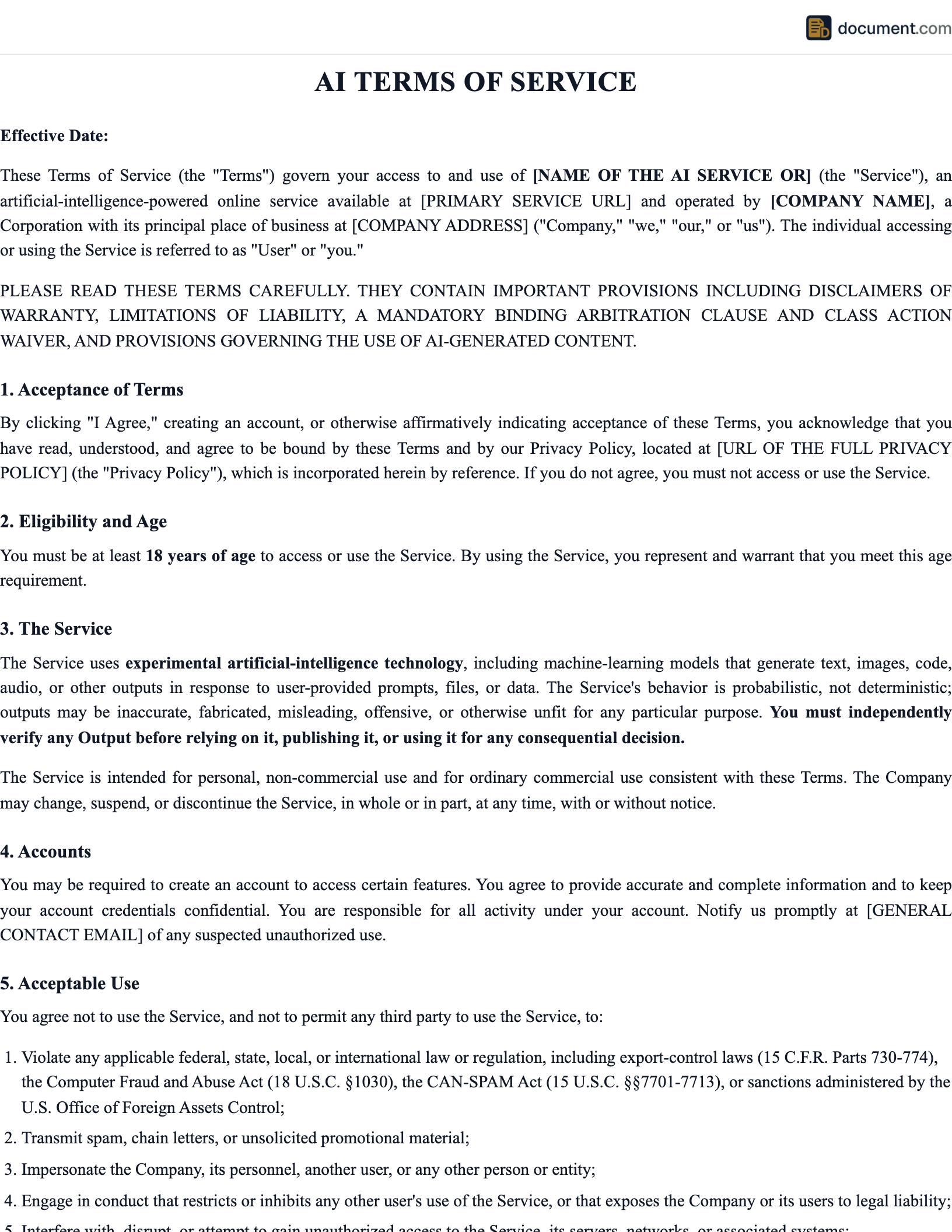



What Are Website Terms of Use?
Website terms of use are a legal agreement between a website operator and anyone who accesses the site. They establish the rules visitors must follow when using the website, define the intellectual property rights that protect the site's content, limit the operator's legal exposure, and describe how disputes will be resolved. Every commercial website, whether it sells products, publishes content, collects user data, or simply maintains an online presence, benefits from a clearly drafted terms of use agreement.
Unlike a privacy policy, which is driven by specific regulatory mandates, terms of use are primarily a contractual tool. They let you control how people interact with your site, what they can and cannot do with your content, and where and how legal disputes will be resolved. Without terms of use, you are exposed to broader liability, have fewer tools to remove bad actors, and lack a contractual basis for enforcing your intellectual property rights against scrapers, copiers, and unauthorized redistributors.
Courts have consistently held that well-presented online terms of use are enforceable contracts. The key question is always whether the user had reasonable notice of the terms and manifested assent. Clickwrap implementations, where the user must actively check a box or click an "I Agree" button, receive the strongest enforcement. Browsewrap implementations, where terms are merely linked in the footer, receive the weakest. For websites without a login or registration flow, conspicuous banners referencing the terms can improve enforceability.
Our attorney-reviewed template produces a terms of use agreement tailored to your website type, covering acceptable use, intellectual property, disclaimers, limitation of liability, indemnification, user-generated content, DMCA compliance, linking policies, governing law, and dispute resolution.
IP Protection
Protect your content, trademarks, and brand assets from unauthorized use and scraping
Liability Shield
Limit exposure through conspicuous disclaimers, liability caps, and indemnification
Dispute Control
Choose your governing law, forum, and resolution process before a dispute arises
Terms of Use Form Preview
Below is a visual preview of the sections included in our standard website terms of use template. The completed document is customized to your website type and jurisdictional requirements.
Website Terms of Use
Legal Agreement
Section 1: Agreement to Terms
Section 2: Acceptable Use
Users shall NOT:
- Violate any applicable law or regulation
- Infringe intellectual property rights
- Transmit malware, spam, or harmful code
- Scrape, mine, or harvest data without permission
- Impersonate any person or entity
Section 3: Intellectual Property
All content, design, and code are owned by the website operator or its licensors. No license is granted except the limited right to access and view the site for personal, non-commercial use.
Terms of Use vs Other Website Agreements
Websites often need multiple legal documents working together. Understanding the relationship between terms of use and other common website agreements helps you build a complete legal framework.
Terms of Use vs Terms of Service
Terms of Use
- - Governs passive website access
- - No account or registration needed
- - Focused on content consumption
- - Common for informational sites
Terms of Service
- - Governs active service usage
- - Requires account and login
- - Focused on service delivery
- - Common for SaaS and platforms
Bottom line: If your website requires user accounts or provides interactive services, you likely need a terms of service. If it is primarily an informational or content site, terms of use are the better fit.
Terms of Use vs Privacy Policy
Terms of Use
- - Voluntary contractual protection
- - Sets rules for website access
- - Protects the website operator
Privacy Policy
- - Mandatory regulatory disclosure
- - Describes data handling practices
- - Protects the website user
Best practice: Your terms of use should reference your privacy policy but never replace it. They serve fundamentally different legal purposes.
Acceptable Use Policies
The acceptable use section of your terms of use defines what visitors can and cannot do on your website. A well-drafted acceptable use policy gives you the contractual basis to terminate access, remove content, and pursue legal remedies against bad actors.
Prohibited Activities
Your terms should explicitly prohibit activities that could harm your website, your users, or your business. Common prohibitions include violating applicable laws, infringing intellectual property, transmitting malware or harmful code, scraping or data mining, sending spam or unsolicited communications, impersonating other users or entities, interfering with site operations, and accessing areas of the site that are restricted or not intended for public access. Be specific about what constitutes a violation so enforcement is clear and defensible.
User-Generated Content Rules
If your website allows comments, reviews, forum posts, or other user contributions, your acceptable use policy should set content standards. Prohibit content that is defamatory, obscene, threatening, harassing, discriminatory, or that infringes third-party rights. Reserve the right to remove content at your discretion, without prior notice, and without liability. Include a content license granting you the rights you need to display, distribute, and archive user contributions.
Linking and Framing
Your terms should address both inbound and outbound links. For inbound links, you can set rules about who may link to your site and how. Some operators prohibit deep linking (linking directly to inner pages, bypassing the homepage) or framing (displaying your content within another site's frame). For outbound links, include a disclaimer that you are not responsible for the content, privacy practices, or availability of third-party websites linked from your site.
How to Create Website Terms of Use: 8 Steps
A terms of use agreement should be tailored to your website's specific features, content, and business model. Generic templates downloaded from the internet often fail to address your actual needs. Follow these steps to build a terms of use document that is both protective and enforceable.
Identify Your Website Type and Features
Document whether your website is an informational site, a blog, an e-commerce store, a content platform with user contributions, or a hybrid. Note every interactive feature: contact forms, newsletter signups, comment sections, file downloads, user accounts, payment processing, and embedded third-party tools. Each feature creates specific legal considerations that your terms must address.
Draft the Acceptable Use Policy
List every activity that users are prohibited from performing on your website. Cover illegal activity, IP infringement, malware, scraping, spam, impersonation, and interference with site operations. If your site allows user-generated content, add content standards and a content license clause. Be specific enough to enforce but broad enough to capture emerging threats.
Write Intellectual Property Provisions
State clearly that all content, design, code, trademarks, and other intellectual property on the website belong to you or your licensors. Grant users only the limited right to access and view the site for personal, non-commercial purposes. Prohibit copying, distributing, modifying, or creating derivative works without your written permission. If you use Creative Commons or other open licenses for certain content, specify which content is covered.
Draft Disclaimers and Limitation of Liability
Disclaim warranties about the accuracy, completeness, and availability of your website and its content. State that the site is provided 'as is' and 'as available.' Cap your total liability and exclude consequential damages. Make disclaimers conspicuous. If you provide informational content (legal, medical, financial), include a specific disclaimer that the content is not professional advice and does not create a professional relationship.
Add Indemnification
Require users to indemnify and hold you harmless against claims, damages, and expenses arising from their use of the website, their violation of the terms, or their infringement of third-party rights. Indemnification shifts the financial burden of litigation caused by user misconduct back to the user. Courts generally enforce indemnification clauses in commercial terms of use.
Include DMCA Provisions
If your website hosts or transmits user content, include a DMCA section identifying your designated agent, describing the takedown and counter-notification process, and stating your repeat infringer policy. Register your designated agent with the U.S. Copyright Office to qualify for DMCA safe harbor protection against liability for user-posted infringing content.
Choose Governing Law and Dispute Resolution
Select the governing law (typically your home state), the exclusive forum for litigation, and whether disputes will be resolved through arbitration or court proceedings. If you choose arbitration, specify the provider (AAA, JAMS), the applicable rules, and whether the arbitration will be conducted individually or on a class-wide basis. Include a class action waiver if permitted in your jurisdiction.
Implement and Display the Terms
Publish the terms on a dedicated page and link to it from your website's footer on every page. If you have a registration or checkout flow, add a checkbox requiring users to acknowledge the terms before proceeding. Add a 'last updated' date and maintain version archives. Review and update the terms at least annually and whenever you add significant new features.
Key Components of Website Terms of Use
A thorough terms of use agreement covers each of the following areas. Skipping any of them can leave gaps in your legal protection.
| Component | Description |
|---|---|
| Agreement to Terms | Statement that accessing the website constitutes acceptance of the terms |
| Acceptable Use Policy | Enumeration of prohibited activities and user conduct standards |
| Intellectual Property Rights | Ownership statement and limited license for website access |
| User-Generated Content | Content license, moderation rights, and user representations |
| Third-Party Links | Disclaimer of responsibility for linked third-party websites |
| Disclaimers | Warranty disclaimers and 'no professional advice' statements |
| Limitation of Liability | Damages cap and consequential damages exclusion |
| Indemnification | User's obligation to hold the operator harmless |
| DMCA Compliance | Designated agent, takedown procedures, and repeat infringer policy |
| Account Termination | Right to suspend or terminate access for violations |
| Governing Law | Choice of law and exclusive jurisdiction |
| Dispute Resolution | Arbitration clause, class action waiver, or court selection |
| Modifications | Right to amend terms with notice and continued-use acceptance |
| Severability | Provision preserving remaining terms if any clause is invalidated |
| Entire Agreement | Integration clause preventing reliance on prior representations |
Legal Enforceability
The enforceability of website terms of use depends on how they are presented to the user. Courts consistently distinguish between different methods of obtaining user assent, and the method you choose directly affects whether your terms will hold up in litigation.
The Assent Spectrum
Clickwrap agreements (active click on "I Agree") are consistently enforced. Sign-in-wrap agreements (terms referenced near a "Sign Up" button) are enforced when the reference is conspicuous. Browsewrap agreements (terms linked only in the footer) are rarely enforced because courts find that merely posting terms does not constitute reasonably conspicuous notice. The Second Circuit's Specht v. Netscape decision and the Ninth Circuit's Nguyen v. Barnes & Noble ruling are the leading cases on this spectrum.
Unconscionability Challenges
Even when a user has clearly assented to terms of use, courts can refuse to enforce specific provisions that are unconscionable. Unconscionability has two prongs: procedural (unfair surprise or unequal bargaining power) and substantive (unreasonably one-sided terms). California courts are particularly active in finding unconscionability in consumer online contracts. To reduce risk, avoid burying important terms in dense legalese, provide conspicuous notice of key provisions like arbitration and liability limits, and include mutual obligations rather than purely one-sided protections.
Modification and Continued Use
Many terms of use include a clause stating that continued use of the website after changes are posted constitutes acceptance of the modified terms. While courts have upheld this approach for minor changes, material modifications (such as adding an arbitration clause) may require more conspicuous notice and affirmative re-acceptance. The safest practice is to notify users of material changes via email or a prominent site banner and prompt re-acceptance.
International Considerations
- EU Consumer Rights: EU consumer protection directives limit the enforceability of one-sided terms and restrict mandatory arbitration in consumer contracts
- UK CRA 2015: The Consumer Rights Act includes a fairness test for contract terms, and unfair terms are not binding on consumers
- Australian Consumer Law: Prohibits unfair contract terms in standard form consumer contracts and small business contracts
Frequently Asked Questions
Common questions about website terms of use, enforceability, IP protection, and dispute resolution.
Official Resources
Authoritative sources on website legal compliance, intellectual property, and online contracts.
U.S. Copyright Office
Federal copyright registration, DMCA agent designation, and guidance
FTC Business Guidance
Federal Trade Commission rules on online disclosures and consumer protection
DMCA Information
Digital Millennium Copyright Act safe harbor requirements and procedures
AAA Consumer Arbitration
American Arbitration Association consumer rules and fee schedules
UCC Article 2
Uniform Commercial Code provisions relevant to online contracts and warranties
WIPO
World Intellectual Property Organization resources on international IP protection
Create your Website Terms of Use in under 10 minutes.
Answer a few questions and download a compliant, attorney-drafted document ready for your state.