


Key Takeaways
- •Describe what the business and its vendors actually do; do not assume no sale, no training, encryption or human review.
- •Separate current practices from required historical disclosures, including the applicable reporting period.
- •A privacy notice does not itself obtain consent or provide a lawful international-transfer mechanism.
- •California ADMT, Colorado covered ADMT and EU solely automated decisions have different scopes and rights.
- •Unresolved facts or applicability keep the output a working draft; a generated notice does not implement the promised controls.
Reviewed for accuracy by the document.com legal team. Educational information, not legal advice.
What Is AI Privacy Policy Template?
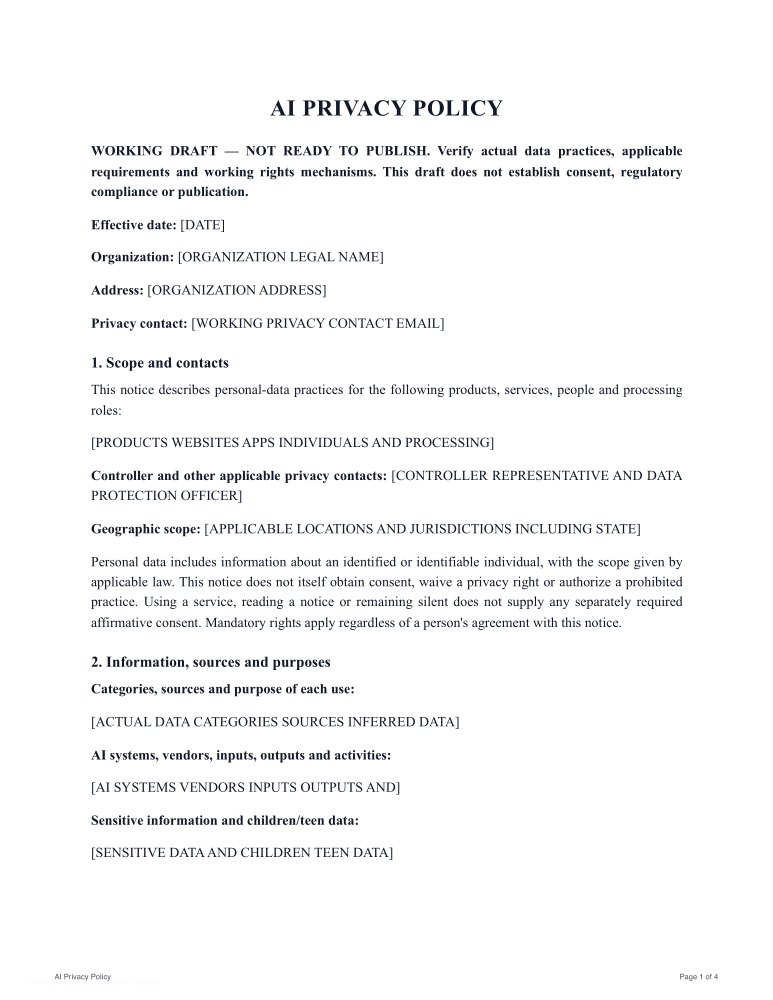
An AI privacy notice explains the personal data used by a business’s AI-enabled products and the choices and rights that apply. It should connect each category and source to a purpose, recipient, retention period and working request method.
A useful policy distinguishes ordinary service processing, model development, profiling and consequential decisions. It also explains vendor activity, advertising technologies, sensitive data and the information needed to exercise applicable rights.
Why This Matters Now
A product can add a vendor or change a model workflow faster than its published policy changes. Review the actual data flow and the statements users previously received before drafting a replacement.
Operational controls and public disclosures need to agree. A working opt-out, accurate retention practice and trained request-handling process matter as much as the wording.
The Legal Backbone
FTC: promises must match practice
Statements about model use, sharing and confidentiality must be accurate. Material omissions also matter. Existing privacy commitments cannot be discarded through a quiet retroactive rewrite.
California: effective date versus compliance date
The 2025 regulations became effective January 1, 2026. ADMT-specific compliance begins January 1, 2027. Determine actual coverage, significant-decision use, notices, rights and exceptions from the final text.
Colorado: decision-triggered disclosures
SB26-189 generally applies to consequential decisions from January 1, 2027. Its adverse-outcome disclosure runs from the decision, not the consumer’s later request. The distinct Colorado Privacy Act signal process concerns sale and targeted advertising.
EU: rights and a valid processing basis
Identify the basis and any sensitive-data condition for each purpose. Covered solely automated significant decisions require a valid Article 22 exception and applicable safeguards. An ordinary privacy notice does not supply explicit consent.
Biometrics and AI transparency
Actual data, uses and jurisdiction determine biometric duties. For EU AI transparency, identify provider/deployer roles and the particular activity. A general privacy-policy paragraph does not replace an in-context notice or required marking.
Review the actual jurisdictions and activities
Selected California, Colorado, Illinois and EU provisions illustrate different requirements. This page is not a completed 50-state survey. Check additional state, local, federal, sector-specific and international rules for the people and processing involved.
The builder records actual applicability separately from the organization’s address and keeps unresolved practices in a working draft.
Write the policy from verified practices
Begin with a data inventory covering the business and its vendors. Identify where inputs, derived information, logs, outputs and model artifacts go.
State sale and advertising practices independently. Legal sale, cross-context sharing, targeted advertising and ordinary provider disclosure are not synonyms.
Describe each training, fine-tuning and evaluation use, its data and recipients, actual choices and the handling of prior commitments.
Describe profiling and decisions using their real effects and human involvement, then apply each relevant law’s actual scope.
Use verified security and retention descriptions. Do not insert an encryption, audit, deletion or human-review promise merely because it sounds standard.
Give working rights channels, distinct deadlines, appeal routes, signal handling and appropriate identity-verification procedures.
Review sensitive data, children and teens, international transfers, prior notices and applicable additional laws before publication.
When You Need This
Preparing an accurate privacy notice for an AI-enabled product, service or website.
Revising disclosures after a real change to vendors, data uses, models, advertising or automated decisions.
Documenting actual practices alongside separate consent, processing agreements, assessments and operational controls where needed.
The template is not a complete all-jurisdiction compliance program or a substitute for verifying the intended activity.
How to Fill Out AI Privacy Policy Template
1. Map the actual processing
Record information, sources, purposes, people, vendors, locations and retention.
2. Verify business statements
Check sale, advertising, training and security claims against implemented practices, contracts and technical settings.
3. Review applicable requirements
Separate jurisdiction and activity-specific rules, exclusions, rights and operative dates.
4. Test the rights process
Confirm each contact, preference mechanism, signal handler, deadline and escalation route works.
5. Resolve and publish
Keep unresolved facts in a working draft. Prepare the publication version after factual and legal review; preserve the prior version and existing commitments.
Key Terms Defined
- Personal data
- Information about an identified or identifiable person, subject to the applicable legal definition.
- Model use
- Training, fine-tuning, evaluation or operation of a model; these can have different purposes and recipients.
- Sale and sharing
- Defined legal categories that may differ from ordinary-language disclosure or a cash sale.
- Significant decision
- A decision within a particular law’s defined effects and domains; definitions are not interchangeable across regimes.
- Preference signal
- A technical indication of a privacy choice, with a particular legal scope and implementation.
Related Documents
Privacy notice and consent record
A notice describes practices and rights. A consent record captures a specific actual choice; publishing the notice does not obtain it.
Privacy notice and data processing addendum
The notice addresses individuals. A processing addendum sets customer/provider duties and required instructions.
Privacy notice and AI use policy
An internal use policy governs staff behavior. The public privacy notice must reflect what the organization actually does with people’s information.
Legal Authorities & Sources
This page is grounded in primary law. The statutes and official resources below are the authorities behind the guidance above. Verify the current text of any statute before relying on it.
- FTC: actual privacy commitments
- FTC: retroactive changes
- California final regulations
- California effective and compliance dates
- Colorado SB26-189 enacted text
- Colorado universal opt-out mechanisms
- Illinois BIPA section 15
- EDPB: individual rights and response timing
- European Commission: Article 50 roles
- EU GDPR text
Frequently Asked Questions
Create your AI Privacy Policy Template in minutes.
Answer a few questions and download a clear, attorney-drafted document that cites the controlling law and is ready to sign.