
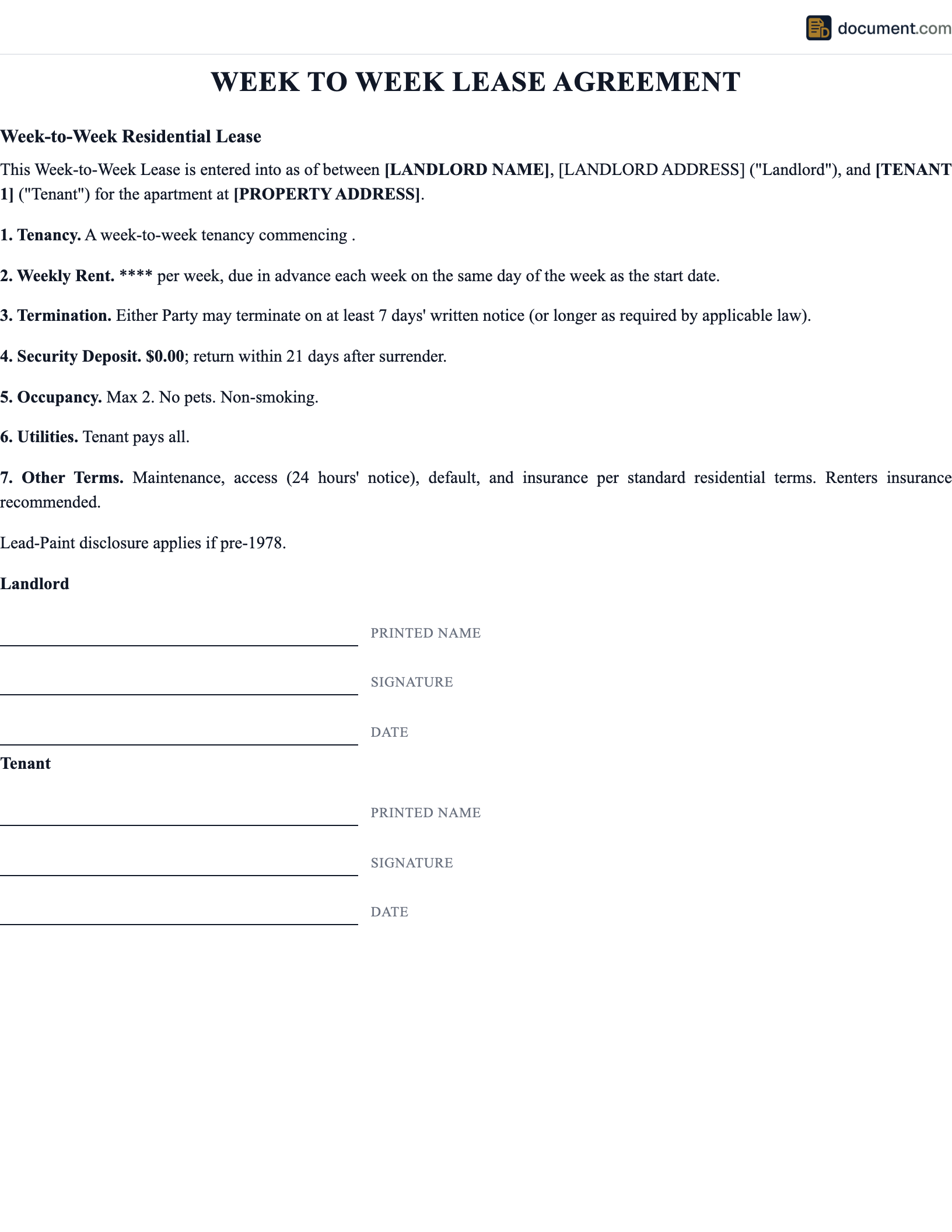



Wisconsin Week-to-Week Lease Overview
A Wisconsin week-to-week lease creates a periodic tenancy that automatically renews every seven days under Wis. Stat. Chapter 704. What makes Wisconsin's rental landscape distinctive is the outsized role of ATCP 134 — an administrative code promulgated by the Department of Agriculture, Trade and Consumer Protection (DATCP). While most states rely solely on statutes passed by the legislature to govern landlord-tenant relationships, Wisconsin layers a detailed administrative code on top of its statutes, giving tenants an enforcement pathway through DATCP that exists in very few other jurisdictions.
Weekly tenancies are common across Wisconsin's varied rental markets. University towns like Madison and Milwaukee see high demand from students at UW–Madison, UWM, and Marquette who need flexible housing between semesters. Tourism-driven communities — Door County, Wisconsin Dells, and Lake Geneva — rely on weekly arrangements for seasonal hospitality workers. Military-connected renters near Fort McCoy, manufacturing employees in Fox Valley communities, and agricultural workers in the state's dairy belt also benefit from the low-commitment structure of a seven-day lease cycle.
7 days
Notice Period (§704.19)
No cap
Security Deposit Amount
21 days
Deposit Return (ATCP 134)
Mandatory
Check-In Sheet (ATCP 134)
ATCP 134: Wisconsin's Administrative Code Protections
ATCP 134 is the backbone of Wisconsin tenant protection, and understanding it is essential for anyone entering a week-to-week lease in the state. Adopted by DATCP under its consumer-protection authority, ATCP 134 regulates security deposit handling, mandatory disclosures, prohibited lease clauses, and landlord practices with a level of specificity that most states reserve for statute books. Violations are enforced through DATCP's administrative process — tenants can file complaints directly with the agency rather than hiring an attorney and going to court.
Mandatory Check-In Sheet (ATCP 134.06(1)(a))
The landlord must provide a written check-in sheet documenting the unit's condition at the start of every tenancy. The tenant has seven days to complete and return it. Without a properly executed check-in sheet, the landlord may forfeit the right to make any deductions from the security deposit — regardless of actual damage.
Prohibited Lease Clauses (ATCP 134.08)
Wisconsin voids any lease provision that waives the tenant's right to a habitable dwelling, authorizes confession of judgment, shifts the landlord's liability for negligence to the tenant, or permits the landlord to seize the tenant's property without a court order. Weekly leases are not exempt — these protections apply to every residential tenancy.
Disclosure of Code Violations (ATCP 134.04)
Before accepting a deposit or signing a lease, the landlord must disclose any outstanding housing or building code violations that affect the unit. This requirement is enforced by DATCP, not by the local code-enforcement office, which gives tenants a statewide complaint channel.
Utility Allocation Disclosure
When utility costs are shared among tenants or included in rent, ATCP 134 requires the landlord to disclose the allocation method before the lease begins. For weekly tenants who may share a building with other short-term occupants, this prevents surprise charges on move-out.
Why ATCP 134 Matters for Weekly Tenants
Because week-to-week leases turn over rapidly, landlords sometimes treat them more casually than long-term agreements. ATCP 134 eliminates that gap. The check-in sheet, deposit return timeline, and disclosure duties apply with equal force whether the tenancy lasts one week or one year. Tenants who believe their landlord has violated ATCP 134 can file a complaint with DATCP online or by phone — a remedy that bypasses the cost and delay of small claims court entirely.
Security Deposit & Mandatory Check-In Sheet
Wisconsin does not cap the dollar amount of a security deposit, but ATCP 134.06 tightly regulates how the deposit is collected, held, and returned. Within 21 days of the tenancy ending, the landlord must either return the full deposit or deliver an itemized statement explaining every deduction. Failing to meet the 21-day deadline — or failing to itemize — can expose the landlord to double damages under Wis. Stat. §100.20(5).
The mandatory move-in check-in sheet under ATCP 134.06(1)(a) is the single most important document protecting both parties in a weekly lease. It establishes a baseline record of the unit's condition so that legitimate damage can be distinguished from pre-existing wear. Landlords who skip the check-in sheet effectively waive their ability to withhold deposit funds — even if the tenant caused real damage. For short-duration weekly tenancies, completing the sheet on the first day is critical because there is no grace period in practice.
Deposit Return Best Practices for Weekly Landlords
Because weekly tenancies can end frequently, Wisconsin landlords should build the 21-day return cycle into their operations. Keep the check-in sheet on file for the duration of the tenancy plus a reasonable buffer. Photograph the unit at check-in and check-out. Provide the itemized statement by certified mail or documented delivery so you can prove the 21-day deadline was met. DATCP takes deposit complaints seriously — it is one of the most common categories in the agency's consumer-protection caseload.
Notice & Termination Rules
Wis. Stat. §704.19(3) sets the baseline: a periodic tenancy requires written notice at least equal to the rental period. For a week-to-week lease, that means seven days' notice, and the notice must expire at the end of a rental period — mid-week termination is not permitted unless both parties agree in writing. This rule applies symmetrically to landlords and tenants.
- Minimum 7 days' written notice required under §704.19(3)
- Notice must expire at the end of a rental period, not mid-week
- Verbal notice is insufficient — Wisconsin requires a written instrument
- Rent increases also require at least 7 days' written notice (no rent control — §66.1015)
- Retaliatory termination is prohibited under §704.45
Wisconsin Eviction Process for Weekly Tenants
When a weekly tenant fails to pay rent, the landlord must serve a 5-day notice to pay or vacate under Wis. Stat. §704.17(1)(b). The tenant has the right to cure the default by paying in full within those five days. If the tenant neither pays nor vacates, the landlord files an eviction complaint in small claims court — Wisconsin handles residential evictions through its small claims division, which keeps filing fees relatively low but still requires a court hearing.
Self-help eviction is flatly illegal. A landlord who changes the locks, removes the tenant's belongings, or shuts off utilities without a court order faces liability for the tenant's actual damages plus potential punitive damages. Wis. Stat. §704.07 establishes the landlord's duty to repair, and tenants may invoke the “repair and deduct” remedy when the landlord fails to maintain habitable conditions — a right that remains available even in a week-to-week tenancy.
Wisconsin Weekly Lease Fees & Rules
| Item | Wisconsin Rule |
|---|---|
| Weekly Notice Period | 7 days (§704.19(3)) |
| Security Deposit Cap | No statutory cap |
| Deposit Return Deadline | 21 days with itemized statement (ATCP 134.06) |
| Check-In Sheet | Mandatory (ATCP 134.06(1)(a)) |
| Non-Payment Eviction Notice | 5-day pay-or-vacate (§704.17(1)(b)) |
| Eviction Court | Small claims court |
| Rent Control | Preempted statewide (§66.1015) |
| Repair & Deduct | Permitted (§704.07) |
| Retaliation Protection | Prohibited (§704.45) |
| Lead Paint Disclosure | Required (pre-1978 properties) |
Official Wisconsin Resources
Review the full statutory and administrative code text, file tenant complaints with DATCP, and access state-published landlord-tenant guides.
Other Wisconsin Lease Agreement Types
Need a different rental arrangement in Wisconsin? Every template below incorporates the same ATCP 134 protections and Wis. Stat. Chapter 704 requirements.
Wisconsin Residential Lease
Standard fixed-term residential lease agreement
Wisconsin Month-to-Month Lease
28-day notice periodic tenancy under §704.19
Wisconsin Sublease Agreement
Sublet all or part of a rental unit with landlord consent
Wisconsin Roommate Agreement
Co-tenant agreement for shared rental units
Wisconsin Week-to-Week Lease FAQ
Common questions about Wisconsin weekly rental law, ATCP 134 requirements, and Wis. Stat. Chapter 704 obligations for landlords and tenants.
Create your Wisconsin Week To Week Lease Agreement in under 5 minutes.
Answer a few questions and download a Wisconsin-compliant document, ready for the state agency.