
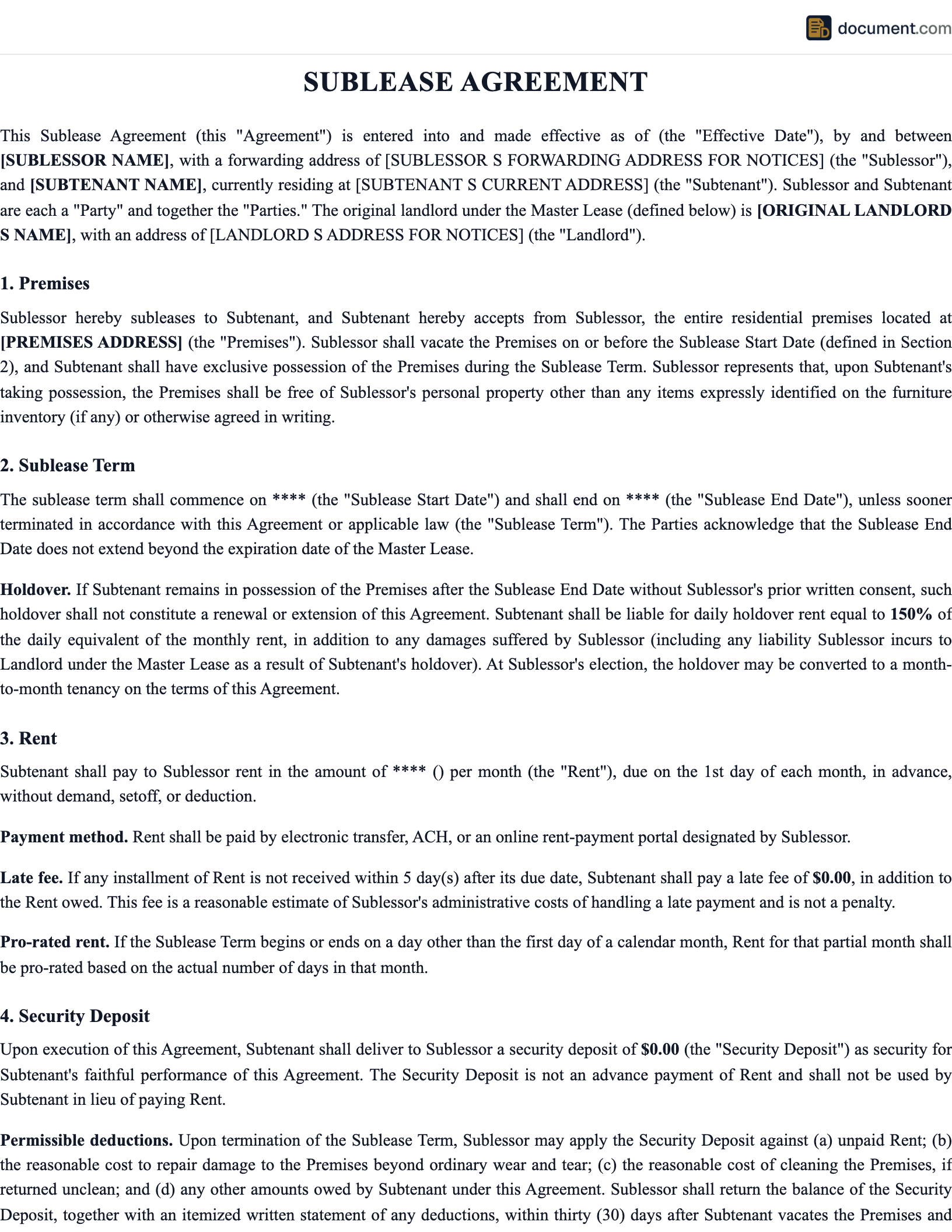



Wisconsin Commercial Sublease Agreement Overview
A Wisconsin commercial sublease allows an existing tenant (the sublessor) to transfer possession of leased space to a third party (the subtenant) for a period that does not exceed the remaining term of the prime lease. The sublessor continues to occupy its position under the prime lease and remains fully liable to the landlord for rent, maintenance, and all other lease obligations. The subtenant's right to occupy the space is entirely derived from the sublessor's rights under the prime lease.
Wisconsin commercial sublease activity is driven by tenants who have more space than they currently need, businesses restructuring operations, and companies that have signed long-term leases in markets like Milwaukee or Madison before their space needs changed. Because Wisconsin has no commercial rent tax, sublease rent is not subject to an additional excise layer beyond what the prime lease already requires.
The three-party structure of a commercial sublease requires careful documentation. The landlord must consent, the prime lease obligations must flow appropriately to the subtenant, and the subtenant must understand its exposure if the prime lease terminates early. A well-drafted Wisconsin commercial sublease protects all three parties by making each relationship explicit.
Consent
Required from landlord
Full liability
Original tenant retains
No privity
Subtenant vs. landlord
Contract
Governs all terms
Wisconsin Commercial Sublease Requirements
Wisconsin commercial subleases are governed by the prime lease and by contract law. Before executing a sublease, both the sublessor and the subtenant need to understand their respective obligations and risks.
Wisconsin Landlord Consent and Original Tenant Liability
Subletting without written landlord consent in violation of the prime lease constitutes a default that can result in lease termination. Even with proper consent, the original tenant remains fully liable to the landlord for all prime lease obligations throughout the sublease term. Subtenants should understand they have no privity with the landlord and their right to occupy the space depends entirely on the original tenant remaining in good standing under the prime lease.
Sublessor (Original Tenant) Obligations
- Obtain Written Landlord Consent: Submit the proposed subtenant's information to the landlord and obtain written approval before the sublease becomes effective
- Continue Paying Prime Lease Rent: The original tenant must continue paying the landlord directly under the prime lease regardless of whether the subtenant pays the sublease rent on time
- Screen the Subtenant: Verify the subtenant's financial capacity and business operations to minimize the risk of default that would expose the original tenant to liability under the prime lease
- Provide Prime Lease Copy: Deliver a complete copy of the prime lease to the subtenant so they understand the obligations that govern the premises and their use of the space
Subtenant Obligations
- Pay Sublease Rent: Pay rent to the sublessor on the terms stated in the sublease agreement by the stated due date
- Comply with Prime Lease Terms: Operate within the permitted use restrictions, maintenance standards, and all other requirements set by the prime lease, which are incorporated into the sublease
- Understand Prime Lease Termination Risk: Recognize that if the original tenant defaults under the prime lease for any reason, the subtenant's right to occupy the space may be terminated regardless of whether the subtenant is current on all sublease obligations
- Vacate at Sublease End: Surrender the subleased space in the required condition on or before the sublease expiration date, which cannot extend beyond the prime lease term
How to Prepare a Wisconsin Commercial Sublease Agreement
A Wisconsin commercial sublease involves more than filling in standard form fields. The following steps describe how to structure and execute the sublease properly.
Review the Prime Lease and Obtain Landlord Consent
Read the prime lease carefully to identify any restrictions on subletting, required consent procedures, and conditions the landlord may impose on the subtenant. Submit the proposed subtenant's financial information and intended use to the landlord in writing. Do not finalize the sublease or allow the subtenant to occupy the space until written consent is received.
Draft the Sublease to Incorporate Prime Lease Obligations
The sublease should incorporate the relevant prime lease provisions by reference so the subtenant is bound by the same use restrictions, maintenance obligations, and other requirements that govern the premises. Identify any prime lease provisions that apply only to the original tenant and confirm how they are handled in the sublease context.
Address Prime Lease Termination Risk
Include a provision explaining to the subtenant that their occupancy rights derive from the prime lease and could terminate if the original tenant defaults. Consider whether the transaction warrants seeking a non-disturbance agreement from the landlord, particularly in longer-term subleases where the subtenant is making significant investment in the space.
Execute and Distribute to All Parties
Have all parties execute the sublease and attach the landlord's written consent as an exhibit. Provide a fully executed copy to the sublessor, subtenant, and landlord. If the subtenant will be making improvements to the space, confirm that the prime lease permits alterations and that any required landlord approval for the work has been obtained separately.
Wisconsin Commercial Sublease Fees and Costs
Commercial sublease costs in Wisconsin include the negotiated sublease rent, security deposit, and any fees associated with the landlord consent process or professional review. Ranges below reflect typical Wisconsin commercial markets.
| Cost Item | Typical Range |
|---|---|
| Sublease Rent | $8 to $25 per sq ft annually; often at a discount to direct market rates depending on space and term |
| Security Deposit | Negotiated; typically one to three months of sublease rent for commercial space |
| Landlord Consent Processing Fee | $500 to $2,500 depending on landlord and prime lease terms |
| Attorney Review | $1,500 to $4,000 for commercial sublease review and negotiation |
| Tenant Improvement Allowance | Varies; sublessors sometimes offer a modest allowance to attract subtenants in challenging markets |
Sample Wisconsin Sublease Agreement
Below is a preview of our Wisconsin-specific sublease agreement. Your customized document will include all provisions required under WI law.
STATE OF WISCONSIN
SUBLEASE AGREEMENT
Residential Subletting Contract
SUBLESSOR (Original Tenant):
Name: [Sublessor Name]
Address: [Wisconsin Address]
SUBLESSEE (New Occupant):
Name: [Sublessee Name]
Current Address: [Address]
SUBLEASE TERMS
Start Date: [Date]
End Date: [Date]
Monthly Rent: $[Amount]
Security Deposit: $[Amount]
Wisconsin Sublease Agreement FAQ
Answers to common questions about sublease agreements in Wisconsin.
Other Wisconsin Lease Agreement Templates
Need a different type of lease agreement for Wisconsin? We offer state-specific templates for every type of rental arrangement.
Wisconsin Residential Lease
Standard rental agreements
Wisconsin Month-to-Month Lease
Flexible short-term rentals
Wisconsin Vacation Rental
Short-term vacation properties
Wisconsin Commercial Lease
Business and retail spaces
Wisconsin Roommate Agreement
Shared living arrangements
Wisconsin Rent-to-Own
Lease with purchase option
Wisconsin Equipment Lease
Equipment rental agreements
Wisconsin Land Lease
Land rental agreements
Wisconsin Room Rental
Individual room rentals
Create your Wisconsin Sublease Lease Agreement in under 5 minutes.
Answer a few questions and download a Wisconsin-compliant document, ready for the state agency.