
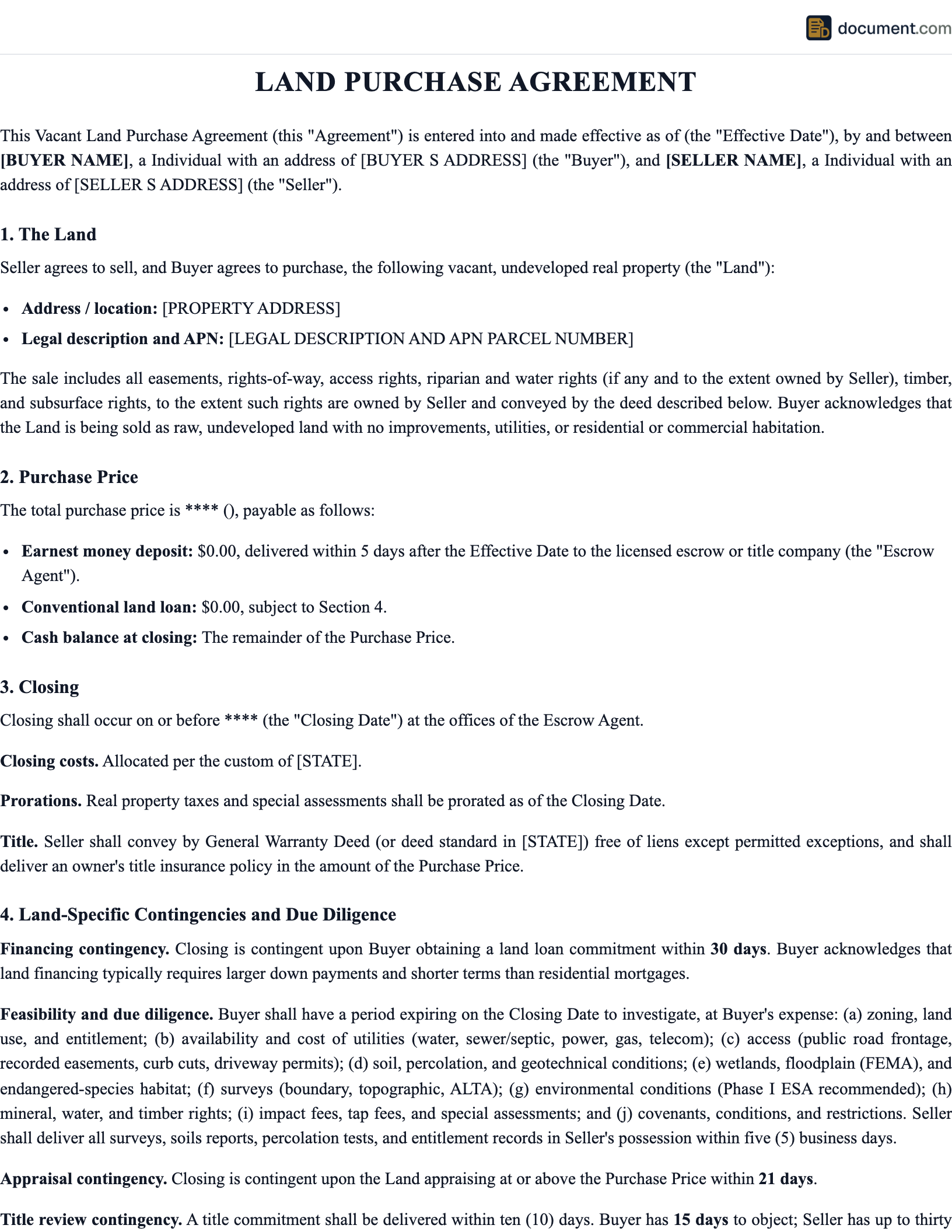



What Is a Land / Vacant Lot Purchase Agreement?
A land purchase agreement (also called a vacant lot purchase agreement or land sale contract) is a legally binding document that outlines the terms and conditions for the sale and transfer of undeveloped or vacant land from a seller to a buyer. Unlike a residential purchase agreement for an existing home, a land purchase agreement must address unique issues including boundary surveys, mineral and water rights, easements, environmental conditions, access rights, and development potential.
Purchasing vacant land is fundamentally different from buying improved property. There is no existing structure to inspect, no appraisal based on comparable home sales, and no standard home inspection contingency. Instead, the buyer must conduct due diligence on soil conditions, utility availability, road access, zoning restrictions, environmental contamination, flood zones, and whether the land can support the buyer's intended use — whether that is building a home, farming, commercial development, or recreation.
A well-drafted land purchase agreement protects both parties by clearly defining what is being sold (surface rights, mineral rights, timber, water rights), setting contingencies for due diligence (survey, environmental testing, zoning verification, soil testing), establishing the closing timeline and financing terms, and allocating risk for discovered issues. Without a comprehensive agreement, buyers risk purchasing land they cannot use or develop as intended.
Survey & Boundaries
Professional boundary surveys with legal descriptions by metes and bounds
Mineral & Water Rights
Complete allocation of subsurface mineral and water rights between parties
Environmental Protection
Phase I/II ESA contingencies and environmental liability provisions
Land Purchase Agreement by State
Each state has different laws governing land sales, property transfers, recording requirements, mineral rights, water rights, and environmental regulations. Select your state below for a template customized to your state's legal requirements.
Key Provisions & Clauses
A comprehensive land purchase agreement must contain specific provisions that address the unique aspects of vacant land transactions. These go far beyond what is included in a standard home purchase contract.
| Provision | Description |
|---|---|
| Legal Description | Metes and bounds, lot/block/subdivision, or government survey description of the property |
| Survey Contingency | Allows buyer to obtain a professional boundary survey and cancel if issues arise |
| Easements & Rights-of-Way | Disclosure of all existing easements (utility, access, conservation, drainage) |
| Mineral Rights | Specifies whether mineral rights are included or have been previously severed |
| Water Rights | Allocation of surface water, groundwater, and irrigation rights |
| Timber Rights | Ownership and harvesting rights for standing timber on the property |
| Environmental Contingency | Right to conduct Phase I/II ESA and cancel if contamination is found |
| Zoning Verification | Contingency to verify current zoning allows buyer's intended use |
| Soil & Percolation Testing | Testing for septic system feasibility, building foundation suitability |
| Access & Road Rights | Legal access from a public road, private road maintenance agreements |
| Utility Availability | Verification of electric, water, sewer, gas, internet availability and connection costs |
| Development Restrictions | HOA/POA covenants, deed restrictions, conservation easements, historic overlays |
Surveys & Boundaries
A professional land survey is one of the most critical steps in any land purchase. The survey establishes the exact boundaries of the property, identifies encroachments, reveals easements, and confirms the acreage you are purchasing matches what is represented.
There are several types of land surveys, each serving different purposes. Understanding which survey you need is essential for protecting your investment and ensuring your purchase agreement includes the appropriate contingency.
Boundary Survey
The most common survey type for land purchases. A licensed surveyor physically locates and marks the property corners, establishes boundary lines, and creates a plat map showing the property dimensions. Cost: $500-$3,000 depending on acreage, terrain, and complexity. Essential for any land purchase where boundaries are unclear or unmarked.
ALTA/NSPS Survey
The most comprehensive survey type, meeting standards set by the American Land Title Association and National Society of Professional Surveyors. Required by most title insurance companies and commercial lenders. Includes boundary lines, easements, rights-of-way, encroachments, improvements, utilities, flood zones, and zoning classification. Cost: $2,000-$10,000+.
Topographic Survey
Maps the elevation contours, natural features (streams, trees, rock outcroppings), and man-made features on the property. Essential for construction planning, drainage design, and development feasibility. Often required by local building departments before issuing grading or building permits. Cost: $1,000-$5,000+ depending on acreage and detail level.
Mineral & Water Rights
Two of the most valuable and often overlooked aspects of a land purchase are mineral rights and water rights. These rights can be worth more than the surface land itself and have significant implications for how you can use the property.
Critical: Severed Mineral Rights
In many states, mineral rights can be (and often have been) severed from surface rights through previous transactions. This means you could buy land where someone else owns the oil, gas, or minerals beneath your property — and they may have the legal right to access the surface to extract them. Always conduct a thorough mineral rights title search before purchasing.
Mineral Rights Include
- Oil and natural gas deposits
- Coal and other fossil fuels
- Metal ores (gold, silver, copper, iron)
- Stone, gravel, and sand
- Geothermal resources
Water Rights Include
- Surface water (streams, rivers, ponds)
- Groundwater (wells, aquifers)
- Irrigation water allocations
- Riparian rights (waterfront property)
- Prior appropriation rights (western states)
Environmental Assessments & Soil Testing
Environmental due diligence is critical for any land purchase. Under federal CERCLA (Superfund) law and state equivalents, landowners can be held liable for environmental contamination on their property — even if they did not cause it. Conducting proper environmental assessments before closing protects you from inheriting expensive cleanup obligations.
Beyond contamination concerns, soil testing determines whether the land can support your intended use. A failed percolation test means you cannot install a septic system. Poor soil bearing capacity means expensive foundation work. Wetland areas may be undevelopable. All of these issues should be discovered before you commit to the purchase.
Phase I Environmental Site Assessment
A Phase I ESA is a records review and site inspection that identifies potential environmental contamination. It reviews historical property use, aerial photographs, regulatory databases (EPA, state environmental agencies), and includes interviews with property owners and government officials. A Phase I ESA does not involve sampling — it identifies recognized environmental conditions (RECs) that warrant further investigation. Cost: $1,500-$4,000.
Phase II Environmental Site Assessment
If the Phase I ESA identifies RECs, a Phase II ESA involves physical sampling and laboratory analysis of soil, groundwater, and sometimes air quality. This confirms whether contamination exists, defines its extent, and identifies the contaminants. Cost: $5,000-$50,000+ depending on scope, number of samples, and contaminants of concern.
Soil & Percolation Testing
Soil testing evaluates the load-bearing capacity for building foundations and the percolation rate for septic system design. A percolation (perc) test is required by most health departments before approving a septic system permit. If the land fails a perc test and is not on a municipal sewer system, it may not be buildable for residential use. Cost: $500-$2,000.
Zoning & Land Use
Zoning laws dictate what you can and cannot do with the land. Before purchasing, you must verify that the property's current zoning classification permits your intended use. Attempting to rezone land or obtain a variance after purchase is expensive, time-consuming, and not guaranteed.
Your purchase agreement should include a zoning contingency that allows you to verify the current zoning, confirm your intended use is permitted, and cancel the contract if the zoning does not support your plans.
Residential Lot
Empty lots zoned for single-family or multi-family residential construction
Agricultural Land
Farmland, ranches, pastures, and crop-producing acreage
Recreational Land
Hunting properties, timberland, lakefront, and rural retreats
Commercial Land
Lots zoned for retail, office, industrial, or mixed-use development
Timberland
Forested land with harvestable timber rights and sustainable yield plans
Waterfront Property
Lakefront, riverfront, and oceanfront vacant land with riparian rights
Sample Land Purchase Agreement
Below is a preview of our land purchase agreement template. Your customized document will include all provisions required by your state's real property laws.
LAND / VACANT LOT PURCHASE AGREEMENT
Real Property Sale Contract
This Land Purchase Agreement is entered into on[Date]between:
SELLER:
Name: [Seller Name]
Address: [Seller Address]
BUYER:
Name: [Buyer Name]
Address: [Buyer Address]
1. PROPERTY DESCRIPTION
Legal Description: [Metes & Bounds / Lot-Block]
County: [County] State: [State]
Approximate Acreage: [Acres]
Parcel ID: [Tax Parcel Number]
2. PURCHASE PRICE & TERMS
Purchase Price: $[Amount]
Earnest Money: $[Amount]
Financing: [Cash / Loan / Seller Financing]
3. RIGHTS INCLUDED
Mineral Rights: [Included / Excluded / Severed]
Water Rights: [Included / Excluded]
Timber Rights: [Included / Excluded]
Frequently Asked Questions
Find answers to common questions about land and vacant lot purchase agreements, surveys, mineral rights, and property transfers.
Create your Land Purchase Agreement in under 10 minutes.
Answer a few questions and download a compliant, attorney-drafted document ready for your state.