
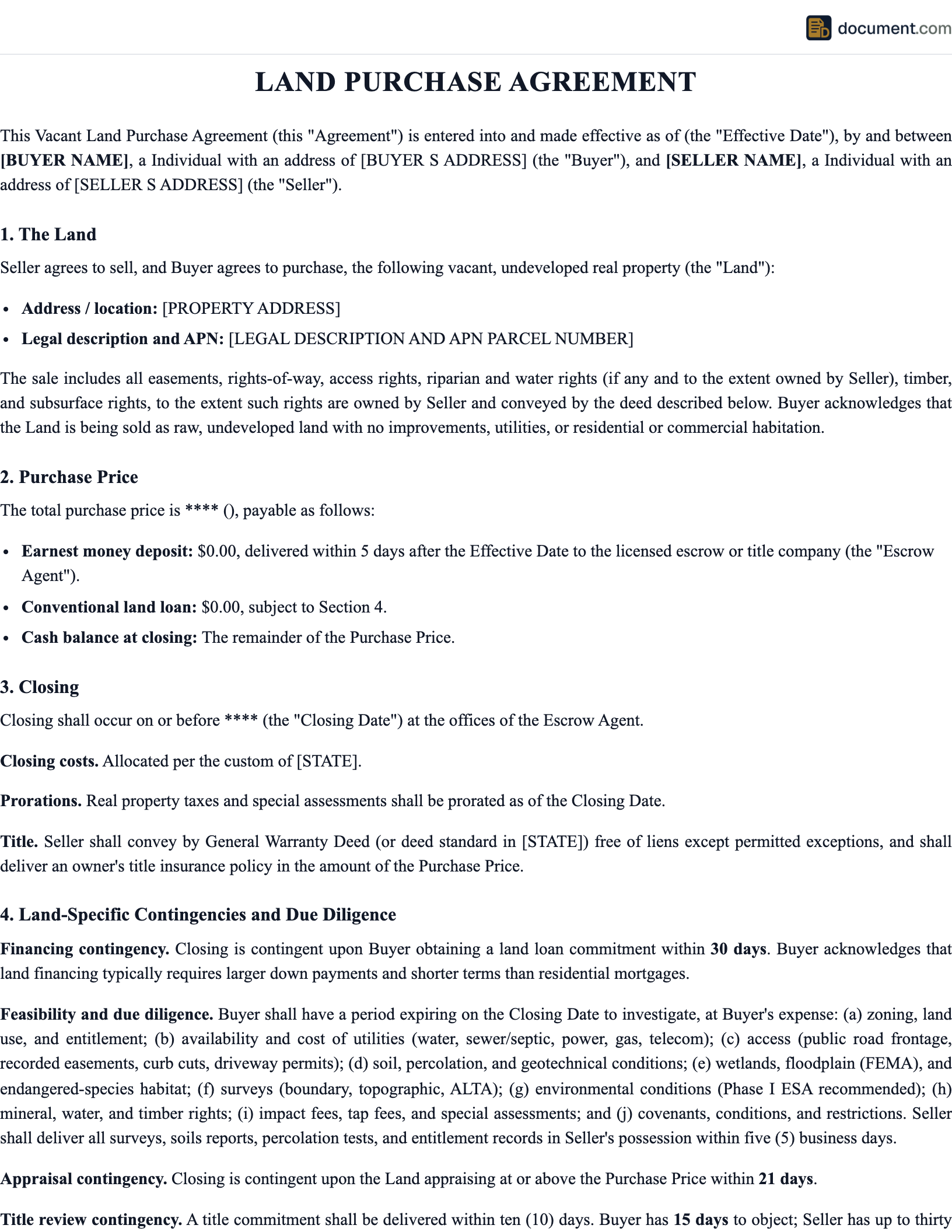



Kentucky Land Purchase Agreement Overview
Purchasing vacant land in Kentucky requires a comprehensive purchase agreement that addresses the state's specific requirements for real property transfers. Kentucky law requires all land sale agreements to be in writing under the Statute of Frauds, and the deed must be recorded with the County Clerk office in the county where the property is located.
Kentucky uses county-based zoning authority, meaning land use regulations are administered at the county level. Before purchasing vacant land in Kentucky, buyers should verify zoning classification, permitted uses, setback requirements, and any overlay districts or special designations that could affect development plans.
The standard deed type used in Kentucky land transactions is the Warranty Deed. Our Kentucky-specific land purchase agreement template includes all provisions required under Kentucky real property law, including survey contingencies, mineral and water rights allocations, environmental assessment provisions, and closing requirements specific to Kentucky recording offices.
$0.50 per $500
Transfer tax
Recommended
Survey requirement
Severable
Mineral rights
County-based
Zoning authority
Kentucky Recording Requirements
Kentucky requires all land transfer documents to be recorded with the County Clerk office in the county where the property is situated. Proper recording establishes the public record of ownership and protects against subsequent claims.
Important: Kentucky Recording Requirements
In Kentucky, failure to promptly record the deed can leave the buyer vulnerable to claims from subsequent purchasers or creditors. Record the deed as soon as possible after closing to establish priority. Kentucky uses a "notice" recording system, meaning proper recording is essential to protect your ownership interest.
Documents Required for Recording
- Signed Warranty Deed: The primary conveyance document transferring ownership from seller to buyer
- Transfer Tax Declaration: Required form documenting the sale price for tax calculation
- Legal Description: Metes and bounds, lot/block, or government survey description matching the survey
- Recording Fee: Payable to the County Clerk office (varies by county and page count)
- Title Insurance Commitment: Recommended to protect against title defects, liens, and encumbrances
How to Complete Your Kentucky Land Purchase Agreement
Follow these steps to properly complete your Kentucky-specific land purchase agreement. Our template guides you through each provision to ensure compliance with Kentucky law.
Identify the Parties
Enter the full legal names and addresses of both buyer and seller. For entities (LLCs, corporations, trusts), include the entity name and the name of the authorized signatory. Verify that the seller's name matches exactly how it appears on the current deed recorded with the Kentucky County Clerk office.
Describe the Property
Provide the complete legal description of the land (metes and bounds, lot/block/subdivision, or government survey description). Include the county, tax parcel number, and approximate acreage. The legal description must match the survey and the description that will appear on the Warranty Deed recorded in Kentucky.
Specify Rights Included
Clearly state whether mineral rights, water rights, and timber rights are included in the sale. In Kentucky, mineral rights are severable, so it is critical to conduct a title search to determine current mineral rights ownership. Specify any reserved rights, existing leases, or encumbrances affecting these rights.
Set Purchase Price & Terms
Document the purchase price, earnest money deposit amount and escrow holder, financing terms (cash, conventional loan, seller financing), and the closing date. For seller-financed land purchases in Kentucky, include the down payment, interest rate, payment schedule, and default provisions. Kentucky imposes a transfer tax of $0.50 per $500 which should be addressed in the closing costs allocation.
Include Contingencies
Add appropriate contingencies for your Kentucky land purchase: survey contingency (professional boundary survey), environmental contingency (Phase I ESA), soil/percolation testing contingency, zoning verification contingency, financing contingency, and title contingency. Each contingency should specify the deadline and remedies if the contingency is not satisfied.
Sign and Execute
Both buyer and seller must sign the purchase agreement. In Kentucky, the deed itself must be notarized before it can be recorded with the County Clerk office. Some Kentucky counties may have additional execution requirements. After closing, record the Warranty Deed promptly to establish the public record of ownership.
Mineral & Water Rights in Kentucky
Understanding mineral and water rights is essential for any Kentucky land purchase. These rights can significantly affect the value and usability of vacant land.
In Kentucky, mineral rights are classified as "Severable." This means that mineral rights can be separated from surface rights and may have been previously severed through prior transactions. Always conduct a thorough mineral rights title search before purchasing land in Kentucky.
Kentucky Mineral Rights
- Classification: Severable
- Title search recommended before purchase
- Include mineral rights clause in agreement
- Specify if included, excluded, or reserved
Kentucky Water Rights
- Riparian rights system (reasonable use)
- Verify water rights transfer with purchase
- Check well permits and irrigation allocations
- Groundwater regulations may apply
Kentucky Land Transfer Taxes & Fees
Understanding the costs associated with a Kentucky land purchase helps you budget accurately and avoid surprises at closing.
| Fee / Tax | Amount |
|---|---|
| State Transfer Tax | $0.50 per $500 |
| Recording Fee | Varies by county ($10-$50 per page) |
| Title Insurance | Based on purchase price (typically 0.5-1%) |
| Boundary Survey | $500-$5,000+ (depends on acreage) |
| Environmental Assessment | $1,500-$4,000 (Phase I ESA) |
| Soil/Perc Test | $500-$2,000 |
Sample Kentucky Land Purchase Agreement
Below is a preview of our Kentucky-specific land purchase agreement. Your customized document will include all provisions required under Kentucky real property law.
STATE OF KENTUCKY
LAND / VACANT LOT PURCHASE AGREEMENT
Real Property Sale Contract
SELLER:
Name: [Seller Name]
Address: [Kentucky Address]
BUYER:
Name: [Buyer Name]
Address: [Kentucky Address]
PROPERTY DESCRIPTION
Legal Description: [Metes & Bounds]
County: [County] Acreage: [Acres]
Parcel ID: [Tax Parcel #]
Purchase Price: $[Amount]
Kentucky Land Purchase Agreement FAQ
Answers to common questions about Kentucky land purchase agreements, surveys, mineral rights, and property transfer requirements.
Official Kentucky Resources
Use these resources to verify Kentucky land purchase requirements, find recording offices, and access government forms.
Create your Kentucky Land Purchase Agreement in under 5 minutes.
Answer a few questions and download a Kentucky-compliant document, ready for the state agency.