
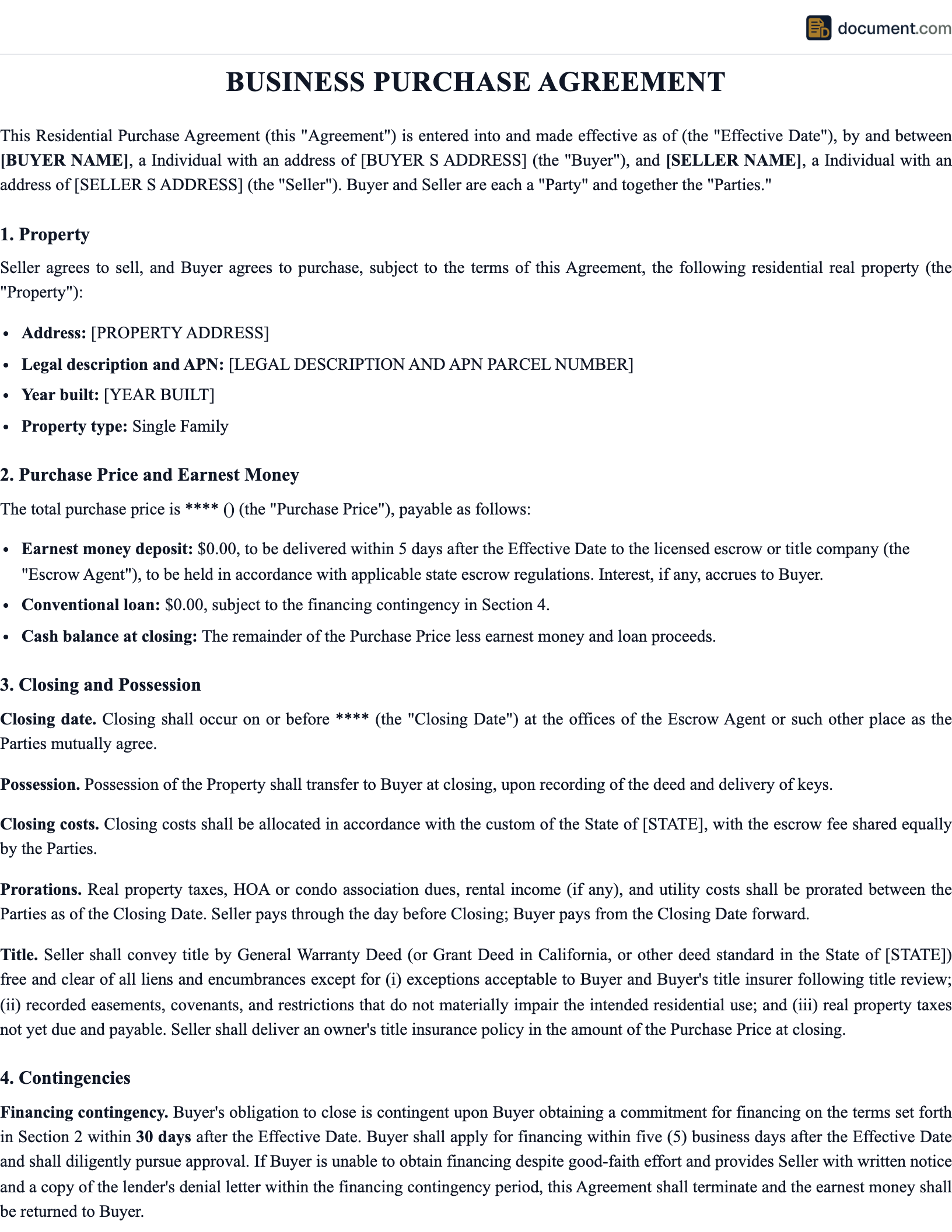



What Is a Business Purchase Agreement?
A business purchase agreement (also called a business acquisition agreement, business sale agreement, or asset purchase agreement) is a comprehensive legal document that governs the sale of a business from one party to another. This agreement defines everything from the purchase price and payment terms to representations, warranties, indemnification obligations, non-compete covenants, and post-closing obligations.
Buying or selling a business is one of the most complex transactions a person or company can undertake. Unlike real estate or vehicle sales, a business purchase involves intangible assets (goodwill, customer relationships, brand value), ongoing obligations (employee agreements, vendor contracts, lease assignments), potential hidden liabilities (pending lawsuits, tax obligations, environmental issues), and regulatory requirements (licenses, permits, industry-specific regulations).
A well-drafted business purchase agreement protects both the buyer and seller by clearly defining what is being purchased (asset sale vs. stock sale), establishing a thorough due diligence process, allocating the purchase price among asset categories for tax purposes, including representations and warranties that survive closing, and providing indemnification for breaches. Without a comprehensive agreement, both parties face significant financial and legal risk.
Business Valuation
Multiple valuation methods and purchase price allocation for tax optimization
Due Diligence
Comprehensive financial, legal, and operational investigation period
Indemnification
Post-closing protection through reps, warranties, and indemnification clauses
Business Purchase Agreement by State
Each state has different laws governing business sales, bulk transfer requirements, non-compete enforceability, sales tax on asset transfers, and Secretary of State filing requirements. Select your state below for a template customized to your state's legal requirements.
Business Valuation Methods
Determining the fair market value of a business is both an art and a science. Multiple valuation methods should be considered to arrive at a defensible purchase price.
Seller's Discretionary Earnings (SDE) Multiple
The most common method for small businesses (under $5M revenue). SDE equals net profit plus owner's salary, benefits, one-time expenses, and discretionary spending. The SDE is multiplied by an industry-specific multiple (typically 1.5x-4x). Higher multiples for businesses with strong growth, recurring revenue, diverse customer base, and systems that don't depend on the owner.
EBITDA Multiple
Used for mid-market businesses ($5M+ revenue). EBITDA (Earnings Before Interest, Taxes, Depreciation, and Amortization) provides a cleaner picture of operating profitability. EBITDA multiples typically range from 3x-8x depending on industry, size, growth trajectory, and market conditions. This is the standard metric used by private equity firms and sophisticated buyers.
Discounted Cash Flow (DCF)
Projects future cash flows and discounts them to present value using a risk-adjusted discount rate. DCF is the most theoretically sound method but requires reliable financial projections. The discount rate reflects the risk of the investment — higher risk businesses use a higher discount rate, resulting in a lower present value. Best suited for businesses with predictable, growing cash flows.
Asset-Based Valuation
Calculates value based on the net value of the business's tangible and intangible assets minus liabilities. Two approaches: going concern (assets valued at current use) and liquidation (assets valued at quick-sale prices). Most useful for asset-heavy businesses, holding companies, or businesses being wound down. Often sets the floor for the purchase price.
Due Diligence Checklist
Due diligence is the buyer's opportunity to verify everything the seller has represented about the business. A thorough due diligence process protects against overpaying, inheriting unknown liabilities, and post-closing surprises. Your purchase agreement should include a due diligence period (typically 30-90 days) with the right to terminate if material issues are discovered.
Critical: Don't Skip Due Diligence
The majority of failed business acquisitions can be traced to inadequate due diligence. Even if the seller is a friend or family member, conduct full due diligence. Undiscovered tax liabilities, pending lawsuits, lease issues, or customer concentration problems can destroy the value of your acquisition.
Financial Due Diligence
- 3-5 years of tax returns (business and personal)
- Profit & loss statements and balance sheets
- Accounts receivable and payable aging reports
- Bank statements and cash flow analysis
- Inventory valuation and obsolescence
- Debt schedule and loan agreements
Legal Due Diligence
- Articles of incorporation / organization
- Business licenses and permits
- Pending or threatened litigation
- All contracts, leases, and agreements
- Intellectual property registrations
- UCC filings and lien searches
Operational Due Diligence
- Customer list and revenue concentration
- Vendor/supplier agreements and pricing
- Employee roster, compensation, and benefits
- Equipment condition and maintenance records
- Technology systems and software licenses
- Standard operating procedures (SOPs)
Tax Due Diligence
- Federal and state tax compliance history
- Sales tax collection and remittance
- Payroll tax compliance (W-2 vs 1099)
- Outstanding tax liabilities or audits
- Purchase price allocation (Section 1060)
- State-specific business transfer taxes
Key Provisions & Clauses
A comprehensive business purchase agreement contains dozens of critical provisions. Here are the most important clauses that protect both buyer and seller.
| Provision | Description |
|---|---|
| Purchase Price & Allocation | Total price and allocation among asset categories (equipment, inventory, goodwill, IP) per IRS Section 1060 |
| Assets Included/Excluded | Detailed schedules of all assets being transferred and any specifically excluded |
| Liabilities Assumed | Which liabilities the buyer assumes and which remain with the seller |
| Representations & Warranties | Seller's factual statements about the business, surviving 12-24 months post-closing |
| Indemnification | Financial protection if reps/warranties are breached, with caps, baskets, and survival periods |
| Non-Compete Covenant | Restrictions on seller competing with the sold business for a defined period and geography |
| Customer Contracts | Assignment or novation of existing customer agreements and obtaining required consents |
| Intellectual Property | Transfer of trademarks, trade names, patents, copyrights, trade secrets, and domain names |
| Accounts Receivable | Whether A/R is included, collection rights, and aging adjustments |
| Closing Conditions | Conditions that must be met before closing (financing, landlord consent, license transfers) |
Non-Compete Agreements in Business Sales
A non-compete agreement is one of the most critical components of a business purchase. Without it, the seller could open an identical business across the street the day after closing, taking their customer relationships and industry knowledge with them. The value of goodwill you are purchasing is directly tied to the seller's commitment not to compete.
Non-competes in business sales are treated differently than employment non-competes by courts. Because the seller receives substantial consideration (the purchase price) and is voluntarily choosing to sell, courts enforce business sale non-competes more broadly. However, the covenant must still be reasonable in scope, duration, and geographic area.
Typical Terms
- Duration: 2-5 years post-closing
- Geography: 25-100 mile radius or defined market
- Scope: Same or substantially similar business
- Non-solicitation of customers and employees
Enforcement Considerations
- Must be supported by adequate consideration
- Reasonable in time, geography, and scope
- State-specific enforceability rules apply
- Some states allow judicial modification (blue pencil)
Employee Transitions
How employees are handled during a business sale affects everything from business continuity and customer retention to legal compliance and workplace morale. The approach differs significantly between asset purchases and stock purchases.
Sole Proprietorship
Single-owner businesses including freelancers, consultants, and independent contractors
LLC / Partnership
Limited liability companies, general partnerships, and limited partnerships
Corporation (S-Corp / C-Corp)
Incorporated businesses with shareholders, stock transfers, and board governance
Franchise
Franchise businesses with franchisor approval requirements and territory rights
Professional Practice
Medical, dental, legal, accounting, and other licensed professional practices
Retail / Restaurant
Brick-and-mortar retail stores, restaurants, bars, and food service businesses
Sample Business Purchase Agreement
Below is a preview of our business purchase agreement template. Your customized document will include all provisions required by your state's business transfer laws.
BUSINESS PURCHASE AGREEMENT
Asset / Equity Acquisition Contract
This Business Purchase Agreement is entered into on[Date]between:
SELLER:
Name/Entity: [Seller Name]
Address: [Seller Address]
Entity Type: [LLC / Corp / Sole Prop]
BUYER:
Name/Entity: [Buyer Name]
Address: [Buyer Address]
1. BUSINESS DESCRIPTION
Business Name: [DBA / Trade Name]
Type of Business: [Industry]
Location: [Business Address]
2. PURCHASE PRICE & ALLOCATION
Total Purchase Price: $[Amount]
Equipment: $[Amount] Inventory: $[Amount]
Goodwill: $[Amount] IP: $[Amount]
Frequently Asked Questions
Find answers to common questions about business purchase agreements, valuations, due diligence, and business transfer requirements.
Create your Business Purchase Agreement in under 10 minutes.
Answer a few questions and download a compliant, attorney-drafted document ready for your state.