



What Is a Demand Promissory Note?
A demand promissory note is a negotiable instrument under UCC § 3-104 in which the maker promises to pay a sum certain to the holder on presentment, with no fixed maturity date. UCC § 3-108(a) treats an instrument as payable on demand if it states so on its face, says “at sight” or “on presentation,” or does not state any time of payment. The holder may demand full payment of principal plus accrued interest at any time without cause; the maker must pay on the day of presentment or face dishonor. State enactments of UCC Article 3 (adopted in some form by all 50 states and the District of Columbia, with material variations in Louisiana's civil law treatment) control the operative mechanics.
The instrument fits arrangements where the lender values flexibility over predictability: intra-family loans, shareholder advances to closely held companies, bridge financing pending a take-out facility, and informal business lines of credit. The borrower accepts demand risk in exchange for either lower interest, simpler documentation, or trust-based access to capital that a term lender would not extend. Both sides should understand that a demand note is enforceable on its face from the moment of execution; UCC § 3-118(b) sets a 6-year statute of limitations starting on the date of demand (or 10 years from the last interest payment if no demand is ever made), with state-specific shorter periods in California (4 years, Cal. Code Civ. Proc. § 337), Texas (4 years, Tex. Civ. Prac. & Rem. Code § 16.004), and Florida (5 years, Fla. Stat. § 95.11(2)(b)).
A properly drafted demand note specifies the parties, principal amount in numbers and words, interest rate (compliant with state usury caps), default rate (typically the contract rate plus 5 percent, capped at usury), notice period (10 to 60 days standard), method of presentment (certified mail, hand delivery), governing law, attorney-fee shifting under state collection statutes, and signatures. Negotiability under UCC § 3-104 requires an unconditional written promise signed by the maker, payable to order or bearer, for a sum certain in money, payable on demand. Defects that destroy negotiability include conditional language, payment in kind, or non-money obligations; non-negotiable instruments lose holder-in-due-course protection under UCC § 3-302 and § 3-305.
UCC Article 3 negotiability requirements
UCC § 3-104(a) defines a negotiable instrument as an unconditional promise or order to pay a fixed amount of money, payable to bearer or to order at the time it is issued, payable on demand or at a definite time, and not stating any other undertaking by the person promising payment except as authorized by Article 3. A demand promissory note meets the time requirement on its face. The promise is unconditional even if the note refers to another writing for a statement of rights with respect to collateral or the right to acceleration; UCC § 3-106(b) preserves negotiability for such references. Conditional language (“subject to,” “governed by”) destroys negotiability; if the note is non-negotiable, the holder cannot achieve holder-in-due-course status and takes subject to all defenses the maker could assert against the original payee.
Statute of limitations and presentment timing
The statute-of-limitations clock on a demand note is jurisdiction-specific. UCC § 3-118(b) provides a 6-year period running from the date of demand. If no demand is made, the action is barred if no principal or interest has been paid for 10 years. State limitations may shorten the period further; California, Texas, and Florida apply 4-, 4-, and 5-year written-contract periods. A minority view treats demand notes as due immediately on execution, starting the limitations clock at signing rather than at demand; verify the rule in the controlling jurisdiction before relying on a long-dormant note. Presentment under UCC § 3-501 may be made at the place of payment specified in the note or, if none, at the maker's place of business or residence. Failure to present timely discharges secondary parties (indorsers, accommodation parties) under UCC § 3-415(e) but does not discharge the maker as primary obligor.
Payable on Demand
No fixed maturity. Holder calls the loan on presentment under UCC § 3-501.
Family & Friends
Standard structure for intra-family lending under IRC § 7872 AFR rules.
Flexible Repayment
No installment schedule unless the parties contract for one separately.
Demand Promissory Note by State
Each state enacts UCC Article 3 with local variations affecting demand notes. The most consequential state-specific variables are the statute of limitations on collection actions, the usury cap on interest, the form of permitted default rate, and notarization or witness requirements for enforceability against third parties. California (Cal. Code Civ. Proc. § 337) imposes a 4-year limitations period on written contracts; Cal. Const. art. XV § 1 caps consumer loan interest at 10 percent with broad exceptions for licensed lenders and business loans. New York applies a 6-year period under CPLR § 213(2) and a 16 percent civil usury cap (25 percent criminal) under General Obligations Law § 5-501. Texas applies a 4-year period under Tex. Civ. Prac. & Rem. Code § 16.004 and an 18 percent cap under Tex. Fin. Code § 303 for non-licensed lenders.
Florida applies a 5-year period under Fla. Stat. § 95.11(2)(b) and an 18 percent cap under Fla. Stat. § 687.02 (with criminal usury at 25 percent under § 687.071). Louisiana operates under civil law rather than UCC Article 3 in some respects; consult La. Civ. Code arts. 3494 and 3499 for prescription periods (3 years for open accounts, 5 years for negotiable instruments, 10 years for personal actions) and La. R.S. § 9:3500 for the conventional interest cap. Select your state for a compliant template referencing local statutes.
Demand Note vs. Term Note
UCC § 3-108 distinguishes the two. A term note (also called a time note) has a definite maturity date or installment schedule under § 3-108(b); the holder cannot accelerate without a contractual default. A demand note under § 3-108(a) has no maturity; the holder may demand full payment at any time without cause. The choice between them allocates timing risk between maker and holder. Term notes give the maker certainty (the loan cannot be called) at the cost of giving the holder less flexibility. Demand notes give the holder flexibility (capital is recoverable at will) at the cost of imposing call risk on the maker. The choice typically follows the relationship: arm's-length institutional lending uses term notes; trust-based intra-family or shareholder lending uses demand notes; bridge financing splits the difference with short-fuse term notes that mature in 30 to 90 days.
Acceleration clauses in term notes
Term notes commonly include acceleration clauses that allow the holder to demand full payment on default. Acceleration triggers typically include payment default (failure to pay any installment when due, often after a 10- or 30-day cure period), insolvency (filing of bankruptcy, assignment for the benefit of creditors, appointment of receiver), failure to maintain insurance on collateral, breach of any covenant, or material adverse change. Acceleration on a term note converts it functionally into a demand note from the date of trigger forward. The contract should state whether acceleration is automatic on the trigger or requires written notice from the holder; New York courts in Albertina Realty Co. v. Rosbro Realty Corp., 258 N.Y. 472 (1932) require an "affirmative overt act" to accelerate.
| Feature | Demand Note | Term Note |
|---|---|---|
| Maturity Date | None; payable on presentment under UCC § 3-501 | Fixed date (e.g., 12 months) |
| Payment Schedule | Optional; flexible by contract | Fixed monthly or quarterly installments |
| Holder Flexibility | May call loan at any time | Must wait until maturity unless default triggers acceleration |
| Maker Certainty | Lower; loan can be called without cause | Higher; fixed timeline |
| SOL Trigger | Date of demand (UCC § 3-118(b)) | Maturity date or default |
| Best For | Family loans, shareholder advances, bridge | Bank financing, mortgages, consumer credit |
Common Uses for Demand Notes
Demand promissory notes appear across a defined set of relationships where the lender values capital flexibility and the borrower accepts call risk. Family loans top the list because the demand structure preserves the lender's ability to recall funds for unforeseen need without committing to a fixed maturity that would feel transactional within the relationship. Shareholder loans to closely held corporations and LLCs use demand structure to preserve debt classification under IRS Notice 94-47 and the Estate of Mixon v. United States, 464 F.2d 394 (5th Cir. 1972) factors; equity recharacterization risk drops when the loan has demand mechanics, fixed interest, and arm's-length terms.
Bridge financing uses demand notes when the take-out facility is uncertain; the lender retains the right to pull funding if the permanent loan fails to close. Informal business lines of credit between operating companies and their owners (or between affiliated entities) use demand notes to preserve flexibility while documenting intercompany advances for transfer-pricing purposes under IRC § 482. Estate planning advisors use intra-family demand notes paired with grantor retained annuity trusts (GRATs), intentionally defective grantor trusts (IDGTs), and installment sales to grantor trusts to shift appreciation outside the estate while preserving the lender's control under IRC § 7872 AFR compliance.
Family Loans
Loans between family members where flexible repayment is preferred and no fixed deadline is needed. Charge at least the IRS Applicable Federal Rate (AFR) to avoid imputed-gift treatment under IRC § 7872.
Friend-to-Friend Loans
Personal loans between friends where the lender wants the right to call the debt without a fixed maturity. Document principal, rate, and notice period to avoid probate ambiguity.
Business Lines of Credit
Informal revolving credit between businesses or business owners where the lender wants flexibility to demand repayment without triggering a default under other credit facilities.
Shareholder Loans
Loans from shareholders to their corporation or LLC, callable when the shareholder needs liquidity. Document interest, demand notice, and arm's-length terms to avoid recharacterization as equity.
Bridge Financing
Short-term loans intended to bridge to a defined permanent financing event, with demand mechanics letting the lender pull funding if the take-out facility fails to close.
Estate Planning
Intra-family loans used in estate planning to transfer wealth while maintaining IRS documentation for AFR compliance and IRC § 7872 below-market loan treatment.
Key Components of a Demand Promissory Note
A demand note must satisfy UCC § 3-104 to qualify as a negotiable instrument: an unconditional written promise signed by the maker, payable to order or bearer, for a sum certain in money, payable on demand. Beyond the bare negotiability requirements, a properly drafted note specifies the parties (maker and original payee) with full legal names and addresses, the principal amount in both numbers and words to control over numerical errors, the interest rate (annual percentage rate compliant with the controlling state usury cap), the default rate (typically contract rate plus 5 percent, also capped at usury), the notice period before suit on dishonor (commonly 10 to 60 days), the method of presentment (certified mail with return receipt, hand delivery), and the governing-law clause naming the state whose law applies.
Attorney-fee shifting and prejudgment interest
A demand note should expressly authorize collection of attorney's fees and costs of collection if the holder must sue to enforce. Most states follow the American Rule that each party bears its own fees absent statute or contract; the contract clause is the operative authority. State collection statutes may also authorize fee-shifting in certain note actions: California Cal. Civ. Code § 1717 makes one-sided attorney-fee clauses bilateral as a matter of public policy; Texas Tex. Civ. Prac. & Rem. Code § 38.001 authorizes fees on a written contract claim including a promissory note. Prejudgment interest accrues from the date of demand under most state statutes (Cal. Civ. Code § 3287, N.Y. CPLR § 5001); post-judgment interest accrues at the statutory rate (10 percent in California per Cal. Code Civ. Proc. § 685.010, 9 percent in New York per CPLR § 5004).
| Component | Description |
|---|---|
| Maker & Payee Names | Full legal names and addresses; entity name and state of formation if not natural person |
| Principal Amount | Sum certain in money, in numbers and words; words control if discrepant under UCC § 3-114 |
| Interest Rate | Annual rate compliant with state usury caps; AFR floor for IRC § 7872 family loans |
| Demand Clause | Express “payable on demand” satisfies UCC § 3-108(a) |
| Notice Period | Days between presentment and right to sue (10 to 60 days standard) |
| Presentment Method | Certified mail with return receipt or hand delivery with witnessed acknowledgment |
| Default Rate & Fees | Default interest (contract rate plus 5 percent, capped at usury) and attorney-fee shifting |
| Governing Law | State whose UCC enactment and limitations period apply |
| Maker Signature | Dated signature; notarization not required for negotiability but adds evidentiary weight |
Sample Demand Promissory Note
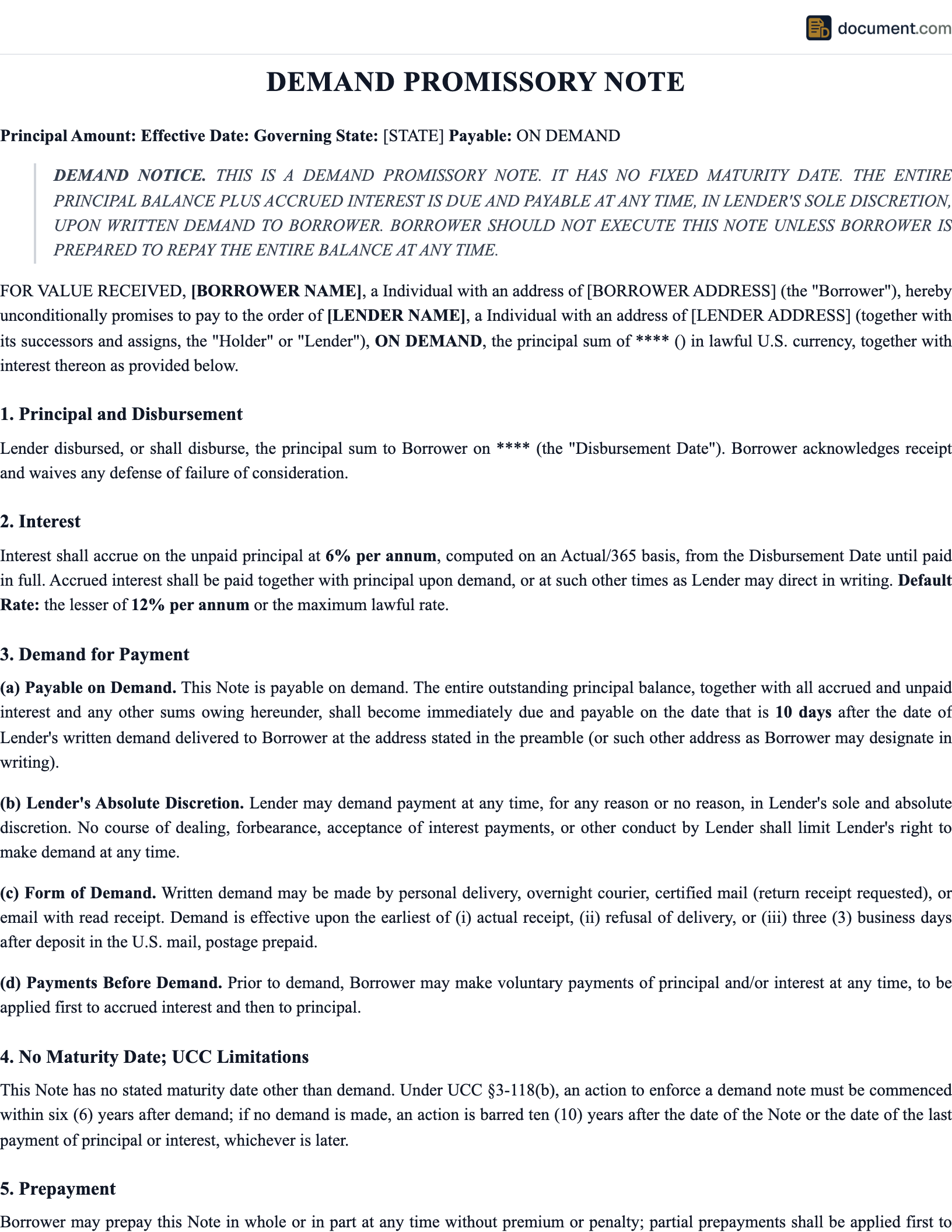
Below is a preview of our demand promissory note template structured to satisfy UCC § 3-104 negotiability requirements.
DEMAND PROMISSORY NOTE
Payable on Demand. No Fixed Maturity Date.
FOR VALUE RECEIVED, the undersigned Borrower promises to pay to the order of Lender the principal sum of $[Amount] ON DEMAND.
LENDER:
Name: [Lender Name]
BORROWER:
Name: [Borrower Name]
INTEREST
Interest: [Rate]% per annum on the unpaid balance
DEMAND
Payable in full within [30] days of written demand by the Lender
Frequently Asked Questions
Common questions about UCC Article 3 mechanics, presentment, statute of limitations, and IRS treatment of demand notes.
Create your Demand Promissory Note in under 10 minutes.
Answer a few questions and download a compliant, attorney-drafted document ready for your state.