


Key Takeaways
- •A notarial acknowledgment is a notary's certificate stating that a named person appeared before the notary, their identity was established through satisfactory evidence or personal knowledge, and they acknowledged signing the document voluntarily. The notary does not confirm the document's truth or legal validity.
- •An acknowledgment differs fundamentally from a jurat. An acknowledgment confirms voluntary signing and identity; a jurat confirms the signer swore under oath that the document's contents are true and signed in the notary's presence. The signer or the document's drafter chooses the correct form, not the notary.
- •California Civil Code section 1189 prescribes the exact wording for all-purpose acknowledgments taken in California. The certificate must include a boxed notice stating that the notary verifies only the signer's identity, not the document's truthfulness, accuracy, or validity.
- •The venue line -- the 'State of ___, County of ___' portion -- identifies where the notarization took place, not where the property sits or the signer lives. It reflects the notary's jurisdiction and must be filled in accurately.
- •Representative-capacity acknowledgments cover corporate officers, partners, trustees, and attorneys-in-fact who sign on behalf of another person or entity. The certificate language identifies both the signer's name and the capacity in which they signed.
- •As of 2026, most U.S. states have enacted permanent remote online notarization (RON) laws permitting notarizations over audiovisual technology. The acknowledgment form and requirements remain substantively the same under RON; the method of appearance and identity verification differ.
- •This page is educational information, not legal advice. Statutory wording requirements vary by state and document type. Confirm the form required by your jurisdiction and the recording county before finalizing any notarized instrument.
Reviewed for accuracy by the document.com legal team. Educational information, not legal advice.
What Is Notarial Acknowledgment Certificate?
A notarial acknowledgment is a certificate, completed and signed by a notary public or other authorized notarial officer, that attests a named person appeared before the officer, was identified by satisfactory evidence or personal knowledge, and declared that they signed the attached document voluntarily as their own act. The certificate travels with the document. It is not a statement that the document itself is accurate, valid, or legally effective -- only that the signer's identity was confirmed and the signing was acknowledged as voluntary.
The word 'acknowledgment' describes both the act and the resulting certificate. As a notarial act, an acknowledgment occurs when a person appears before a notary, presents identification, and declares -- out loud or by conduct -- that the signature on the document is theirs and that they executed it for the purposes stated in the document. The notary then completes the certificate, signs it, applies their seal or stamp, and attaches or embeds the certificate in the document record. Under the Revised Uniform Law on Notarial Acts (RULONA), which the Uniform Law Commission promulgated as a model law and roughly 28 states have adopted in some form, the short-form certificate for an individual reads: 'This record was acknowledged before me on [date] by [name of individual].'
Four certificate variants appear most frequently in practice: the individual acknowledgment (a single person signing for themselves), the representative-capacity acknowledgment (a corporate officer, managing partner, trustee, or attorney-in-fact signing on behalf of an entity or principal), the partnership acknowledgment, and the attorney-in-fact acknowledgment. The operative difference in each is who signed, in what capacity, and what authority that capacity carries. California is a notable exception to the representative-capacity distinction: under California law, the all-purpose acknowledgment form prescribed by Civil Code section 1189 is used for all signers -- individual or representative -- and California notaries are prohibited from certifying a signer's representative capacity in the certificate.
Notarial acknowledgments should not be confused with a jurat, a proof of execution by subscribing witness, or a simple notarial witness attestation. Each is a distinct notarial act with its own certificate language, timing rules, and legal purpose. Getting the form right matters because recording offices and courts scrutinize acknowledgment certificates, and a defective or missing acknowledgment can prevent a deed from being recorded or affect a document's legal standing.
Why This Matters Now
The practical reason acknowledgments are discussed more now is that remote online notarization has changed where and how they happen. For most of U.S. history, 'appearing before a notary' meant appearing in person. Most states now have permanent RON statutes authorizing notarizations conducted over two-way audiovisual technology, with identity verified through knowledge-based authentication and credential analysis rather than a face-to-face ID check. The acknowledgment certificate itself looks the same; the mechanics of appearance and identification are different. Anyone involved in real estate closings, loan signings, or estate planning documents needs to understand both the traditional and RON forms.
Recording offices in high-transaction states have also become more rigorous about rejecting documents with defective acknowledgments. A deed submitted to a county recorder with an incomplete venue, a missing seal, or certificate language that does not match the state's prescribed form may be returned unfiled. An unrecorded deed provides no constructive notice to subsequent purchasers under recording acts, so a faulty acknowledgment can render an otherwise valid conveyance vulnerable to intervening claims and title gaps that are expensive to unwind.
The growth of document-signing platforms and distributed workforces has led to more signings where the notary is in a different county or state from the document's subject matter, the parties, or the drafter. Each of those layers adds a question: whose form applies, and what wording is required? California's all-purpose acknowledgment under Civil Code section 1189 is widely used for California-property documents, and the state expressly permits notaries in other states to use California's prescribed form. But a California notary completing an out-of-state form must still operate within their California commission authority.
For businesses and professionals who deal in volume -- title companies, lenders, law firms, property managers -- building accurate acknowledgment language into templates from the start is less expensive than correcting defective instruments after the fact. A single rejected deed re-recording can cost far more in title insurance, courier fees, and attorney time than getting the certificate right initially.
Legal Authority Behind Notarial Acknowledgments
Revised Uniform Law on Notarial Acts (RULONA, 2010 and 2018 versions)
RULONA is a model law drafted by the Uniform Law Commission that provides a comprehensive framework for notarial acts, including acknowledgments. Approximately 28 states have adopted some version of RULONA or its predecessor, the 1982 Uniform Law on Notarial Acts (ULONA). RULONA section 2(1) defines 'acknowledgment' as a declaration by an individual before a notarial officer that the individual has signed a record for the purpose stated in the record and, if signed in a representative capacity, that the individual signed the record with proper authority and as the act of the person or entity identified in the record. Section 6 establishes what a notarial officer must determine before taking an acknowledgment: that the individual appearing before the officer has the identity claimed, using personal knowledge or satisfactory evidence such as a government-issued ID or credible witnesses. Section 15 requires that notarial acts be evidenced by a certificate signed and dated by the notarial officer, identifying the jurisdiction, and including the officer's title and, if applicable, the expiration of their commission. RULONA also prohibits loose certificates that are not attached to or incorporated in the record they relate to, and the 2018 version added provisions for remote online notarization.
California Civil Code section 1189 -- the all-purpose acknowledgment form
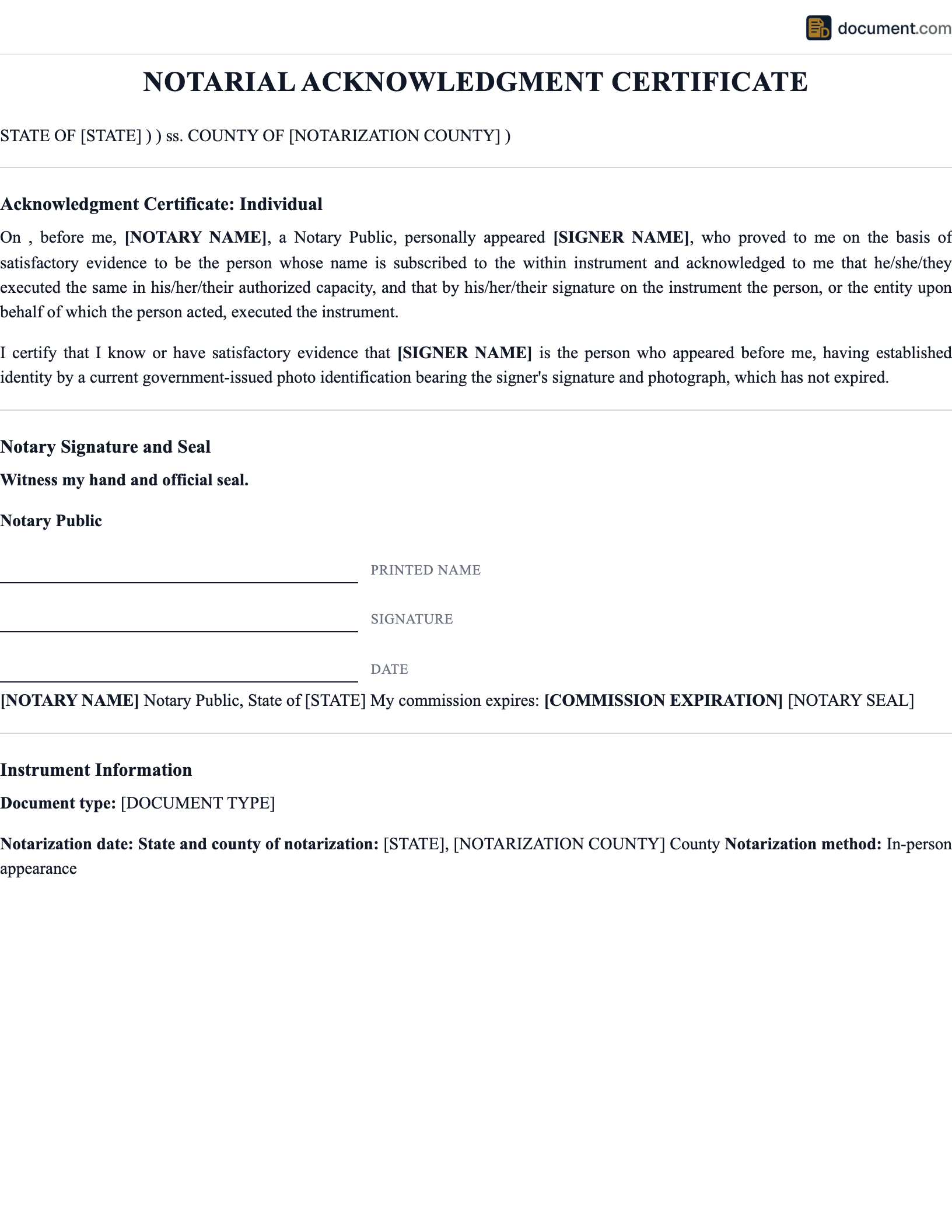
California prescribes exact statutory wording for acknowledgments taken within the state. Civil Code section 1189, as amended effective January 1, 2015, requires that any certificate of acknowledgment taken in California include a boxed notice at the top reading: 'A notary public or other officer completing this certificate verifies only the identity of the individual who signed the document to which this certificate is attached, and not the truthfulness, accuracy, or validity of that document.' The prescribed acknowledgment language then reads, in part: 'On [date] before me, [name and title of the officer], personally appeared [name of signer], who proved to me on the basis of satisfactory evidence to be the person(s) whose name(s) is/are subscribed to the within instrument and acknowledged to me that he/she/they executed the same in his/her/their authorized capacity(ies)...' The certificate concludes with a penalty-of-perjury certification clause and space for the notary's signature and seal. A notary who willfully states a false material fact in a California acknowledgment faces a civil penalty of up to $10,000 under the statute. California also expressly permits acknowledgments taken outside the state using the form prescribed in the jurisdiction where the acknowledgment was taken, provided that the out-of-state form substantially meets California's requirements.
Recording statutes and the acknowledgment requirement
Every U.S. state has a recording act that governs when a deed, mortgage, deed of trust, or other instrument affecting real property can be recorded in the public land records. In virtually every state, an instrument must be acknowledged -- that is, have a proper notarial acknowledgment -- to be entitled to recording. The recording requirement exists to provide constructive notice: a deed that is not recorded is generally void as against a subsequent bona fide purchaser for value who records first without knowledge of the prior deed. New Mexico Statutes section 14-8-4, for example, requires that instruments be 'acknowledged' in the sense the state's version of RULONA defines, meaning notarized by a person authorized under that act. Courts have consistently held that while an unacknowledged deed may still be valid between the original parties, the absence of acknowledgment defeats recording and thus defeats constructive notice to the world. That practical consequence -- the inability to record and the resulting vulnerability to intervening claims -- is why acknowledgments are treated as non-optional in real estate practice.
Authorized notarial officers beyond notaries public
The title 'notary public' is the most common designation, but it is not the only one. Under RULONA and state statutes, notarial acts may be performed by judges, clerks and deputy clerks of courts of record, military officers authorized under federal law to perform notarial acts for members of the armed forces, and, in some states, commissioners of deeds and other designated public officers. U.S. diplomatic and consular officers at American embassies and consulates abroad may also perform notarial acts under 22 C.F.R. Part 92, including taking acknowledgments for documents to be used in the United States. The officer completing the acknowledgment certificate must identify their title in the certificate, and if their authority is limited to a particular jurisdiction or office (as a county clerk's is, for example), the certificate must reflect that. Some states also grant limited notarial authority to officers of specific agencies for documents generated by those agencies.
Remote online notarization (RON) and the acknowledgment certificate
Most U.S. states now have permanent RON statutes. Under RON, the signer appears before the notary through real-time audiovisual communication technology rather than in person. Identity is established through a combination of knowledge-based authentication (answering questions only the signer is likely to know from public records) and credential analysis (an automated check of the ID document's authenticity). The notarized record is typically an electronic document, and the notary applies an electronic seal and signature. The acknowledgment certificate form under RON is substantively the same as in-person acknowledgment; the venue reflects the notary's physical location at the time of the notarial act, not the signer's. States that have enacted RON laws generally specify that an electronic acknowledgment certificate is treated the same as a paper certificate for recording and other legal purposes, provided it meets the state's technical standards. California notaries cannot currently perform RON. Senate Bill 696 created a future program, but the Secretary of State has not announced its commencement; check the current official guidance before proceeding.
Florida Statutes section 117.05 -- physical-presence or online-notarization checkbox
Florida Statutes section 117.05 governs the form of notarial certificates for Florida notaries public. Subsection (4) requires every jurat and notarial certificate to state whether the signer appeared before the notary by physical presence or by means of audio-video communication technology. Subsection (13) provides the prescribed statutory certificate forms, each of which includes checkboxes reading: 'physical presence or online notarization.' For example, an acknowledgment certificate reads 'acknowledged before me by means of [checkbox] physical presence or [checkbox] online notarization.' Florida enacted its online notarization framework (Part II, sections 117.201 through 117.305) effective January 1, 2020. The section 117.05 checkbox amendment followed to align the paper certificate forms with the new online pathway, so a recording office can tell from the face of the certificate which method of appearance was used. Florida notaries performing RON sessions must also satisfy additional requirements including use of an approved RON service provider, a $25,000 notary bond, and credential analysis plus knowledge-based authentication for identity verification.
Acknowledgment vs. jurat, and what the notary actually verifies
The distinction between an acknowledgment and a jurat is one of the most frequently confused points in notary practice, and getting it wrong produces an invalid certificate.
An acknowledgment certificate confirms three things: the signer appeared before the notary, their identity was established by the notary through personal knowledge or satisfactory evidence, and the signer declared that the signature on the document is theirs and that they executed the document voluntarily. The document may have been signed before the signer appeared before the notary -- that is not disqualifying for an acknowledgment. What matters is that the person appeared, was identified, and personally acknowledged the signing. Acknowledgments are used most commonly on deeds, mortgages, deeds of trust, powers of attorney, articles of incorporation, and other instruments that need to be recorded or that require formal execution.
A jurat does something different. A jurat (sometimes called a verification on oath or affirmation) confirms that the signer appeared before the notary, signed the document in the notary's presence at that time, and swore or affirmed under oath that the contents of the document are true. The signature must happen in real time, in front of the notary. Jurats appear on affidavits, sworn statements, declarations, and court documents where the law requires the signer to swear to the document's contents. The certificate language uses 'subscribed and sworn to before me' or 'subscribed and affirmed before me,' which is how a reader can tell a jurat from an acknowledgment at a glance.
The notary's role in an acknowledgment is deliberately limited. The notary does not read the document, does not evaluate whether it is accurate, does not assess whether the transaction is fair, and does not certify anything about the document's legal effect. California's Civil Code section 1189 makes this explicit with the required boxed notice -- the notary verifies only the identity of the signer. That limitation protects everyone: it keeps notaries from practicing law, and it prevents a notarial seal from being misread as an endorsement of the document's truth.
Identity verification is the substantive duty the notary owes in an acknowledgment. Satisfactory evidence of identity, under RULONA and most state laws, means a passport, driver's license, or other government-issued photo ID that contains the person's signature and is not expired (some states allow recently expired IDs by narrow exception). Where the notary has personal knowledge of the individual -- meaning dealings with that person sufficient to provide reasonable certainty of identity -- no ID document is required, though many notaries require one anyway. A third pathway exists in states that permit reliance on credible witnesses: typically, one or two individuals personally known to the notary or the signer who can swear to the signer's identity. The notary chooses the least risky path their state allows and documents what they relied on.
When a signer appears in a representative capacity, the certificate must identify both the individual signer and the capacity in which they signed. For a corporate officer, that means the officer's name, their title, and the name of the corporation. For a partner, it means the partner's name and the partnership's name. For an attorney-in-fact, it means the agent's name and the principal's name. The notary's job is to identify the individual who actually appeared -- the officer, partner, or agent -- not to investigate whether that person's authority is valid or whether the entity gave them permission to sign. Verifying authorization is the responsibility of the parties and their attorneys, not the notary. California departs from this: its all-purpose form does not certify representative capacity at all, and California notaries are prohibited from completing certificate language purporting to verify such capacity.
When a notarial acknowledgment is required
You are recording a deed, mortgage, deed of trust, or other conveyance instrument in a county recording office. Recording acts in every state require an acknowledged instrument, and a recorder will return an instrument with a defective or missing acknowledgment unfiled.
You are executing a durable power of attorney or healthcare power of attorney. Most state power-of-attorney statutes require notarization, and many require both notarization and witness signatures. The principal's signature on the power of attorney is acknowledged before a notary.
You are signing a real estate purchase contract, commercial lease, or other agreement that calls for notarization in the execution block. The contract or applicable state law dictates whether an acknowledgment, a jurat, or a notarial witness is required.
You are executing a trust document, certificate of trust, or deed transferring real property into a trust. Trust deeds that affect real property need to be recorded and therefore need a proper acknowledgment.
A corporate officer, managing member, partner, or attorney-in-fact is signing on behalf of an entity or principal, and the instrument requires notarization. A representative-capacity acknowledgment identifies both the signer and the capacity.
You are signing a vehicle title document, bill of sale for personal property, or other transfer document in a state that requires notarization of such documents.
A document must be recorded in a foreign jurisdiction or country, and the jurisdiction requires proof that the signature was acknowledged before a competent officer. U.S. consular officers can take acknowledgments abroad for documents intended for use in the United States, and many foreign recording authorities accept acknowledgments taken before designated U.S. officers.
You are completing a remote online notarization through an approved RON platform and need to confirm the certificate form required by the recording county or state where the document will be filed.
How to Fill Out Notarial Acknowledgment Certificate
1. Confirm the correct certificate type and required form
Before the signing appointment, confirm whether the document requires an acknowledgment, a jurat, or another notarial act. The document's execution block or the state statute governing that document type will specify. Then confirm the required certificate language. California documents to be recorded in California require the Civil Code section 1189 form, including the boxed notice. Documents for recording in other states may require that state's prescribed form. If the document has a preprinted notarial certificate, verify that it matches the required language for the jurisdiction where it will be recorded or used.
2. Identify the signer through satisfactory evidence or personal knowledge
Ask the signer to present a current, government-issued photo ID bearing their signature -- a passport, driver's license, or state ID card are the most common. The name on the ID must match the name on the document. If the notary has personal knowledge of the signer through prior dealings sufficient to establish identity with reasonable certainty, that may substitute for an ID document in states that permit it. Document the type of ID presented in your notarial journal. If the signer's name on the document does not exactly match the ID, note the discrepancy and assess whether your state's rules permit a name variation.
3. Complete the venue line
Fill in the 'State of ___, County of ___' (or 'State of ___, City of ___' in states that use city-level venue) with the state and county where the notarization is physically taking place. The venue reflects where the notary is located at the time of the act, not where the property is located, not where the signer lives, and not where the document was prepared. For remote online notarization, the venue is the notary's physical location at the time of the session.
4. Have the signer acknowledge the signature
Ask the signer: 'Do you acknowledge that this is your signature and that you signed this document voluntarily?' Or words to that effect under your state's guidance. In a representative capacity, the question should identify the capacity: 'Do you acknowledge that you signed this document voluntarily as [title] on behalf of [entity name]?' The signer must be present in person or through an approved audiovisual connection for RON. An acknowledgment, unlike a jurat, does not require the document to be signed in the notary's presence -- the signer may have signed earlier -- but the acknowledgment must happen in real time before the notary.
5. Complete and sign the certificate
Fill in the date, the notary's name and title, the signer's name (and capacity, for representative-capacity acknowledgments), and any other blanks in the prescribed form. Sign the certificate in your official capacity. If your state's form calls for your commission expiration date, include it. Many states require it to appear below or adjacent to the notary's signature.
6. Apply the notarial seal
Affix your official notarial seal or stamp. The seal must be legible. Most states require the seal to include the notary's name, commission number, the state, the county of the notary's principal place of business, and the commission expiration date, though the specific required elements vary by state. An illegible seal is grounds for rejection by a recording office. For electronic notarizations under RON, the notary applies an electronic seal and electronic signature that meet the state's technical standards.
7. Record the notarization in your journal
Most states require notaries to maintain a sequential journal or record book of all notarial acts. Enter the date, the type of notarial act, the name of the signer, the type and identifying information of the ID presented, a description of the document, and the fee charged. Some states require the signer's thumbprint for certain documents, notably deeds and other real property instruments. A proper journal entry is your record if the acknowledgment is ever challenged.
8. Attach or incorporate the certificate in the document
If the acknowledgment certificate is on a separate page rather than preprinted on the document itself, attach it securely to the document before delivery. RULONA expressly prohibits loose certificates. Many notaries use a staple or binding to attach the pages and initial the attachment point to discourage substitution. For electronic records under RON, the electronic certificate is logically incorporated into the record according to the platform's technical standards.
Key Terms Defined
- Acknowledgment
- A notarial act in which a person declares to a notarial officer that they signed a document voluntarily and for the purpose stated in the document. Under RULONA section 2(1), if the signing was in a representative capacity, the declaration also covers the signer's authority to sign on behalf of the identified person or entity. The notary confirms the signer's identity and the voluntary acknowledgment; the notary does not verify the document's accuracy or legal effect.
- Jurat
- A notarial act in which a person appears before a notary, signs a document in the notary's presence, and swears under oath or affirms that the contents of the document are true. Distinguished from an acknowledgment by two points: the document must be signed in the notary's presence at the time of the act, and the signer takes an oath or affirmation as to the document's truth. Certificate language uses 'subscribed and sworn to before me.' Used for affidavits, declarations, and sworn statements.
- Venue
- The 'State of ___, County of ___' clause at the opening of a notarial certificate. The venue identifies where the notarial act took place -- where the notary was physically located -- not where the property is situated, where the parties reside, or where the document was prepared. Completing the venue accurately is the notary's responsibility, and an incorrect or missing venue can cause a recording office to reject the instrument.
- Satisfactory evidence of identity
- The standard of identification a notary must meet before completing a notarial act. Under RULONA and most state laws, satisfactory evidence is typically a current, government-issued photo ID bearing the person's signature, such as a passport, driver's license, or state identification card. Alternative methods include personal knowledge of the individual through prior dealings and, in states that permit it, verification by one or two credible witnesses.
- Representative capacity
- Signing on behalf of another person or entity rather than in one's own name. Common representative capacities include corporate officer (signing on behalf of a corporation), general partner (on behalf of a partnership), trustee (on behalf of a trust), and attorney-in-fact (on behalf of a principal under a power of attorney). A representative-capacity acknowledgment names both the individual signer and the entity or principal they represent. California's all-purpose acknowledgment form under Civil Code section 1189 is used for both individual and representative signers, but California notaries are prohibited from certifying the signer's authority in the certificate.
- Notarial seal
- The official stamp or embossed seal applied to a notarized document. The seal typically includes the notary's name, commission number, the state of commission, the county of the notary's principal place of business, and the commission expiration date, though exact required elements vary by state. The seal must be legible on the document. Recording offices and receiving parties use the seal to confirm that a valid, commissioned notary completed the act within their commission term. For electronic notarizations under RON, the notary applies an electronic seal that meets the state's technical requirements.
- Remote online notarization (RON)
- A form of notarization performed over real-time two-way audiovisual technology, in which the signer appears before the notary electronically rather than in person. Identity is typically verified through knowledge-based authentication and automated credential analysis rather than an in-person ID check. Most U.S. states now have permanent RON statutes. The acknowledgment certificate form is substantively the same as for in-person notarization; the venue reflects the notary's physical location at the time of the session.
- Commission expiration date
- The date on which a notary's appointment by the state authority (typically the secretary of state or governor) ends. Most state commissions run four years, though terms range from two to eight years depending on the state. The commission expiration date must appear in the notary's seal and, in most states, adjacent to or below the notary's signature on any certificate. Acts performed after a commission expires are invalid.
Related Documents
Notarial acknowledgment vs. jurat
Both are notarial acts, but they serve different purposes. An acknowledgment confirms the signer appeared, was identified, and voluntarily acknowledged their signature on the document. The document may have been pre-signed. A jurat confirms the signer appeared, signed the document in the notary's presence at that moment, and swore or affirmed under oath that the contents are true. Deeds and powers of attorney typically use acknowledgments; affidavits and sworn statements use jurats. The notary does not choose between them -- the document type and applicable law determine which is required.
Notarial acknowledgment vs. notarial witness attestation
Some documents require the notary to witness the signing rather than take an acknowledgment. When a notary witnesses a signature, the signer must sign in the notary's presence at that time, and the notary attests to having witnessed the act. The notary still verifies identity. Witnessing differs from an acknowledgment because the signature must happen live before the notary, and the certificate language says 'signed before me' rather than 'acknowledged before me.' Many states distinguish between a notarial signature witness and a lay witness; the notary's attestation often carries more legal weight.
Notarial acknowledgment vs. apostille
An apostille is a certification that authenticates the signature and official capacity of a notary or government official for use in countries that are parties to the Hague Apostille Convention. A notarized document gets an apostille when it must be recognized abroad. The apostille does not duplicate or replace the acknowledgment -- it authenticates the notary's credentials for a foreign jurisdiction. The typical order is: the signer executes the document, the notary completes the acknowledgment, and then the document is submitted to the state-level authority (usually the secretary of state) for an apostille.
Notarial acknowledgment vs. certificate of subscribing witness
A few states permit proof of execution through a subscribing witness rather than direct acknowledgment by the signer. If the grantor or signer is unavailable to appear before a notary, a person who witnessed the signing can appear before a notary and swear that they saw the signer execute the document. New York Real Property Law section 309-a provides for this form of proof. The certificate of subscribing witness is an alternative to acknowledgment, not a supplement, and it is accepted by fewer recording offices than a standard acknowledgment.
Legal Authorities & Sources
This page is grounded in primary law. The statutes and official resources below are the authorities behind the guidance above. Verify the current text of any statute before relying on it.
- California Civil Code section 1189 -- prescribed all-purpose acknowledgment form (California Legislative Information)
- California Secretary of State -- Notary Acknowledgment Requirements and official form
- Uniform Law Commission -- Revised Uniform Law on Notarial Acts (RULONA), approved 2010 and amended 2018
- National Notary Association -- Key differences between acknowledgments and jurats
- National Notary Association -- Guide to notarizing for representative signers
- New Mexico Statutes section 14-8-4 -- acknowledgment required for recording (Justia)
- eCFR 22 C.F.R. Part 92 -- Notarial and Related Services by U.S. consular officers
- Florida Statutes section 117.05 -- notarial certificate forms; physical-presence or online-notarization checkbox (Online Sunshine)
- NotaryLive -- Remote online notarization status by state (2026)
- American Society of Notaries -- Credible witness identity verification
Frequently Asked Questions
Create your Notarial Acknowledgment Certificate in minutes.
Answer a few questions and download a clear, attorney-drafted document that cites the controlling law and is ready to sign.