



Key Takeaways
- •A NIL licensing agreement is what makes an athlete endorsement deal enforceable. It names exactly which rights are licensed, for how long, in what category, and at what price, and it is the document the College Sports Commission and your school's compliance office will ask to see.
- •Since June 6, 2025, when Judge Claudia Wilken granted final approval to the $2.8 billion House v. NCAA settlement, Division I athletes at opt-in schools must report any third-party NIL deal worth $600 or more to the NIL Go clearinghouse (run with Deloitte) within five business days, where it is checked for a valid business purpose and fair market value.
- •Roughly 35 states have their own NIL statutes, and the rules vary widely. California's Fair Pay to Play Act (Senate Bill 206), effective September 1, 2021, was the first; states differ on agent rules, prohibited categories, disclosure, and whether high school athletes can sign at all.
- •NIL rests on the right of publicity, the right to control commercial use of your identity. Without a signed license, a brand that runs an athlete's name or face is exposed to a right-of-publicity claim; the license is the consent that defeats it.
- •The FTC's revised Endorsement Guides (16 C.F.R. Part 255), effective July 26, 2023, require any paid athlete to clearly and conspicuously disclose the brand relationship. The agreement should put that duty in writing because the FTC can hold the athlete and the brand liable.
- •A minor athlete cannot be bound to a contract alone. The deal must be co-signed by a parent or guardian, and some states impose added limits on exclusivity, term, and how much of a minor's earnings can be committed.
Reviewed for accuracy by the document.com legal team. Educational information, not legal advice.
What Is NIL Licensing Agreement?
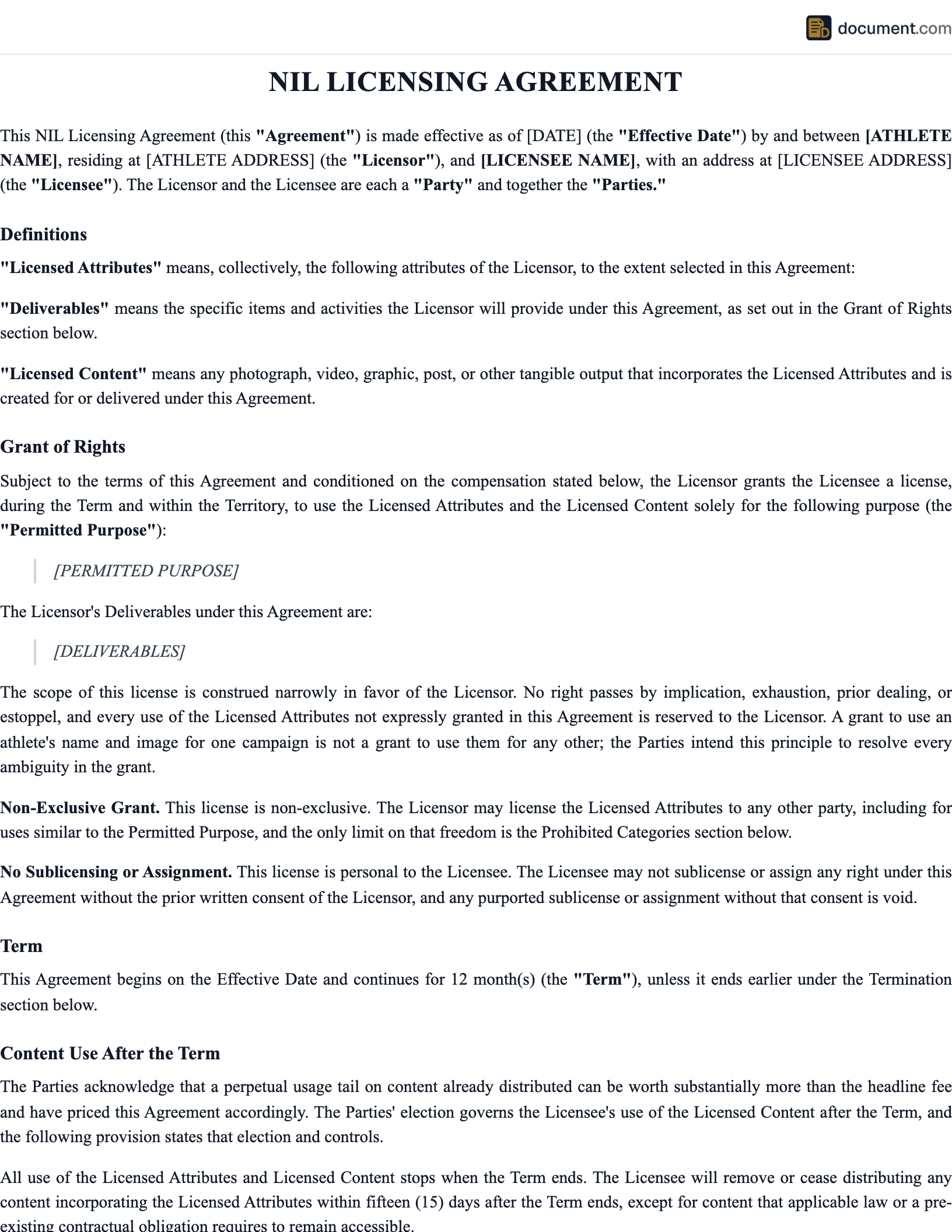
A NIL licensing agreement is a contract in which an athlete licenses the commercial use of their name, image, and likeness to a brand, collective, or agency in exchange for compensation. "NIL" is short for name, image, and likeness, and the agreement is what turns a handshake or a DM into an enforceable deal. It says which rights the athlete is handing over (a name, a photo, a video, a social post, a personal appearance, a merchandise line), what the brand may do with them, where, for how long, whether anyone else can sign a competing deal in the meantime, and what the athlete gets paid. Without it, a brand using an athlete's identity is relying on nothing but goodwill, and the athlete has no written claim to the money.
The agreement is built on the right of publicity, the legal right every person has to control how their identity is used for commercial gain. A signed license is the consent that makes the use lawful. On top of that base sits a second layer that did not exist for college athletes before 2021: a thick set of NCAA, conference, state-statute, and now College Sports Commission rules that govern whether a college athlete may sign at all, what they must disclose, and whether the deal clears a fair-market-value review. A NIL licensing agreement that ignores that second layer can be perfectly valid as a contract and still get an athlete flagged by compliance or rejected by the NIL Go clearinghouse. A good one is written to survive both.
Why This Matters Now
The modern NIL era is barely five years old, and the ground is still moving under it. The NCAA dropped its blanket ban on athlete compensation on July 1, 2021, after the Supreme Court ruled against it on antitrust grounds in NCAA v. Alston. Within months a market that had been worth nothing was worth hundreds of millions, run largely through booster-funded "collectives" and brand deals papered with whatever template was handy. Then came the settlement that rewrote everything.
On June 6, 2025, U.S. District Judge Claudia Wilken granted final approval to the $2.8 billion House v. NCAA settlement. Starting July 1, 2025, schools that opt in can pay athletes directly out of a revenue-sharing pool that begins around $20.5 million per school and is set to climb toward $32.9 million by 2034-35. A new body, the College Sports Commission, was stood up to enforce the cap and police outside deals, and it launched NIL Go, a clearinghouse operated with Deloitte that reviews every third-party NIL deal of $600 or more for a valid business purpose and fair market value. By 2026 the consequences were real: the Nebraska-Playfly arbitration and the College Sports Commission's early enforcement actions showed that a sloppy or inflated NIL agreement is no longer a paperwork problem, it is a deal that can be rejected, unwound, or used as evidence against an athlete and a collective. The document you sign now has to be written for that world.
The Legal Backbone
The right of publicity is the legal base under every NIL deal
NIL is the right of publicity by another name. Every person has the right to control the commercial use of their identity, and that right is what a NIL licensing agreement licenses. There is no single federal statute; it is a state-by-state patchwork. California Civil Code section 3344 is the model many lawyers reach for: it lets a person whose name, voice, signature, photograph, or likeness is used for advertising without consent recover the greater of actual damages or a statutory minimum of $750, plus the user's profits and attorney fees. For a brand, the takeaway is plain. A signed, specific license is the consent that defeats a publicity claim, and a vague one invites the dispute. For the athlete, the same provision is leverage: the right being licensed has real statutory teeth behind it.
State NIL statutes: roughly 35 of them, and no two identical
After California's Fair Pay to Play Act (Senate Bill 206) took effect September 1, 2021, around 35 states passed their own NIL laws, and they vary widely. They differ on whether an athlete must use a licensed or registered agent, which deal categories are off-limits (many bar gambling, alcohol, tobacco, cannabis, and adult products), how quickly a deal must be disclosed to the school, and whether high school athletes may participate at all. Florida, for example, lets high school athletes sign after the FHSAA approved it in 2024, while other states still forbid it. Because eligibility and disclosure turn on the law of the athlete's state and school, the agreement has to be drafted against the right state's statute, not a generic national form.
The House v. NCAA settlement, the College Sports Commission, and NIL Go
This is the layer that did not exist before 2025. Under the House settlement, a Division I athlete at an opt-in school must report any noninstitutional NIL contract or payment worth $600 or more, including multiple payments from the same payor that add up to $600, to the NIL Go clearinghouse within five business days of agreeing to the terms. NIL Go, run with the accounting firm Deloitte, screens the deal for a valid business purpose and fair market value, with special scrutiny on deals from boosters and collectives ("associated entities"). A deal that is really disguised pay-for-play, or priced far above market, can be flagged or rejected, and enforcement runs through the College Sports Commission rather than the NCAA alone. The agreement should require disclosure, allocate who files it, and let the parties unwind cleanly if the clearinghouse rejects the deal.
FTC Endorsement Guides: the disclosure duty that follows the athlete
A paid athlete posting about a product is an endorser under federal law. The FTC's revised Endorsement Guides at 16 C.F.R. Part 255, effective July 26, 2023, were the first overhaul since 2009 and were written for the social-media era. They require that any material connection between a brand and an endorser (payment, free product, an affiliate cut, a family or employment tie) be disclosed clearly and conspicuously, in the same medium as the endorsement, so a video endorsement needs the disclosure on screen and not buried in a caption. The FTC has said advertisers, endorsers, and intermediaries can each be liable. A NIL agreement should put the #ad / #sponsored obligation squarely on the athlete and give the brand the right to require it, because a hidden paid post is a problem for both signatures on the page.
Minors: capacity, parental consent, and extra guardrails
A person under 18 generally cannot be bound to a contract on their own, and in most states a minor can disaffirm a contract they signed alone. That is why a NIL deal with a high school or younger athlete must be co-signed by a parent or legal guardian who joins as a party. Several states layer on more: limits on exclusivity and term so a small payout cannot lock a teenager out of future deals for years, restrictions on certain categories, and in some cases protections for the minor's earnings. The agreement's minor version brings the guardian onto the signature page and narrows the grant so it does not over-commit a young athlete's future.
NIL Laws by State: All 50 States and DC
Name, image, and likeness law is a state-by-state patchwork layered on top of the new national settlement rules. 38 of the 51 U.S. jurisdictions now have an NIL statute, and they differ on agents, prohibited categories, disclosure, and whether high school athletes can sign at all. The table below covers all fifty states and the District of Columbia. Confirm your state law and your school, conference, and College Sports Commission rules before signing.
| State | NIL statute | HS NIL | Notes |
|---|---|---|---|
| Alabama | None | No | No state NIL statute. College athletes operate under NCAA/House settlement (July... |
| Alaska | None | Yes | No state statute (regulatory vacuum). High school NIL permitted under ASAA (December... |
| Arizona | A.R.S. § 15-1892 (2021, SB 1296); SB 1615... | Limited | Initial 2021 law (SB 1296, codified A.R.S. § 15-1892) allows college NIL with agent... |
| Arkansas | Ark. Code §§ 4-75-1301 to 4-75-1309... | Limited | Original statute (2021) allowed NIL with restrictions. Act 839 (April 2025, signed... |
| California | California Education Code §§ 67456-67457 (SB... | No | SB 206 (Fair Pay to Play Act, Sept 2019) pioneered NIL law nationally; applies to... |
| Colorado | HB 25-1041 (Chapter 38, 2025 Session Laws) | Limited | College athletes only; high school athletes may engage in NIL unconnected to school... |
| Connecticut | Public Act 21-132 (HB 6402); amended C.G.S.... | Limited | College statute; high school NIL governed by CIAC athletic association rules... |
| Delaware | SB 297 (Title 24, Chapter 54 - Revised... | Limited | Primarily regulates athlete agents; high school NIL via DIAA bylaws (2024-25), not... |
| District of Columbia | D.C. Law 24-245 (Omnibus Uniform Athlete... | Yes | HIGH SCHOOL: DCSAA permits NIL per Part V Section H (August 2022). Restrictions: no... |
| Florida | Fla. Stat. § 1006.74 (HB 7, effective July 1,... | Limited | Statute covers postsecondary only; high school NIL via FHSAA Bylaw 9.9 (2024). HS:... |
| Georgia | HB 617 (O.C.G.A. § 20-3-680, 20-3-681,... | No | Postsecondary institutions only; high school explicitly excluded. Allows optional... |
| Hawaii | None | Unclear | SB3263 (2026) proposed NIL endowment for UH athletes with $10M funding (state +... |
| Idaho | None | Unclear | No state college NIL statute. IHSAA proposed NIL rule changes in April 2026 (status... |
| Illinois | 110 ILCS 190 (Student-Athlete Endorsement... | Limited | College NIL: Allows compensation commensurate with market value; agents permitted... |
| Indiana | None (general rights of publicity: Ind. Code... | Yes | No state college NIL statute. IHSAA approved 'personal branding activities' by 13-5... |
| Iowa | Iowa Code Chapter 261I (provides framework... | Limited | College: Chapter 261I permits NIL compensation for endorsements, sponsorships,... |
| Kansas | None | Yes | Kansas has NO state NIL statute for college athletes. High school NIL permitted via... |
| Kentucky | KRS 164.6941-164.6951 (amended 2025 Ky. Acts... | Limited | College: KRS 164.6945 permits NIL compensation; institutions can sublicense athlete... |
| Louisiana | SB 60 (2021, eff. July 1, 2021); amended SB... | Limited | College: SB 60 permits NIL compensation for intercollegiate athletes. 427 LA... |
| Maine | LD 1893 (2022), codified as 20-A MRSA § 12974... | Yes | College: LD 1893 prohibits institutions from blocking NIL compensation; athletes not... |
| Maryland | Md. Code Ann., Educ. § 15-131 (Jordan McNair... | Limited | College: § 15-131 prohibits public institutions from banning NIL, reducing... |
| Massachusetts | None | Limited | MA General Law Chapter 214 Section 3A is general right of publicity statute... |
| Michigan | HB 5217 (college athletes, effective Dec 31,... | Yes | HB 5217 applies to collegiate athletes. MHSAA approved expanded NIL for high school... |
| Minnesota | None | Limited | Minnesota lacks comprehensive NIL statute. Minn. Stat. 135A.1915 expresses... |
| Mississippi | None | No | Mississippi has no NIL statute. HB 1400 (Mississippi High School Student-Athlete NIL... |
| Missouri | RSMo 173.280 (effective Aug 28, 2023 via HB... | Limited | RSMo 173.280 (originally 2021, amended 2023 via HB 417) allows HS athletes NIL... |
| Montana | Mont. Code Ann. 20-1-232 (SB 248, effective... | Unclear | College NIL confirmed via SB 248. HB 513 addresses digital likeness/voice rights,... |
| Nebraska | Neb. Rev. Stat. § 48-3603 (LB 1137, amended... | Yes | College athletes protected from institutional penalties for NIL per existing... |
| Nevada | Nev. Rev. Stat. § 398.300-398.330 (AB 254,... | Limited | College athletes can earn NIL compensation via AB 254. High school NIL permitted... |
| New Hampshire | None | Yes | No state statute enacted as of June 2026. HB 312 referred for Interim Study January... |
| New Jersey | N.J.S.A. 18A:3B-86 to 18A:3B-89 (P.L.2020,... | Yes | College athletes protected - institutions cannot prevent NIL compensation. NIL... |
| New Mexico | Senate Bill 94 (2021) - Student Athlete... | Limited | NMAA board approved HS NIL policy June 1, 2023 (separate from statute, which covers... |
| New York | Senate Bill 5891-F (2022) - New York... | Yes | Original statute covers college only. Expanded July 2023 via A07107B to include HS... |
| North Carolina | None | No | Executive Order 223 (issued July 2, 2021) rescinded March 8, 2024. State Board of... |
| North Dakota | None | Yes | No state statute. NDHSAA adopted HS NIL policy June 7, 2022 allowing NIL with... |
| Ohio | House Bill 110 (2021) - Ohio Revised Code §... | Limited | HB 110 addresses college only (effective Sept 30, 2021). High school NIL approved... |
| Oklahoma | Student Athlete Name, Image, and Likeness... | Yes | OSSAA approved NIL guidelines for high school athletes. College NIL revenue-sharing... |
| Oregon | ORS 702.200 (Senate Bill 5, effective June... | Yes | OSAA Rule 8.4.4 permits high school NIL (effective 2022). College law allows... |
| Pennsylvania | Senate Bill 381, Article XX-K (effective July... | Yes | PIAA approved high school NIL policy December 7, 2022 (25-4 vote). College NIL... |
| Rhode Island | None | Limited | No state statute (HB 5082 failed in 2021). RIIL permits NIL for high school with... |
| South Carolina | House Bill 4957, S.C. Code §§ 59-158-10 to... | No | Collegiate NIL only. Institutions can facilitate NIL for college athletes. College... |
| South Dakota | None | Limited | No state statute. High school NIL allowed under SDHSAA bylaws (effective July 1,... |
| Tennessee | Tennessee Code Annotated § 49-7-2802 | Unclear | College athletes: TCA § 49-7-2802 established by HB 1351 (2021, repealed 2022) and... |
| Texas | Texas Education Code § 51.9246 | Limited | College athletes: EDUC § 51.9246 (SB 1385, effective July 1, 2021; amended HB 2804... |
| Utah | Utah Code § 53B-16-601 and § 53B-16-602 | Yes | College athletes: HB 202 (signed March 1, 2024, effective May 1, 2024) codified in... |
| Vermont | None | Limited | No state statute. S.328 (Student Athlete Compensation Act, 2020) died in committee.... |
| Virginia | Va. Code § 23.1-408.1 (College); Va. Code §... | Yes | College NIL (§23.1-408.1): Students may earn NIL compensation; prohibited for... |
| Washington | Wash. SB 5913 (2024), effective June 6, 2024,... | Limited | College: SB 5913 clarifies public university staff can advise on NIL without ethics... |
| West Virginia | W.Va. Code § 18B-22 (HB 2576, signed... | Yes | College (§18B-22): Students can earn NIL from institutions or third parties;... |
| Wisconsin | Wisc. Stat. § 36.11(12) (College, AB 1034/SB... | Yes | College (§36.11(12)): Board of Regents may provide NIL compensation; prohibited for... |
| Wyoming | W.S. § 21-25-401 (SF 53, 2026, High School -... | No | High School (§21-25-401, SF 53, signed 3/3/2026): Requires amateurism for... |
Compiled from primary state statutes and verified against legislative sources in 2026. NIL law and high-school rules change every legislative session; confirm current law before signing.
Endorsement, exclusivity, and revenue-share: the grants that are not interchangeable
This is where the free templates fall apart, and where money is won or lost. A one-post social shoutout, a season-long exclusive ambassadorship, an autograph-and-appearance deal, and a cut of a co-branded merchandise line are four different grants with four different price tags and four different risk profiles. A template that treats them as one paragraph quietly hands a brand far more than the athlete meant to give, or leaves the brand paying for rights it never actually locked down. The field that does the most damage when it is wrong is exclusivity. Exclusivity is not bad by itself, but the scope and the duration have to match the money. A modest one-time fee should never buy a brand the right to keep an athlete out of an entire product category for two years. The agreement forces you to draw that line on purpose: exclusive or non-exclusive, in which category, for how long, and in what territory.
The grant clause has to name the deliverables and the channels with real specificity, because "use of NIL" means nothing until you say what use. Three Instagram posts and one TikTok over a 60-day campaign is a grant. So is "likeness on packaging for a signature shoe, sold nationally, for 18 months." Vague grants are where disputes start, and in the post-House world they are also where the NIL Go clearinghouse gets suspicious, because a deal that pays a lot but describes almost no work looks like disguised pay-for-play. Concrete deliverables, a defined term, a stated territory, and a compensation structure that plausibly matches the work are what get a deal through fair-market-value review and keep it out of a compliance file.
Compensation deserves the same care as the grant. The agreement should state whether the athlete is paid a flat fee, per deliverable, on a royalty or commission tied to sales, in equity, or in product, and when each payment is due. It should address whether the brand may use the content after the term ends (a common and expensive trap, since a perpetual usage tail can be worth far more than the headline fee), who owns the photos and videos created, and what happens to existing inventory if the deal terminates. For a college athlete it should also carry the compliance machinery: a duty to disclose to the school and to NIL Go, a representation that the deal is for a valid business purpose at fair market value, a morals or conduct clause that protects the brand, and a clean termination path if the clearinghouse rejects the deal or the athlete's eligibility status changes.
When You Need This
A college athlete signing an endorsement, social-media, or ambassador deal with a brand, a local business, or a NIL collective.
A brand, agency, or marketing firm engaging an athlete to post, appear, sign autographs, or front a product, and wanting the rights and the FTC disclosure duty locked down in writing.
A NIL collective formalizing payments to athletes in a way that can survive College Sports Commission and NIL Go review for valid business purpose and fair market value.
A parent or guardian negotiating a deal for a high school or younger athlete who cannot legally sign on their own.
A professional or Olympic athlete, or any public figure, licensing their name and likeness for a campaign, a merchandise line, or a co-branded product.
An agent or attorney papering a deal and needing a starting agreement that already accounts for exclusivity, term, compensation, disclosure, and termination, rather than a one-size release.
How to Fill Out NIL Licensing Agreement
1. Identify the parties
Enter the full legal name and address of the athlete (the licensor) and the brand, collective, or agency receiving the rights (the licensee). If the athlete is under 18, the form switches to the minor version and adds the parent or guardian as a co-signing party. For a college athlete, note the school and conference, because eligibility and disclosure run on that institution's rules.
2. Define the NIL grant and deliverables
Specify exactly what is licensed: the name, image, photographs, video, social posts, personal appearances, autographs, voice, or a merchandise likeness. List the deliverables with numbers, for example three Instagram posts, one TikTok, and one two-hour appearance. "Use of NIL" with no detail is the most common and most dangerous gap in a NIL deal.
3. Set exclusivity, category, and territory
Choose exclusive or non-exclusive. If exclusive, name the product category the athlete may not promote for a competitor and the territory where the limit applies. Match the exclusivity to the money: a small fee should not buy a long category-wide lockout. State the geographic scope, from a single state to worldwide.
4. Set the term and any usage tail
Choose how long the brand may use the NIL, from a single campaign to a fixed term to perpetual. Address separately whether the brand may keep running the content after the term ends. A perpetual usage tail can be worth more than the fee itself, so make it a deliberate choice, not a default buried in boilerplate.
5. Set compensation and payment terms
State whether the athlete is paid a flat fee, per deliverable, by royalty or commission tied to sales, in equity, or in product, and the schedule for each payment. Record who owns the photos and videos that get created and what happens to unsold inventory if the deal ends early.
6. Add FTC disclosure and compliance duties
Require the athlete to disclose the paid relationship clearly and conspicuously (#ad or #sponsored) under the FTC Endorsement Guides, and give the brand the right to require it. For a college athlete, add the duty to report the deal to the school and to NIL Go within five business days, and a representation that the deal is for a valid business purpose at fair market value.
7. Set conduct, termination, and clearinghouse fallback
Add a morals or conduct clause, a list of prohibited categories the deal must avoid (often gambling, alcohol, tobacco, cannabis, and adult products), and termination rights. Include a clean exit if NIL Go rejects the deal or the athlete's eligibility status changes, so a failed clearinghouse review does not leave either side stuck.
8. Sign, date, and add parental consent if a minor
Both parties sign and date. For a minor athlete, the parent or guardian signs the consent block as a party to the contract. Notarization is optional but recommended for high-value, multi-year, or merchandise-royalty deals. Then download as PDF or Word, e-sign, or send for signature through the built-in flow.
Key Terms Defined
- NIL (name, image, and likeness)
- The athlete's identity rights that can be licensed for commercial use: their name, image, photographs, video, social-media presence, voice, signature, and recognizable likeness. NIL is the right of publicity applied to athletes.
- Right of publicity
- The legal right of every person to control the commercial use of their identity. It is recognized through state statutes and common law and is the legal foundation that a NIL licensing agreement licenses. California Civil Code section 3344 is a leading example, with a $750 statutory minimum plus profits and attorney fees.
- NIL collective
- A booster- or fan-funded organization, usually independent of the school, that pools money to sign athletes to NIL deals. Under the House settlement, collectives are treated as "associated entities," and their deals get heightened scrutiny from the NIL Go clearinghouse for valid business purpose and fair market value.
- NIL Go / College Sports Commission
- NIL Go is the clearinghouse, operated with Deloitte, where Division I athletes at opt-in schools must report third-party NIL deals of $600 or more within five business days for review. The College Sports Commission is the enforcement body created under the House settlement that oversees the revenue-sharing cap and outside-deal review.
- Exclusivity clause
- A term that bars the athlete from promoting a competing product or brand during the deal. Its fairness depends on matching the scope (which category), the territory, and the duration to the compensation paid.
- Material connection (FTC)
- Any relationship between a brand and an endorser, including payment, free product, an affiliate commission, or a family or employment tie, that a reasonable audience would not expect. Under 16 C.F.R. Part 255, it must be disclosed clearly and conspicuously.
Related Documents
Sponsorship / Endorsement Agreement
A general endorsement or sponsorship agreement handles the same commercial bones: the grant of identity rights, exclusivity, term, and pay. A NIL licensing agreement is the athlete-specific version that adds school and NIL Go disclosure, fair-market-value representations, prohibited-category limits, and eligibility-protective termination. Use the general form for a non-athlete spokesperson; use the NIL agreement for any college or amateur athlete whose eligibility is on the line.
AI Voice and Likeness Release
Where a NIL agreement licenses an athlete's identity for endorsements and appearances, an AI voice and likeness release governs feeding a person's voice or image into an AI model that can generate new synthetic output. If a brand wants to create an AI avatar or voice clone of an athlete, that crosses from a NIL deal into AI-replica territory and needs the release's training-data, deletion, and model-retirement terms layered on top.
Talent / Agent Representation Agreement
A NIL licensing agreement is the deal between the athlete and the brand. A representation agreement is the deal between the athlete and the agent or agency that negotiates those deals and takes a commission. They sit side by side: the rep agreement sets the agent's authority and cut, and many state NIL statutes regulate who may serve as an athlete's agent, so the two should be drafted to line up.
Legal Authorities & Sources
This page is grounded in primary law. The statutes and official resources below are the authorities behind the guidance above. Verify the current text of any statute before relying on it.
- NCAA v. Alston, U.S. Supreme Court (2021) opinion
- House v. NCAA settlement final approval coverage (ESPN, June 2025)
- Congressional Research Service: College Athlete Compensation and the House Settlement
- FTC Endorsement Guides, 16 C.F.R. Part 255 (eCFR, current)
- FTC: Endorsements, Influencers, and Reviews (business guidance)
- California Fair Pay to Play Act, Senate Bill 206 (CA Legislative Information)
- California Civil Code section 3344 (use of name, voice, likeness)
Frequently Asked Questions
Create your NIL Licensing Agreement in minutes.
Answer a few questions and download a clear, attorney-drafted document that cites the controlling law and is ready to sign.